Desk essay
Why We Rely on Simon Sinek Quotes When Workplace Communication Breaks Down
The language of corporate leadership shifted dramatically when executives realized that clarity requires more than just a well-crafted memo.
By Morgan Ellis
Morgan Ellis

I remember sitting with my former manager in a diner booth off Route 66 in Flagstaff, Arizona, in 2021, listening to him explain why his entire department was turning over. He kept pointing to the company's new communication guidelines, bewildered that memos and weekly all-hands meetings were not fixing the underlying distrust. The mechanics of message delivery were flawless. The actual human connection was completely severed. This fracture represents the exact space where modern workplace theory usually steps in to diagnose the failure.
For decades, executive training treated communication as a logistical challenge. Leaders focused on the frequency of emails, the structure of slide decks, and the cadence of quarterly reviews. The underlying assumption held that if information left the sender's desk, it successfully entered the receiver's mind. Corporate breakdowns eventually proved this mechanical view inadequate. We began looking for different vocabularies to explain why highly communicative teams still failed to understand one another.
Simon Sinek provided a framework that separated the act of broadcasting from the act of connecting. His approach dismantled the idea that talking equates to leading. By framing dialogue as a biological and emotional necessity rather than a corporate obligation, his work changed how the language of service evolved in boardrooms. We stopped measuring the volume of our words and started examining the psychological safety required to hear them.
The Shift from Information Transfer to Behavioral Trust
The most significant intervention in modern leadership theory involves redefining what communication actually accomplishes. It is not merely the transfer of data. It is the continuous negotiation of trust between individuals sharing a common environment.
"Communication is not about speaking what we think. Communication is about ensuring others hear what we mean." — Simon Sinek, Start With Why, 2009
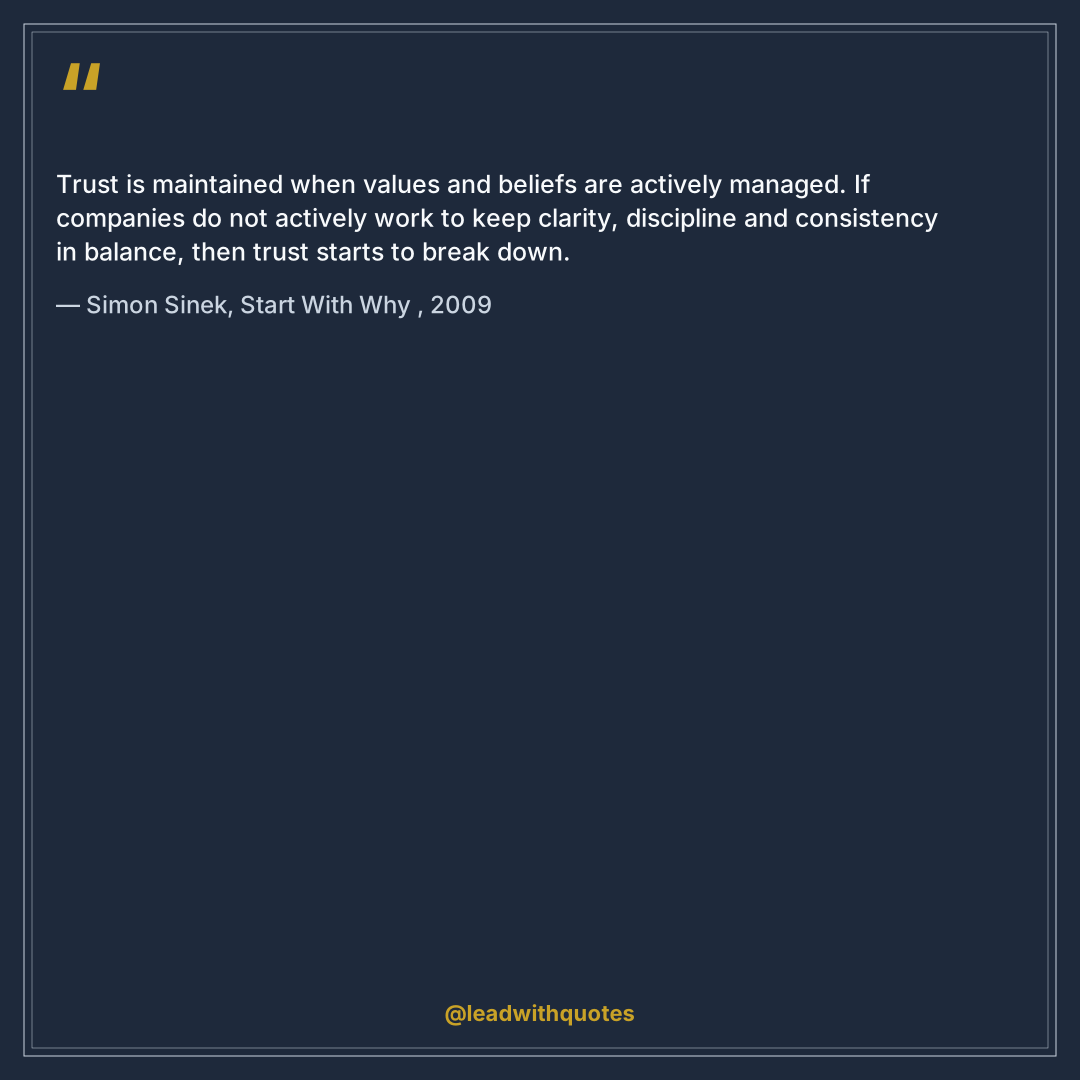
This distinction from his breakout book shifts the burden of comprehension entirely onto the leader, demanding that they calibrate their message to the listener's frequency.
"There is a difference between listening and waiting for your turn to speak." — Simon Sinek, Leaders Eat Last, 2014
Sinek captured the performative nature of corporate meetings here, identifying how often executives formulate their rebuttals while pretending to absorb feedback.
"Words may inspire, but only action creates change." — Simon Sinek, Start With Why, 2009
The original text uses this principle to ground lofty corporate mission statements in observable daily behaviors.
When leadership relies solely on verbal declarations, organizations develop a cynical detachment from the stated culture. The gap between what a company announces and what it tolerates becomes the actual culture. Sinek's observations force managers to audit their own behavioral inconsistencies before drafting another company-wide email.
Listening as an Active Leadership Metric
Passive hearing allows organizations to drift into misalignment. Active listening requires a deliberate suspension of ego, which is remarkably difficult for individuals promoted specifically for their decisive speaking abilities.
"Hearing is listening to what is said. Listening is hearing what isn't said." — Simon Sinek, Public Address, 2018
This formulation challenges managers to pay attention to body language, strategic silences, and the hesitation that often accompanies difficult workplace conversations.
"If you don't understand people, you don't understand business." — Simon Sinek, Start With Why, 2009
Sinek frequently uses this absolute statement to remind financial and operational leaders that every metric ultimately relies on human behavior.
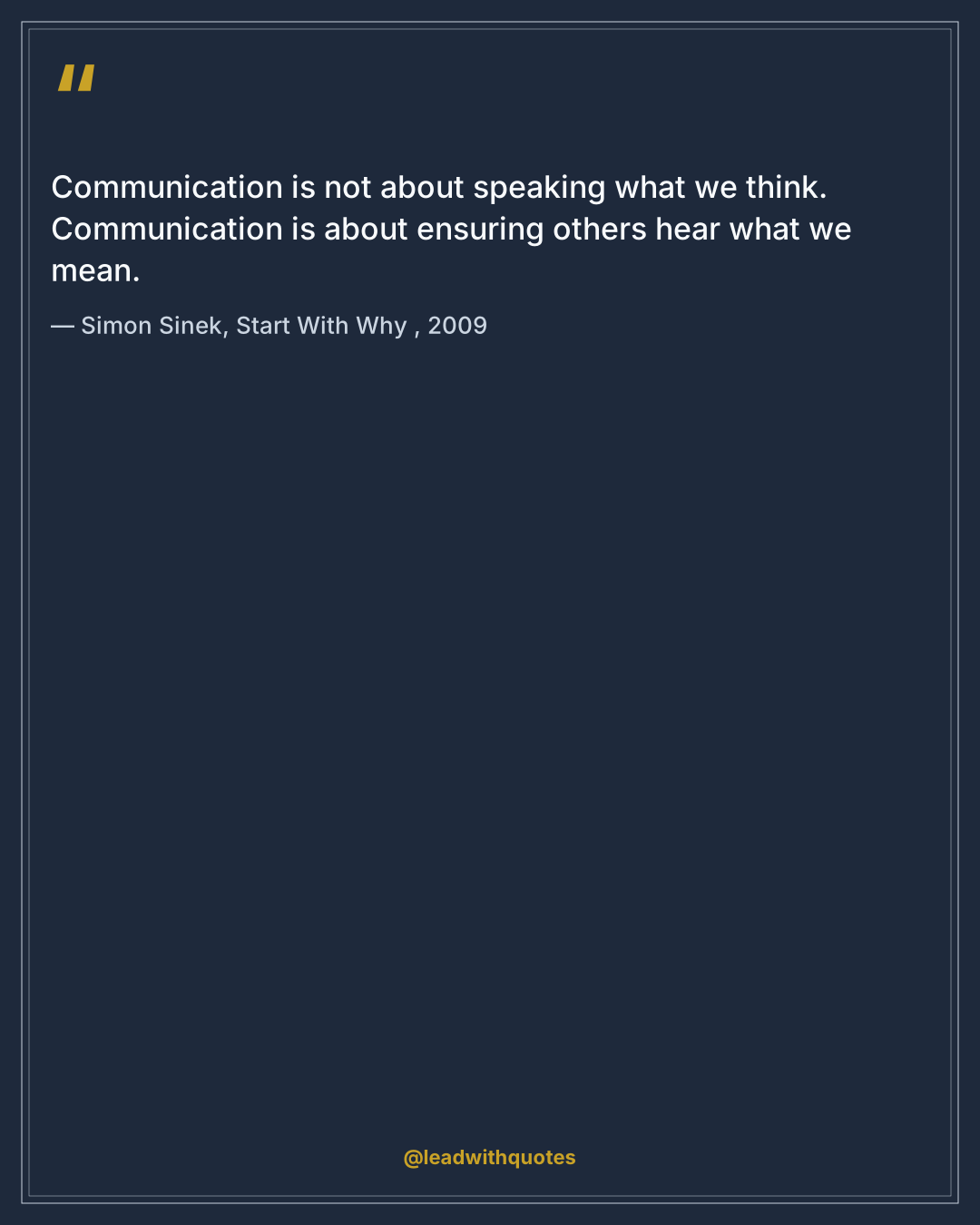
"Trust is maintained when values and beliefs are actively managed. If companies do not actively work to keep clarity, discipline and consistency in balance, then trust starts to break down." — Simon Sinek, Start With Why, 2009
The mechanics of organizational decay are laid bare in this passage, linking the erosion of trust directly to a lack of communicative discipline.
Managers who excel at this kind of active engagement do not simply wait for complaints to reach their desks. They build environments where dissent is treated as valuable data rather than insubordination. The architecture of a healthy team requires channels where bad news travels just as quickly as congratulations.
The Danger of Confusing Broadcasts with Connection
Technology allows leaders to scale their voices infinitely. A single keystroke can place a directive in front of ten thousand employees simultaneously. This efficiency often masks a profound isolation at the center of the organization.
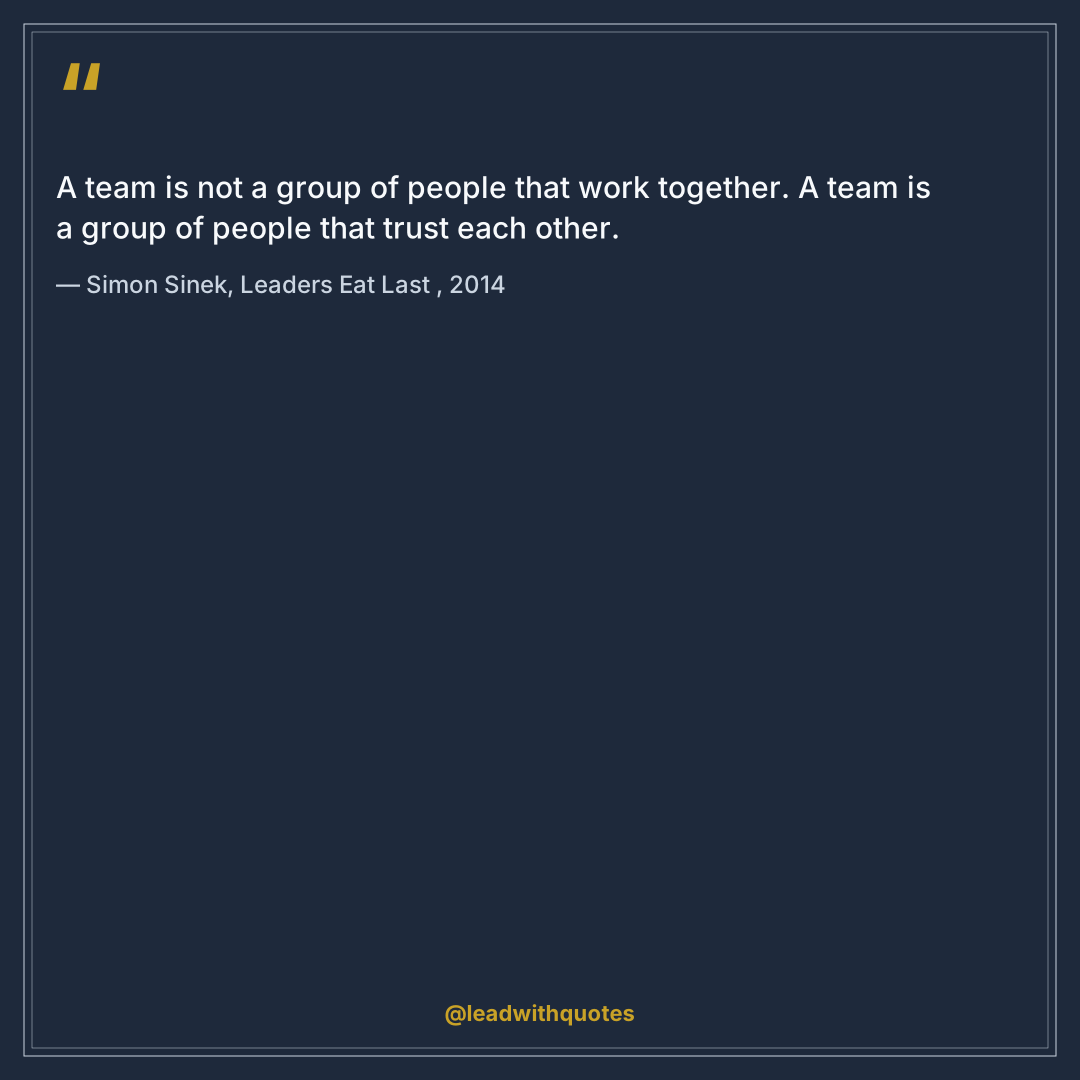
"A team is not a group of people that work together. A team is a group of people that trust each other." — Simon Sinek, Leaders Eat Last, 2014
This redefinition of team dynamics moves the focus away from shared tasks and toward the psychological bonds that sustain long-term collaboration.
"We communicate to be understood, not just to share information." — Inspired by Simon Sinek, The Infinite Game, 2019
This synthesis reflects the later evolution of his work, where the infinite mindset requires a constant re-evaluation of how shared meaning is constructed.
True alignment happens in the quiet moments after the formal presentation concludes. It occurs in the clarifying questions asked in the hallway and the honest feedback shared behind closed doors. Leaders who master this dynamic understand that the broadcast is merely the invitation to the actual conversation.
Further reading
- why we quote Simon Sinek during crises
- essential phrases every manager needs
- why the best team directives remain brief
- short leadership maxims
- famous leadership frameworks
A Few Honest Corrections
Common claim: Sinek invented the concept of active listening in business.
Closer to the evidence: Psychologists like Carl Rogers pioneered active listening frameworks in the 1950s, while management theorists like Peter Drucker emphasized the importance of communication decades before Sinek published Start With Why in 2009.
Common claim: All communication problems stem from a lack of "Why."
Closer to the evidence: While a shared purpose is critical, many organizational communication failures are purely structural, resulting from poor software integration, conflicting reporting lines, or inadequate resource allocation rather than a philosophical deficit.
Common claim: Leaders should always speak last in every situation.
Closer to the evidence: Sinek advocates for speaking last to gather input, but crisis situations, emergency protocols, and moments requiring immediate ethical clarity demand that a leader speak first to establish boundaries and provide immediate direction.
The next time a team project stalls due to misaligned expectations, take a moment to review the last three messages you sent. Look at the ratio of directives to questions, and consider whether you are merely broadcasting or actively building the trust required for the work to continue.