Desk essay
Thinkers on the Heart of a Servant: 12 Quotes from Historical Letters and Speeches
The philosophy of putting others first reveals itself through these historical letters and public addresses from advocates of shared responsibility.
By Morgan Ellis
Morgan Ellis

What does it actually mean to lead from the bottom up? How do individuals balance the weight of authority with the vulnerability of putting others first?
The answers rarely emerge in corporate boardrooms or polished executive seminars. I first recognized this dynamic while watching my uncle manage a crowded community kitchen in Detroit, Michigan, during the winter of 1994. He never shouted orders across the room. He simply picked up a mop when a spill threatened the serving line, silently demonstrating that principles of servant-based guidance require physical action rather than verbal commands. This quiet approach mirrors the shift toward service-based frameworks we see in modern organizational theory.
If we could gather history's most dedicated advocates for communal responsibility around a single table, their conversation would likely bypass traditional metrics of success. They would focus instead on the daily friction of elevating others. Through their letters, essays, and public addresses, we can reconstruct a dialogue about the true cost and profound value of leading by serving.
On Humility
The discussion opens with the foundational requirement of stepping back so others can step forward.
"True greatness, true leadership, is found in giving yourself in service to others, not in coaxing or inducing others to serve you." — J. Oswald Sanders, Spiritual Leadership, 1967
Sanders wrote these words to challenge the prevailing top-down corporate structures of the mid-twentieth century. His perspective offers unexpected perspectives on holding power by framing influence as a sacrifice rather than an acquisition.
A contemporary voice adds a secular dimension to this spiritual principle.
"The servant-leader is servant first... It begins with the natural feeling that one wants to serve, to serve first." — Robert K. Greenleaf, The Servant as Leader, 1970
Greenleaf coined the modern terminology in an essay written after reading Hermann Hesse's fictional accounts of communal journeys. This foundational text still helps managers when navigating breakdowns in team alignment.
An older, poetic voice reminds the table that humility often goes unnoticed.
"The highest type of ruler is one of whose existence the people are barely aware." — Laozi, Tao Te Ching, 400 BCE
Ancient philosophy frequently aligns with modern management theory regarding the invisibility of effective support. The best facilitators vanish once the group achieves its specific geographic or organizational goal.
On Sacrifice
The dialogue shifts toward the personal toll of prioritizing the collective well-being.
"Life's most persistent and urgent question is, 'What are you doing for others?'" — Martin Luther King Jr., Montgomery Speech, 1957
King delivered this challenge to an exhausted community facing systemic opposition in Alabama. It strips away the glamour of public influence to reveal the raw demand of community care.
A pioneer of social work interjects with a practical observation from the slums of Chicago.
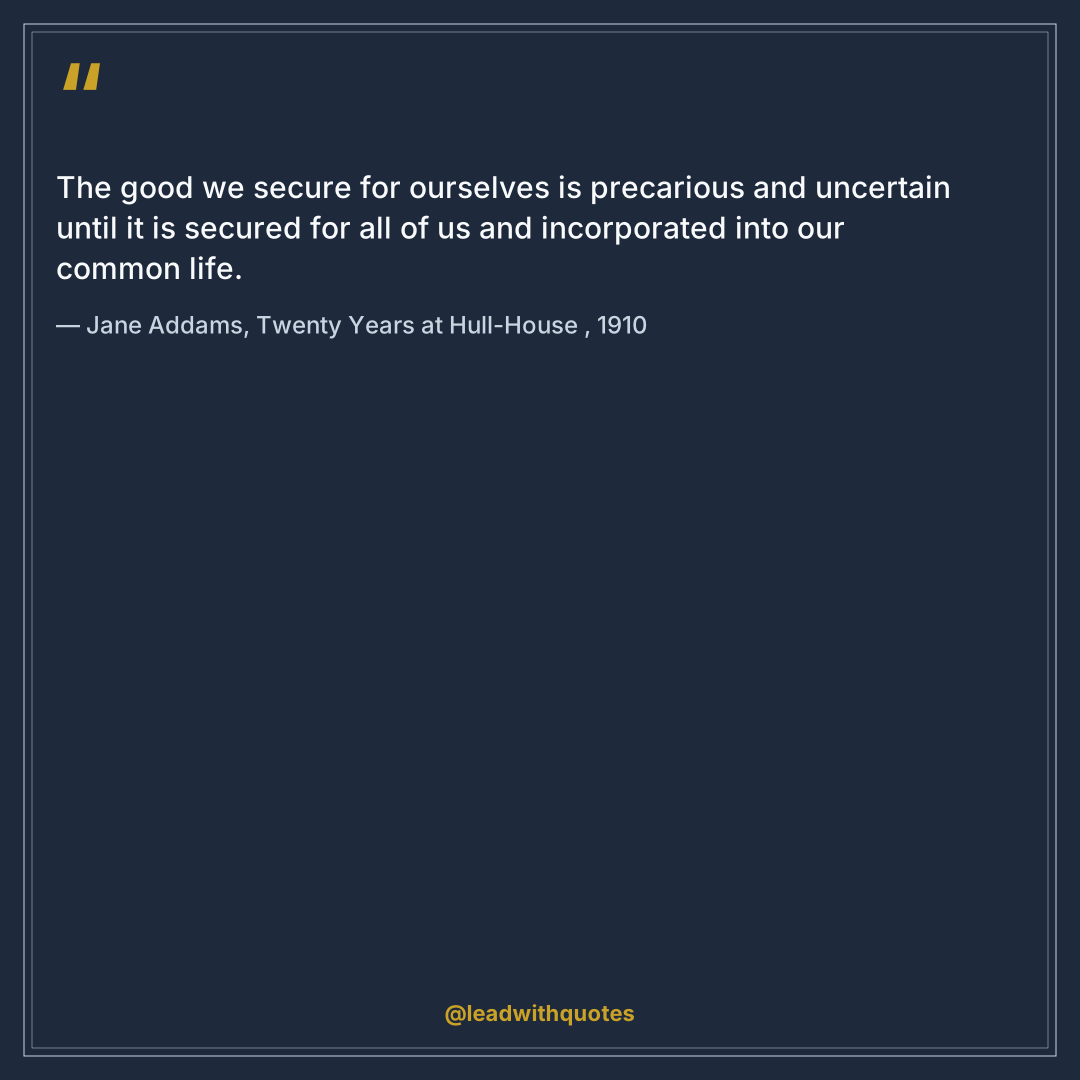
"The good we secure for ourselves is precarious and uncertain until it is secured for all of us and incorporated into our common life." — Jane Addams, Twenty Years at Hull-House, 1910
Addams understood that isolated success remains fragile in an interconnected society. Her work at Hull-House demonstrated how organizations weather prolonged crises through mutual reliance.
A voice from the nursing profession emphasizes the daily grind of care.
"I attribute my success to this: I never gave or took any excuse." — Florence Nightingale, Personal Letters, 1861
While often remembered for her compassion, Nightingale's letters reveal a fierce, uncompromising dedication to logistical excellence in service. Empathy without discipline rarely changes physical conditions in a hospital ward.
On Action
The conversation turns from internal philosophy to external execution.
"To love our neighbor as ourselves is such a truth for regulating human society, that by that alone one might determine all the cases in social morality." — John Locke, An Essay Concerning Human Understanding, 1689
Locke framed service not merely as charity, but as the fundamental organizing principle of a functional European society.
A pragmatic voice cuts through the theory with a call for immediate application.
"Do what you can, with what you have, where you are." — Theodore Roosevelt, Squire Bill Widener Citation, 1913
Roosevelt popularized this phrase to honor a humble citizen's philosophy of local action. It serves as one of those perfect brief maxims on directing others by focusing entirely on immediate physical agency.
An educator highlights the transformative power of small, consistent acts.
"I long to accomplish a great and noble task, but it is my chief duty to accomplish small tasks as if they were great and noble." — Helen Keller, The Story of My Life, 1903
Keller recognized that grand visions often distract from the immediate needs of the people standing right in front of us. She anchored her legacy in the daily repetition of difficult, unglamorous work.
On Legacy
As the hypothetical gathering draws to a close, the speakers address what remains after the work is done.
"The purpose of life is not to be happy. It is to be useful, to be honorable, to be compassionate, to have it make some difference that you have lived and lived well." — Ralph Waldo Emerson, Journals, 1860
Emerson recorded this thought privately in Concord, Massachusetts, wrestling with his own desire for impact versus comfort.
A scientist reflects on the ultimate measure of a life's work.
"Only a life lived for others is a life worthwhile." — Albert Einstein, The New York Times Interview, 1932
Even while unlocking the universe's physical laws, Einstein viewed human connection and support as the primary metric of value. He leveraged his massive public platform to advocate for refugees fleeing persecution across Europe.
The final word goes to a thinker who viewed service as an inevitable human duty.
"We make a living by what we get, but we make a life by what we give." — Winston Churchill, Public Address, 1908
Though Churchill's own leadership style was notoriously forceful, he understood that history judges leaders by the safety and prosperity they leave behind for the general populace.
The quiet work of elevating others rarely commands the spotlight in real time. It happens in the margins of busy days, through small concessions and deliberate acts of support that accumulate over decades. When we strip away the titles and the organizational charts, the fundamental mechanism of human progress remains the simple willingness of one person to carry the weight for another.
Key Takeaways
- Service functions as a practical organizational strategy rather than just a moral ideal.
- Effective facilitators often operate invisibly to allow their teams to claim the final victory.
- Systemic stability requires leaders to prioritize the collective well-being over isolated personal success.
- Grand visions must translate into immediate, localized actions to have any real impact on a community.
- The historical consensus points to usefulness and compassion as the ultimate metrics of a worthwhile legacy.