Desk essay
Why We Rely on Strong Confident Woman Quotes When the Room Goes Quiet
The language of female authority often serves as a private armor when professional spaces demand an impossible balance of warmth and steel.
By Morgan Ellis
Morgan Ellis

To the woman staring at her muted microphone on a Tuesday afternoon. You know the feeling. Why do we suddenly lose our voice when the stakes are highest? What happens in that split second between knowing the exact right answer and deciding to let someone else speak first? I first understood the weight of female authority watching my aunt navigate a contentious zoning board meeting in downtown Calgary in 2004. She did not raise her voice, but she refused to yield the floor when interrupted by a commercial developer twice her age. We reach for the recorded words of those who came before us because they offer a tangible blueprint for holding our ground under immense pressure.
You know the silence that follows your pitch
The air leaves the room. You offered a meticulously researched solution, and now twelve silent faces stare back at you through a sterile grid of high-definition video feeds.
"The most difficult thing is the decision to act, the rest is merely tenacity." — Amelia Earhart, Letter to her husband, 1928
Earhart wrote these words before her transatlantic flight, capturing the exact moment momentum shifts from internal doubt to external reality.
Tenacity is exactly what you need when the initial adrenaline of your presentation fades into the quiet reality of execution. You might find yourself seeking out voices of female leadership just to remind yourself that the friction you feel is entirely normal. The resistance you encounter is not a sign that your underlying idea is flawed, but rather the inevitable friction of altering the status quo in a rigid corporate hierarchy.
You must stop apologizing for the space you occupy

Every reflexive apology chips away at your foundation. Every email that begins with a justification for your own existence signals to the room that you do not believe you belong at the table.
"I am not afraid of storms, for I am learning how to sail my ship." — Louisa May Alcott, Little Women, 1868
Alcott gave this line to Amy March, framing resilience not as an innate magical gift, but as an acquired maritime skill forged in rough waters.
You are allowed to learn while actively steering the vessel. When you study historical figures reflecting on leadership, you rarely see them asking for permission to exist in the rooms they fought so bitterly to enter. They claimed their territory.
You will face rooms that mistake your clarity for coldness
Directness is a luxury often denied to women in traditional corporate spaces. You are expected to soften your directives, pad your feedback with warmth, and manage the emotional weather of the entire department.
"I have learned over the years that when one’s mind is made up, this diminishes fear." — Rosa Parks, Quiet Strength, 1994
Parks published this reflection decades after the Montgomery bus boycott, stripping away the public myth of spontaneous courage to reveal a deeply calculated resolve.
Your clarity is a precision tool, not a character flaw to be managed. When colleagues push back against your established boundaries, remember that words that ignite female ambition are rarely polite or accommodating to the comfort of others. They are necessary.
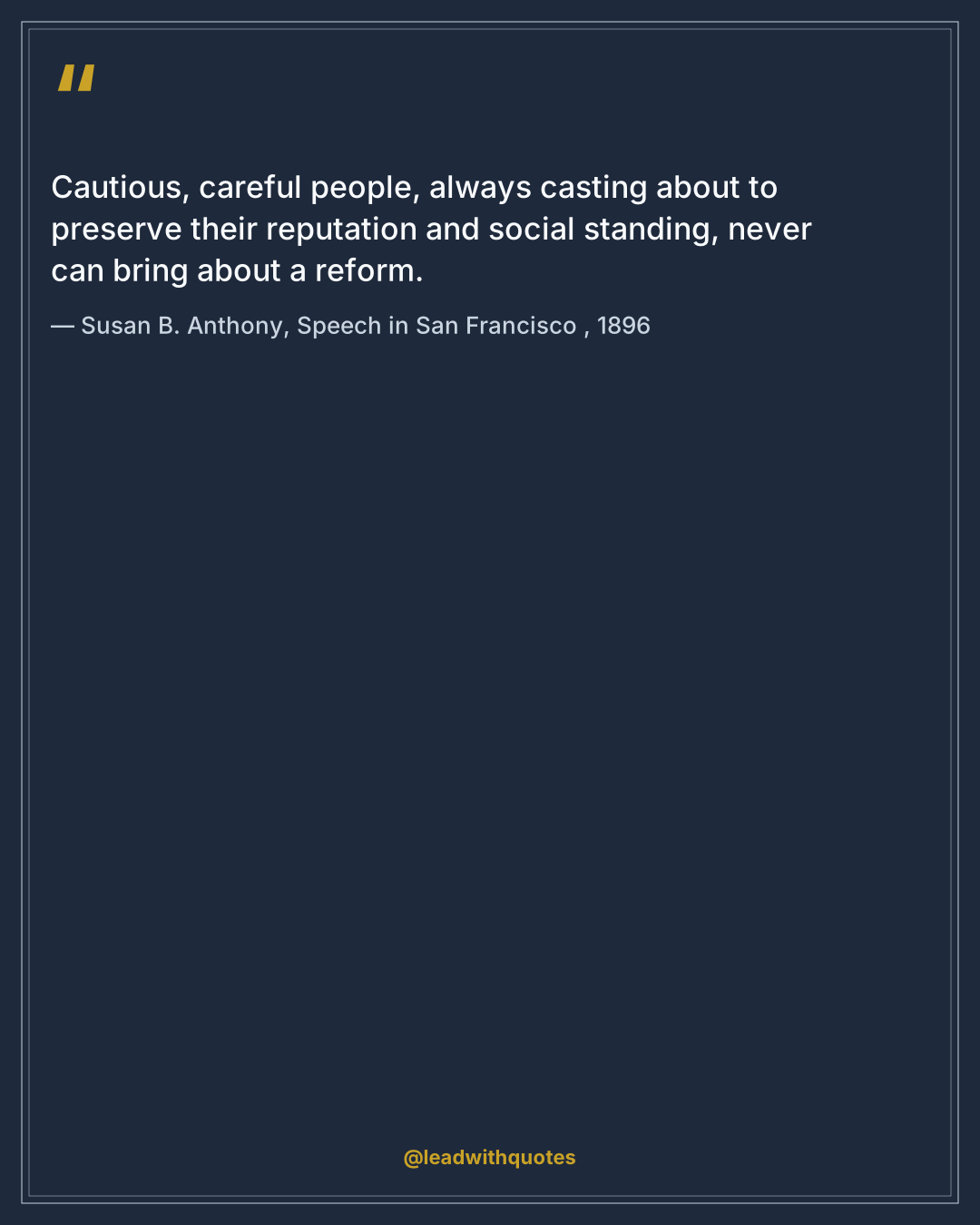
"Cautious, careful people, always casting about to preserve their reputation and social standing, never can bring about a reform." — Susan B. Anthony, Speech in San Francisco, 1896
Anthony delivered this sharp critique to crowds who preferred quiet, socially acceptable advocates over effective political operatives.
You cannot manage everyone's emotional reaction to your baseline competence. Focus your energy instead on building genuine organizational trust through consistent, unvarnished truth-telling and reliable execution.
You have to push off the edge eventually
Sometimes the paralysis is entirely self-inflicted. You gather the data, you prepare the slides, and you still hesitate at the threshold of visibility.
"You can't be that kid standing at the top of the waterslide, overthinking it." — Tina Fey, Bossypants, 2011
Fey used this childhood metaphor to describe the chaotic, terrifying necessity of producing a live national television show every single Saturday night.
At some point, the obsessive preparation has to end. You have to let gravity do its work and trust the structure you built.
What to Carry Forward
- Treat your clarity as a professional asset rather than a social liability that requires constant softening.
- Recognize that the silence following a strong proposal is often the sound of a room processing a paradigm shift, not a rejection.
- Eliminate the reflexive apologies from your written correspondence to instantly change how your authority is perceived.
- Accept that managing the emotional reactions of your colleagues is not a line item in your job description.
- Study the historical record to see that every boundary pushed by a woman was initially met with institutional resistance.
Further reading
- how professionals navigate life's friction
- prominent women taking charge
- what happens when workplace communication breaks down
Unmute the microphone. State your position clearly, without a preamble, and let the silence hang in the air until someone else fills it.