Leadership Quotes for Uncertain Times: 12 Lines Spoken in Real Crises, and When to Use Each
12 leadership quotes for uncertain times, each traced to the real crisis it came from, with a picker by moment and templates for team updates and setbacks.
What do you say to a team when you do not know what happens next? Most leadership quotes were written at a desk, long after the danger had passed. The twelve below were not. Each was spoken or written by someone in the middle of a real crisis: a losing war, a bank collapse, a prison camp, a pandemic. Each one is dated and traced to its source, so you can quote it in an all-hands, an email or a toast without repeating a line its speaker never said.
The page is arranged by the moment you are facing, not by author. Start with the picker, then read the context for the line you choose. The practical part, on writing the message around the quote, comes after the four groups.
Quick picker: the line for the moment
| Your moment | Line to borrow | Who, where, when |
|---|---|---|
| Bad news, still unfolding | "These are the times that try men's souls." | Thomas Paine, The American Crisis, Dec 1776 |
| People are frozen, waiting | "This Nation is asking for action, and action now." | Franklin D. Roosevelt, inaugural address, 1933 |
| Hope without spin | "You must never confuse faith that you will prevail in the end…" | James Stockdale, in Good to Great, 2001 |
| The old plan no longer fits | "The dogmas of the quiet past are inadequate to the stormy present." | Abraham Lincoln, message to Congress, 1862 |
| Planning for the unknown | "Plans are worthless, but planning is everything." | Dwight D. Eisenhower, remarks, 1957 |
| After a failed attempt | "It is hard to fail, but it is worse never to have tried to succeed." | Theodore Roosevelt, Chicago, 1899 |
| Owning a risky call | "If any blame or fault attaches to the attempt it is mine alone." | Eisenhower, note written 5 June 1944 |
| Taking on more responsibility | "The price of greatness is responsibility." | Winston Churchill, Harvard, 1943 |
| Values under pressure | "The ultimate measure of a man…" | Martin Luther King Jr., Strength to Love, 1963 |
| A long, grinding stretch | "never give in, never give in, never, never, never…" | Churchill, Harrow School, 1941 |
| Anxiety about what's next | "Let not future things disturb thee…" | Marcus Aurelius, Meditations VII.8 |
| Closing a hard season | "better days will return" | Queen Elizabeth II, broadcast, 5 April 2020 |
When the news is bad and still unfolding
The first message in a crisis has one job: say plainly that things are hard, without pretending to know the ending. These three lines do that.
These are the times that try men's souls. The summer soldier and the sunshine patriot will, in this crisis, shrink from the service of their country; but he that stands it now, deserves the love and thanks of man and woman.
Thomas Paine, The American Crisis, No. I, December 1776
Paine wrote this while marching with Washington's retreating army, after the loss of New York, when enlistments were about to expire. The pamphlet first appeared in the Pennsylvania Journal on 19 December 1776, and the editor of Paine's collected writings, Moncure Conway, notes that its opening sentence became the watchword of the attack on Trenton days later. Its strength for a modern leader is the honesty of the first sentence: it names the difficulty before asking anything of anyone. If you use it today, the first sentence alone is usually enough; the second is a call to stay, which reads as pressure in a workplace unless you mean it that way.
This Nation is asking for action, and action now.
Franklin D. Roosevelt, First Inaugural Address, 4 March 1933
Roosevelt took office with banks closed or restricted in most states and roughly a quarter of the workforce unemployed. The same speech contains the far more quoted line about having nothing to fear but fear itself, but this sentence, a few paragraphs later, is the one that turns mood into a commitment. It suits a message where people are waiting for someone to move first: it promises motion, not a solution. Use it only if your next sentence names the action.
You must never confuse faith that you will prevail in the end—which you can never afford to lose—with the discipline to confront the most brutal facts of your current reality, whatever they might be.
Vice Admiral James Stockdale, quoted in Jim Collins, Good to Great, 2001
Stockdale was shot down over North Vietnam in 1965 and was the highest-ranking American naval officer held as a prisoner of war, including in the Hoa Lo prison ("Hanoi Hilton"), until his release in 1973. Collins interviewed him for Good to Great, and Stockdale explained that the prisoners who did not make it were the optimists who kept naming a release date that never came. Collins called the idea the Stockdale Paradox, and the full interview passage is on his site. It is the best single line here for a leader who wants to be hopeful without promising a date.
When the plan has stopped working
Uncertainty often means the plan everyone agreed on no longer matches the facts. These lines give permission to change course without pretending the old plan was foolish.
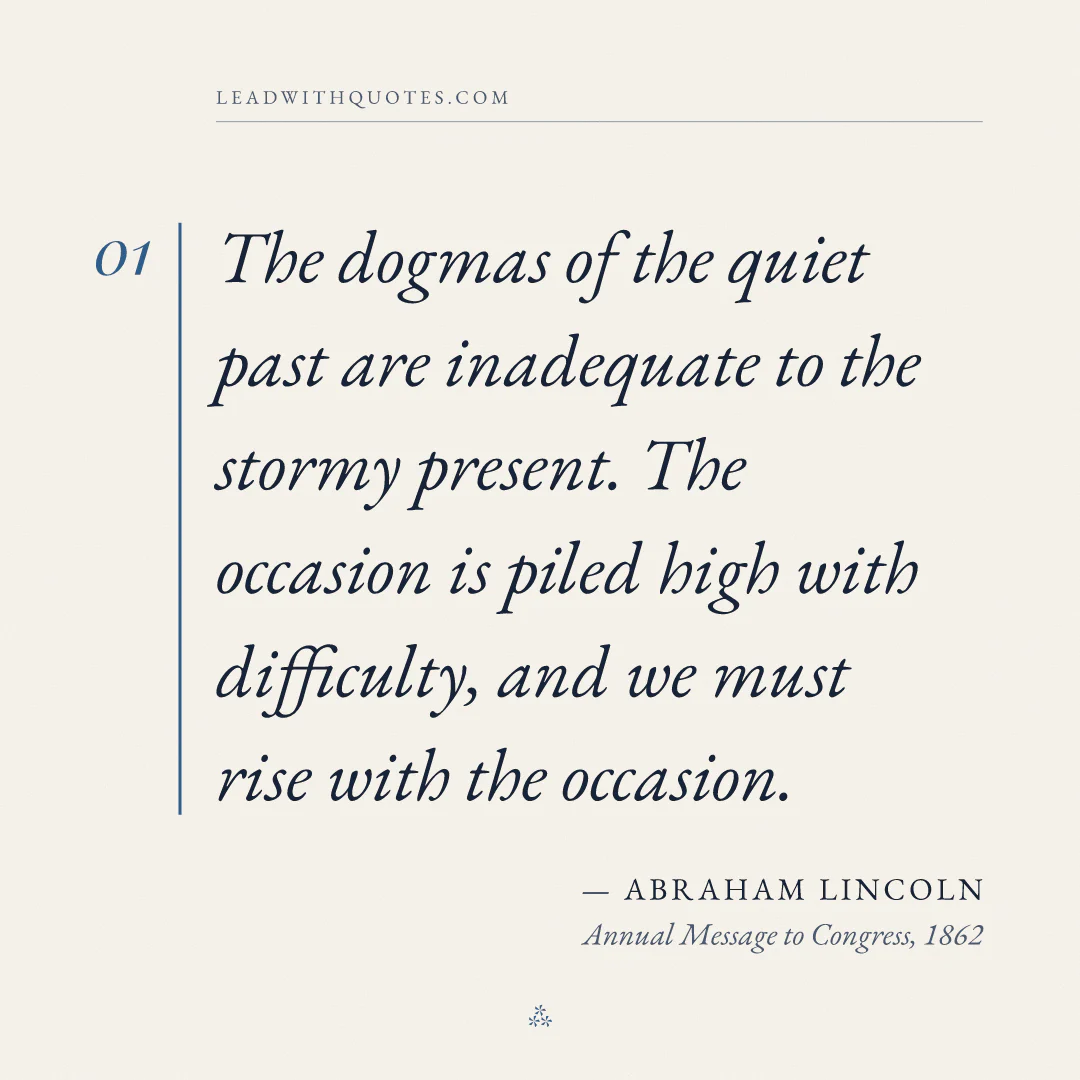
The dogmas of the quiet past are inadequate to the stormy present. The occasion is piled high with difficulty, and we must rise with the occasion. As our case is new, so we must think anew and act anew.
Abraham Lincoln, Annual Message to Congress, 1 December 1862
Lincoln sent this message to Congress a month before the Emancipation Proclamation took effect, in the second year of a war that was going badly for the Union. The passage closes a long argument for compensated emancipation, a plan Congress never adopted; its point is that habits formed in peacetime cannot be applied unchanged to a war. "Think anew and act anew" works well at the top of a strategy reset, because it frames the change as a response to new conditions, not as an admission that everyone was wrong.
Plans are worthless, but planning is everything.
Dwight D. Eisenhower, remarks at the National Defense Executive Reserve Conference, Washington, 14 November 1957
Eisenhower introduced it as something he "heard long ago in the Army", so he presents it as a soldier's saying rather than his own invention. He went straight on to explain it: the very definition of an emergency is that it is unexpected, so it will not happen the way you planned. The full sentence is on the American Presidency Project transcript. Quote the explanation with it; the short version alone can sound like an excuse not to plan at all.
In this life we get nothing save by effort. It is hard to fail, but it is worse never to have tried to succeed.
Theodore Roosevelt, "The Strenuous Life", speech to the Hamilton Club, Chicago, 10 April 1899
Roosevelt, then governor of New York, gave the speech a year after the Spanish–American War, and much of it argues for American expansion abroad, which is worth knowing before you quote it at length. The middle sentence, though, stands on its own and is a fair thing to say after a launch, a bid or a project that did not land. Pair it with what the team learned, so it reads as recognition rather than consolation.
When the decision is yours to own
In uncertain times a leader is often asked to make a call on incomplete information. These lines are about carrying that weight in public.
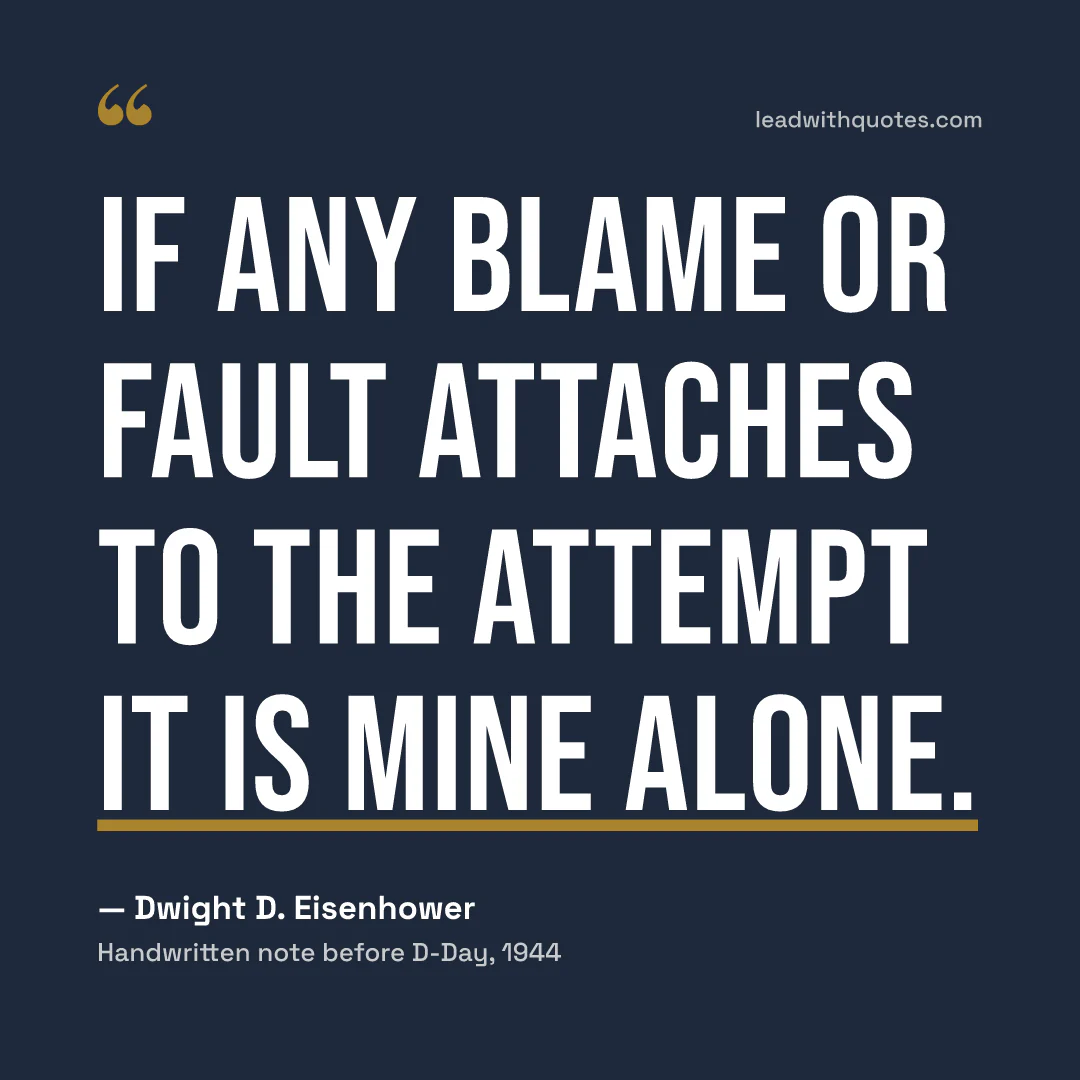
Our landings in the Cherbourg-Havre area have failed to gain a satisfactory foothold and I have withdrawn the troops. My decision to attack at this time and place was based upon the best information available. The troops, the air and the Navy did all that bravery and devotion to duty could do. If any blame or fault attaches to the attempt it is mine alone.
Dwight D. Eisenhower, handwritten note, 5 June 1944
Eisenhower wrote this the day before D-Day, in case the Normandy landings failed. They did not, and the note was never needed. He misdated it "July 5", which is why it sometimes appears with the wrong month. The original is held by the National Archives, which publishes a scan and transcription. Its structure is a model for owning a decision: what happened, why the call was made, credit to the people who carried it out, and blame placed on one person.
The price of greatness is responsibility.
Winston Churchill, speech at Harvard University, 6 September 1943
Churchill spoke after receiving an honorary degree, and the sentence opens an argument aimed at the United States: a nation that rises to lead cannot stay out of the world's problems. In its own context it is about a country accepting the burden that comes with its power. It fits a promotion, a new mandate or a team taking on work nobody else will touch, where the message is that more influence brings more to answer for.
The ultimate measure of a man is not where he stands in moments of comfort and convenience, but where he stands at times of challenge and controversy.
Martin Luther King Jr., "On Being a Good Neighbor", Strength to Love, 1963
The sermon is a reading of the parable of the Good Samaritan, and the sentence leads into King's point that the true neighbor will risk position and prestige for the welfare of others. The book was published in 1963, the year of the Birmingham campaign. In a leadership setting the line works when a decision costs something, such as protecting a team, keeping a commitment or saying no to a client, because it measures character by what a person does when it is expensive.
When it is going to take a long time
Some crises are not a single bad week but months of slow pressure. The last three lines are about staying steady across that stretch.
never give in, never give in, never, never, never—in nothing, great or small, large or petty—never give in except to convictions of honour and good sense.
Winston Churchill, address at Harrow School, 29 October 1941
Churchill said this to the boys of his old school, two years into the war, before the United States had entered it. It is often shortened to "Never, never, never give up", a wording he did not use, and sometimes described as a whole speech of three words, which it was not; the International Churchill Society has the passage. Keep the qualifier "except to convictions of honour and good sense": it turns a slogan into advice about when stubbornness is right.
Let not future things disturb thee, for thou wilt come to them, if it shall be necessary, having with thee the same reason which now thou usest for present things.
Marcus Aurelius, Meditations, VII.8, trans. George Long, 1862
Marcus wrote the Meditations in Greek as private notes, much of it while campaigning on the Danube frontier in the 170s. This short entry is about anticipatory worry: whatever arrives, you will meet it with the same judgment you are using now. It is a good line for one-to-one conversations with someone who is anxious about a reorganisation or a deadline. For more passages and how the translations differ, see our page of Marcus Aurelius quotes on leadership.
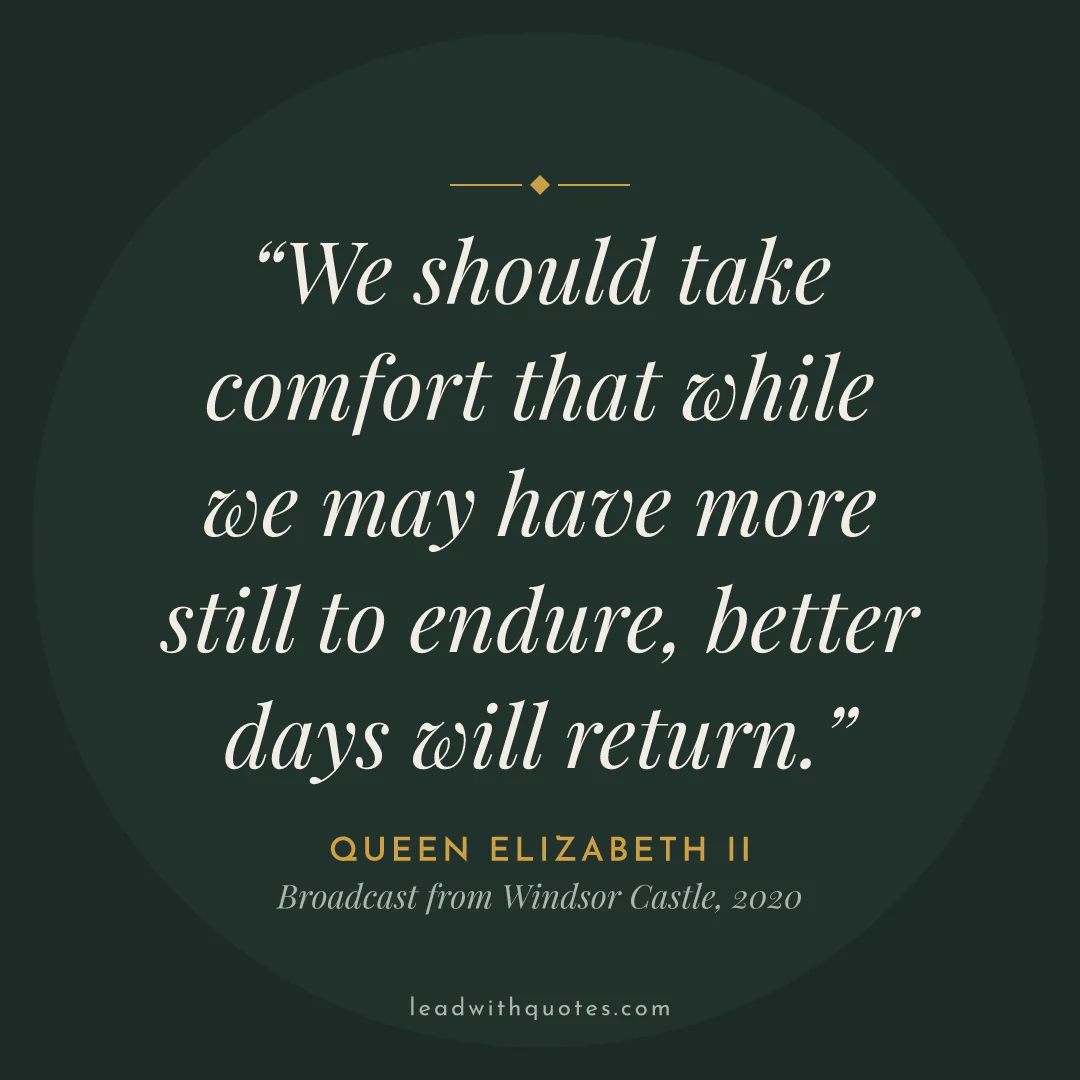
We should take comfort that while we may have more still to endure, better days will return: we will be with our friends again; we will be with our families again; we will meet again.
Queen Elizabeth II, broadcast from Windsor Castle, 5 April 2020
This was only the fifth special televised address of her reign outside the Christmas broadcasts, recorded in the first weeks of the COVID-19 lockdown in the United Kingdom. "We will meet again" deliberately echoes Vera Lynn's Second World War song, and in the same broadcast she recalled her first radio address, made with her sister in 1940 to evacuated children. The line works at the end of a long, hard season because it admits there is "more still to endure" before it offers hope.
Writing the message around the quote
A quote cannot carry a crisis message on its own. Read together, the documents above share a structure that is easy to copy. Eisenhower's note is the clearest example:
- Say what is known. One or two plain sentences, no adjectives. ("Our landings … have failed to gain a satisfactory foothold.")
- Say what is not known yet, and when that will change. This is the part most messages skip, and the gap people fill with rumour.
- Say what happens next. One concrete action, with an owner. Roosevelt's "action now" only works because the speech goes on to list what he will ask Congress for.
- Give credit and take responsibility. Credit to the people doing the work, responsibility for the decision to yourself.
- Then, if at all, the quote. At the end it sums up; at the start it can sound like you are hiding behind it.
Three short examples you can adapt:
- All-hands after losing a major client: "We lost the renewal. We don't yet know how it changes next quarter's hiring; finance will have a view by Friday and you will hear it from me first. Until then, every current project continues. The people on that account did excellent work, and the decision on pricing was mine. Lincoln put it well in 1862: 'As our case is new, so we must think anew and act anew.'"
- Email when a plan is being rewritten: "The plan we agreed in March assumed a market that has changed. We are rebuilding it over the next two weeks, and I want your input before it is fixed. Eisenhower's line applies: 'Plans are worthless, but planning is everything.' The work you put into the first plan is why we can redo it quickly."
- Note at the end of a long, hard stretch: "It has been a long few months, and there is more to do before it eases. Thank you for carrying it. As the Queen said in April 2020, 'better days will return.'"
If you want a short line rather than a full passage, our list of short leadership quotes is sorted by moment too, and lead by example quotes covers the "show, don't tell" side of leading through a hard period.
Four crisis lines with a shaky pedigree
These turn up on almost every list of quotes for difficult times. Each has a problem worth knowing before you put it on a slide.
- "Nearly all men can stand adversity, but if you want to test a man's character, give him power." Credited to Abraham Lincoln, but there is no evidence he said it. Quote Investigator traces it to the orator Robert G. Ingersoll, who said something close to it about Lincoln in the 1880s: "Most people can bear adversity, but if you wish to know what a man really is give him power." Credit Ingersoll if you use it.
- "Failure is not an option." Attributed to flight director Gene Kranz during Apollo 13 in 1970. It was written for the 1995 film Apollo 13, after flight controller Jerry Bostick told the screenwriters that when things went wrong, "we just calmly laid out all the options, and failure was not one of them." Kranz later used the phrase as the title of his 2000 memoir, which is why it now looks authentic.
- "The Chinese word for crisis is made of 'danger' and 'opportunity'." John F. Kennedy really did say this, in Indianapolis on 12 April 1959, and later speakers copied him. The claim itself is wrong: Victor Mair, a sinologist at the University of Pennsylvania, explains that the second character, jī, means something closer to "a critical point", not "opportunity". Quote it as a Kennedy line only if you are also correcting it.
- "Men wanted for hazardous journey… Safe return doubtful." Credited to Ernest Shackleton as a newspaper advertisement for the 1914 Antarctic expedition. Researchers searching the archives of The Times and other papers have never found it, and the earliest known printing is a 1944 book, as Smithsonian reported. Treat it as legend.
Before you paste any of the twelve lines into a deck, copy the speaker, the document and the year with it. A sourced line holds up when someone in the room checks it, and in an uncertain week that is the kind of credibility a leader needs most.