FDR First Inaugural Address Quotes: 6 Lines in Context, and Who Wrote "Fear Itself"
Six lines from FDR’s 1933 inaugural with the sentences around them, who drafted “fear itself” (Moley, Howe), and why “broad Executive power” is misread.

On Saturday, March 4, 1933, Franklin D. Roosevelt took the oath from Chief Justice Charles Evans Hughes and spoke for about twenty minutes to a country with its banks closing and a quarter of its workers without jobs. The text, 1,883 words by Wikipedia's count, is the best-known piece of crisis leadership in American politics, and only one sentence of it is widely quoted. This page takes six lines from the First Inaugural Address, gives the sentence around each one, and says who actually wrote the famous line. The answer is not just Roosevelt.
Who wrote the speech? Moley, Roosevelt and Louis Howe
The first draft came from Raymond Moley, a Columbia professor in Roosevelt's brain trust. According to the history teaching site run by George Mason University, which draws on the Roosevelt Library, Moley brought his draft to Hyde Park and Roosevelt reworked it; Louis Howe, his longtime adviser, arrived the next day with revisions, and one of Howe's additions was the sentence beginning "So first of all let me assert my firm belief that the only thing we have to fear is fear itself." Roosevelt then changed the ending before delivery.
Where the idea came from is less certain. Eleanor Roosevelt suggested her husband may have read something very like it in Thoreau, who wrote in 1851, "Nothing is so much to be feared as fear." Moley remembered seeing the phrase in a department-store newspaper advertisement earlier in February, though the same source says it could not find such an ad. So the line is Roosevelt's by delivery and Howe's by insertion, with an older source in the background. Credit it to the speech, not to a lone author.
"The only thing we have to fear": diagnosing the problem first
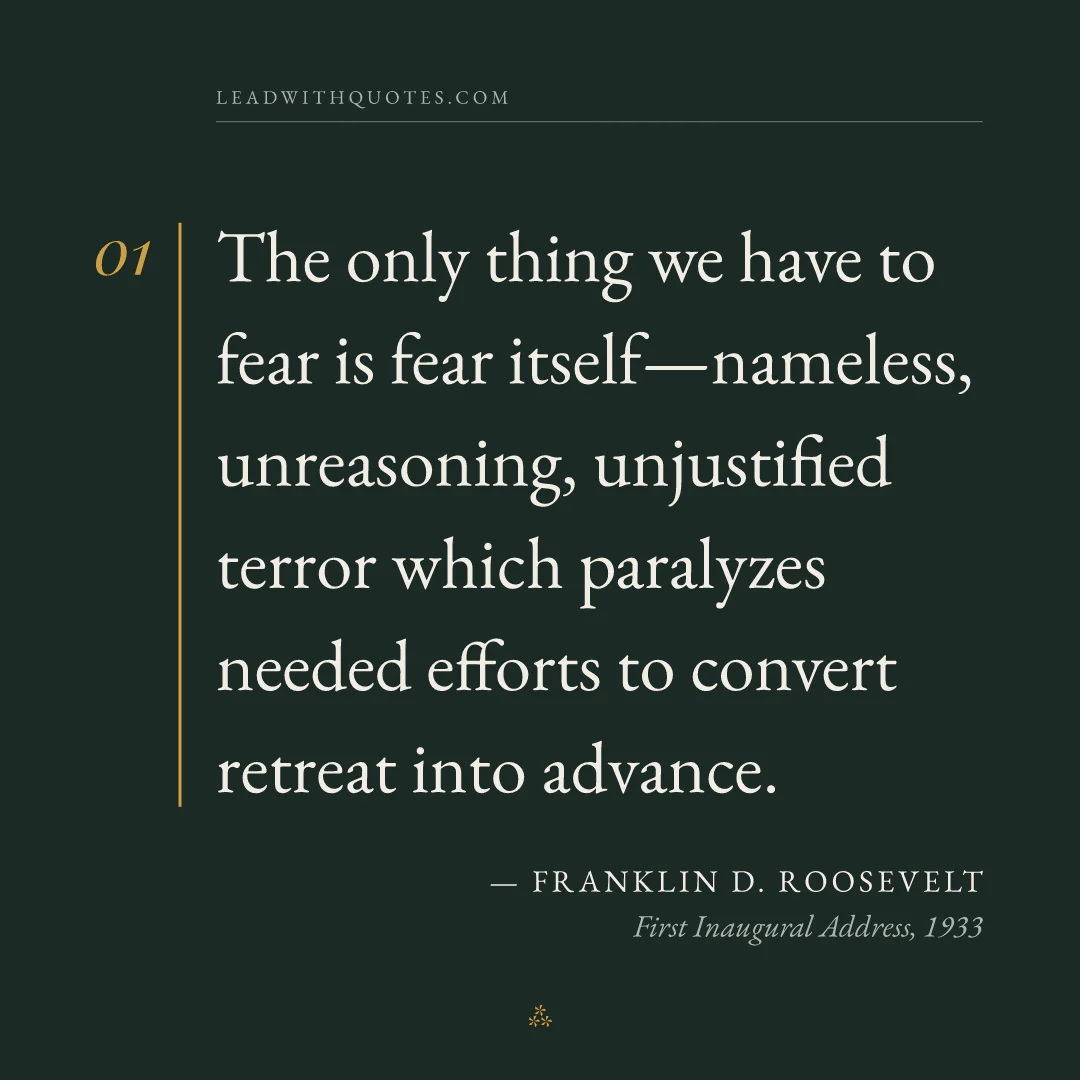
So, first of all, let me assert my firm belief that the only thing we have to fear is fear itself—nameless, unreasoning, unjustified terror which paralyzes needed efforts to convert retreat into advance.
Franklin D. Roosevelt, First Inaugural Address, March 4, 1933
Read the whole sentence, not the first half. The point is not "don't be afraid"; it is that a particular kind of fear, the unnamed kind, stops people from acting. Roosevelt names it ("nameless, unreasoning, unjustified terror") so that it can be separated from the real economic damage he lists a few paragraphs later. A leader who says this is saying: first the panic, then the plan. Use it when a team is frozen by rumour rather than by facts, and follow it, as he did, with the facts.
Blaming and naming: the money changers
The money changers have fled from their high seats in the temple of our civilization.
Franklin D. Roosevelt, First Inaugural Address, 1933
This is the speech's sharpest sentence and the one most often left out of quote lists. It borrows the image of Jesus driving the money changers from the temple, and it assigns blame to bankers in a moment when the public wanted someone to blame. Roosevelt follows it at once with a remedy: "We may now restore that temple to the ancient truths." The lesson for any leader is the order. He names the failure plainly, then turns to what comes next, and does not stay on the accusation.
Work as the first policy
Our greatest primary task is to put people to work. This is no unsolvable problem if we face it wisely and courageously.
Franklin D. Roosevelt, First Inaugural Address, 1933
Notice what comes first. Before banking reform or farm relief, Roosevelt states one priority, and he says it can be solved. Compare this with the many "priorities" lists in modern strategy decks. A single named task, with a promise that it is solvable, is why the sentence is remembered. It is also a good test for your own planning: can you say your first priority in nine words?
Redefining success after a crash
Happiness lies not in the mere possession of money; it lies in the joy of achievement, in the thrill of creative effort.
Franklin D. Roosevelt, First Inaugural Address, 1933
Speaking about three and a half years after the 1929 crash, Roosevelt moved the measure of success from wealth to work. It comes straight after the temple image above: "The measure of the restoration lies in the extent to which we apply social values more noble than mere monetary profit." A little later he speaks of "the falsity of material wealth as the standard of success." It is a moral argument made to people who had lost their money, which is why it still travels well to other settings: teams that have just missed a financial target can borrow its logic without borrowing its politics.
The sentence people misread: "broad Executive power"
The war-powers passage is often quoted in the middle, so here is the order of the three paragraphs. First Roosevelt hopes the "normal balance of executive and legislative authority may be wholly adequate." Then he says he will recommend measures, adding that "these measures, or such other measures as the Congress may build out of its experience and wisdom, I shall seek, within my constitutional authority, to bring to speedy adoption." Only then:
But in the event that the Congress shall fail to take one of these two courses, and in the event that the national emergency is still critical, I shall not evade the clear course of duty that will then confront me. I shall ask the Congress for the one remaining instrument to meet the crisis—broad Executive power to wage a war against the emergency, as great as the power that would be given to me if we were in fact invaded by a foreign foe.
Franklin D. Roosevelt, First Inaugural Address, 1933
Quoted alone, "broad Executive power to wage a war" sounds like a bid for sweeping power. In context it is a conditional: only if Congress fails to act, and only by asking Congress for it. Whether one finds that reassuring is a political judgement; the wording itself is not in doubt. Cutting the conditions changes the meaning, which is exactly the kind of trimming we flag in our guide to leadership quotes leaders never said.
Closing on the public's mandate
We do not distrust the future of essential democracy. The people of the United States have not failed. In their need they have registered a mandate that they want direct, vigorous action.
Franklin D. Roosevelt, First Inaugural Address, 1933
Here Roosevelt turns the weight of the moment onto the voters. They have not failed, he says; they have asked for action, and he is giving it. A leader who credits the people for the mandate invites them to share the work and the risk. If you are writing a speech of your own, this is the structural move to study: after the hard words comes an act of trust.
How to quote this speech without cutting it
- Cite the date and the occasion. "First Inaugural Address, March 4, 1933" costs seven words and puts the line back in a crisis.
- Keep the sentence whole. "Fear itself" without "nameless, unreasoning, unjustified terror" loses the definition; "broad Executive power" without the conditions reverses the meaning.
- Say who shaped it. Say the line is "from the 1933 inaugural" rather than "Roosevelt's own words", since Moley and Howe both worked on the text.
- Pair the line with a fact. Roosevelt followed his fear sentence with a count of what was wrong. If you borrow the sentence, bring numbers too; see our page on accountability quotes for lines that put the duty on the speaker.
Questions readers ask
Did Roosevelt write the "fear itself" line?
Not by himself. Moley wrote the first draft, and according to the Roosevelt Library material cited above, Louis Howe added the "fear itself" sentence in his revisions. Roosevelt delivered and finished the text. An earlier source may lie behind it: Thoreau wrote "Nothing is so much to be feared as fear" in 1851.
What is the full "fear itself" quote?
"So, first of all, let me assert my firm belief that the only thing we have to fear is fear itself—nameless, unreasoning, unjustified terror which paralyzes needed efforts to convert retreat into advance."
Did Roosevelt ask for the powers of a wartime president?
He said he would ask Congress for "broad Executive power to wage a war against the emergency" only if Congress failed to act on the measures he would recommend. The sentence is a conditional request, not a claim.
For another account of how leaders earn trust in a bad stretch, see how organizations actually build trust.