Leadership Quotes Leaders Never Said: 24 Famous Lines and Who Really Said Them
24 leadership quotes credited to Churchill, Drucker, Gandhi, Lincoln and others, traced to who really said them, with the research behind each fix linked.

On 21 January 2024, Ron DeSantis ended his presidential campaign with a line from Winston Churchill: "Success is not final, failure is not fatal: it is the courage to continue that counts." The same day, PolitiFact had a statement from the International Churchill Society: the sentence appears nowhere in Churchill's canon. A campaign's farewell message had put its last line in the mouth of a man who never said it.
Leadership quotes have this problem more than most. A line sounds stronger with a famous name under it, so the name gets added, and later copies drop the doubt. This page collects 24 of the most widely shared leadership and management lines that the people they are credited to never said, or never said in that form. For each one we give the verdict, the earliest source that researchers have found, a link to that research or to the primary text, and a line you can quote instead. Last reviewed 10 October 2026. We add entries and update verdicts when an earlier source turns up.
All 24 lines at a glance
Three verdicts are used below. Someone else said it: the real author is known. Real idea, later wording: the credited person said something similar, but not these words. No source found: nobody has traced the line to the credited person, and often not to anyone.
| Popular line (short form) | Usually credited to | What the record shows | Verdict |
|---|---|---|---|
| Culture eats strategy for breakfast | Peter Drucker | Earliest close match 2000, a consulting firm | No source found |
| Management is doing things right; leadership is doing the right things | Peter Drucker | Drucker's efficiency/effectiveness idea, recast by Bennis and Nanus (1985) | Real idea, later wording |
| In God we trust; all others must bring data | W. Edwards Deming | Called a "cliche" in a 1978 congressional hearing | No source found |
| They would have said faster horses | Henry Ford | First credited to Ford in 2001 | No source found |
| Insanity is doing the same thing over and over… | Albert Einstein | Twelve-step groups, 1981 | No source found |
| Not the strongest of the species survives… | Charles Darwin | Leon Megginson, 1963 | Someone else said it |
| Success is not final, failure is not fatal… | Winston Churchill | Not in Churchill's canon | No source found |
| If you're going through hell, keep going | Winston Churchill | Not in Churchill's canon | No source found |
| We make a living by what we get… | Winston Churchill | A 1944 newspaper column | No source found |
| If you want to test a man's character, give him power | Abraham Lincoln | Robert G. Ingersoll, about Lincoln, 1883 | Someone else said it |
| All that is necessary for evil to triumph is for good men to do nothing | Edmund Burke | Modern form 1916; nearest real lines Burke 1770, Mill 1867 | Real idea, later wording |
| Our deepest fear is not that we are inadequate… | Nelson Mandela | Marianne Williamson, 1992 | Someone else said it |
| If your actions inspire others to dream more… | John Quincy Adams | Earliest version credited to Dolly Parton, 1997 | Someone else said it |
| Failure is not an option | Gene Kranz | Screenwriters of Apollo 13 (1995), from Jerry Bostick's words | Someone else said it |
| Men wanted for hazardous journey… | Ernest Shackleton | No copy of the ad found; earliest printing 1944 | No source found |
| Go where there is no path and leave a trail | Ralph Waldo Emerson | Muriel Strode, 1903 | Someone else said it |
| Be the change you wish to see in the world | Mahatma Gandhi | Gandhi 1913 in longer form; short form 1974 | Real idea, later wording |
| Preach the Gospel at all times; when necessary, use words | Francis of Assisi | Rule of 1221 says preach by deeds | Real idea, later wording |
| Everything we hear is an opinion, not a fact… | Marcus Aurelius | Not in Meditations | No source found |
| A leader is best when people barely know he exists | Laozi | Chapter 17, in Witter Bynner's 1944 version | Real idea, later wording |
| The true price of leadership is… | Simon Sinek | Lt. Gen. George Flynn, foreword to Leaders Eat Last | Someone else said it |
| The cost of leadership is self-interest | Simon Sinek | Flynn, quoted in Leaders Eat Last, ch. 8 | Someone else said it |
| No one can make you feel inferior without your consent | Eleanor Roosevelt | Earliest printing Reader's Digest, 1940, unsourced | No source found |
| Never doubt that a small group of thoughtful, committed citizens… | Margaret Mead | No contemporaneous source known | No source found |
Management maxims no management writer wrote
Business books and slide decks pass these around as if they came from the field's founders. Four of the six have no link to the person named at all.
Did Peter Drucker say "Culture eats strategy for breakfast"?
No evidence says he did. Quote Investigator found the earliest close match in March 2000, credited to the Giga Information Group, and a "for lunch" variant later that year. The Drucker credit arrived years after that, once executives such as Ford's Mark Fields had made the phrase famous around 2006. The nearest scholarly ancestor is Edgar Schein's Organizational Culture and Leadership (1985), which says culture "constrains" and "determines and limits" strategy. If you want the idea with a real author, cite Schein.
Did Drucker say "Management is doing things right; leadership is doing the right things"?
Not in those words. Drucker's own distinction, made in the 1960s and set out in The Effective Executive (1967), was between efficiency, doing things right, and effectiveness, doing the right things. It was Warren Bennis and Burt Nanus, in Leaders: The Strategies for Taking Charge (1985), who moved the contrast onto managers and leaders. Barry Popik's citations show Stephen Covey's The 7 Habits of Highly Effective People printing the combined sentence and crediting it to both men, which is how it settled on Drucker.
Did W. Edwards Deming say "In God we trust; all others must bring data"?
Probably not first, and possibly never. The earliest print use that Popik found is testimony by Edwin R. Fisher to a House committee on 7 September 1978, where he called it "a well-recognized cliche in scientific circles." Mary Walton's The Deming Management Method (1986) printed a version, and the Deming credit grew from there. The irony is that Deming warned against running a company on numbers alone. In Out of the Crisis (1982) he listed "running a company on visible figures alone" among the deadly diseases of management, and quoted the statistician Lloyd S. Nelson: "the most important figures that one needs for management are unknown or unknowable."
Did Henry Ford say customers would have asked for "a faster horse"?
There is no record of it. Quote Investigator found the first link to Ford in 1999, when a cruise-ship designer imagined what people would have told Ford, and the first direct quotation of Ford in a 2001 letter to Marketing Week. Ford died in 1947. The idea itself is older: writers in 1930 and 1946 noted that breeding faster horses would never have produced the railway or the car.
Did Einstein say insanity is "doing the same thing over and over again and expecting different results"?
No. Princeton University Press's The Ultimate Quotable Einstein lists it as misattributed. Quote Investigator traces it to recovery groups: an Al-Anon member quoted in a Knoxville paper in October 1981, and a Narcotics Anonymous pamphlet a month later. It reached Einstein around 1990, 35 years after his death. Change-management talks use it constantly; credit it as "a saying from twelve-step recovery groups."
Did Darwin say the species that survives is "the most adaptable to change"?
No. The Darwin Correspondence Project at Cambridge lists it among things Darwin never said. The words belong to a management professor at Louisiana State University, summarising Darwin in a 1963 speech:
It is not the most intellectual of the species that survives; it is not the strongest that survives; but the species that survives is the one that is able best to adapt and adjust to the changing environment.
Leon C. Megginson, Southwestern Social Science Quarterly, 1963
Megginson gave it as his reading of On the Origin of Species, without quotation marks. Later speakers shortened it, added the marks, and moved it to Darwin. For a talk about adapting to change, Megginson is the honest credit, and a management professor is a fitting source for a management point.
Lines put in the mouths of statesmen
Politicians and wartime leaders are the biggest magnets for stray quotes, and Churchill attracts the most. The International Churchill Society keeps a list of lines it has checked against the roughly fifty million words by and about him.
Did Churchill say "Success is not final, failure is not fatal"?
No. The Society says it can find no attribution for either half and that they are "found nowhere in his canon." It adds that many sites give the line to Abraham Lincoln instead, with no better evidence. This is the line from the DeSantis speech above.
Did Churchill say "If you're going through hell, keep going"?
No. The same Society list calls it a fake quote that "is not a phrase that is contained anywhere in the canon of Winston Churchill's written or spoken words," despite its long life on motivational posters.
Did Churchill say "We make a living by what we get, but we make a life by what we give"?
No. The Society notes it was even used in a 2005 Lockheed Martin advertisement, but it is "definitely not Winston Churchill." Barry Popik's research puts the earliest known version in a 1944 column in the Altoona Mirror in Pennsylvania.
Did Lincoln say "If you want to test a man's character, give him power"?
No, but it was said about him. Quote Investigator traces it to the orator Robert G. Ingersoll, praising Lincoln:
Most people can bear adversity. But if you wish to know what a man really is, give him power. This is the supreme test.
Robert G. Ingersoll, Unity (Chicago), 1883
Ingersoll's point was that Lincoln passed this test. Over the next fifty years the tribute turned into a Lincoln quotation; Quote Investigator's earliest example of the switch is an Iowa newspaper in 1931. Credit Ingersoll, and you keep both the line and the compliment to Lincoln.
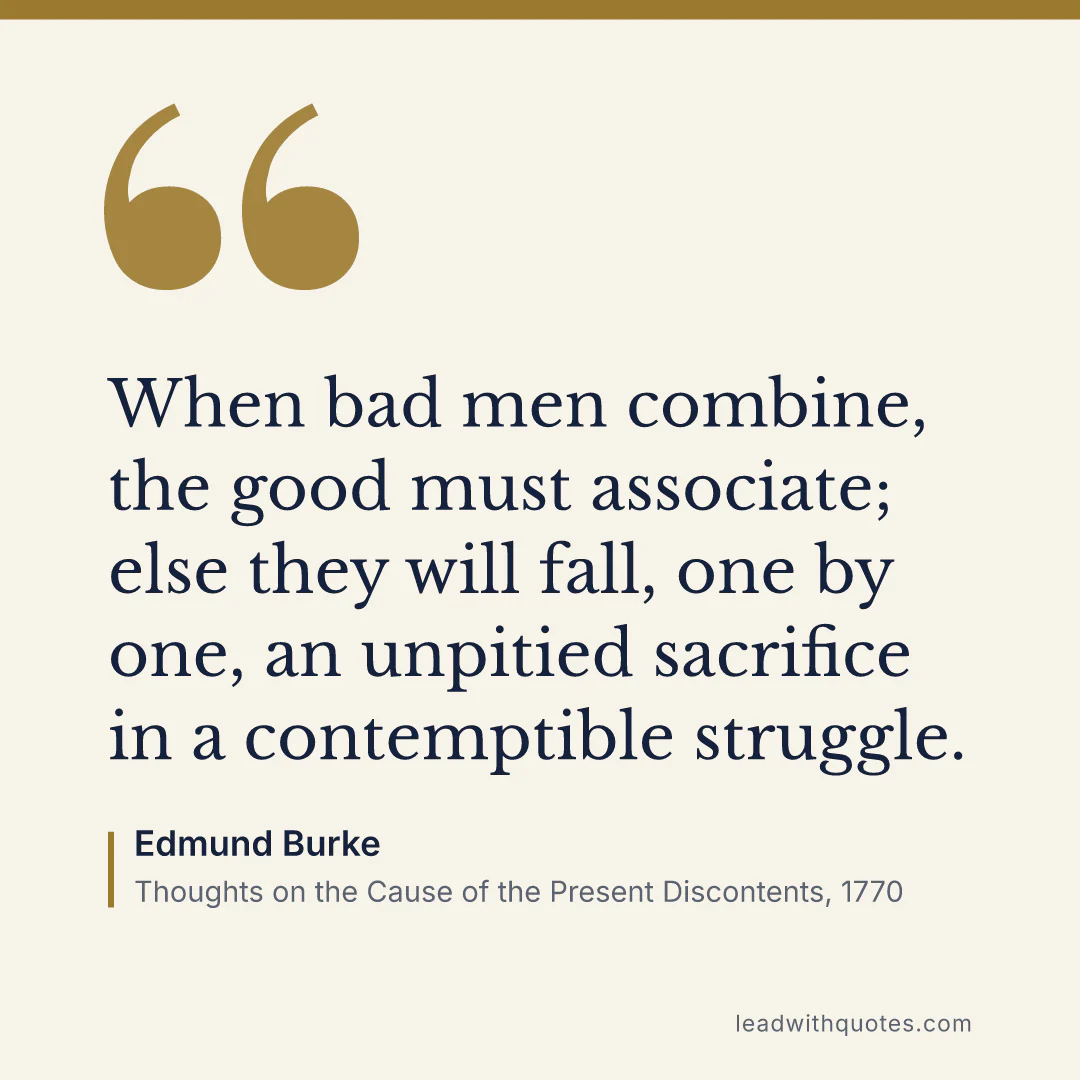
Did Edmund Burke say "All that is necessary for the triumph of evil is that good men do nothing"?
Not in any of his writings. Quote Investigator found the modern wording in a 1916 speech by the Reverend Charles F. Aked, and the first credit to Burke in 1920. Burke did write something in the same spirit, in a pamphlet about organised opposition:
When bad men combine, the good must associate; else they will fall, one by one, an unpitied sacrifice in a contemptible struggle.
Edmund Burke, Thoughts on the Cause of the Present Discontents, 1770
Burke's actual argument is narrower and more useful to anyone running a team: good intentions are not enough unless good people organise. The closest match to the popular wording comes a century later, from John Stuart Mill's rectorial address at St Andrews on 1 February 1867: "Bad men need nothing more to compass their ends, than that good men should look on and do nothing."
Did Nelson Mandela say "Our deepest fear is not that we are inadequate"?
No. The passage opens chapter 7 of a spiritual self-help book:
Our deepest fear is not that we are inadequate. Our deepest fear is that we are powerful beyond measure.
Marianne Williamson, A Return to Love, 1992
The Nelson Mandela Foundation states that "Mr Mandela did not use the quotation in any of the three public addresses at the time of his inauguration" in 1994. Quote Investigator found a columnist crediting it to the inaugural speech by 1996, and by 1998 it was appearing in commencement speeches under Mandela's name.
Did John Quincy Adams say "If your actions inspire others to dream more… you are a leader"?
No source links it to Adams. Quote Investigator found the earliest version in a 1997 collection, The Most Important Thing I Know, credited there to Dolly Parton. The Adams credit is so common that it appears in the foreword of a bestselling leadership book. We list it with other lead-by-example strays in our lead by example quotes.
Mission control, a polar ad and a poet
Did Gene Kranz say "Failure is not an option" during Apollo 13?
No. The line was written for the 1995 film Apollo 13. Flight controller Jerry Bostick has described how screenwriters Al Reinert and Bill Broyles asked him whether anyone in Mission Control panicked, and he answered that "we just calmly laid out all the options, and failure was not one of them." Broyles turned that into the film's tagline, and Ed Harris spoke it as Kranz (the account is summarised, with its source, on Wikipedia). Kranz then used the phrase as the title of his 2000 memoir, which is why it now looks like a quotation from 1970. Bostick's own sentence is the better one for a crisis briefing: it describes a method, not a slogan.
Did Shackleton place an ad reading "Men wanted for hazardous journey… Safe return doubtful"?
Nobody has found it. Researchers have searched The Times and other papers of the period without success, and the earliest known printing of the text is in a 1944 book, as Smithsonian reported. Treat it as a legend about Shackleton, not a document by him. Our leadership quotes for uncertain times offer crisis lines that are on the record.
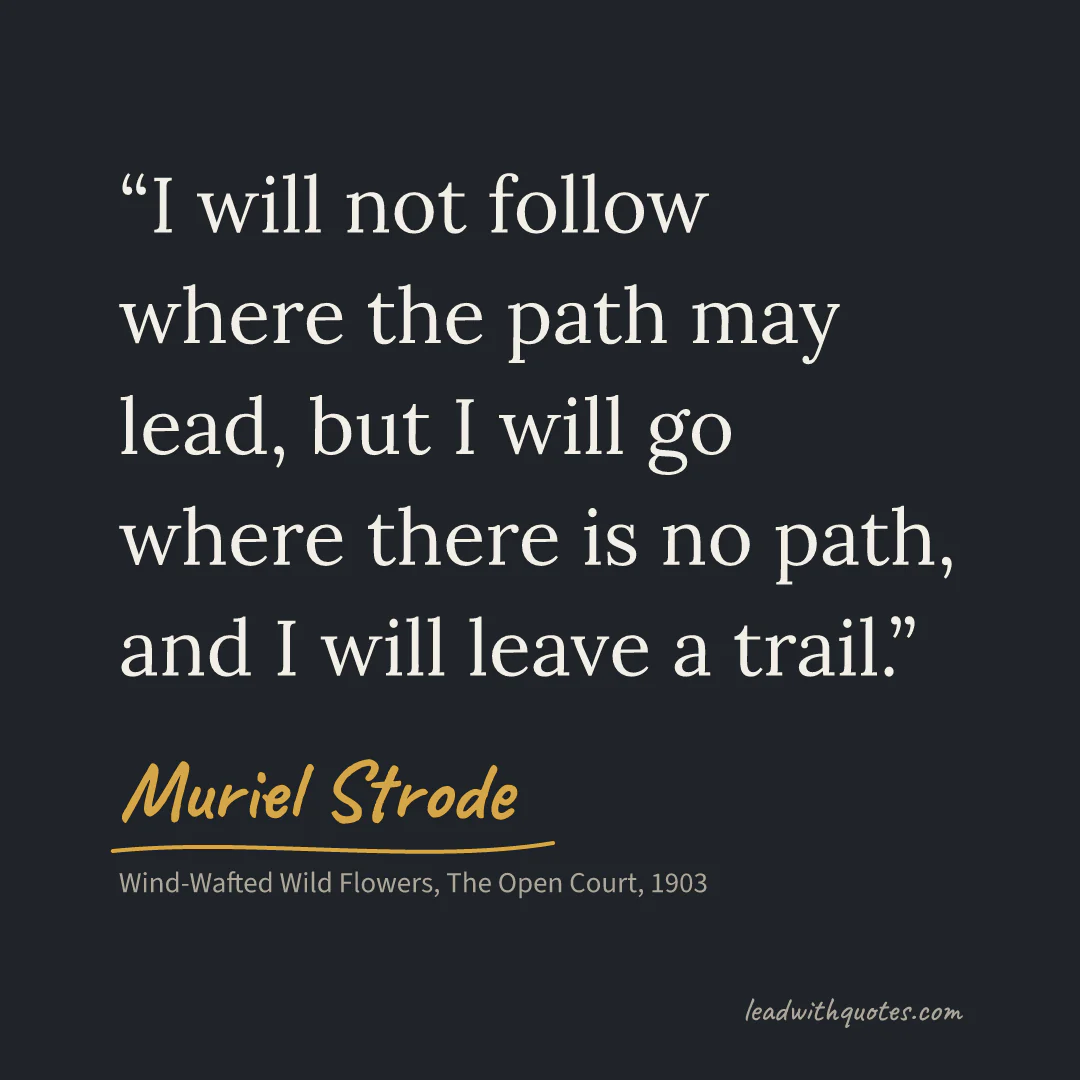
Did Emerson say "Do not go where the path may lead; go instead where there is no path and leave a trail"?
No such sentence is in his works. Quote Investigator traced it to a little-known poet:
I will not follow where the path may lead, but I will go where there is no path, and I will leave a trail.
Muriel Strode, "Wind-Wafted Wild Flowers", The Open Court, 1903
Strode's version is first person, a statement of intent rather than advice, which suits a founder's talk or a team that is doing something new. It also gives credit to a woman whose line spent a century under a more famous man's name.
Sages and saints, smoothed into slogans
These four are not inventions. Each has a real text behind it, and the popular version has drifted away from that text.
Did Gandhi say "Be the change you wish to see in the world"?
Not in those words. His actual passage is longer and more modest:
We but mirror the world. All the tendencies present in the outer world are to be found in the world of our body. If we could change ourselves, the tendencies in the world would also change.
Mahatma Gandhi, Indian Opinion, 9 August 1913
Quote Investigator finds the short form in 1974, in a chapter by the educator Arleen Lorrance ("be the change you want to see happen"). If the poster version is all you have room for, write "a line often credited to Gandhi."
Did Francis of Assisi say "Preach the Gospel at all times; when necessary, use words"?
It is not in his writings or his early biographies. The nearest real text is the Earlier Rule of 1221, which tells all the brothers to preach by their deeds. Francis was also a tireless preacher in words, so the slogan reverses part of his example. See the fact-checks by The Gospel Coalition and Aleteia.
Did Marcus Aurelius write "Everything we hear is an opinion, not a fact"?
No translation of Meditations contains it. Classicists consulted by PolitiFact in 2019 pointed out that it contradicts Stoic thought, which holds that facts exist but need not disturb us. The nearest real passage is short:
The universe is transformation: life is opinion.
Marcus Aurelius, Meditations IV.3, trans. George Long, 1862
In context, IV.3 is advice on retreating into your own mind when things go badly, not a claim that truth is relative. Our Marcus Aurelius quotes on leadership give twelve real passages by book and section, and two more lines he did not write.
Did Laozi say "A leader is best when people barely know he exists"?
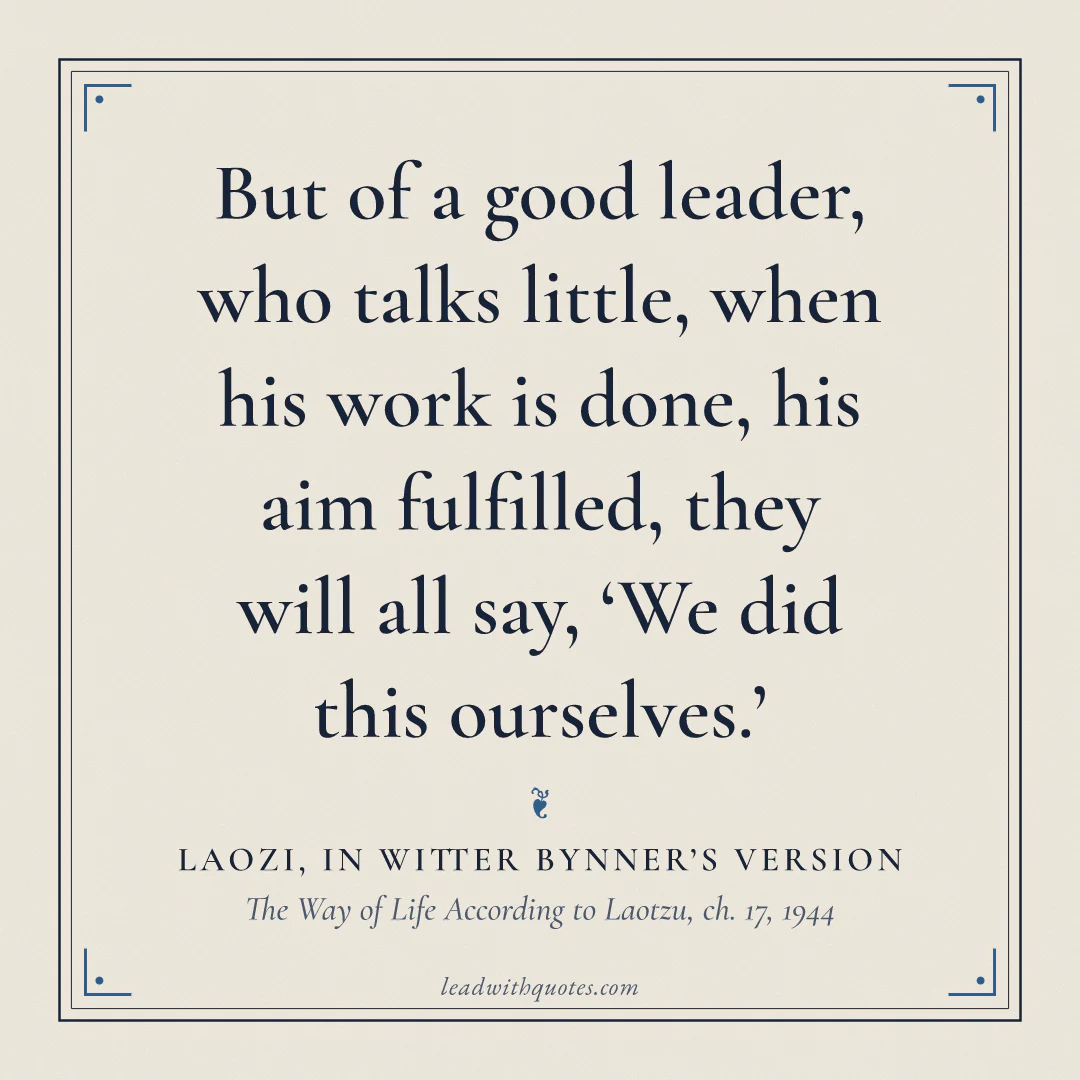
The idea is chapter 17 of the Tao Te Ching; the wording is an American poet's. James Legge's 1891 translation begins "In the highest antiquity, (the people) did not know that there were (their rulers)." The leadership-poster version comes from Witter Bynner's free 1944 rendering, which ends:
But of a good leader, who talks little, when his work is done, his aim fulfilled, they will all say, 'We did this ourselves.'
Laozi, in Witter Bynner's The Way of Life According to Laotzu, ch. 17, 1944
Bynner's version is readable online. It is fine to quote; just name the version, because a reader who looks for "leader" in a literal translation will not find it.
Modern books and speeches: the wrong name on a real page
Did Simon Sinek write "The true price of leadership is the willingness to place the needs of others above your own"?
It is printed in his book, but not by him. It comes from the foreword to Leaders Eat Last, written by a retired Marine general:
Marine leaders are expected to eat last because the true price of leadership is the willingness to place the needs of others above your own.
Lt. Gen. George J. Flynn, foreword to Leaders Eat Last, 2014
Quote sites credit everything between the covers to the author on the cover. Flynn's foreword is where the book's title comes from: in Marine mess halls, junior Marines are served first and the most senior last.
Did Sinek say "The cost of leadership is self-interest"?
Also Flynn. In chapter 8 of Leaders Eat Last, Sinek writes: "'The cost of leadership,' explains Lieutenant General George Flynn of the United States Marine Corps, 'is self-interest.'" The endnotes date it to Sinek's interview with Flynn in November 2011. Our Leaders Eat Last quotes separate Sinek's own lines from the ones he quotes.
Did Eleanor Roosevelt say "No one can make you feel inferior without your consent"?
No one has found it in her writing. It is often credited to her 1937 autobiography This Is My Story, but Quote Investigator found it in none of her books. The earliest known printing is Reader's Digest in 1940, without documentation. If you use it, write "attributed to Eleanor Roosevelt."
Did Margaret Mead say "Never doubt that a small group of thoughtful, committed citizens can change the world"?
Unproven. Wikiquote lists it as disputed: "No contemporaneous source is known." Ralph Keyes noted in The Quote Verifier (2006) that the books crediting Mead cite each other rather than an original. It may be hers, spoken and not recorded, but there is no text to point to. The fair credit is "commonly attributed to Margaret Mead."
What the 24 have in common
Counting the verdicts above: 11 lines have no traceable source at all, 8 have a known author who is not the person credited, and 5 are real ideas in later words. Twenty different famous names are involved, and Churchill carries three lines on his own.
Three patterns repeat:
- The tribute becomes the quote. Ingersoll praised Lincoln; Flynn introduced Sinek's book; Megginson summarised Darwin. In each case words about a leader, or printed next to one, turned into words by that leader.
- The line gets shorter and the name gets bigger. Gandhi's three sentences became seven words. Strode's poem lost its "I". Each trim made the line easier to share and easier to give to someone more famous.
- The date gives it away. Einstein died in 1955, and his name reached the insanity line around 1990. Ford died in 1947; the first quotation of him on horses is from 2001. A first appearance decades after the speaker's death is the clearest warning sign there is.
A five-minute check before you put a name under a quote
- Ask for the document. A real quote comes with a book, a speech, a letter or an interview, and a year. If the post you copied it from has only a name, assume nothing yet.
- Search the text itself. For books out of copyright, search the full text on Project Gutenberg or the Internet Archive for a short exact phrase. If a famous line is not in the book it is credited to, that settles it.
- Check the specialists. Quote Investigator for English-language sayings; the International Churchill Society for Churchill; the Nelson Mandela Foundation for Mandela; the Darwin Correspondence Project for Darwin; Wikiquote's "Disputed" and "Misattributed" sections for most others.
- Compare dates. Find the earliest appearance you can. If it comes long after the person died, or only after the line became popular, treat the credit as doubtful.
- Write what you know. Credit the real author if there is one ("Robert G. Ingersoll, 1883"). If there is not, write "commonly attributed to…" or choose a line with a record. A sourced line holds up when someone in the audience checks it.
For a speech or a slide, the second option is usually better. Most of the people on this list said something just as good that is on the record: Burke's "When bad men combine", Bostick's options, Gandhi's mirror. Using the real line costs nothing, and anyone who checks it will find it where you say it is.
How this page is kept
Each entry links to the research it relies on: a primary text where one exists (a book, an address, a foreword), or a published investigation that cites the primary documents. Where researchers disagree or the trail is thin, the verdict says "no source found" rather than naming a culprit. Several of these corrections first appeared on our topic pages as we audited them; this page brings them together and will be updated as new entries are checked or earlier sources come to light.
The next time a famous name is attached to a perfect sentence, check the date.