Desk essay
15 Humble Inspiring Leadership Quotes That Redefine Authority
Examining historical texts and quiet moments of reflection reveals how the most effective commanders often operate from a place of profound modesty.
By Morgan Ellis
Morgan Ellis

Robert K. Greenleaf published his essay The Servant as Leader in 1970 and inverted the usual order of the question: the test of a leader, he argued, is whether the people being served grow. The idea reads as obvious now and remains rare in practice. Authority rarely requires a megaphone. True influence often takes root in the quiet spaces where ego steps aside to let capability breathe.
The historical record of human management is littered with statues built to unyielding conquerors, yet the organizations that actually survive generational shifts tend to be built by people who understood their own insignificance. Studying inspirational frameworks for management requires looking past the bluster of modern executive branding. When a founder admits a strategic error or a commander defers to a frontline soldier's expertise, they dismantle the brittle facade of infallibility. This vulnerability builds a far more resilient operational structure. Teams will follow a flawed human who tells the truth much further than they will follow a flawless persona manufactured for a quarterly report.
The Admission of Limits
Recognizing the boundaries of one's own control is the first mechanical step toward genuine stewardship. Leaders who pretend to orchestrate every variable eventually collapse under the weight of their own fiction. Those who state their limitations plainly invite collaboration, turning personal deficits into organizational strengths.
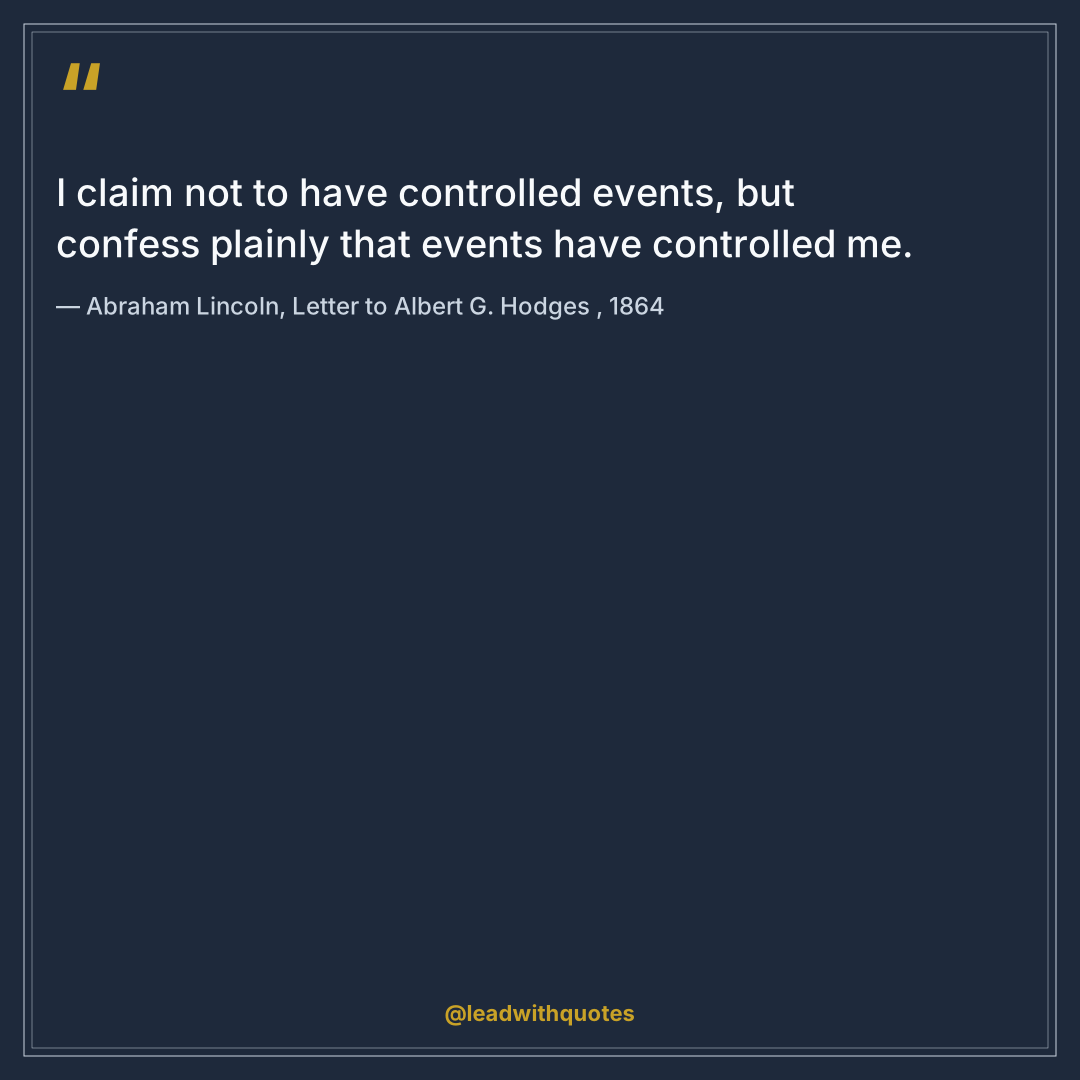
"I claim not to have controlled events, but confess plainly that events have controlled me." — Abraham Lincoln, Letter to Albert G. Hodges, 1864
Lincoln wrote this reflection near the end of a devastating civil war, acknowledging that the massive historical currents of his presidency were far beyond his personal mastery.
"I am still learning." — Michelangelo, Sketchbook Motto, 1560
At age 85, after completing the Sistine Chapel and reshaping Renaissance art, the sculptor penned this four-word phrase alongside a sketch of an old man in a go-cart.
"We are all apprentices in a craft where no one ever becomes a master." — Ernest Hemingway, The Wild Years, 1962
Hemingway viewed the act of writing not as a mountain to be conquered, but as a daily, grinding trade that demanded perpetual submission to the blank page.
"A great man is always willing to be little." — Ralph Waldo Emerson, Compensation, 1841
Emerson argued that the desperate need to project dominance is a symptom of internal poverty, while true scale allows a person to inhabit small, unglamorous roles without fear.
Also worth reading: how modest approaches to guidance shape team dynamics
Questioning One's Own Certainty
Absolute certainty is the enemy of adaptation. When a manager decides they hold all the answers, the intellectual growth of the entire department halts immediately. The most effective strategists maintain a deliberate suspicion of their own brilliance, actively seeking out dissenting data before committing capital or personnel to a new direction.
"It is unwise to be too sure of one's own wisdom." — Mahatma Gandhi, Young India, 1924
Writing during the Indian independence movement, Gandhi constantly warned his followers against the kind of rigid ideological purity that blinds a movement to its own ethical failures.
"I am not a saint, unless you think of a saint as a sinner who keeps on trying." — Nelson Mandela, Conversations with Myself, 2010
Mandela spent his post-presidential years actively dismantling the mythological, flawless persona the global press had built around him during his imprisonment on Robben Island.
"My greatest strength as a consultant is to be ignorant and ask a few questions." — Peter Drucker, Interview with Forbes, 1997
The father of modern management theory built his career not by handing executives pre-packaged solutions, but by forcing them to articulate the fundamental realities of their own businesses.
"Humility is not thinking less of yourself, it's thinking of yourself less." — Rick Warren, The Purpose Driven Life, 2002
Often misattributed to C.S. Lewis, this specific phrasing by Warren clarifies that modesty is an issue of focus and attention allocation, not a mandate for self-deprecation.
Also worth reading: what modern strategists say about fostering psychological safety
The Quiet Mechanics of Influence
Volume rarely correlates with impact. The loudest voice in a meeting usually belongs to the person most terrified of losing control, while the most secure directors often speak last. By studying historical perspectives on service, we see a recurring pattern where silence is deployed as an active tool for gathering intelligence and empowering junior staff.
"The only true wisdom is in knowing you know nothing." — Socrates, Apology, ~399 BC
Plato recorded this foundational philosophical stance during Socrates' trial in Athens, establishing intellectual modesty as the prerequisite for all subsequent discovery.
"I have no special talent. I am only passionately curious." — Albert Einstein, Letter to Carl Seelig, 1952
Einstein consistently attributed his breakthroughs in theoretical physics to a childlike insistence on asking basic questions about space and time, rather than possessing superior computational ability.
"I have often regretted my speech, never my silence." — Publilius Syrus, Sententiae, ~43 BC
A former Syrian slave who became a celebrated writer in ancient Rome, Syrus codified the strategic advantage of withholding immediate reactions in volatile political environments.
"Leadership and learning are indispensable to each other." — John F. Kennedy, Undelivered Speech in Dallas, 1963
This line was typed on the reading copy of the speech Kennedy was scheduled to deliver at the Trade Mart in Texas on the afternoon of his assassination.
Also worth reading: the daily practices that keep ambitious founders grounded
Action Without Ego
The final test of a leader's character is their relationship to credit. When a project succeeds, the humble executive pushes the spotlight onto the analysts and engineers who executed the vision. When a project fails, that same executive stands in front of the board and absorbs the entirety of the blame. This asymmetry is the tax one pays for the privilege of directing others.
"I am only one, but I am one. I cannot do everything, but I can do something." — Edward Everett Hale, The Lend a Hand Society, 1902
Hale's motto became a rallying cry for progressive era volunteers, emphasizing that individual limitations do not excuse a person from contributing their specific, localized effort.
"Mountaintops inspire leaders but valleys mature them." — J. Oswald Sanders, Spiritual Leadership, 1967
Sanders observed that while vision is often cast during periods of high success, the actual emotional endurance required to govern is forged exclusively during periods of obscure, uncelebrated hardship.
"A leader is best when people barely know he exists." — Lao Tzu, Tao Te Ching, ~400 BC
The foundational text of Taoism advocates for a style of governance so seamless and integrated that the population believes they accomplished the monumental tasks entirely by themselves.
Also worth reading: ancient and modern thoughts on the origins of true authority
Assumptions Worth Revisiting
Common claim: Humble leaders lack the decisiveness required for crisis management.
Closer to the evidence: Modesty regarding one's own intellect actually accelerates crisis response by removing the need to protect an ego. When an executive does not care about looking foolish, they can immediately pivot away from a failing strategy without wasting days trying to justify their initial, incorrect assumptions to the board.
Common claim: Admitting ignorance diminishes a manager's credibility with their team.
Closer to the evidence: Feigning knowledge destroys trust far faster than admitting a blind spot. Teams possess a highly tuned radar for corporate bluffing; when a director plainly states they need help understanding a technical problem, the team's respect for that director's honesty typically overrides any concerns about their technical proficiency.
Common claim: Quiet leadership is only effective in small, highly collaborative organizations.
Closer to the evidence: Massive logistical operations often require the most decentralized, ego-free command structures to function. The sheer complexity of global supply chains or multinational military deployments means that a single authoritarian bottleneck at the top will inevitably cause the entire system to seize up and fail.
True influence does not require a theatrical display of dominance. The most durable changes in corporate culture and civic life are usually orchestrated by individuals who prioritize the structural integrity of the work over the preservation of their own public image.