Desk essay
11 Simon Sinek Quotes About Life Every Professional Should Read
The author's evolving philosophy on human connection and infinite games offers a sharp lens for examining our daily routines and long-term ambitions.
By Morgan Ellis
Morgan Ellis

"Fulfillment is a right and not a privilege." Simon Sinek built an entire career around this central premise, shifting the corporate gaze from quarterly earnings toward human sustainability. Sitting with my aunt in a crowded diner in downtown Chicago in 2017, I first realized how deeply corporate vocabulary had infected our personal lives. We were discussing her retirement plans, yet she kept using terms like "value proposition" and "strategic alignment" to describe her own hobbies. Sinek's broader philosophy attempts to reverse this flow, injecting human empathy back into rigid systems. His observations stretch beyond boardroom mechanics to examine how we allocate our limited time on earth.
2020s: The Infinite Mindset and Post-Pandemic Life
The global disruptions of the early 2020s forced a collective reevaluation of ambition, prompting thinkers to frame daily struggles within a much longer timeline. Sinek's publication of The Infinite Game in 2019 set the stage for this decade, arguing that life itself has no definitive finish line or declared winners. This framework proved essential when traditional career milestones vanished overnight.
"The goal is not to be perfect by the end, the goal is to be better today." — Simon Sinek, The Infinite Game, 2019
This subtle shift in perspective moves the focus from an impossible future state to immediate, actionable progress within our daily routines.
"Life is beautiful not because of the things we see or do. Life is beautiful because of the people we meet." — Simon Sinek, A Bit of Optimism Podcast, 2020
During a period defined by intense isolation, he repeatedly emphasized that human connection remains the primary engine of a meaningful existence.
"Working hard for something we don't care about is called stress; working hard for something we love is called passion." — Simon Sinek, Social Media Address, 2021
He frequently uses this distinction to help professionals diagnose their burnout, separating sheer exhaustion from the deep fatigue that accompanies purposeful labor.
2010s: Fulfillment and The Human Element
Throughout the 2010s, the conversation around work-life balance evolved into a search for genuine integration and emotional safety. Sinek published Leaders Eat Last in 2014, exploring the biological and anthropological roots of trust within communities. When examining his thoughts on building resilient teams, it becomes clear that he views professional environments as extensions of our fundamental tribal needs.
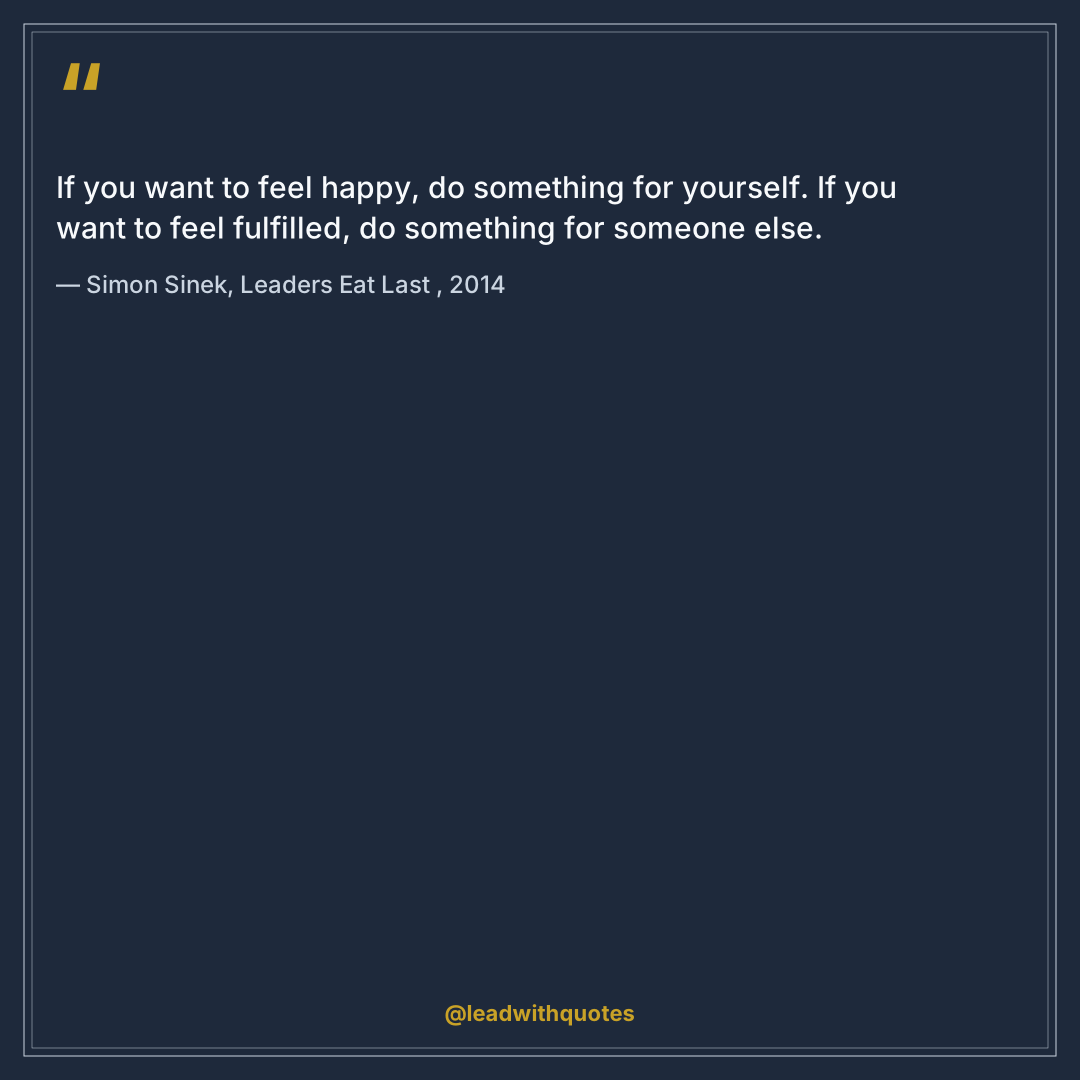
"If you want to feel happy, do something for yourself. If you want to feel fulfilled, do something for someone else." — Simon Sinek, Leaders Eat Last, 2014
Happiness is framed as a fleeting, biologically driven state, whereas fulfillment requires the sustained effort of serving a community.
"Children are better off having a parent who works into the night in a job they love than a parent who works shorter hours but comes home unhappy." — Simon Sinek, Together Is Better, 2016
This observation challenges the purely quantitative measurement of parenting time, suggesting that emotional resonance carries more weight than mere physical proximity.
"We are not victims of our situation. We are the architects of it." — Simon Sinek, Public Lecture, 2015
He pushes back against passive acceptance of toxic environments, demanding that individuals take ownership of their immediate cultural spheres. Those seeking concise leadership motivations often return to this specific call for personal agency.
"Value is not determined by those who set the price. Value is determined by those who choose to pay it." — Simon Sinek, Together Is Better, 2016
While originally applied to market economics, he frequently adapts this principle to describe self-worth and the boundaries we set in our personal relationships.
2000s: The Origins of 'Why'
Before he became a fixture on global stages, Sinek was an advertising executive trying to understand why some organizations inspired fierce loyalty while others merely transacted. His 2009 TED Talk and subsequent book, Start With Why, introduced the Golden Circle concept to a massive audience. If you are navigating breakdowns in daily communication, his early work provides a diagnostic tool for finding the missing emotional core.
"People don't buy what you do; they buy why you do it." — Simon Sinek, Start With Why, 2009
This remains his most repeated maxim, serving as a foundational thesis for aligning our outward actions with our internal convictions.
"Safe is good for sidewalks and swimming pools, but life requires risk if we are to get anywhere." — Simon Sinek, Start With Why, 2009
He reminds readers that the pursuit of absolute security often paralyzes growth, demanding a willingness to step into the unknown.
"The true price of leadership is the willingness to place the needs of others above your own." — Simon Sinek, Early Seminars, 2008
Long before he formalized his biological theories of trust, he was already redefining power dynamics at work by framing authority as a burden of care rather than a mechanism of control.
"Let us all be the leaders we wish we had." — Simon Sinek, Start With Why, 2009
This closing thought acts as a universal mandate, stripping away the need for formal titles and placing the responsibility for cultural change squarely on the individual.
Tracing these ideas back to their origins reveals a consistent thread connecting his earliest marketing theories to his current sociological observations. The mechanics of human inspiration have not changed since he first sketched the Golden Circle on a flip chart. We still require a clear purpose to weather the inevitable friction of daily existence.
Questions Readers Send In
Does Simon Sinek write specifically about personal life or just business?
While his books are categorized under business management, his core frameworks rely on biology and anthropology. He argues that the human brain does not distinguish between professional trust and personal trust, making his corporate advice highly applicable to family dynamics and friendships.
What is the difference between happiness and fulfillment in his philosophy?
He defines happiness as a temporary, chemically driven response to achieving a goal or acquiring something for oneself. Fulfillment is described as a lasting state generated by contributing to the well-being of others, which aligns with his broader views on service.
Why does he emphasize the "infinite game" concept for individuals?
Applying the infinite game to a human life removes the pressure of arbitrary deadlines and societal milestones. It reframes existence as a continuous process of growth and contribution, rather than a series of finite contests to be won or lost before retirement.