6 Leadership Quotes by Women of Color, With the Source Behind Each Line
Six leadership quotes by women of color, from Chisholm and Ida B. Wells to Sotomayor and Harris, each with its real source, year and context.

In 1912, at the National Negro Business League convention in Chicago, the league's founder, Booker T. Washington, declined to give a hair-care entrepreneur named Madam C. J. Walker a place on the program. She stood up from the floor and spoke anyway. That moment is a good way into this page. Each of the six women quoted below led from a position the existing structure had not made room for, and each line is printed here with its documented source. Some of these lines circulate online with the wrong book, the wrong year or slightly wrong words. Where that happens, the note under the quote says so. This page is part of our collection of women leadership quotes.
You must create the space they forgot to build for you
The first two lines are about access. One is advice about the meetings people get left out of, and the other is a short account of a career built with no invitation.
If they don't give you a seat at the table, bring in a folding chair.
Shirley Chisholm, as recalled by Donna Brazile, People, January 17, 2005
In 1968 Chisholm became the first Black woman elected to the U.S. Congress, and in 1972 she ran for the Democratic presidential nomination. Her 1970 memoir, Unbought and Unbossed, is often given as the source of this line, but the line has not been traced to that book. The earliest printed version is in People's tribute after her death in January 2005, where the strategist Donna Brazile recalled it as advice Chisholm gave her directly. Quote Investigator treats Brazile's account as good support for the attribution. Use it when someone has been left off an agenda, a panel or an invite list. It works because it is a practical instruction: show up with what you need and take part.
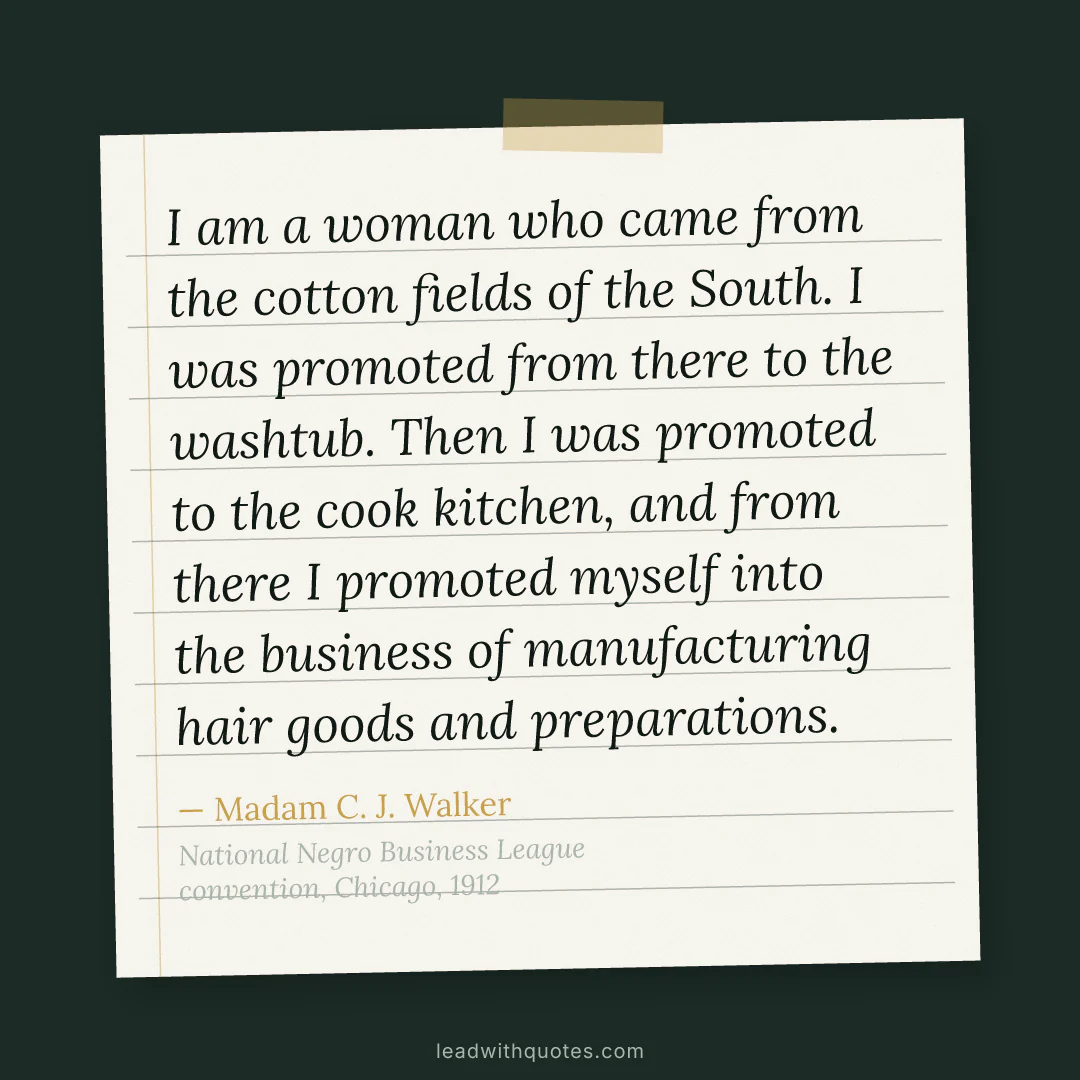
I am a woman who came from the cotton fields of the South. I was promoted from there to the washtub. Then I was promoted to the cook kitchen, and from there I promoted myself into the business of manufacturing hair goods and preparations.
Madam C. J. Walker, National Negro Business League convention, Chicago, 1912
Walker was born Sarah Breedlove in Louisiana in 1867 to parents who had been enslaved. These are the words she used to introduce herself when she took the floor uninvited, as told in the National Archives' account of her career. The sentence moves steadily from cotton fields to washtub, kitchen and factory. The verb changes only at the last step, from "was promoted" to "promoted myself", and that change is the point she was making to a room that had overlooked her. The line suits a founder's talk or a career-story post because it names each stage instead of skipping to the success.
Pairs well with: women empowerment quotes in English
You will have to anchor your authority in truth
The second pair treats leadership as a duty to tell people the facts and to take responsibility for the place you live or work.
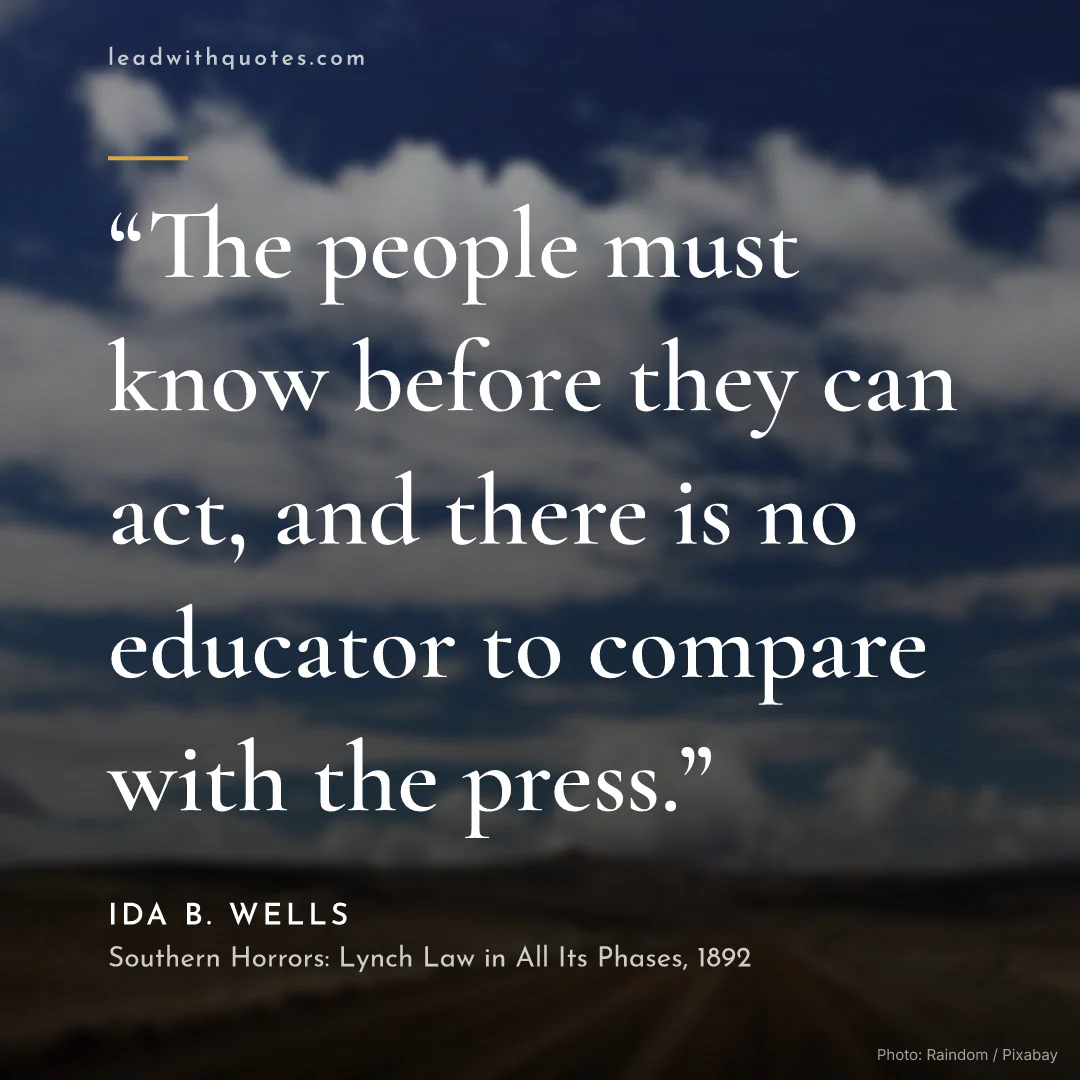
The people must know before they can act, and there is no educator to compare with the press.
Ida B. Wells, Southern Horrors: Lynch Law in All Its Phases, 1892
Wells wrote Southern Horrors in 1892. Earlier that year a mob had lynched three Black businessmen in Memphis, and after she wrote about it, the offices of her newspaper, Free Speech, were destroyed. The pamphlet was paid for by Black women in New York and Brooklyn, who held a testimonial for her on October 5, 1892. This sentence comes from the last chapter, "Self-Help", where she argues that documenting the facts has to come before any campaign. For a leader, the order matters: inform people first, then ask them to act. This is a good line for a team that is about to make a decision on incomplete information.
I've come to believe that you cannot change any society unless you take responsibility for it, unless you see yourself as belonging to it and responsible for changing it.
Grace Lee Boggs, "Revolution as a New Beginning," interview in Upping the Anti No. 1, 2005
Boggs (1915–2015) was a Chinese American philosopher and organizer who spent more than sixty years in Detroit. The interview took place at her Detroit home on July 22, 2003. Her next sentence was "I didn't know that until I met Jimmy," meaning James Boggs, the autoworker and writer she married in 1953. Many websites credit the line to her 1998 autobiography, Living for Change, but the interview is the documented source. The idea fits anyone who leads from inside an organization they did not design: you earn the right to change it by treating it as your own.
Pairs well with: how historical figures viewed authority
You are holding the door open for the next arrival
The last two lines are about what a first appointment means for the people who come next, and about not letting other people's expectations set the measure.
I do know one thing about me: I don't measure myself by others' expectations or let others define my worth.
Sonia Sotomayor, interview with Nina Totenberg, NPR, January 2013
Sotomayor became the first Hispanic justice of the U.S. Supreme Court in 2009. She said this in an NPR interview around the publication of her memoir, My Beloved World (2013), in answer to a question about affirmative action and her admission to Princeton. That context matters: she was responding to people who doubted she had earned her place. The line is often credited to the memoir itself. Credit the interview instead, which is where the wording is documented. It works well in a note to someone who has just been promoted and is hearing that they "only got it because…".
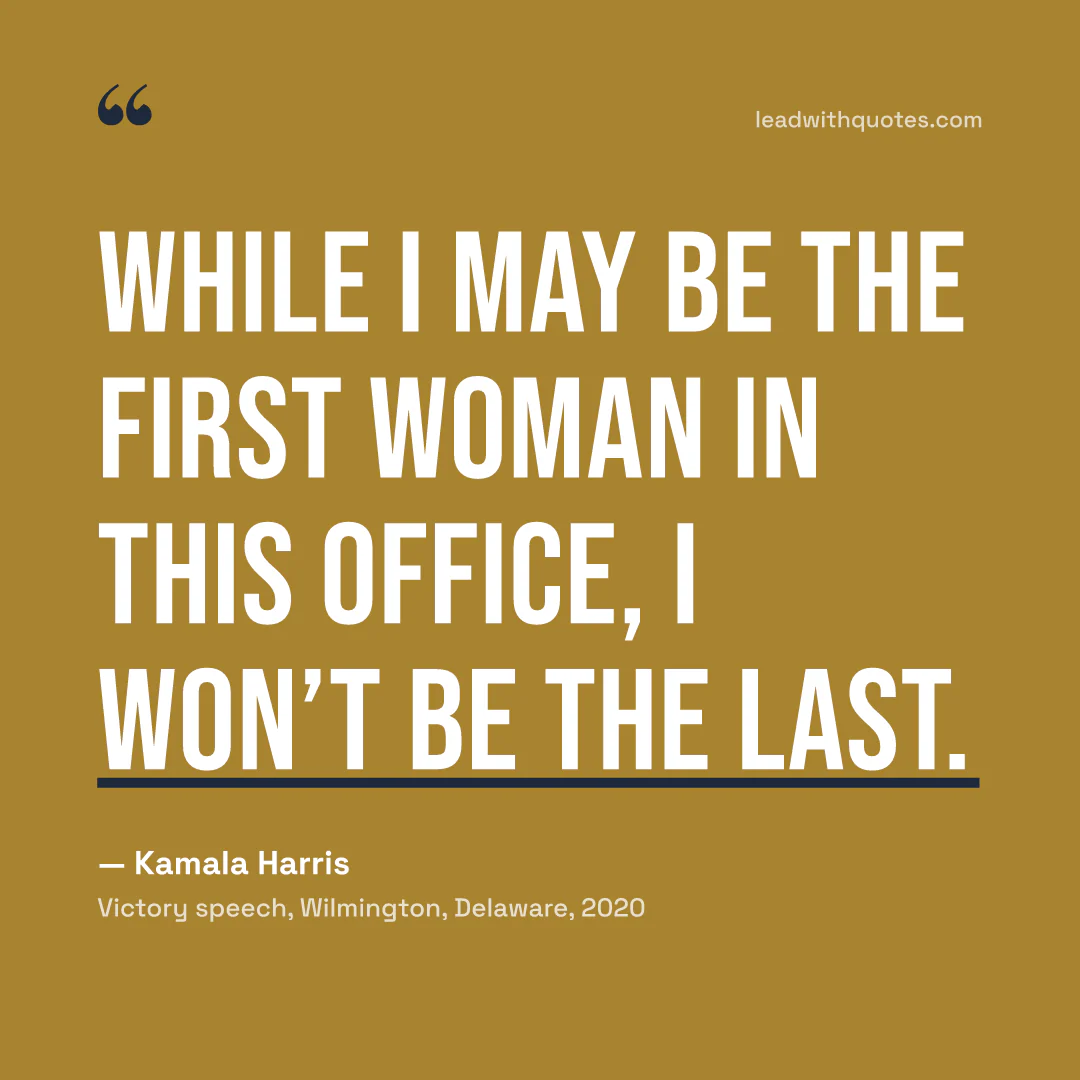
While I may be the first woman in this office, I won't be the last. Because every little girl watching tonight sees that this is a country of possibilities.
Kamala Harris, victory speech, Wilmington, Delaware, November 7, 2020
Harris gave this speech as vice president-elect, the first woman and the first Black and South Asian American elected to the office. The full transcript (PBS NewsHour) shows she said "won't". The common version, "I will not be the last", is a later tidying of the wording. The second sentence matters as much as the first. It moves the point from her own milestone to the people watching. Use the full pair when you mark a first hire, a first promotion or a first graduate in a family.
Pairs well with: short women leadership quotes for moments of doubt
The six sources at a glance
| Speaker | Role at the time | Where the line is documented | Year |
|---|---|---|---|
| Shirley Chisholm | Former congresswoman (recalled advice) | Donna Brazile in People tribute | 2005 |
| Madam C. J. Walker | Founder, Madam C. J. Walker Manufacturing Co. | National Negro Business League convention, Chicago | 1912 |
| Ida B. Wells | Journalist, co-owner of Free Speech | Southern Horrors, chapter "Self-Help" | 1892 |
| Grace Lee Boggs | Philosopher and Detroit organizer | Upping the Anti interview (recorded 2003) | 2005 |
| Sonia Sotomayor | Associate Justice, U.S. Supreme Court | NPR interview with Nina Totenberg | 2013 |
| Kamala Harris | Vice president-elect | Victory speech, Wilmington, Delaware | 2020 |
Lines that travel with the wrong source
Each of these women also has lines that circulate widely in a form the record does not support. If you are putting a quote on a slide or a poster, these are the ones to check.
- "The way to right wrongs is to turn the light of truth upon them." This is the best-known Ida B. Wells line, sometimes cited as "The Light of Truth, 1892". The Light of Truth is actually a 2014 Penguin Classics anthology of her writing. The sentence does not appear in Southern Horrors or The Red Record. It is commonly attributed to Wells, with no primary source located, so credit it that way or use the 1892 line above.
- "I had to make my own living and my own opportunity… Get up and make them." This is widely credited to Madam C. J. Walker's 1912 convention address. No documented account of that speech includes it. It is commonly attributed to her, with no primary source located.
- The folding chair line is usually printed as coming from Unbought and Unbossed (1970). Its documented trail starts in 2005, as described above.
- "I will not be the last." Harris said "I won't be the last."
Using these lines at work without flattening them
These quotes are often used for heritage-month posts, employee resource group events and mentoring notes. A few habits keep them from reading like decoration:
- Give the full name, the role and the year. "Ida B. Wells, 1892" tells the reader she was writing while her own life was under threat. A name with no date loses that.
- Match the line to the moment. Chisholm suits a conversation about who gets invited. Walker suits a career story. Wells suits a decision that needs facts first. Boggs suits change from inside an organization. Sotomayor suits someone whose promotion is being questioned. Harris suits a first.
- Don't trim the meaning away. Harris's first sentence alone is about her. The second sentence is about the girls watching. Boggs's line begins with "I've come to believe", which presents it as something she learned, not a rule handed down.
- Add one sentence of your own. Say why the line matters for this team or this person right now. A quote followed by a concrete commitment, like a named sponsor or a seat on the next panel, means more than the quote alone.
For more speeches and lines from public life, see the desk's political leadership quotes.
Common Questions, Straight Answers
Did Shirley Chisholm really say "bring a folding chair"?
The attribution is reasonable, but it rests on a recollection, not on her writing. Donna Brazile recalled Chisholm giving her this advice in People's January 2005 tribute. The line has not been traced to Unbought and Unbossed or to anything else published in Chisholm's lifetime.
Is "the way to right wrongs is to turn the light of truth upon them" a real Ida B. Wells quote?
It is widely credited to her, but no original document has been located. It does not appear in Southern Horrors (1892) or The Red Record (1895). For a line with a documented source, use "The people must know before they can act" from Southern Horrors.
Which of these quotes work for a Women's History Month or Black History Month post?
All six have documented sources, so any of them can be credited accurately. Walker's 1912 introduction and Wells's 1892 line give a historical anchor. Harris's 2020 lines suit a post about firsts. Include the year and the source as shown in the table so readers can check them.