Historical Leadership Quotes: 9 Verified Lines, and the 10 We Dropped
Nine leadership and vision quotes from Patton, Lincoln, Churchill, Shaw and more, with exact wording and sources, plus ten popular lines that fail the check.

This page used to carry twelve quotes from famous people on leadership. When we checked each one against a text, a speech or a catalogued source, five held up and seven did not. Below are those five, plus one new line from a letter every manager should know, each with the exact wording and where it sits. After them comes a short table of the seven we dropped and why, because a cut list is often more useful than a quote list: those are the lines that will otherwise end up on your slide with the wrong name under them. Further down are three lines about vision, from Shaw, Clarke and Churchill, and three popular vision quotes that carry the wrong name.
Tell them what, not how: Patton on delegation
George S. Patton's War As I Knew It was published in 1947, two years after his death. Near the end, in notes on how to run a command, he wrote a run of short rules. One of them is the line most often pasted into management decks, and it is genuinely his. The same page holds a less famous rule that makes it stronger: issuing an order is "only about 5 per cent of the responsibility of command", and the other ninety-five per cent is checking that it is carried out.
Never tell people how to do things. Tell them what to do and they will surprise you with their ingenuity.
George S. Patton, War As I Knew It (1947), notes on command, next to the entry "Issuing Orders" (full text on the Internet Archive)
Read both rules together and the line stops being a licence to disappear. Patton wants the goal stated clearly and the follow-up done personally. For a manager that means one sentence on the outcome, one date for checking in, and no instructions on method unless asked. The Drucker page covers the same ground from the management side.
Learn to follow first: Aristotle's borrowed proverb
This line is usually credited to Aristotle as if he coined it. In Book III of the Politics he is arguing that a citizen in a free state must be able both to rule and to be ruled, and he reaches for an older saying to prove it. In Benjamin Jowett's translation the sentence reads:
It has been well said that 'he who has never learned to obey cannot be a good commander.'
Aristotle, Politics, Book III, tr. Benjamin Jowett (MIT Classics archive)
Two details matter when you quote it. First, the words in quotation marks belong to a proverb Aristotle is citing, so "Aristotle said" is accurate only in the sense that he preserved it. Second, his example is practical: a cavalry commander learns the job by serving under one, an infantry commander by serving under one, and by having led a company first. It is an argument for apprenticeship, not for obedience as a virtue.
Keep an ear on the people: Woodrow Wilson, 1890
The old version of this page cited Wilson's The New Freedom (1913) for this line. That was the wrong source. It comes from "The Leaders of Men", an address Wilson gave at the University of Tennessee on 17 June 1890, when he was a professor and not yet in politics. The surrounding sentences show what he meant.
The constituent habit of a people inheres in its thought, and to that thought legislation—even the legislation that advances and modifies habit—must keep very near. The ear of the leader must ring with the voices of the people.
Woodrow Wilson, "The Leaders of Men", University of Tennessee, 17 June 1890 (text at Teaching American History)
Wilson is arguing for a leader who serves "the slow-paced daily demand" rather than playing prophet. In a workplace the equivalent is the leader who sits in the support queue or on the shop floor before announcing a change. It is a good line for a section on listening, as long as the date is 1890 and not 1913.
Ambition under orders: Lincoln to Hooker, 1863
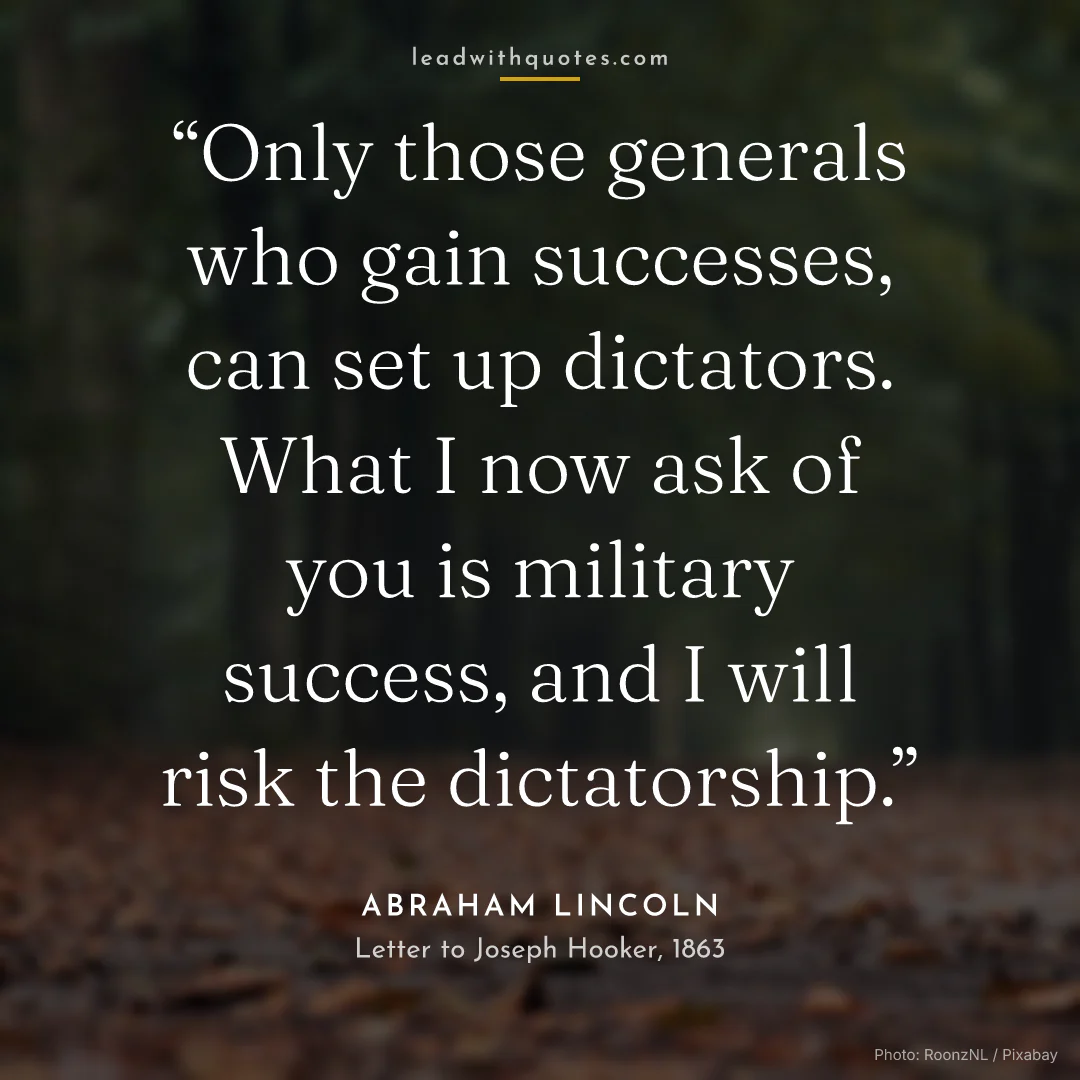
On 26 January 1863, after the Union defeat at Fredericksburg, Abraham Lincoln put Joseph Hooker in command of the Army of the Potomac and wrote him a letter that is half praise and half warning. He tells Hooker he is ambitious, which "within reasonable bounds, does good rather than harm", and then turns the word into a test.
Only those generals who gain successes, can set up dictators. What I now ask of you is military success, and I will risk the dictatorship.
Abraham Lincoln, letter to Major General Joseph Hooker, 26 January 1863 (Abraham Lincoln Online)
The letter is a model of how to correct a strong subordinate without crushing them: name the strength, name the risk it carries, state the one result you need, and say plainly what you are betting on them. Few bosses put their own risk in writing like that.
What responsibility costs: Churchill at Harvard, 1943
On 6 September 1943 Winston Churchill received an honorary degree at Harvard, a visit that followed the Quebec conference and was meant to show Anglo-American unity. He told his audience that the United States could not stand aside from the world's problems now that it had risen to its position.
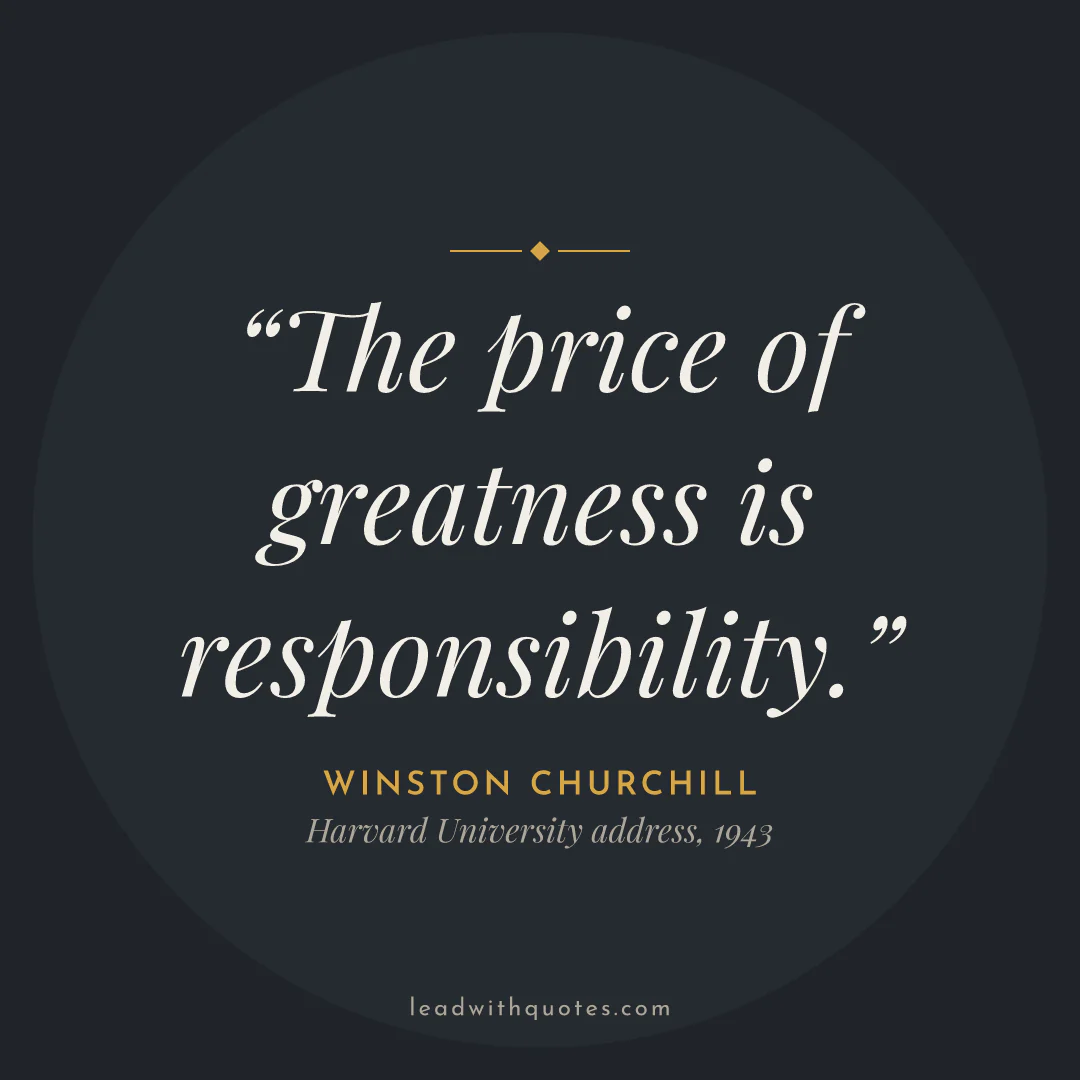
The price of greatness is responsibility. If the people of the United States had remained in a mediocre station ...
Winston Churchill, address at Harvard University, 6 September 1943 (text at ibiblio; the sentence continues past our cut)
The sentence is often used about individual leaders, but Churchill said it about a country. It still works for a team or a company that has grown into a role it did not plan for. If you need a line on owning a failure, the accountability page has twelve sourced ones.
Commanding is the harder task: Nietzsche in a dream
In "The Stillest Hour", the chapter that closes Part II of Thus Spake Zarathustra, Zarathustra describes a silent voice that tells him he has unlearned how to obey and so must now command. The voice is not flattering him. It accuses him of having the power and refusing to use it.
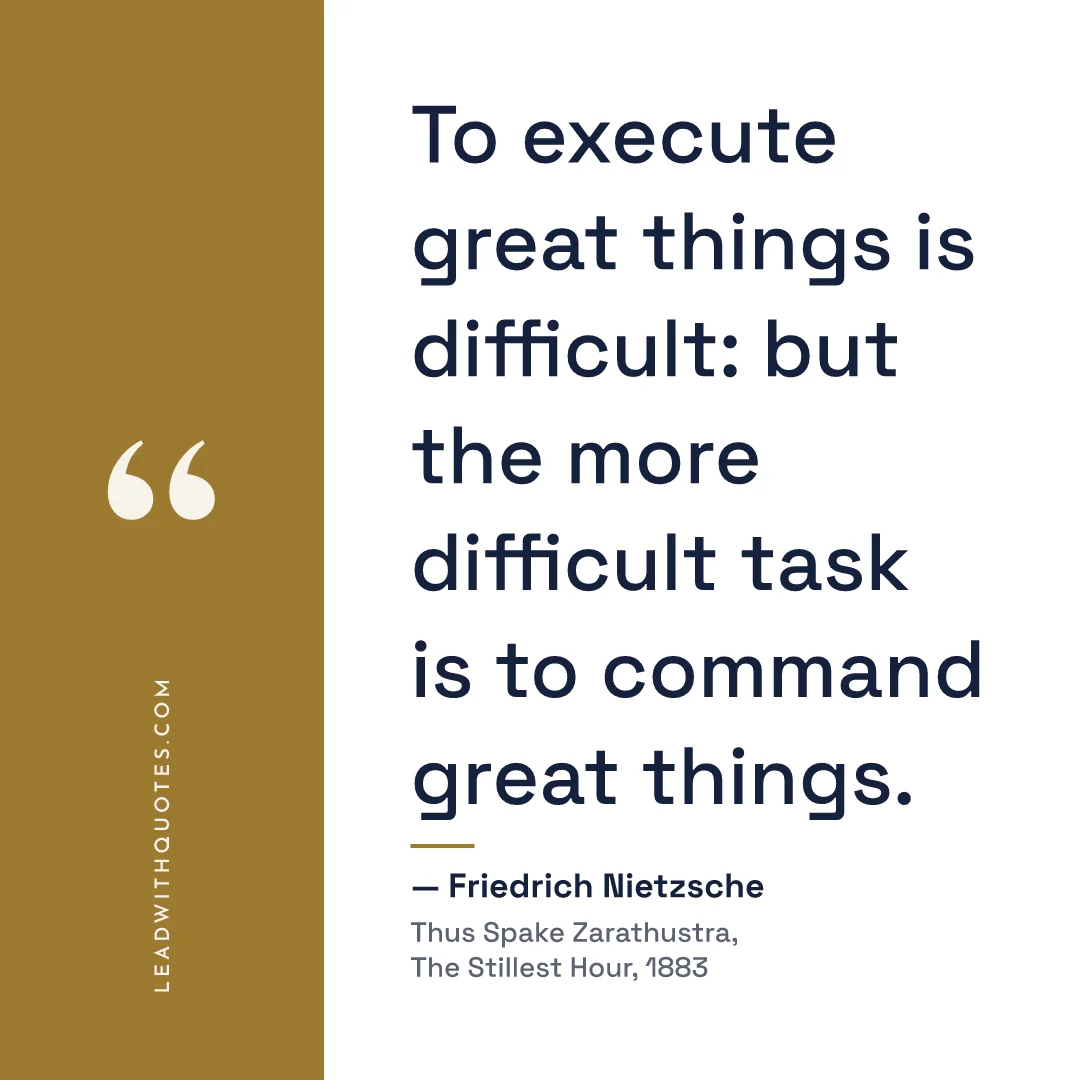
To execute great things is difficult: but the more difficult task is to command great things.
Friedrich Nietzsche, Thus Spake Zarathustra, Part II, "The Stillest Hour" (1883), tr. Thomas Common
That context changes the reading. It is a line about hesitation: knowing what ought to be commanded and being too ashamed to say so. Zarathustra's reply is "I lack the lion's voice for all commanding." It suits a talk about leaders who know the decision and delay it. Other translations word the sentence differently, so cite the translator.
Visionary lines: Shaw, Clarke and Churchill
Three more lines hold up when the question is vision rather than command: imagining what has not happened yet, going past what seems possible, and building power on ideas. Each was checked against a primary text.
Imagining what has not happened yet
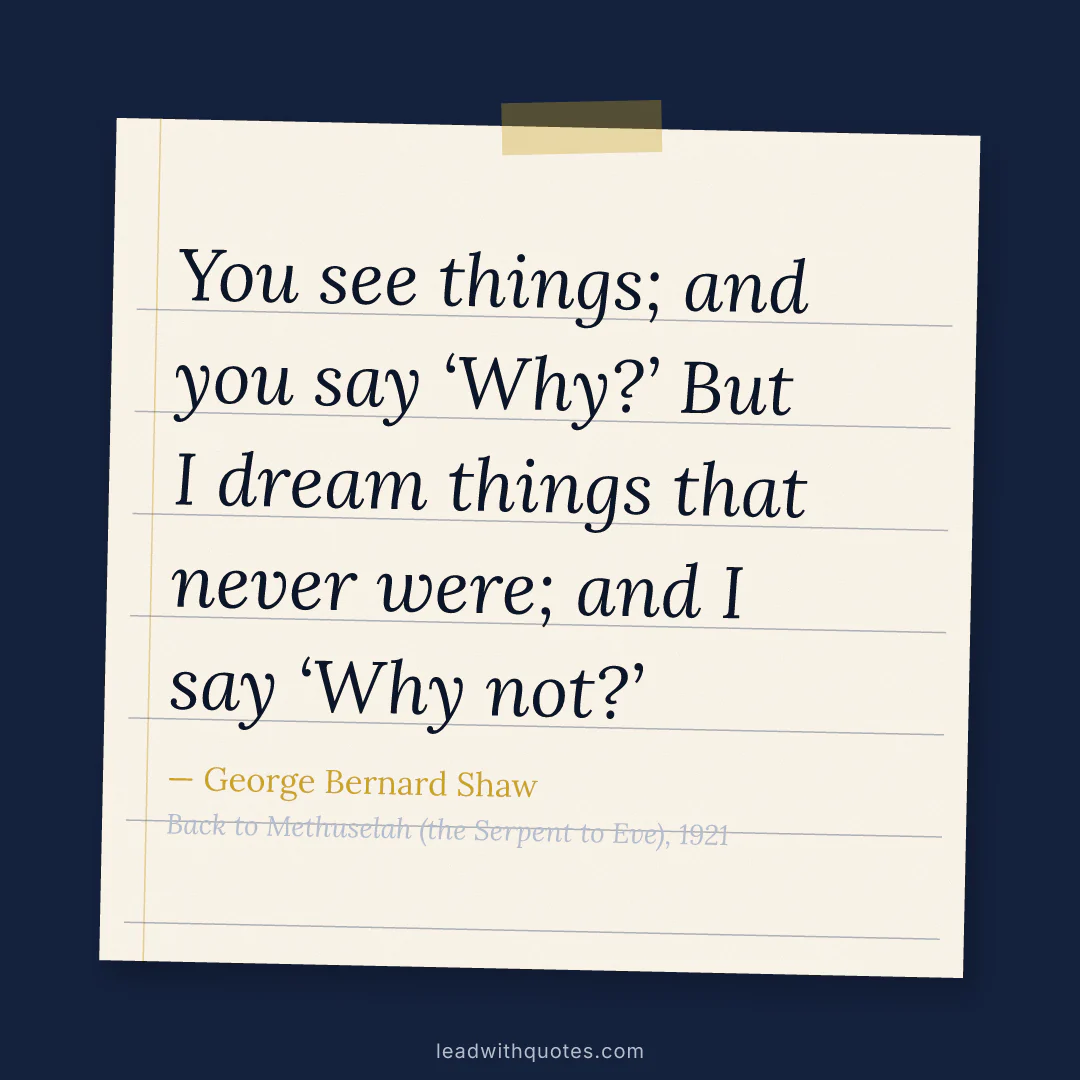
The "Why not?" line is spoken by the Serpent, not by Shaw in his own voice, and it comes from his five-play cycle Back to Methuselah. In Part I the Serpent tells Eve how it thinks, in a speech that Project Gutenberg's text of the play gives as:
When you and Adam talk, I hear you say 'Why?' Always 'Why?' You see things; and you say 'Why?' But I dream things that never were; and I say 'Why not?'
George Bernard Shaw, Back to Methuselah, Part I, 1921
Shaw wrote the preface in 1920 and published the book in 1921. The line is a good opener for a kickoff because it separates two jobs: asking why something is the way it is, and asking why it could not be different. If you quote it, use the Serpent's full words above rather than the shortened version.
Going past the edge of what is considered possible
Clarke's line is the second of the three "laws" he stated in the essay "Hazards of Prophecy: The Failure of Imagination", collected in Profiles of the Future. It is often quoted with the wrong ending ("go beyond them into the impossible"), so the exact words matter:
The only way of discovering the limits of the possible is to venture a little way past them into the impossible.
Arthur C. Clarke, Profiles of the Future, 1962
The phrase "a little way" is the useful part. Clarke is not telling anyone to bet the company on fantasy; he is saying that you only learn where a boundary is by testing a step beyond it. That fits a pilot project or a prototype better than a grand announcement, and it pairs well with the advice in our guide to leading by example, where the leader goes first.

Power that comes from ideas, not territory
Churchill said this at Harvard on 6 September 1943, when he received an honorary degree in the middle of the war. The International Churchill Society and Harvard Magazine both place it in the part of the speech about Basic English, the simplified vocabulary he wanted shared across the English-speaking countries. The sentence follows his call to "go forward in malice to none and good will to all":
The empires of the future are the empires of the mind.
Winston Churchill, address at Harvard University, 6 September 1943
Read in that setting, it is a claim about language and education as sources of influence after the war, not a general line about corporate strategy. That is still a good reason to use it when you argue for investing in skills or shared knowledge rather than assets; just do not present it as a statement about business.

Vision quotes Faulkner, Saint-Exupéry and others did not say
Three popular lines do not survive a source check. Here is what we found for each.
"You cannot swim for new horizons…" is Gide, not Faulkner
The line is credited to William Faulkner (sometimes with "Letters, 1957" attached) in quote galleries. We found no Faulkner source for it, and the Wikiquote collection of Faulkner's quotations does not include it. The thought belongs to André Gide, in The Counterfeiters (1925):
One doesn't discover new lands without consenting to lose sight, for a very long time, of the shore.
André Gide, The Counterfeiters, 1925 (French: "On ne découvre pas de terre nouvelle sans consentir à perdre de vue, d'abord et longtemps, tout rivage.")
Wikiquote also notes that this passage is frequently misquoted as "Man cannot discover new oceans unless he has the courage to lose sight of the shore" and credited to Christopher Columbus. Gide's original includes "for a very long time", which the popular versions drop; that phrase is the honest part, since it admits that the loss of the shore lasts.
"If you want to build a ship…" is a paraphrase
The popular version reads "If you want to build a ship, don't drum up the men to gather wood, divide the work, and give orders. Instead, teach them to yearn for the vast and endless sea." Quote Investigator found no close match in Saint-Exupéry's writing. The nearest passage is in Citadelle (published in English as The Wisdom of the Sands, 1948), section LXXV, which begins "Créer le navire ce n'est point tisser les toiles, forger les clous, lire les astres, mais bien donner le goût de la mer…" — roughly, "Building the ship is not weaving the sails, forging the nails or reading the stars, but giving a taste for the sea." The earliest appearance of the modern wording that Quote Investigator found is a Usenet post from November 1999. Cite the French passage, or say "adapted from Saint-Exupéry", not "Saint-Exupéry said".
The rock pile and the cathedral
"A rock pile ceases to be a rock pile the moment a single man contemplates it, bearing within him the image of a cathedral" is credited everywhere to Saint-Exupéry, sometimes to Flight to Arras (1942). We could not find the passage in a primary text or in a source that cites one, so this page does not use it as a quote. If you need the idea, the ship passage above is the sourced Saint-Exupéry text on the same theme.
The seven lines we dropped, and what we found
These all appeared on the earlier version of this page with a confident source. None could be confirmed as printed there. "Not found" means we looked at the cited work or the usual catalogues and did not locate the wording; it is not proof that nobody said it.
| Line | Credited on this page before | What we found |
|---|---|---|
| "No man will make a great leader who wants to do it all himself, or to get all the credit for doing it." | Andrew Carnegie, Autobiography, 1920 | Not among the passages catalogued from the Autobiography on Wikiquote's Carnegie page; no passage located. |
| "The task of the leader is to get his people from where they are to where they have not been." | Henry Kissinger, Years of Upheaval, 1982 | Absent from Wikiquote's Kissinger page, including its disputed section; no book citation found. |
| "The boss drives his men; the leader coaches them." | Theodore Roosevelt, 1910 convention address | Commonly credited to the retailer H. Gordon Selfridge in Mr. Selfridge's Romance of Commerce; we found no Roosevelt source for this wording. |
| "In matters of style, swim with the current; in matters of principle, stand like a rock." | Thomas Jefferson, letter to Elias Shipman, 1801 | We could not confirm the wording in that letter. Treat it as unsourced until a text turns up. |
| "Leadership is the capacity and will to rally men and women to a common purpose and the character which inspires confidence." | Bernard Montgomery, Memoirs, 1958 | Widely repeated; the earliest citation we reached was a 1975 journal, and we could not confirm it in the Memoirs. |
| "Leadership consists of picking good men and helping them do their best." | Chester Nimitz, 1948 interview | Not on Wikiquote's sourced Nimitz page. Historians do describe him as someone who picked able subordinates and let them work, so the idea fits him; the wording is unsourced. |
| "You cannot be a leader, and ask other people to follow you, unless you know how to follow, too." | Sam Rayburn, congressional remarks, 1955 | Wikiquote traces it to The Leadership of Speaker Sam Rayburn: Collected Tributes of His Congressional Colleagues (1961), p. 34, a colleague's recollection and not a 1955 speech. Credit it as recalled by colleagues. |
The Roosevelt, Carnegie and similar cases sit alongside two dozen others on our leadership quotes leaders never said page, which is the place to check a line before you print it. For commanders whose words are documented, see the military leadership quotes.
Which line for which moment
| You are writing about | Use | Cite as |
|---|---|---|
| Delegating a project | Patton, "Never tell people how to do things" | War As I Knew It, 1947 |
| Promoting someone strong and ambitious | Lincoln to Hooker | Letter, 26 January 1863 |
| Mentoring a future manager | Aristotle, "learned to obey" | Politics III, Jowett translation, as a proverb Aristotle cites |
| Listening to customers or staff | Wilson, "ear of the leader" | "The Leaders of Men", 1890 |
| A team taking on a bigger role | Churchill, "price of greatness" | Harvard, 6 September 1943 |
| A decision that keeps getting put off | Nietzsche, "command great things" | Zarathustra II, tr. Thomas Common |
Three checks before you print a historical quote
- Find the text, not the quote site. A speech archive, a full book on the Internet Archive, or a translator's edition counts. A page of quotes with no citation does not.
- Match the sentence to the source. Wilson's line is real and the 1913 book was wrong. A correct quote with the wrong source still fails a fact-check.
- Say who is speaking. Aristotle is quoting a proverb and Nietzsche is writing a character's dream. Putting the real speaker in the attribution costs a few words and avoids the quiet error.
If a line passes the first check and fails the second, fix the source and keep the line. If it fails the first, leave it out, however well it fits your slide.