Women in the Workplace Quotes: 9 Lines on Pay, Power and Being Heard, With Their Sources
Nine women in the workplace quotes from Chisholm, Woolf, Earhart, Ginsburg and more, each traced to its speech, book or letter, with tips for using them.

The most-shared quote about women at work, "No one can make you feel inferior without your consent," does not appear in Eleanor Roosevelt's own writings. What she actually said, in March 1935, was a reply to a reporter about a workplace slight: whether Frances Perkins, the first woman in a U.S. Cabinet, had been snubbed on a work trip. Her real answer is sharper than the poster version, and it is the first of the nine lines below.
This page collects nine quotes about women in the workplace that we could trace to a speech, a book, a letter or a recorded interview. Each one comes with the situation it was said in, because a line about pay reads differently once you know it was spoken on the House floor in 1969. The lines are grouped by the problem they answer: being counted, being taken seriously, taking the risk, and the pressure that comes from inside. After them you'll find a table of where each line works, some tips for using one in a talk or a note, and three popular lines whose sources don't hold up.
Counted out: lines about jobs, posts and pay
Before anyone wrote about confidence, women wrote about numbers: who got hired, who got promoted, who got paid. These two lines from Shirley Chisholm are blunt for a reason.
More than half of the population of the United States is female. But women occupy only 2 percent of the managerial positions.
Shirley Chisholm, remarks introducing the Equal Rights Amendment, U.S. House of Representatives, May 21, 1969
Chisholm had been in Congress for less than five months when she gave this speech for the Equal Rights Amendment. She opened with a young woman graduating from college and looking for her first job, who "is likely to have a frustrating and even demeaning experience ahead of her." The 2 percent figure was the 1969 number; it is not today's. The line still works as a model: one fact, one comparison, and no adjectives. If you use it, keep the year next to it, so nobody takes the number for a current statistic.
Tremendous amounts of talent are being lost to our society just because that talent wears a skirt.
Shirley Chisholm, Unbought and Unbossed, 1970
Chisholm's autobiography came out the year after the House speech. In it she argued that sex discrimination was something she had felt in politics more than racial discrimination. The sentence makes a cost argument, not a fairness one: the loss falls on "our society," not only on the woman passed over. That is why managers and HR leads find it useful. It turns a diversity slide into a talent question.
Shrunk in the room: lines about being taken seriously
Small slights at work are hard to answer in the moment. The next two lines come from women who answered them in public.
A snub is the effort of a person who feels superior to make someone else feel inferior. To do so, he has to find someone who can be made to feel inferior.
Eleanor Roosevelt, answering reporters, Associated Press report of March 26, 1935
Reporters asked the First Lady about Frances Perkins, the Secretary of Labor, and a Charter Day speech at the University of California, Berkeley. The person who usually hosted the speaker had declined to host her. Roosevelt didn't say whether Perkins had been snubbed. She explained how a snub works, and in doing so took it apart. Quote Investigator traced the polished line "No one can make you feel inferior without your consent" to Reader's Digest in September 1940, five years later. It ran there with Roosevelt's name and no source. The 1935 version is longer, but it is hers, and it gives the snubbed person the last word.
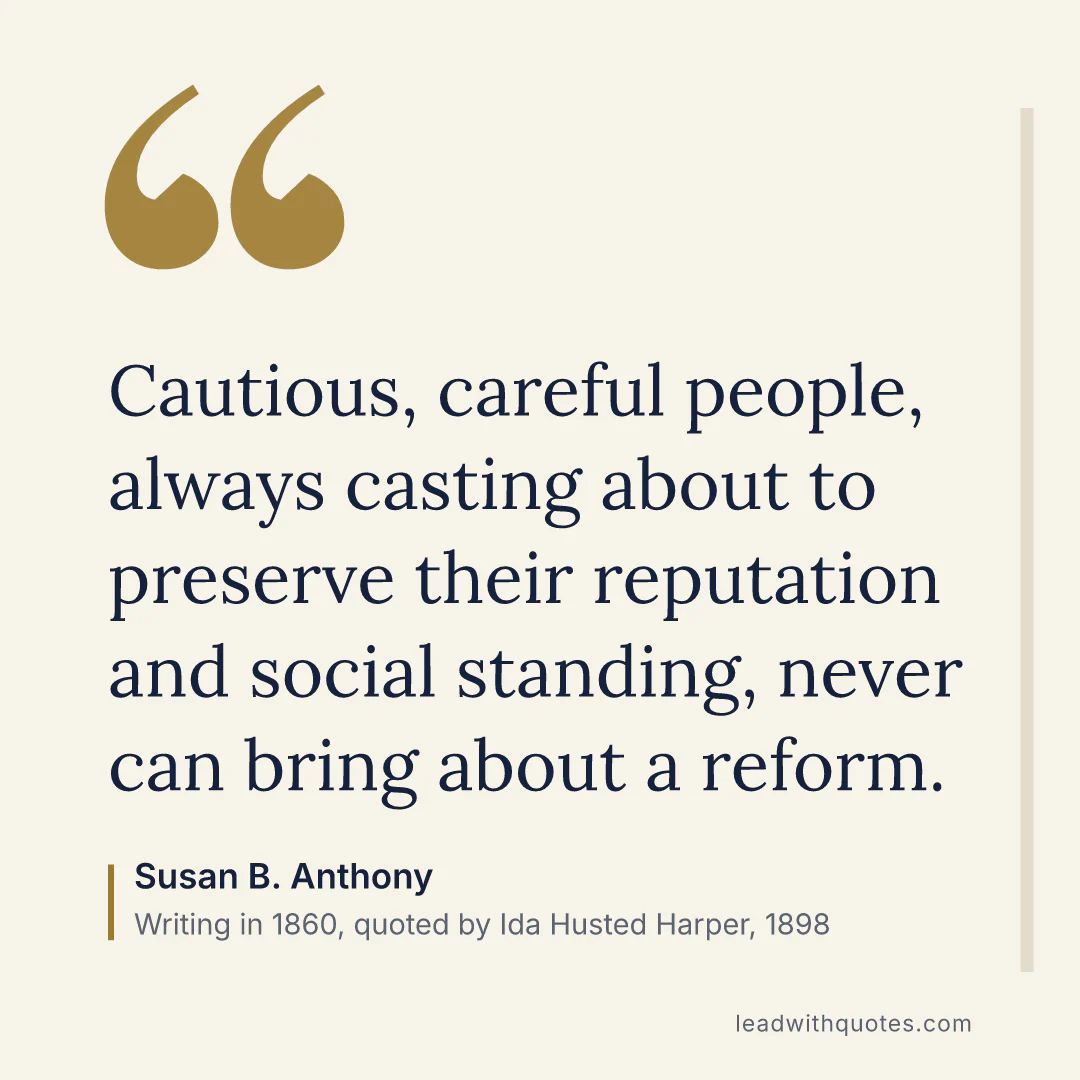
Cautious, careful people, always casting about to preserve their reputation and social standing, never can bring about a reform.
Susan B. Anthony, writing in 1860, quoted in Ida Husted Harper, The Life and Work of Susan B. Anthony, vol. 1, 1898
Older versions of this page dated the line to an 1860 "speech in Chicago." Harper's authorized biography, which reprints it in chapter XII, places it during the 1860 fight over divorce reform. Allies had urged Anthony and Elizabeth Cady Stanton to drop that subject because it was hurting their reputation. The next sentence says that people who are "really in earnest must be willing to be anything or nothing in the world's estimation." Use it when someone tells a colleague to wait for a better moment. It is not meant as a slogan for being rude.
Taking the risk anyway: lines about ambition
Please know that I am aware of the hazards. I want to do it because I want to do it. Women must try to do things as men have tried. When they fail, their failure must be a challenge to others.
Amelia Earhart, letter to George P. Putnam before her last flight, printed in Last Flight, 1937
Earhart left this letter for her husband before the 1937 round-the-world flight she did not return from. He printed it in Last Flight, the book he put together from her notes that year. Popular versions add a "but" ("must be but a challenge"), and a lot of posters cut the first two sentences. Keep them in. "I want to do it because I want to do it" is the part of the letter that sounds like a person rather than a monument. It suits anyone taking a role others think is too big for them. The failure sentence is generous: it treats a woman's setback as a starting point for the next woman, not a verdict on all of them.
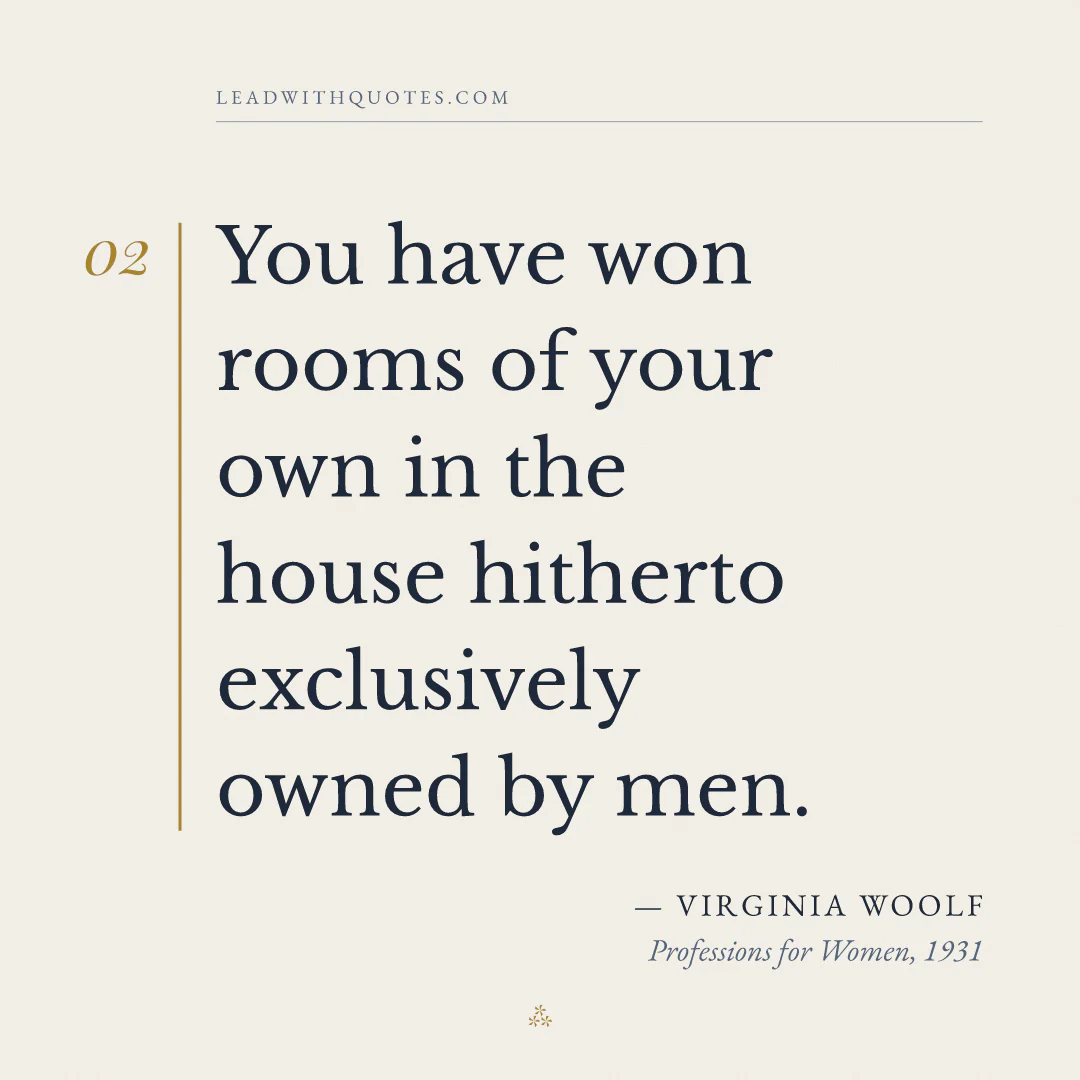
You have won rooms of your own in the house hitherto exclusively owned by men. You are able, though not without great labour and effort, to pay the rent.
Virginia Woolf, "Professions for Women," paper read to the Women's Service League, London, January 1931
Woolf's hosts were, in her words, a society "concerned with the employment of women." She was asked to talk about her own career as a writer. The text was published after her death in The Death of the Moth and Other Essays (1942). The rooms image looks back to A Room of One's Own (1929): by 1931 her audience held the professions that book had asked for. Her next sentence reads: "But this freedom is only a beginning." It is a good line for a promotion note or an anniversary toast for a women's network, because it marks progress without calling the work finished.
The pressure that comes from inside
Some of the hardest obstacles at work are the expectations a woman carries in with her. Two very different women said this out loud.
Killing the Angel in the House was part of the occupation of a woman writer.
Virginia Woolf, "Professions for Women," 1931
The "Angel in the House" was the ideal Victorian wife from Coventry Patmore's poem: sympathetic, self-sacrificing, never holding an opinion of her own. In the same 1931 talk, Woolf said this Angel came between her and the page whenever she reviewed a book by a man, urging her to flatter and soothe. She treats her own politeness as a job hazard. The second problem she named, "telling the truth about my own experiences as a body," she admitted she had not solved. Quote the Angel line to someone who keeps softening their own feedback until there's nothing left in it.
I don't think women can have it all. I just don't think so. We pretend we have it all.
Indra Nooyi, in conversation with David Bradley, Aspen Ideas Festival, 2014
Nooyi was PepsiCo's chief executive when she said this on stage. It was widely reported and debated afterward, partly because she also said, "If you ask our daughters, I'm not sure they will say that I've been a good mom." It is not an inspirational line, and that is why it belongs here. Use it to open an honest conversation about workload and caregiving, not as a caption over a sunrise.
Changing the place, not just surviving it
Fight for the things that you care about, but do it in a way that will lead others to join you.
Ruth Bader Ginsburg, remarks on receiving the Radcliffe Medal, Harvard, May 29, 2015
Ginsburg was 82 and was asked what advice she would give young women. This sentence was her answer. At the same event she described the goal of her equality cases as getting "at a stereotype that held women back from doing whatever their talent would allow them to do." The second half of the sentence is what makes it a leadership line rather than a protest line. Persuading people is part of the fight. Leave the "but" in when you quote it.

Where each line works
| Line (short form) | Speaker, source | Fits best |
|---|---|---|
| "…only 2 percent of the managerial positions" | Chisholm, House of Representatives, 1969 | A data slide on representation (keep the year) |
| "…that talent wears a skirt" | Chisholm, Unbought and Unbossed, 1970 | Hiring and promotion talks; the business case |
| "A snub is the effort of a person who feels superior…" | Eleanor Roosevelt, AP, 1935 | Mentoring after a public slight |
| "Cautious, careful people… never can bring about a reform" | Susan B. Anthony, 1860 (Harper, 1898) | Backing a colleague who raised an unpopular issue |
| "Women must try to do things as men have tried" | Amelia Earhart, letter, 1937 | A first-of-her-kind appointment or a stretch role |
| "You have won rooms of your own…" | Virginia Woolf, 1931 | Women's network anniversaries; promotion notes |
| "Killing the Angel in the House…" | Virginia Woolf, 1931 | Feedback and assertiveness workshops |
| "I don't think women can have it all" | Indra Nooyi, Aspen, 2014 | Panels on caregiving and workload |
| "Fight for the things that you care about…" | Ruth Bader Ginsburg, 2015 | Kickoffs for an employee group or a policy campaign |
Putting a line to work
A quote at work needs to be correct and easy to read. These habits help:
- Credit the source with three things: name, where it was said, and year. "Virginia Woolf, 'Professions for Women,' 1931" fits on a slide and answers the person who asks, "Did she really say that?"
- Don't cut what changes the meaning. Ginsburg's "but" and Earhart's "I want to do it because I want to do it" are the point of those lines. Margaret Thatcher's well-known "if you want anything done, ask a woman" starts with "In politics." We cover that line and Madeleine Albright's "special place in hell" on our page of short women leadership quotes.
- Put old statistics in their own decade. Chisholm's 2 percent belongs to 1969. Put the year on the slide.
- Match the line to the job it has to do. A promotion note should celebrate, so use Woolf or Earhart. After a bad meeting, Roosevelt's 1935 answer helps more than a pep talk.
Three short examples:
- For a colleague's promotion: "Woolf told a room of working women in 1931, 'You have won rooms of your own in the house hitherto exclusively owned by men.' This one is yours. Well earned."
- After a meeting where someone was talked over: "Eleanor Roosevelt once explained that a snub 'has to find someone who can be made to feel inferior.' It didn't find one today. Your numbers were the best thing in that room."
- Opening a women's network event: "Ruth Bader Ginsburg's advice was to fight for what you care about 'in a way that will lead others to join you.' That's what tonight is for."
For pay and recognition, our page of valuable woman quotes from women writers traces lines from Austen to Keller, with notes on who really said them.
Three popular lines with a weak source
"No one can make you feel inferior without your consent." As explained above, this first appeared in Reader's Digest in 1940, credited to Roosevelt, and it is not in her autobiography This Is My Story (1937), where older versions of this page placed it. Quote the 1935 answer, or call the short line "attributed to Eleanor Roosevelt."
"If they don't give you a seat at the table, bring in a folding chair." This is often credited to Chisholm's 1970 book, but the earliest record Quote Investigator found is Donna Brazile recalling Chisholm's advice in People in January 2005, after Chisholm died. It is good secondhand evidence, so credit it as "as recalled by Donna Brazile." Our page of leadership quotes by women of color gives the full version.
"I am deliberate and afraid of nothing." This line is everywhere under Audre Lorde's name. Older versions of this page cited "New Year's Day, 1989," but we could not match that title and date to a published Lorde text, so we took it out. Until someone gives the page number, call it "attributed." Our list of leadership quotes leaders never said tracks more lines like these.
Near the end of her 1931 talk, Woolf added a qualification, not a slogan: "the room is your own, but it is still bare." Most of the lines above work the same way. They record what has been won and point to what is still left to do.