Start With Why Quotes: 13 Simon Sinek Lines, and How to Write Your Own Why
Thirteen Simon Sinek quotes on purpose and communication, checked against Start With Why and Find Your Why, plus a step-by-step way to write your own Why.

On 17 September 2009, at TEDxPugetSound, Simon Sinek sketched three nested circles and spent about eighteen minutes on the one in the middle. The talk, posted on TED.com in May 2010 as "How great leaders inspire action", has since passed 70 million plays. His book Start With Why came out with Portfolio the same year, and most of the lines people now share as "Simon Sinek quotes on purpose" come from those two sources.
This page does two jobs. It gives ten of those lines with the chapter or talk they come from, checked against the 2009 Portfolio edition, the 2017 follow-up Find Your Why and the TED transcript. Then it uses them as a worksheet: the steps Sinek and his co-authors describe for turning a vague sense of purpose into one sentence you can actually use. It is one part of our wider set of Simon Sinek quotes.
The sentence everyone quotes, and where it sits
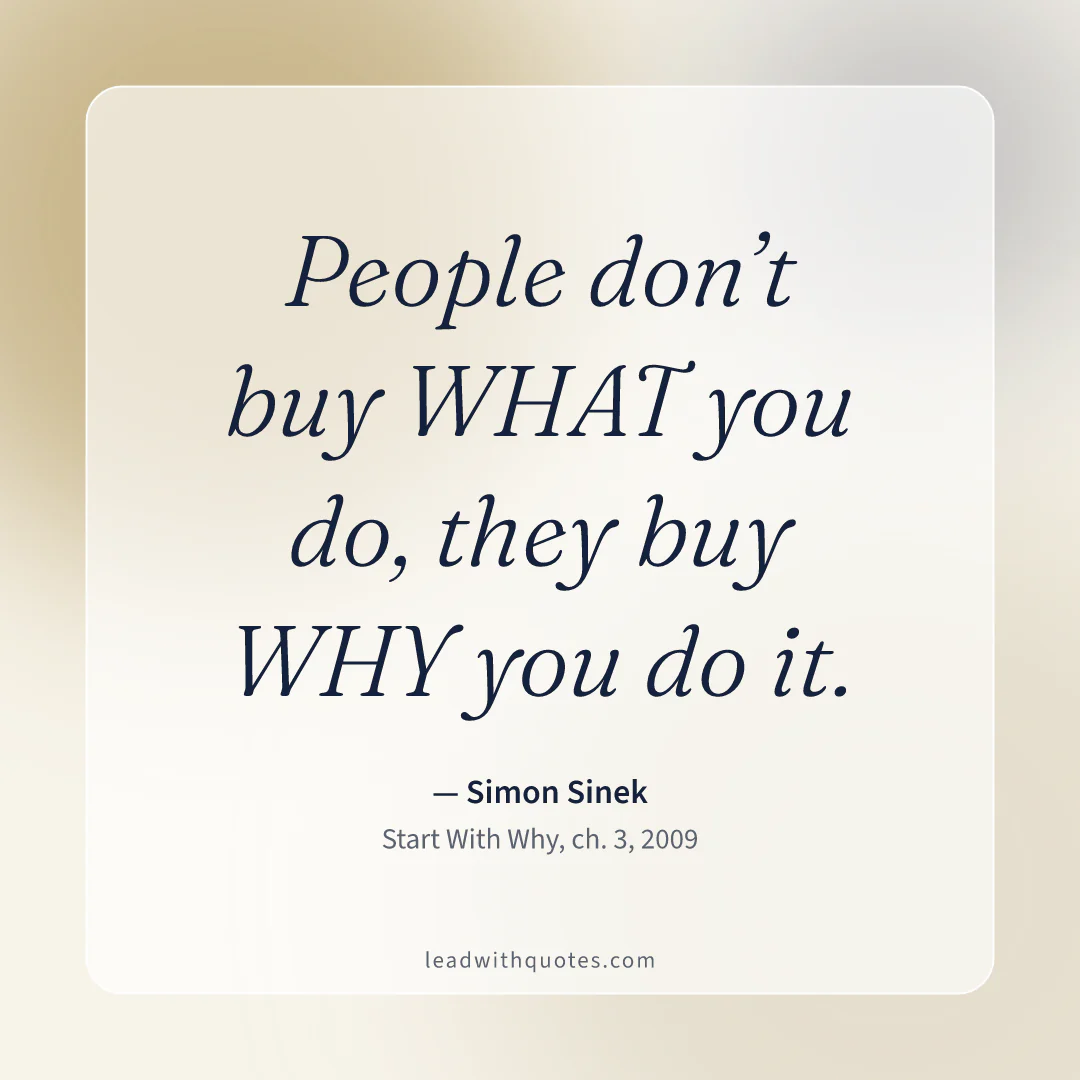
People don't buy WHAT you do, they buy WHY you do it.
Simon Sinek, Start With Why, ch. 3 "The Golden Circle", 2009
In the book the line appears in the Apple section of chapter 3, and Sinek immediately writes "It's worth repeating" and prints it again. The capitals are his: WHAT, HOW and WHY are the names of the three circles, so the sentence is a compressed version of the whole model. In the TED talk he says it with a semicolon, "People don't buy what you do; they buy why you do it", and adds in one of its repetitions that "what you do simply proves what you believe." Quote either version, but name the one you use: the book wording for a printed source, the talk for a slide or a video caption.
Read it as a claim about loyalty, not as permission to neglect the product. In the model the WHAT is the proof of the WHY, so a product that fails proves the opposite of what the company says it believes.
What Sinek means by WHY, in his own definitions
Most misreadings of the model start with treating WHY as a slogan. Sinek defines it twice, and both definitions are short enough to pin above a desk.
By WHY I mean what is your purpose, cause or belief? WHY does your company exist? WHY do you get out of bed every morning? And WHY should anyone care?
Simon Sinek, Start With Why, ch. 3, 2009
The sentence just before this one in the book matters as much: "When I say WHY, I don't mean to make money — that's a result." Profit, growth and awards belong in the outer circle. If a draft purpose statement could be satisfied by a bigger number, it is still a WHAT.
A WHY is just a belief. That's all it is. HOWs are the actions you take to realize that belief. And WHATs are the results of those actions.
Simon Sinek, Start With Why, ch. 5 "Clarity, Discipline and Consistency", 2009
Chapter 5 is where the model becomes a management tool rather than a marketing one. Clarity of WHY, discipline of HOW and consistency of WHAT have to line up; Sinek repeats the belief/actions/results definition in chapters 6 and 8 because the rest of the book depends on it.
| Circle | Sinek's definition | Question to ask your team | Common mistake |
|---|---|---|---|
| WHY | "Purpose, cause or belief" | What would we still believe if this product line disappeared? | Writing a revenue goal or a market position |
| HOW | "The actions you take to realize that belief" | Which two or three behaviours make us different in practice? | Listing values nobody can be held to ("integrity", "excellence") |
| WHAT | "The results of those actions" | Does each product, hire and campaign prove the belief? | Starting every pitch here |
Step 1: Look backward, not at the market
The natural instinct is to find a purpose the way you would find a market: by surveying customers. Sinek argues the opposite in the second-to-last chapter.
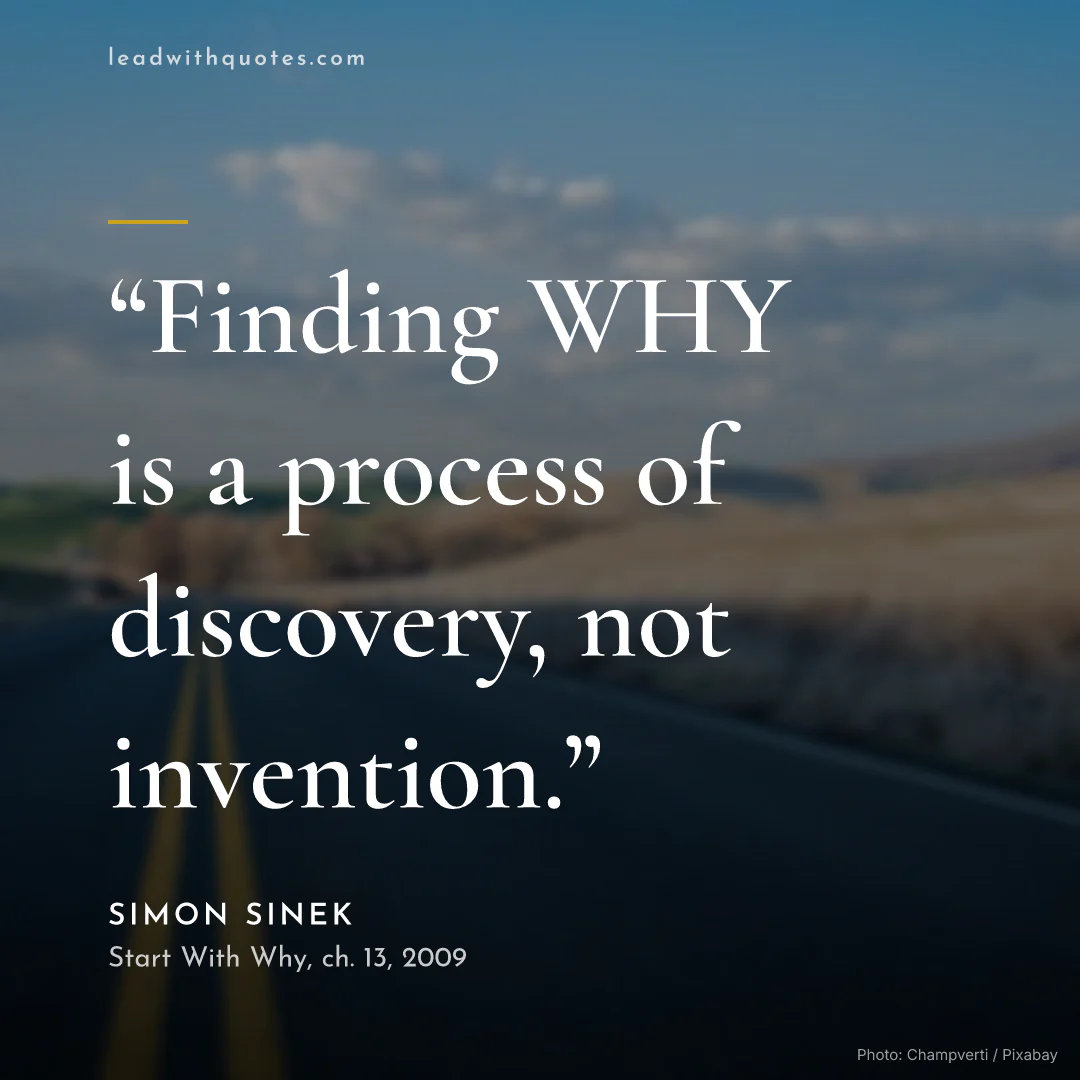
Finding WHY is a process of discovery, not invention.
Simon Sinek, Start With Why, ch. 13 "The Origins of a WHY", 2009
Sinek sets it up with an archer's image: an arrow has to be pulled backward before it can fly forward. The WHY, he writes, "is not born out of any market research"; it is "born out of the upbringing and life experience of an individual or small group." In practice that means collecting specific stories: moments at work or before it when you felt most useful, and moments that made you angry because something mattered. Find Your Why (2017), written with David Mead and Peter Docker, turns this into an exercise and insists on detail; a story you can only summarise in one line will not give you anything to work with.
Regardless of WHAT we do in our lives, our WHY — our driving purpose, cause or belief — never changes.
Simon Sinek, Start With Why, ch. 8 "Start with WHY, but Know HOW", 2009
This is the test that separates a WHY from a job description. In the same passage Sinek says developing software was "merely one of the things" Bill Gates did to bring his cause to life, and an airline was the vehicle for Herb Kelleher's. If your draft would have to be rewritten when you change roles, it describes the role.
Step 2: Fill in "To ___ so that ___"
Find Your Why reduces the statement to a single sentence with two blanks. The first blank is "the contribution you make to the lives of others"; the second is "the impact of your contribution." The authors ask that the sentence be:
- simple and clear;
- actionable;
- focused on the effect you'll have on others;
- expressed in affirmative language that resonates with you.
To inspire people to do the things that inspire them so that, together, we can change our world.
Simon Sinek's Why Statement, as given in Find Your Why, ch. 2, 2017
The book uses Sinek's own statement as the worked example. The second half, "change our world", is broad on purpose; the authors point out that it is the first half, the contribution, that tells him what to do on a Monday morning. Two group statements the book offers as correctly formed are "To believe in people so that they can, in turn, believe in themselves" and "To provoke people to think differently so that they can be awakened to new possibilities."
The drafts below are our own illustrations of the most common problems, rewritten against those four criteria.
| Draft | What is wrong | Rewrite |
|---|---|---|
| To be the leading provider of payroll software in Europe | A market position: a WHAT, and about us, not others | To take the worry out of payday so that small teams can spend their energy on the work they started the company for |
| To deliver excellence and integrity in everything we do | Values, not a contribution; nobody can act on it on Monday | To tell people the hard truth early so that they can make decisions while they still have options |
| To finish every project on time so that I get promoted | The impact serves only the writer (Find Your Why uses a similar example as a warning) | To bring order to messy projects so that the people on them can do their best work without burning out |
Step 3: Test it on hiring, trust and workload
A statement that only lives on a slide has not been tested. Three of Sinek's lines work as checks.
If you hire people just because they can do a job, they'll work for your money, but if they believe what you believe, they'll work for you with blood and sweat and tears.
Simon Sinek, "How great leaders inspire action", TEDxPugetSound, 17 September 2009
He says this in the talk right after "The goal is not just to hire people who need a job; it's to hire people who believe what you believe." Chapter 6 of the book makes the same point through Ernest Shackleton's Antarctic crew. The check: could a candidate tell from your job advert what you believe?
Trust begins to emerge when we have a sense that another person or organization is driven by things other than their own self-gain.
Simon Sinek, Start With Why, ch. 6 "The Emergence of Trust", 2009
This is the line to remember when a purpose statement is drafted mainly to improve an employer brand. If the second blank of your sentence benefits only the company, the statement will not earn the trust the chapter describes. Sinek's later work on teams develops the same idea; our page on Simon Sinek quotes on teamwork and trust collects those lines.
Working hard for something we don't care about is called stress. Working hard for something we love is called passion.
Simon Sinek, Together Is Better: A Little Book of Inspiration, 2016
This line comes from the illustrated 2016 book, not from Start With Why, though quote sites often credit it to the earlier one. It works as a workload check: when a team's hours go up and morale goes down, ask whether people still know what the extra effort is for.
Keeping the WHY clear after the founder
Part 5 of Start With Why is titled "The Biggest Challenge Is Success." Chapters 11 and 12, "When WHY Goes Fuzzy" and "Split Happens", follow Wal-Mart from Sam Walton's single store in Bentonville, Arkansas, to the years after his death, and compare it with Costco, which Sinek says kept its WHY clear while its co-founder Jim Sinegal was still running it. The closing chapter puts the lesson in one sentence.
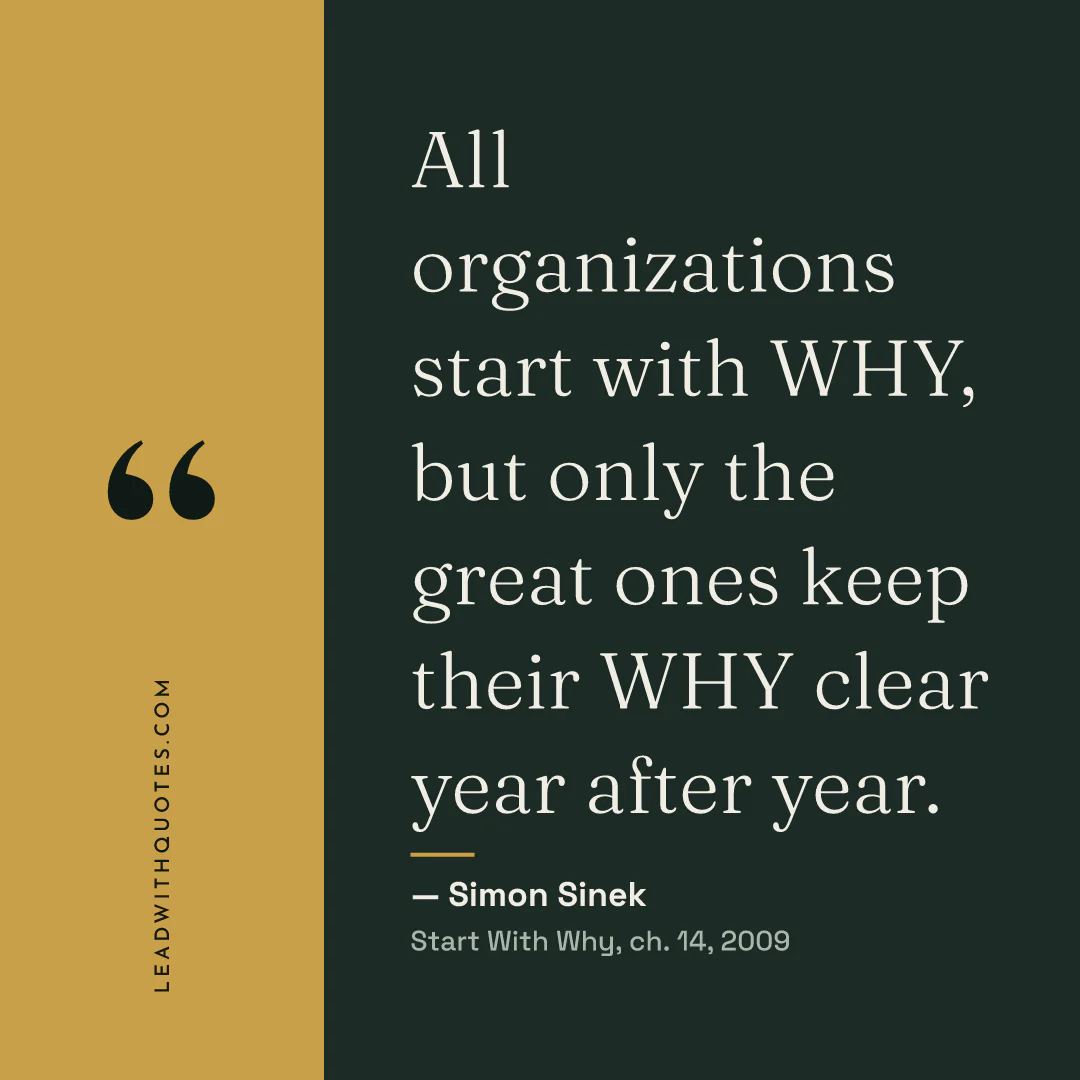
All organizations start with WHY, but only the great ones keep their WHY clear year after year.
Simon Sinek, Start With Why, ch. 14 "The New Competition", 2009
For a leader, the practical version is a yearly question: which decisions this year would the founding team not recognise, and were they changes of WHAT or of WHY? The first kind is healthy. The second is the fuzziness chapter 11 warns about.
What Start With Why says about communication
The book is mostly about purpose, but three passages are about how leaders talk to the people they lead. They are worth quoting together because they make the same point from three sides: the message only counts once one person has heard it.
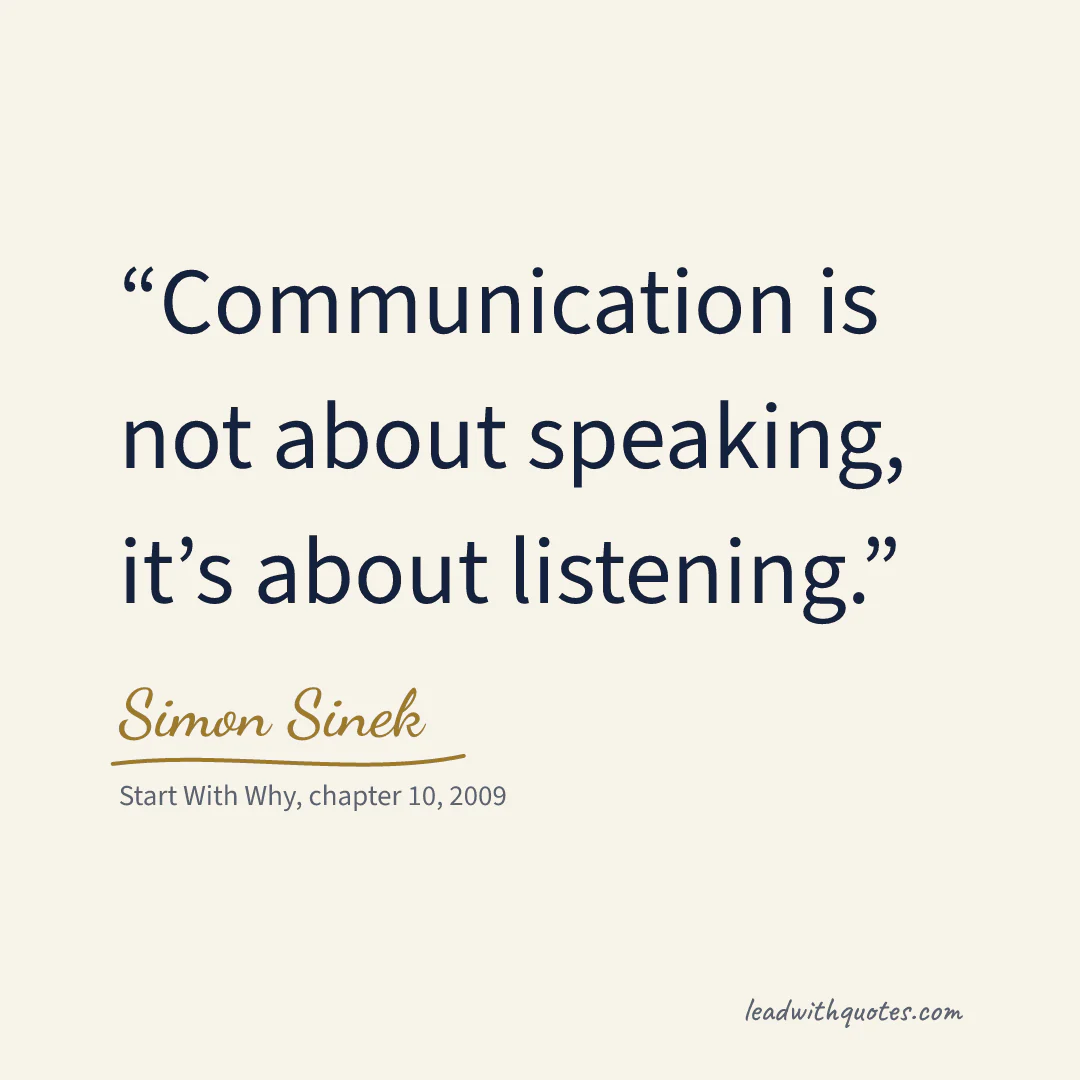
Communication Is Not About Speaking, It's About Listening
Simon Sinek, Start With Why, 2009 (title of chapter 10)
This is a chapter title, not a sentence from the text, so quote it as the title. It puts the work on the speaker: if the team did not hear it, it was not communicated.
What changes is who is talking to us, but it is always a single individual who is listening. Even when a company airs its message on TV, for example, no matter how many people see the commercial, it is always and only an individual that can receive the message.
Simon Sinek, Start With Why, 2009
Sinek wrote this about advertising. It carries straight over to the all-staff email: the list may hold ten thousand names, but each message still lands on one person at a time.
Trust is maintained when the values and beliefs are actively managed. If companies do not actively work to keep their Golden Circle in balance — clarity, discipline and consistency — then trust starts to break down.
Simon Sinek, Start With Why, 2009
This is the passage to use when a team has stopped believing announcements. Sinek's three words map onto the steps above: clarity is the WHY, discipline is the HOW, consistency is whether the WHAT matches both.
Purpose lines that are not in Start With Why
We searched the full 2009 text for each of these. None of them is in it.
- "A clear sense of purpose enables us to focus our efforts on what matters most…" Often captioned as Sinek and Start With Why. It is not in the book, and we found no talk or post where he says it.
- "There is a difference between giving directions and giving direction." Widely shared as Sinek's, but it is not in Start With Why and we could not trace it to a dated primary source. Credit it as "commonly attributed to Simon Sinek" if you use it.
- "Happy employees ensure happy customers." It is in the book, but Sinek is quoting Herb Kelleher of Southwest Airlines (ch. 6, sourced to Kevin and Jackie Freiberg's Nuts!, 1998). Credit Kelleher.
- "Leadership is not about being in charge…" A real Sinek line, but from his later talks, not this book. We trace it in our explainer on that quote.
Where the model is weaker
Chapter 4 is titled "This Is Not Opinion, This Is Biology" and maps the circles onto the brain: the neocortex for WHAT, the limbic brain for HOW and WHY. Treat that as a metaphor. Brain science does not split decisions so neatly, and you do not need the biology to use the model. The book's best-known cases (Apple, the Wright brothers, Martin Luther King Jr.) are also chosen with hindsight; plenty of organisations with a clear WHY still failed. The model is a good tool for clear communication and a good filter for decisions, and Sinek's sequel Leaders Eat Last moves the focus from customers to the people inside the organisation.
If you want one exercise to take away, write down three specific moments when your work felt most worth doing, then fill in "To ___ so that ___" from them, and show the sentence to someone who has watched you work. If they recognise you in it, you have a draft. For lines on the behaviour that has to follow, see our lead by example quotes.