Teamwork Quotes for Work: 11 Lines With Real Sources, Matched to What Your Team Is Going Through
11 teamwork quotes for work, from Babe Ruth to Ed Catmull, each traced to its source, sorted by situation, plus 8 popular lines that don't check out.
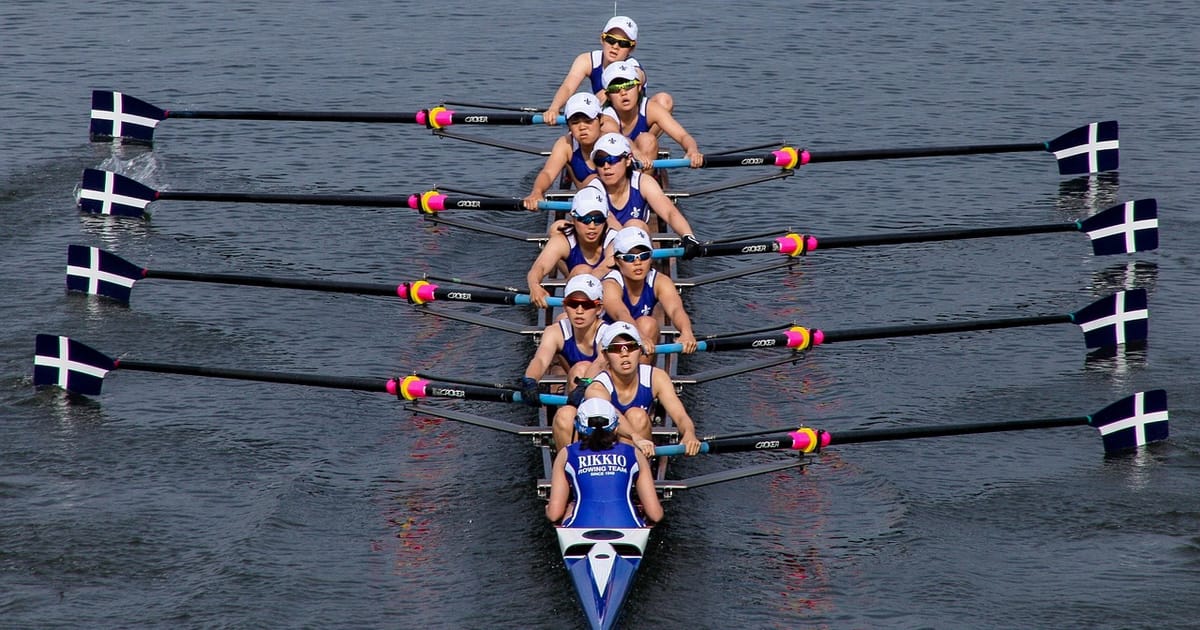
When "teamwork" entered English in the 1820s, it meant work done by a team of horses or oxen; the sense of people pulling together came later, from American baseball writing of the 1880s (Etymonline). The best teamwork quotes for work still say what the old word did: nobody moves the load alone. This page gives you 11 teamwork quotes for work, each traced to the book, speech, interview or article it comes from, sorted by the situation your team is in: short lines for a slide, a star who carries everything, teams stuck in silos, high-stakes work. After them comes a table that matches a line to each stage of a team's life, a short guide to posting one without sounding like a poster, and eight popular teamwork lines whose names or wording don't hold up.
Teamwork in one line: the definition managers actually use
If you need one sentence that says what a team is, use the one most management courses still start from. It comes from two McKinsey consultants, written up from the research behind their book The Wisdom of Teams, and it ran in the Harvard Business Review.
A team is a small number of people with complementary skills who are committed to a common purpose, set of performance goals, and approach for which they hold themselves mutually accountable.
Jon R. Katzenbach and Douglas K. Smith, "The Discipline of Teams," Harvard Business Review, March–April 1993
It is not a pretty line, and that is why it works in a kickoff deck. Each phrase is a test you can run on your own group: are the skills actually different, is the purpose shared, do people hold each other to account, or only report to the boss? Katzenbach and Smith's point was that most "teams" at work are working groups with a team label. Read it out at the start of a project, then ask which of the five parts is weakest. If accountability is the gap, our page of accountability quotes for the workplace picks up from here.
Short teamwork quotes for a slide, a channel topic or a team shirt
These three are old, short and public domain, so you can print them anywhere. Each is given in a named translation, because the wording changes from one to the next.
All for one, one for all.
Alexandre Dumas, The Three Musketeers (1844), Chapter IX; French: "Tous pour un, un pour tous"
In the novel the motto is not ancient tradition. D'Artagnan proposes it on the spot, after he has dragged Athos, Porthos and Aramis into covering his debts and his quarrels, and the four repeat it "with one voice" (Wikisource, ch. 9). Keep Dumas's order, all for one first. "One for all, all for one" is the reversed form used as the traditional motto of Switzerland, so a team that cites Dumas with the Swiss order is half-quoting two sources. It suits a small team that covers for each other; it reads oddly on a 400-person all-hands slide.
Union gives strength.
moral of "The Bundle of Sticks," Aesop, in Joseph Jacobs's translation, The Fables of Aesop (1894)
An old man asks his quarrelling sons to break a bundle of sticks. None can; then he unties it and they snap the sticks one by one. Jacobs ends the fable with this three-word moral (Project Gutenberg). V. S. Vernon Jones's 1912 translation has "Union is strength," so credit whichever wording you print to its translator. The story is the useful part at work: it takes ten seconds to tell before a merger of two teams or a cross-functional sprint, and nobody has heard it since primary school.
For we are made for co-operation, like feet, like hands, like eyelids, like the rows of the upper and lower teeth.
Marcus Aurelius, Meditations, Book II.1, translated by George Long
Marcus wrote this as a note to himself, a reminder at the start of a day that he would meet "the busy-body, the ungrateful, arrogant, deceitful" and still had to work with them, since they shared his nature (MIT Classics). That context makes it a better line for a team with friction than for a team that already gets along. It is honest about annoying colleagues, then says the work needs them anyway.

When one star is carrying the whole team
Every team eventually has a person who is clearly the best at the job and starts to act as if the team is optional. These two lines come from people who were that star, which is why they carry weight.
Baseball always has been and always will be a game demanding team play. You can have the nine greatest individual ball players in the world, but if they don't play together the club won't be worth a dime.
Babe Ruth, Babe Ruth's Own Book of Baseball (1928), Chapter X
The version on most lists begins "The way a team plays as a whole determines its success" and talks about "the greatest bunch of individual stars." That is a later rewrite; the book says the above (Wikiquote, citing ch. X, p. 135). Ruth was the most famous individual player alive when he wrote it, a year after hitting 60 home runs, so it lands as an admission from the star, not a lecture to one. If you swap "baseball" for your field, drop the quotation marks.
My model of business is the Beatles. … Great things in business are never done by one person. They're done by a team of people.
Steve Jobs, interview on CBS's 60 Minutes, 2003
In the same answer Jobs described the Beatles as four people who "kept each other's kind of negative tendencies in check," so that the total was greater than the sum of the parts. It is a striking line from a founder whose public image was the lone genius, and that tension is what makes it work in a team channel: nobody can call it soft. Many sites print "My model for business"; CBS's own caption has "of." Use it when a launch is being credited to one name and you want the whole team on the slide.
When the team works in silos
Cross-department work fails less from bad will than from each group guarding its own turf. These two writers, three centuries apart, argue that the turf is an illusion.
…genuine power is not coercive control, but coactive control. Coercive power is the curse of the universe; coactive power, the enrichment and advancement of every human soul.
Mary Parker Follett, Creative Experience (1924), Introduction, p. xiii
Follett was a Boston social worker turned management thinker who lectured business leaders in the 1920s, long before "collaboration" was a buzzword (full text, archive.org). In a 1925 paper she named the idea "power-with," as opposed to "power-over." The useful move for a manager is the question underneath: which decisions here are being made over another team that could be made with it? It is the line to put in front of two department heads before a joint planning session.
No man is an island, entire of itself; every man is a piece of the continent, a part of the main.
John Donne, Devotions upon Emergent Occasions (1624), Meditation XVII
Donne wrote the Devotions while seriously ill, hearing a church bell toll for someone else's death; the meditation ends "never send to know for whom the bell tolls; it tolls for thee" (Wikisource). The original is about death and shared humanity, not productivity, so use it with a light hand. It fits a moment when one group's problem has quietly become everyone's problem, a missed handover or an outage, and someone needs to say so without blaming anyone.
When the plan is good but the team isn't
Managers often fix the plan when the team is the real problem. This line from Pixar argues for the opposite order.
If you give a good idea to a mediocre team, they will screw it up. If you give a mediocre idea to a brilliant team, they will either fix it or throw it away and come up with something better.
Ed Catmull, Creativity, Inc. (2014)
Catmull, Pixar's co-founder, drew it from the rescue of Toy Story 2, which was being made by a second-string team and had to be largely rebuilt months before release by the team that made the first film. An earlier version ran in his 2008 Harvard Business Review article "How Pixar Fosters Collective Creativity," ending "come up with something that works." Use the book wording above, and use it when a leadership meeting is about to spend another hour on the plan and none on who will run it.
When the work is high-stakes and nobody can be a hero
We train, hire, and pay doctors to be cowboys. But it's pit crews people need.
Atul Gawande, "Cowboys and Pit Crews," Harvard Medical School commencement address, published in The New Yorker, May 26, 2011
Gawande, a surgeon and writer, was telling new doctors that medicine had grown too complex for the brilliant individual who does everything his own way; patients do better with teams that run on checklists and clear roles, like a racing pit crew (Lean Blog transcript excerpt). Some sites quote it as "We've trained, hired, and rewarded"; the line above is the published wording. It travels well outside hospitals: on-call engineering, events, operations, anywhere a single heroic fix at 2 a.m. hides a broken process. Swap "doctors" for your trade only in your own words, outside the quotation marks.
Funny teamwork quotes for the office
Real, sourced funny lines about teamwork are rare. Most "funny teamwork quotes" online are uncredited one-liners. Here is one with a paper trail, and one famous saying that has no author at all.
A team effort is a lot of people, doing what I say.
Michael Winner, film director, quoted in The Sunday Times (London), April 5, 1970
Winner, best known for Death Wish, had a reputation as one of the most autocratic directors in British film, and he repeated the line in his autobiography Winner Takes All (2004) (Wikiquote). Lists usually tidy it to "Teamwork is a lot of people doing what I say." It works as self-mockery from a manager, never as a caption under someone else's photo. The saying "There's no 'I' in team" has no author to credit: its earliest known printing is in a list of rules for winning by Pittsburgh pitcher Vern Law in the Los Angeles Times, August 14, 1960 (Barry Popik); credit it to nobody. For more lines that make a room laugh, see our funny boss quotes.
Which line for which stage of a team
In 1965 the psychologist Bruce Tuckman described small groups moving through four stages: forming, storming, norming and performing ("Developmental sequence in small groups," Psychological Bulletin 63(6), 384–399). A fifth, adjourning, was added in 1977. The stages are a rough map, not a law, but they help you pick a line that fits the week your team is actually having.
| Stage | What the team is going through | Line from this page |
|---|---|---|
| Forming | New people, polite, unclear roles | Katzenbach and Smith's definition; Dumas, "All for one, one for all" |
| Storming | Friction, turf fights, a star going solo | Marcus Aurelius, "made for co-operation"; Babe Ruth; Follett on coactive power |
| Norming | Shared habits, handovers, checklists | Gawande, "pit crews"; Donne, "No man is an island" |
| Performing | Shipping, credit to share | Steve Jobs on the Beatles; Catmull on brilliant teams |
| Adjourning | Project ends, team splits | Aesop's bundle of sticks, told as a thank-you; Winner, for the farewell lunch |
How to post a teamwork quote without it reading like an office poster
A quote alone in a team channel reads like a poster. What makes it land is one sentence tying it to something the team just did. A three-step pattern that works in Slack, Teams or an all-hands:
- Name the moment. One concrete thing: the release, the handover, the night someone stayed late.
- Give the line with its source. Author and where it comes from, in a few words. A named source reads as a choice; an anonymous line reads as filler.
- Name the people. Say who did what. The quote frames the thanks; it does not replace it.
Two examples, written for this page (not quotes):
- Example, after a launch: "Steve Jobs said great things in business are never done by one person (60 Minutes, 2003). Friday's release proves it: Ana's migration plan, Dev's load tests and support's overnight shift. Thank you, all of you."
- Example, after a rough cross-team week: "Mary Parker Follett wrote about 'coactive' power, power you build with people rather than over them (1924). That's what ops and product did this week when the handover broke. Let's write down what worked before Monday."
Keep it under 60 words, and skip the quote entirely if the team is grieving or has just had layoffs; that moment needs plain words. For lines that open a meeting rather than a message, see quotes for team meetings; for notes that thank one person, see employee appreciation quotes.
Eight teamwork lines to check before you post them
These turn up on nearly every teamwork quote list. None is a fake in the sense of being invented to deceive. They are paraphrases or reworded lines, or credits nobody has been able to trace. We left them out of the 11 above.
| Line | Usual credit | What we found |
|---|---|---|
| "The strength of the team is each individual member. The strength of each member is the team." | Phil Jackson | No book or page cited anywhere. It reads as a paraphrase of Kipling's "For the strength of the Pack is the Wolf, and the strength of the Wolf is the Pack" (The Second Jungle Book, 1895), lines Jackson reportedly used as a Bulls motto. Quote Kipling instead. |
| "Individual commitment to a group effort—that is what makes a team work…" | Vince Lombardi | No primary source or date found; not on Wikiquote's sourced list. Say "attributed to Lombardi." |
| "Gettin' good players is easy. Gettin' 'em to play together is the hard part." | Casey Stengel | Earliest known credit is from 1989, 14 years after Stengel died; exact form and date unknown (Popik). |
| "The most important measure of how good a game I played was how much better I'd made my teammates play." | Bill Russell | Credited to his memoir Second Wind (1979), but we could not confirm the wording or page in the book. Plausible; treat as attributed. |
| "The way a team plays as a whole determines its success…" | Babe Ruth | A rewrite. Ruth's own 1928 wording is quoted above. |
| "We must all hang together, or most assuredly we shall all hang separately." | Benjamin Franklin, 1776 | First credited to Franklin in 1840. The same joke appears in an 1801 play and was credited to Richard Penn in 1811 (Popik). |
| "Individually, we are one drop. Together, we are an ocean." | Ryunosuke Satoro | No book, date or biography for any author of this name can be documented. Use it unattributed, if at all. |
| "In the long history of humankind (and animal kind, too) those who learned to collaborate and improvise most effectively have prevailed." | Charles Darwin | The Darwin Correspondence Project lists it among things Darwin never said: "it definitely isn't Darwin" (Cambridge). |
Three more favorites are covered on our team meetings page: Henry Ford's "Coming together is a beginning" (first credited to Edward Everett Hale), the "go fast, go alone" proverb (origin unknown), and Margaret Mead's "small group of thoughtful, committed citizens" (first printed in 1982). The full list of leadership lines with the wrong name is on leadership quotes leaders never said.
How these quotes were checked
Each of the 11 lines was compared with a fetched copy of its source: public-domain texts on Project Gutenberg, Wikisource and MIT's Internet Classics Archive; the archive.org scan of Follett's book; CBS's own 60 Minutes archive page; a full-text copy of the 1993 HBR article; and, for Ruth, Winner and Gawande, Wikiquote's or a transcript's citation of the original publication (we did not see the 1928 book, the 1970 newspaper or the New Yorker page ourselves). Catmull's book wording is confirmed by secondary sources quoting Creativity, Inc., without a page number. Where a translation decides the wording, the translator is named. If you lead a team of team leads, our team leader quotes page is the next stop.