Employee Appreciation Quotes for Hard Work: 13 Sourced Lines, Sorted by the Moment You Need One
13 employee appreciation quotes for hard work, each traced to its source, with Thanksgiving lines for teams, how to write the note and 4 lines to check.

Only about one in three U.S. workers strongly agree that they got recognition or praise for good work in the past seven days. That is Gallup's finding in "Employee Recognition: Low Cost, High Impact" (2016), and the same piece reports that employees who don't feel adequately recognized are twice as likely to say they'll quit in the next year. So the gap is rarely the budget. It is the missing sentence.
This page collects 13 employee appreciation and recognition quotes for hard work, each traced to the book, speech, play or interview it comes from, and sorted by the moment a manager actually needs one: a one-on-one thank-you, a shout-out in front of the team, an Employee Appreciation Day card, a year-end speech, a Thanksgiving note to the team. It belongs to our wider set of leadership quotes for work. After the quotes comes the part most lists skip, how to write the two sentences that go next to the quote, followed by four popular "appreciation" lines that need checking before you print them.
For a one-on-one thank-you after a hard stretch
A private thank-you works best when it is short and specific. These two lines explain why the specifics matter more than the adjectives.
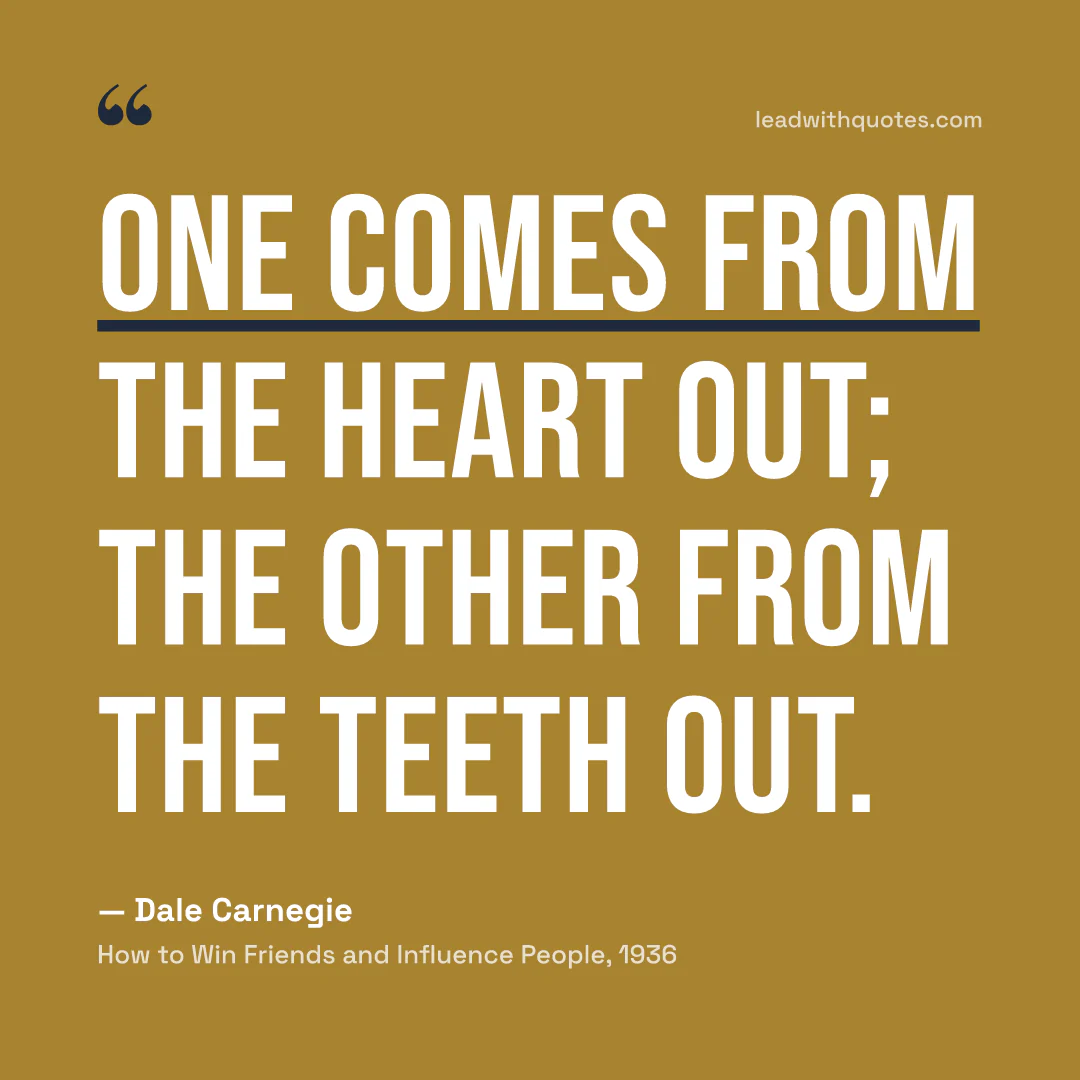
The difference between appreciation and flattery? That is simple. One is sincere and the other insincere. One comes from the heart out; the other from the teeth out.
Dale Carnegie, How to Win Friends and Influence People (1936), Part One, chapter 2
Carnegie wrote this in the chapter that ends with his second principle, "Give honest and sincere appreciation." He spends pages warning against flattery, which he calls counterfeit money that eventually gets you into trouble. For a manager the test is practical: flattery could be said to anyone ("you're a rock star"), appreciation can only be said to this person about this piece of work ("you rebuilt the invoice import over the weekend and finance closed on time"). Use the line itself in a training session or a note to other managers; in a note to an employee, follow its advice instead of quoting it.
I can live for two months on a good compliment.
Mark Twain, as recalled by his biographer Albert Bigelow Paine, Mark Twain: A Biography (1912), chapter 250
Paine was Twain's authorized biographer and worked alongside him in his last years; he sets the remark in a passage on how Twain treated his mail, noting that a fresh, well-expressed note of appreciation "always pleased him." It is a light line, which makes it good for a card or a sticky note on someone's monitor after a long week. Because it comes through Paine rather than Twain's own writing, credit it the way we do above if you print it.
For a shout-out in front of the team
Public recognition is where a quote can do some work, because it frames why you're stopping the meeting to say thank you. The first line below is a management method; the second is the reason it works.
Help people reach their full potential. Catch them doing something right.
Ken Blanchard and Spencer Johnson, The One Minute Manager (1982)
In the book this is the idea behind the "one minute praising": praise people right after they do something well, tell them specifically what they did right, tell them how you feel about it, then pause long enough for it to sink in. The book's point is that most managers are wired to catch mistakes, so praising has to be a deliberate habit. It suits a weekly "caught doing something right" slot at the start of a team meeting; our quotes for team meetings page has more lines for opening one.
Next to physical survival, the greatest need of a human being is psychological survival—to be understood, to be affirmed, to be validated, to be appreciated.
Stephen R. Covey, The 7 Habits of Highly Effective People (1989), Habit 5
Covey wrote this in the chapter on "Seek first to understand, then to be understood", his habit about empathic listening. That context is useful: he is not talking about awards but about being heard. A shout-out lands better when it shows you understood what the work took, the late fix, the difficult customer, the thing nobody else noticed, than when it simply says "great job, everyone."
For an Employee Appreciation Day card
Employee Appreciation Day falls on the first Friday in March (March 5 in 2027). A card needs a line that is short, warm and not about productivity. These three are old enough to feel like a gift rather than a slogan.
For this one virtue is not only the greatest, but is also the parent of all the other virtues.
Cicero, Pro Plancio (54 BC), section 80, translated by C. D. Yonge
The virtue is gratitude. Cicero said it in court while defending Gnaeus Plancius, a friend who had protected him during his exile; part of his argument was that he could not fail to repay that loyalty. The Latin is "haec enim est una virtus non solum maxima sed etiam mater virtutum omnium reliquarum" (The Latin Library). The popular version, "gratitude is not only the greatest of virtues, but the parent of all the others," is a fair paraphrase of it.
I can no other answer make but thanks, / And thanks, and ever thanks.
William Shakespeare, Twelfth Night (c. 1601), Act 3, scene 3
Sebastian says this to Antonio, the sea captain who has followed him into a hostile town and is about to hand him his purse. The line runs on: "and oft good turns / Are shuffled off with such uncurrent pay", meaning that good deeds are too often repaid in worthless coin, mere words. That second half is a nice private joke for a card that comes with an actual bonus, gift card or day off. The text is on the Folger Shakespeare Library site.
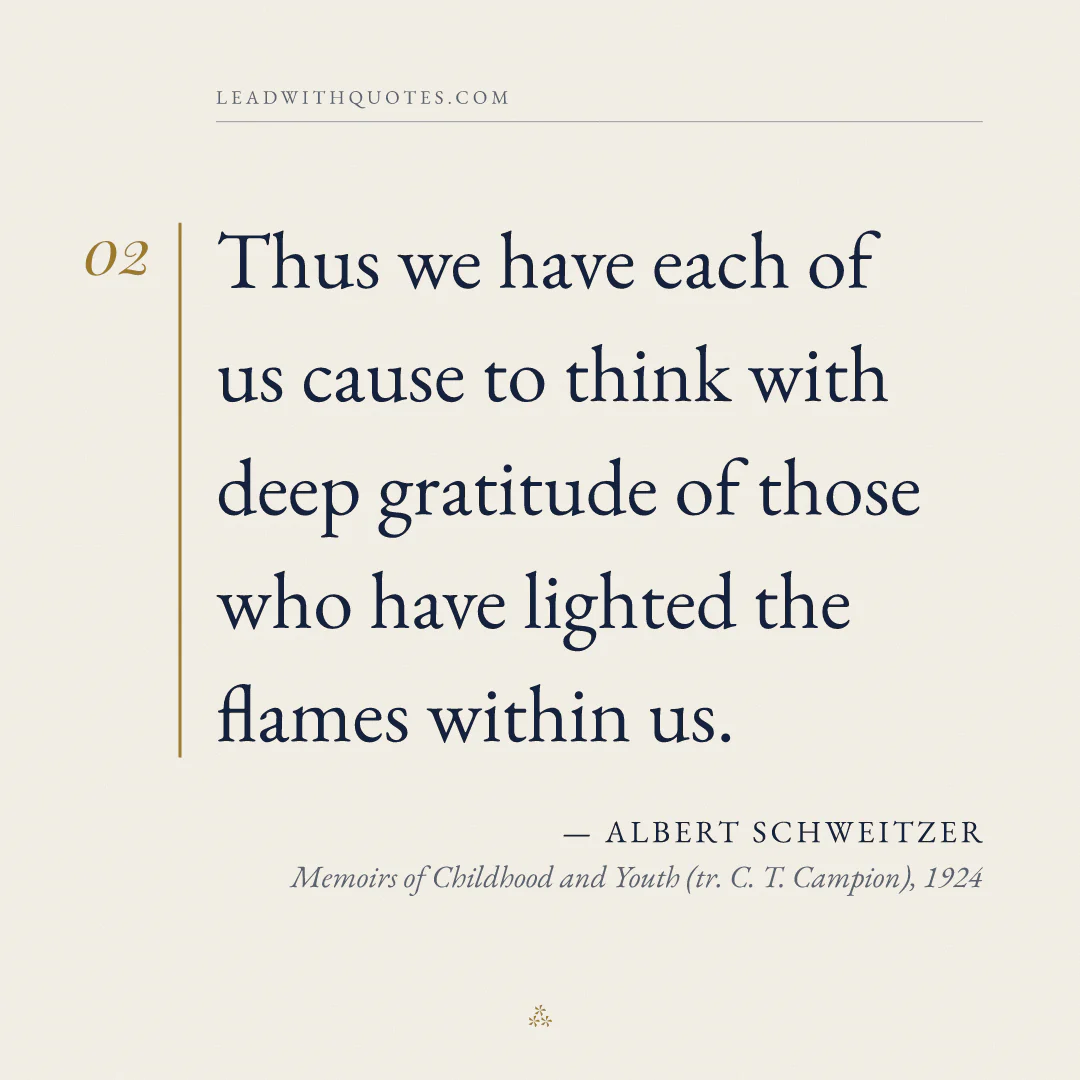
Often, too, our own light goes out, and is rekindled by some experience we go through with a fellow-man. Thus we have each of us cause to think with deep gratitude of those who have lighted the flames within us.
Albert Schweitzer, Memoirs of Childhood and Youth (1924), chapter 5, translated by C. T. Campion
This is the original wording of a line that circulates as "At times our own light goes out and is rekindled by a spark from another person." Quote Investigator traces the shorter modern version to a 1955 photo book, The World of Albert Schweitzer. Either is fine for a card to someone who carried the team through a bad quarter; just credit the version you use.
For a year-end speech or an awards event
A speech can hold a longer line, and the best ones warn against making the speech the whole thank-you.
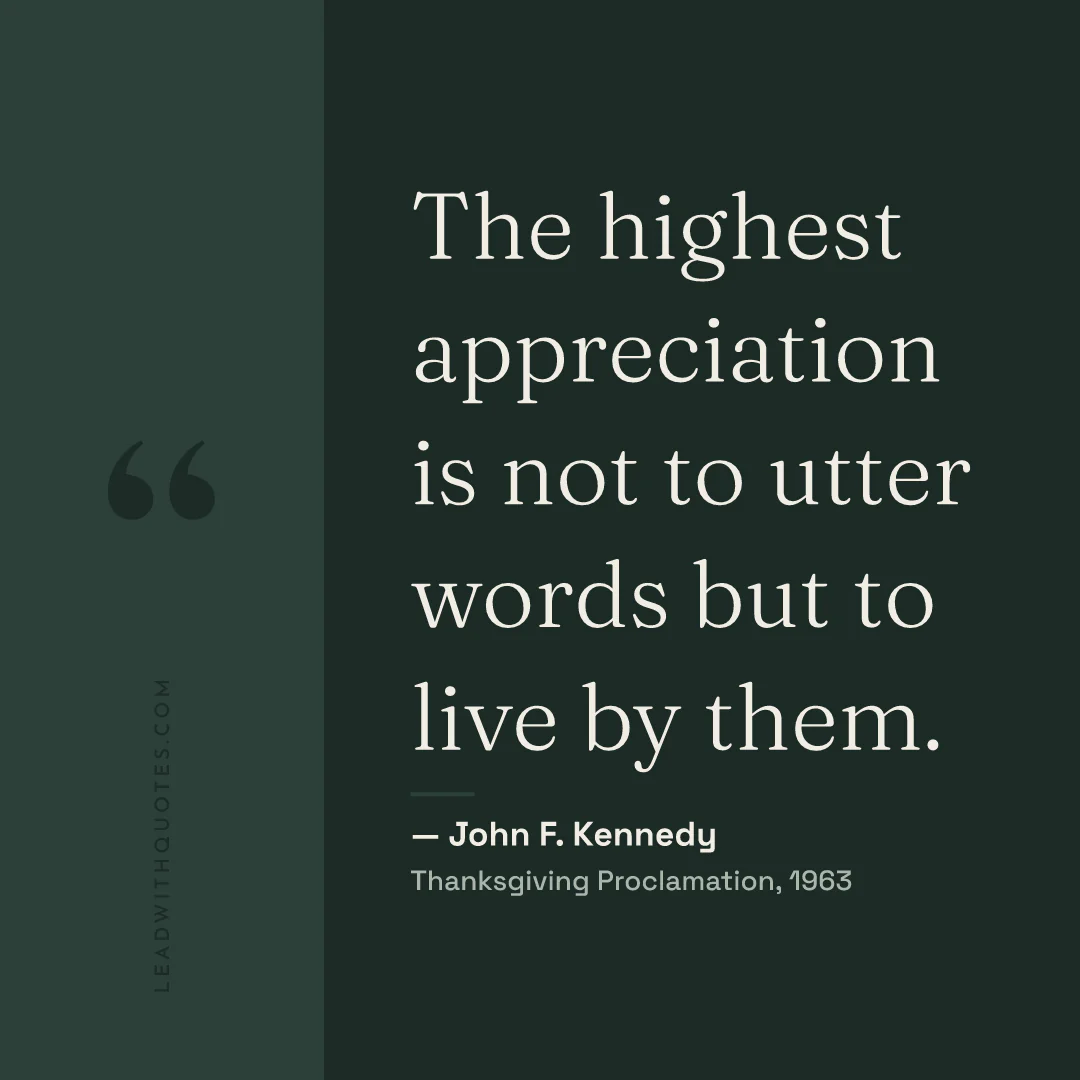
As we express our gratitude, we must never forget that the highest appreciation is not to utter words but to live by them.
John F. Kennedy, Proclamation 3560, Thanksgiving Day, November 5, 1963
Kennedy signed this proclamation seventeen days before his death; the full text is at the American Presidency Project. In a year-end talk it sets up the promise you should make next: what will change because of what the team told you this year (fewer late-night releases, a hiring plan, the tool they asked for). Without that, the line points straight back at the speaker.
To win in the marketplace, you must first win in the workplace.
Douglas Conant, his leadership motto as CEO of Campbell Soup Company (2001–2011)
Conant used this line as his motto through his decade at Campbell and has kept repeating it in talks and interviews since. He also backed it with a habit: about 30,000 handwritten thank-you notes to employees, written 10 or 20 a day on the train home, as he told The Philadelphia Inquirer in 2016. "I wanted them to know it was from me, that I was personally paying attention," he said. It is the right line for leaders talking to other leaders about why recognition belongs in the plan, not in the margins.
Thankful for my team: what to say at Thanksgiving
Name what the team did this year, send it before people leave for the long weekend (Thanksgiving is November 26 in 2026), and use a quote only as the last line. That order is what separates a thank-you from a seasonal email. Kennedy's proclamation above works here too; these four lines are the ones most useful for a team note.
Our harvest being gotten in, our governor sent four men on fowling, that we might after a more special manner rejoice together, after we had gathered the fruits of our labors.
Edward Winslow, letter of December 1621, printed in Mourt's Relation (1622), modernized spelling
This is the only eyewitness description of the 1621 Plymouth harvest apart from a passage in William Bradford, and the passage itself never uses the word "thanksgiving" (Plimoth Patuxet transcription; Pilgrim Hall prints the old spelling, with small differences in wording). The order suits a team message: the work comes first and the celebration second. Winslow also records that Massasoit came with about 90 men, who killed five deer, so don't describe the event as the settlers' feast alone.
Let us, therefore, show how acceptable a gift is by loudly expressing our gratitude for it; and let us do so, not only in the hearing of the giver, but everywhere. He who receives a benefit with gratitude, repays the first instalment of it.
Seneca, On Benefits, Book II, chapter 22, translated by Aubrey Stewart (1887)
Seneca's advice is the case for thanking people where others can hear, including to their manager's manager (Project Gutenberg text). The "first instalment" image is also honest about what a note is: a start on the debt, not the payment. Use it when something concrete follows, such as a bonus, a day off or the hire the team asked for.
I would maintain that thanks are the highest form of thought; and that gratitude is happiness doubled by wonder.
G. K. Chesterton, A Short History of England (1917), chapter 6
This is the short line for a card or a slide (Project Gutenberg text). Chesterton wrote it in an argument about medieval people who believed that good things come from outside oneself, and the sentence before it speaks of dependence on God. It reads as secular on its own, but it wasn't written that way, which is worth knowing if someone asks.
We can only be said to be alive in those moments when our hearts are conscious of our treasures.
Thornton Wilder, The Woman of Andros (1930)
This wording and citation come via Wikiquote; we have not seen the printed page. It is warmer than the others, so it fits a small team that has been through something hard together more than a company-wide email.
Three messages you can adapt:
- Short, for chat: "Thankful for this team, and for [specific result] in particular. Log off early on Wednesday. You earned it."
- For support during a hard year: "This year you [two concrete things]. Seneca wrote that thanks are the first instalment on a debt. This note is my first; [the day off / budget / hire] is the second."
- Funny, if your team likes that: "According to the 1621 account, four people brought in enough birds to feed the whole colony for almost a week. You did [project] with about the same headcount. Thank you, and please take the weekend."
Two cautions before you send it. Thanksgiving is a U.S. and Canadian holiday with different dates, so a global team may do better with a plain end-of-year thank-you; our end-of-year quotes for work page covers that. And the day isn't a celebration for everyone: Native people have gathered at Plymouth for a National Day of Mourning on Thanksgiving since 1970. A note that thanks the team for its work and skips the Pilgrim imagery reads well to everyone.
Writing the note: what goes next to the quote
A quote is the frame. What the employee remembers is the sentence about them. Gallup's same study found that the most memorable recognition comes most often from the employee's own manager (28%), followed by a high-level leader or CEO (24%). So the note matters more than the card design.
A note that works has three parts:
- What they did, in plain detail. Name the task, the day or the result. "Thanks for your hard work" could be sent to anyone; "you stayed with the migration until every account balanced" could not.
- What it changed. For a customer, a deadline, a colleague, you. This is the part people repeat to their family.
- The thanks, then the quote, if any. Put the quote last, or leave it out. It should sound like an echo of what you already said.
Four examples, with the blanks left for you:
- After a crunch: "You took [project] over the line when it would have been easy to stop at good enough. [Client/team] noticed, and so did I. Thank you. Twain said he could live for two months on a good compliment; consider this one a down payment."
- For quiet, steady work: "Nobody sees how often you [routine task] before anyone asks, but the whole team runs on it. Thank you for [specific example this month]."
- For someone who helped a colleague: "When [name] was new, you [what they did]. [Name] is now doing [result], and that started with you. Schweitzer wrote about people who light the flame in others; that was you this year."
- For the whole team on Employee Appreciation Day: "This year you [two concrete results]. I can no other answer make but thanks, and thanks, and ever thanks, and also [the day off / lunch / budget you are actually giving]."
Two habits from real executives are worth borrowing. Conant's was volume and handwriting: short notes, often, signed by hand. Indra Nooyi, as PepsiCo's CEO, wrote to the parents of her senior executives to thank them for raising the people who worked with her, an idea she said came from visitors congratulating her own mother in India (she described it on The David Rubenstein Show, as reported by Refinery29 in 2017). Neither costs anything but time.
If the thank-you is going the other direction, from the team to the boss, our boss appreciation quotes for Boss's Day page covers that card, and team leader quotes has lines for a lead who is moving on.
Which line for which moment
| Moment | Best line | Tone | Length |
|---|---|---|---|
| Sticky note or chat message after a long week | Twain, "two months on a good compliment" | Light | One line |
| Weekly shout-out in a team meeting | Blanchard & Johnson, "catch them doing something right" | Practical | One line |
| Thank-you after someone handled a hard conversation | Covey, "to be understood… to be appreciated" | Warm | One sentence |
| Employee Appreciation Day card | Shakespeare, "thanks, and thanks, and ever thanks" | Warm, a little playful | Two lines |
| Card for a mentor or a colleague who lifted others | Schweitzer, "those who have lighted the flames within us" | Heartfelt | Two sentences |
| Thanksgiving message to the team | Seneca, "the first instalment", or Winslow, "the fruits of our labors" | Warm, grounded | One to two sentences |
| Thanksgiving card or slide | Chesterton, "happiness doubled by wonder" | Warm | One sentence |
| Small team after a hard year | Wilder, "conscious of our treasures" | Heartfelt | One sentence |
| Year-end speech | Kennedy, "not to utter words but to live by them" | Serious | One sentence |
| Talk to other managers about recognition | Carnegie, "from the heart out", or Conant, "win in the workplace" | Direct | One to three sentences |
| Values poster or recognition program name | Cicero, "the parent of all the other virtues" | Formal | One sentence |
Four appreciation lines to check before you print them
These appear on most employee appreciation lists. Each has a problem with its name tag, which is worth knowing before it goes on a plaque. Our leadership quotes leaders never said page tracks more of them.
- "They may forget what you said, but they will never forget how you made them feel." Usually credited to Maya Angelou. Quote Investigator found it in a 1971 collection, Richard Evans' Quote Book, credited to Carl W. Buehner, a Latter-day Saints church official. Credit Buehner, or write "often attributed to Maya Angelou."
- "Feeling gratitude and not expressing it is like wrapping a present and not giving it." Credited to William Arthur Ward, the inspirational writer, on thousands of pages, none of which name a book or article. We found no primary source; label it "attributed to William Arthur Ward."
- "Train people well enough so they can leave, treat them well enough so they don't want to." Widely credited to Richard Branson, and he has repeated the idea in interviews, but we could not find the original post or talk to fix the date and wording. Fine to use with his name; just don't add a year or a book.
- "There are two things people want more than sex and money… recognition and praise." Credited to Mary Kay Ash and tied to her management books (Mary Kay on People Management, 1984; The Mary Kay Way, 2008), but we could not see the page to confirm the exact wording. Paraphrase it rather than putting it in quotation marks.
How these were checked
Each quote above was matched against a full text or a reliable copy of its source: Carnegie's book text, Paine's biography on Project Gutenberg, the Latin of Pro Plancio and Yonge's translation on Perseus, the Folger edition of Twelfth Night, the American Presidency Project for Kennedy, Plimoth Patuxet and Pilgrim Hall for Winslow, Project Gutenberg for Seneca and Chesterton, Quote Investigator's transcription of the 1924 Campion translation for Schweitzer, and Conant's own interviews. The Covey and Blanchard lines were checked against the publishers' and authors' own summaries of the books, and the Wilder line rests on Wikiquote, as noted beside it. Lines we could not trace are in the list above with that said plainly, not mixed in with the rest. For lines that hold people to the result rather than thank them for it, see our accountability quotes.