Change Management Quotes for Leaders: 21 Sourced Lines for Every Stage
Change management quotes checked at the source, sorted by moment: the case for change, pushback, the messy middle. Plus 7 famous lines with shaky credits.

"About 70% of all change initiatives fail" may be the most repeated line in change management, and when a researcher went looking for the evidence behind it, he found none. That is a fair warning for this whole subject: the quotes on change slides are often less solid than they look. This page gives you 21 change management quotes, each checked against its source and sorted by the moment a leader needs it: making the case, announcing the change, handling pushback, getting through the middle, and changing yourself first. There is also a table for picking a line, two example messages, and a list of famous change quotes with a wrong or shaky name on them. For more lines to use at work, see our leadership quotes for work hub.
Do 70% of change initiatives really fail?
There is no good evidence that they do. The figure's best-known home is a Harvard Business Review article by two Harvard professors:
The brutal fact is that about 70% of all change initiatives fail.
Michael Beer and Nitin Nohria, "Cracking the Code of Change", Harvard Business Review, May–June 2000, HBR
In 2011 Mark Hughes of the University of Brighton reviewed five published instances of the 70% claim in the Journal of Change Management. His conclusion: while the popular narrative exists, "there is no valid and reliable empirical evidence to support such a narrative" (abstract, vol. 11 no. 4). So quote Beer and Nohria if you like, but as an opinion from 2000, not as a measured result. If someone on your team asks where the number comes from, "it's a widely repeated estimate, and it has never been properly measured" is the honest answer. Change is still hard; you just don't need a shaky statistic to say so.
Quotes for making the case for change
The strongest case for change admits the risk and then shows that standing still has a cost too. These five lines do one or the other.
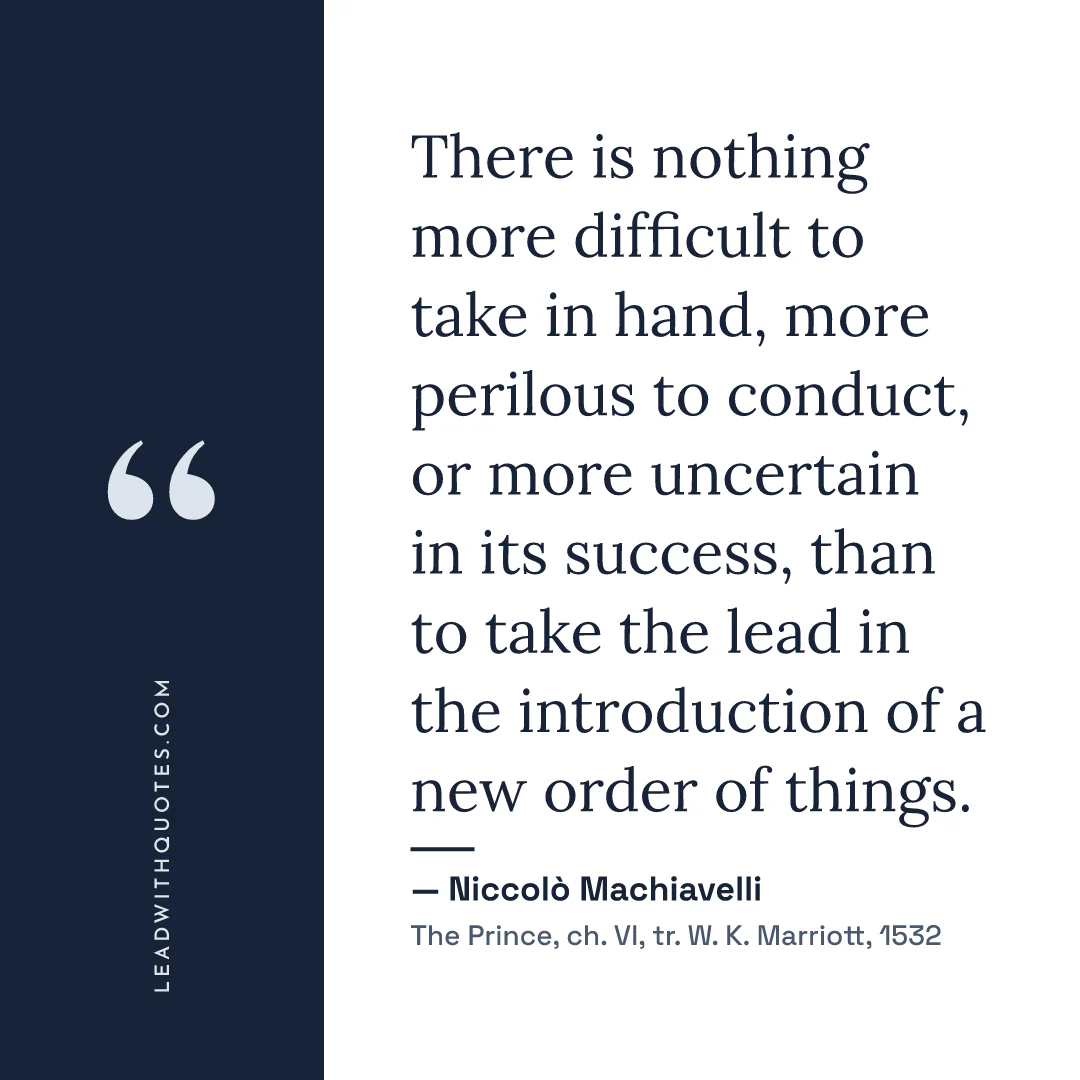
And it ought to be remembered that there is nothing more difficult to take in hand, more perilous to conduct, or more uncertain in its success, than to take the lead in the introduction of a new order of things, because the innovator has for enemies all those who have done well under the old conditions, and lukewarm defenders in those who may do well under the new.
Niccolò Machiavelli, The Prince, ch. VI (published 1532), tr. W. K. Marriott, Project Gutenberg
Most slides stop at "a new order of things" and lose the useful half. The rest is a stakeholder map written five centuries early: people who did well under the old setup will fight, and people who stand to gain will only half-commit, because the gain is still a promise. Use the full sentence when you brief a leadership team on who to talk to first.
He that will not apply new remedies, must expect new evils; for time is the greatest innovator.
Francis Bacon, "Of Innovations", Essays (1625), Project Gutenberg
Bacon's point answers "why can't we leave it as it is?" Leaving it alone is not neutral, because time keeps changing the conditions around you. The line suits a process or system that worked well once and is now quietly falling behind. The same essay warns against changing things just to change them, so it is no licence for novelty.
Success always obsoletes the very behavior that achieved it.
Peter F. Drucker, Management: Tasks, Responsibilities, Practices (1973), p. 88, via Wikiquote
This is the line for a team that is doing well and sees no reason to move. It avoids any suggestion that they did something wrong; what worked is exactly what will stop working. It fits a kickoff where you need to honor the past in the same breath as you ask people to leave it.
Success breeds complacency. Complacency breeds failure. Only the paranoid survive.
attributed to Andrew S. Grove, former Intel CEO, whose book Only the Paranoid Survive appeared in 1996; wording as collected by Barry Popik; we have not seen the printed page
The last sentence was already Grove's saying by 1990, when the Chicago Tribune reported that he often told it to employees (Popik's citation). Use it with care: "paranoid" lands fine at a strategy offsite and badly in a message to people worried about their jobs.
For time and the world do not stand still. Change is the law of life. And those who look only to the past or the present are certain to miss the future.
John F. Kennedy, address at the Paulskirche, Frankfurt, June 25, 1963, American Presidency Project
Kennedy was arguing for Atlantic partnership, and he led in with Faust, who "lost the liberty of his soul" by asking the passing moment to stay. It is a formal line, so save it for an all-hands or a written message from senior leaders, and follow it right away with the specific thing that is changing.
Quotes for announcing a change to your team
An announcement works when people can feel the reason and can see leaders acting on it. That is the thread running through John Kotter, the Harvard professor whose 1995 HBR article and 1996 book Leading Change gave the field its eight steps.
Changing behavior is less a matter of giving people analysis to influence their thoughts than helping them to see a truth to influence their feelings.
John P. Kotter and Dan S. Cohen, The Heart of Change (2002), p. 2, via Wikiquote
Read this before you build the 40-slide deck. It argues for one customer complaint played aloud or one broken process shown live over another chart.
Nothing undermines change more than behavior by important individuals that is inconsistent with the verbal communication.
John P. Kotter, Leading Change (1996; p. 10 in the 2013 edition), via Wikiquote
A line for the leadership team, not for the all-hands. If the announcement says "we're all tightening budgets" and the executive floor is being refurbished, the announcement has already failed. Before you send anything, ask who could contradict it by accident.
One cannot manage change. One can only be ahead of it.
Peter F. Drucker, Management Challenges for the 21st Century (1999), as quoted by Jessica Shambora in Fortune, March 24, 2009
This one is awkward for anyone with "change management" in their job title, and it was meant to be: Drucker's chapter is about the "change leader", an organization that looks for change before it is forced. It works when you are announcing a change early, by choice. It sounds hollow if the change is a reaction everyone already saw coming.
Quotes about resistance to change
Resistance is normal, and the best writers on it treat it as information. Start with a president who had run into plenty of it:
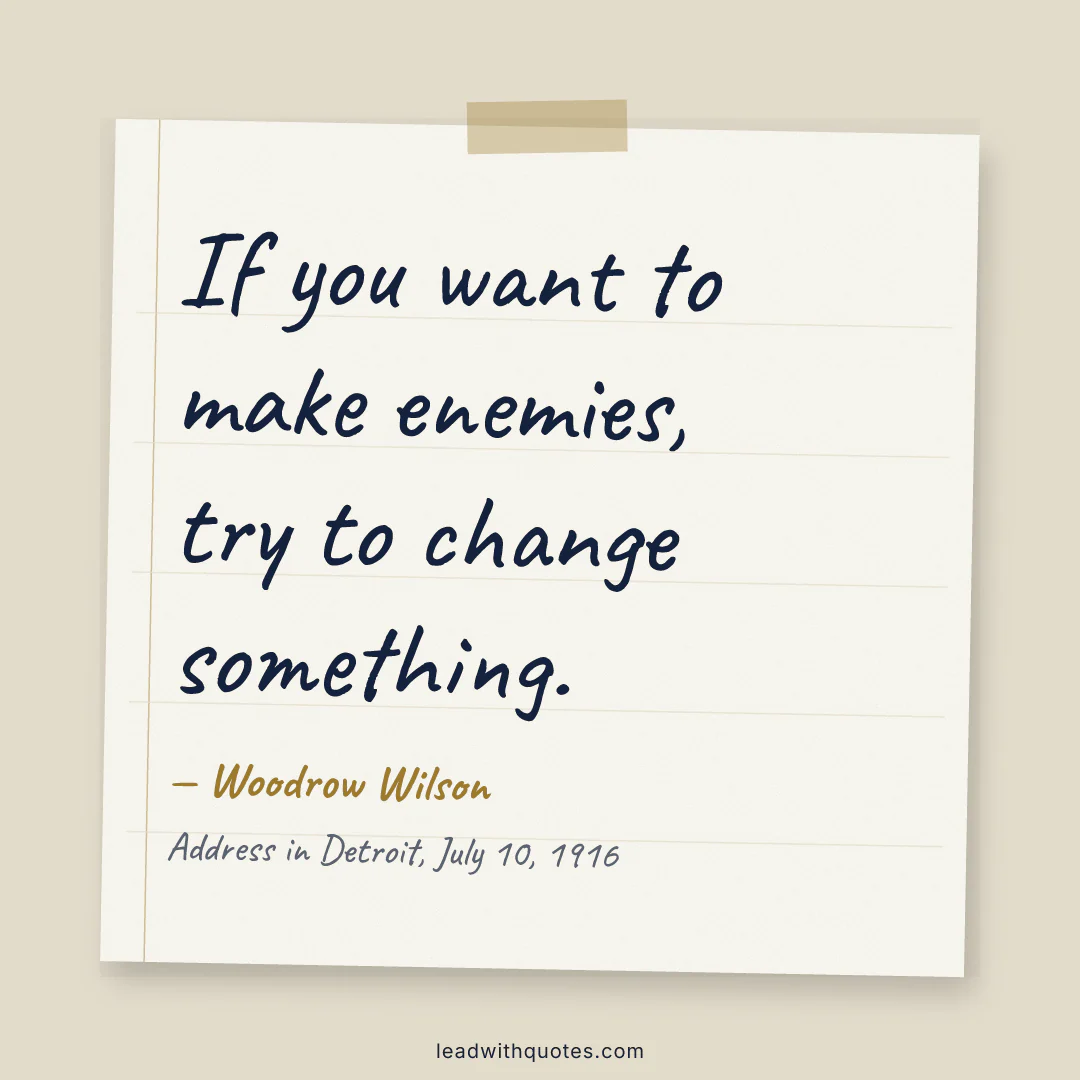
If you want to make enemies, try to change something. You know why it is. To do things to-day exactly the way you did them yesterday saves thinking.
Woodrow Wilson, address in Detroit, July 10, 1916, American Presidency Project
Everyone quotes the first sentence; the third is the insight. Habit is cheap, and a new process charges people for thinking they did not have to do last week. Budget for that cost out loud. One small sourcing wrinkle: the Presidency Project files this speech as a luncheon at the Detroit Athletic Club, while the Woodrow Wilson library's page files the same passage under the Salesmanship Congress he addressed in Detroit that day. Saying "in Detroit, 1916" is safe.
... the expression of a lot of pseudological reasons why the change will not work.
Paul R. Lawrence, "How to Deal with Resistance to Change", Harvard Business Review, January 1969 (HBR page), as quoted by Matthew Reinbold
"Pseudological" is a useful word for the objections that sound technical but aren't. Lawrence's larger argument is that change has both a technical and a social side, and that people mostly object to what it does to their working relationships. So when the fifth reason the new system "can't work" arrives, ask who loses standing, access or a familiar colleague. That is often the conversation you need, and active listening is how you get it.
Whenever smart and well-intentioned people avoid confronting obstacles, they disempower employees and undermine change.
John P. Kotter, Leading Change (1996; p. 10 in the 2013 edition), via Wikiquote
This turns the resistance question back on leaders. Sometimes the blocker is a senior manager nobody wants to confront, and everyone below has noticed. Use this line when a sponsor is being too polite about it. If the blocker is a hard personnel call, see our hard decision quotes.
Quotes for the messy middle of a change
The middle is where most leaders need a line, and where the announcement energy has run out. The old way is gone, the new one doesn't work yet, and people are tired.
It isn't the changes that do you in, it's the transitions.
William Bridges, Managing Transitions, as quoted by Scott Eblin in Government Executive, April 24, 2009
Bridges separates the external event (a new org chart, effective Monday) from the slower inner adjustment people have to make. His name for the stretch between the two is the "neutral zone". Say this line to a manager who is puzzled that the team still seems unsettled six weeks after a change that "already happened".
Anything can look like a failure in the middle. Pushing through this challenging mid-point is the only path to success.
Rosabeth Moss Kanter, Harvard Business School, "My Perspective Led to My Progress", March 23, 2015
She calls this Kanter's Law, and the wording drifts: a 2007 talk summary has "Everything looks like a failure in the middle." In the 2015 piece she adds that you keep going "with openness to learn, modify, adapt, and adjust the goal", so it does not mean ignoring bad news. It belongs in a mid-project check-in, paired with one concrete sign of progress.
Skipping steps creates only the illusion of speed and never produces satisfactory results.
John P. Kotter, "Leading Change: Why Transformation Efforts Fail", Harvard Business Review, March–April 1995, p. 59, via Wikiquote
Keep this for the moment someone proposes declaring the rollout finished so everyone can move on. It's a useful reply to a sponsor who wants the training cut or the pilot dropped to hit a date.
Quotes for leaders who have to change first
People watch whether the person asking for change is changing anything. These three lines point the question inward.
And yet in our world everybody thinks of changing humanity, and nobody thinks of changing himself.
Leo Tolstoy, "Three Methods of Reform", Pamphlets (1900), tr. Aylmer Maude, p. 29, via Wikiquote
The poster version, "Everyone thinks of changing the world", turns up in a 1999 book. Tolstoy's own sentence is sharper for a manager, because "humanity" is so obviously too big. Try it in a leadership retreat, followed by the question: what are we personally doing differently from Monday?
If we could change ourselves, the tendencies in the world would also change. As a man changes his own nature, so does the attitude of the world change towards him.
Mohandas K. Gandhi, 1913 article, as reproduced by Quote Investigator
This is the closest verified text to "Be the change you wish to see in the world", which Gandhi isn't documented as saying (see the table below). The passage is from a piece about snakebites, of all things, and it continues: "We need not wait to see what others do." That last clause is the part leaders can actually use.
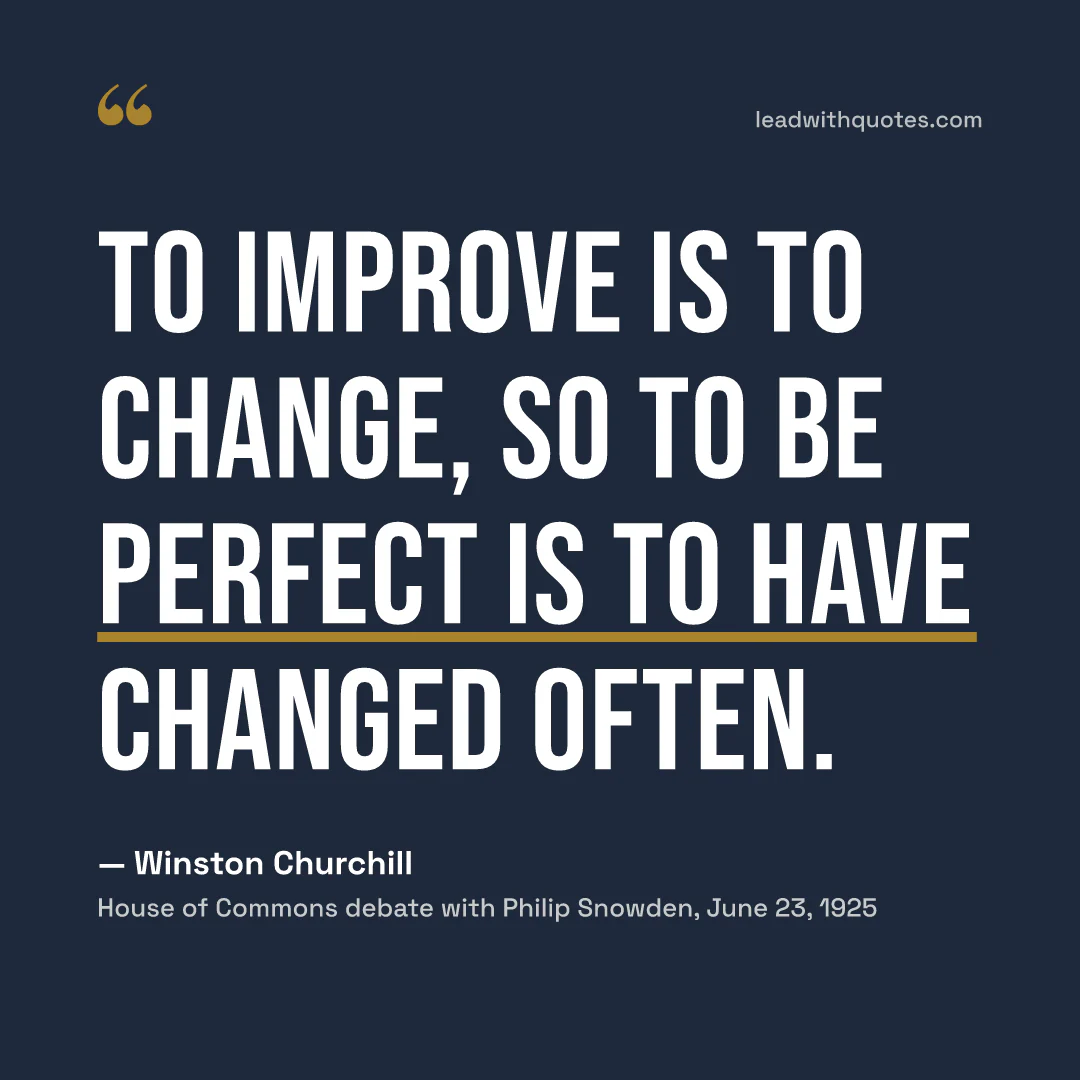
To improve is to change, so to be perfect is to have changed often.
Winston Churchill, debate with Philip Snowden, June 23, 1925, Complete Speeches, vol. 4, p. 3706, via Wikiquote
Note the wording: slides usually have "to be perfect is to change often", which is a misquote. Churchill had changed parties twice by then, so there's self-defense in it. It works well when a leader reverses an earlier decision and wants to say so plainly.
Funny change management quotes that are real
Many "funny change" lines online have no source. These two do, and both are dry rather than jokey, which is the safer register when people's jobs are moving.
He who rejects change is the architect of decay. The only human institution which rejects progress is the cemetery.
Harold Wilson, speech to the Consultative Assembly of the Council of Europe, Strasbourg, January 23, 1967, quoted in The New York Times, January 24, 1967, p. 12, via Wikiquote
The British prime minister gets his laugh in the second sentence. Use it about an old process rather than about people: nobody wants to hear that their team is the cemetery.
If we want things to stay as they are, things will have to change.
Giuseppe Tomasi di Lampedusa, The Leopard (1958), tr. Archibald Colquhoun (1963 ed.), p. 29, via Wikiquote
In the novel, young Tancredi says this to his uncle, a Sicilian prince, as an old order falls: he means changing the surface so that the people on top stay on top. So it cuts two ways. As a wry comment on a reorg that changes the boxes and nothing else, it is perfect. As sincere encouragement, it may make the one person who has read the book smile at the wrong moment.
Who really said "change is the only constant"?
Heraclitus did not say it in those words. Wikiquote lists "Change is the only constant" among the paraphrases that drift from the Greek. His surviving thought reaches us partly second-hand, through Plato:
Heracleitus is supposed to say that all things are in motion and nothing at rest; he compares them to the stream of a river, and says that you cannot go into the same water twice.
Plato, Cratylus, tr. Benjamin Jowett, Project Gutenberg
"Is supposed to say" is Socrates hedging, and you can keep the hedge: "As Plato reports Heraclitus, you cannot go into the same water twice." For a speech, the river is a better picture than the slogan anyway. Here are the other names to watch:
| Popular line | Usually credited to | The evidence |
|---|---|---|
| "It is not the strongest of the species that survives..." | Charles Darwin | Business professor Leon Megginson's paraphrase of Darwin, 1963; not in Darwin (Quote Investigator) |
| "Culture eats strategy for breakfast" | Peter Drucker | Earliest close match is a Giga Information Group headline, March 2000; the Drucker link is "not well supported" (Quote Investigator) |
| "Be the change you wish to see in the world" | Mahatma Gandhi | No documentary evidence; early versions come from Arleen Lorrance's Love Project in the 1970s (Wikiquote). Use the 1913 passage above |
| "Never doubt that a small group of thoughtful, committed citizens can change the world" | Margaret Mead | No contemporaneous source known; listed as disputed (Wikiquote) |
| "It is not necessary to change. Survival is not mandatory." | W. Edwards Deming | No page citation for this familiar version; his colleague Clare Crawford-Mason recalled "Survival is optional. No one has to change." (Lean Blog) |
| "People don't resist change. They resist being changed." | Peter Senge | Widely credited, but no dated source or book page turned up in our check. Label it "often attributed" |
| "The greatest danger in times of turbulence is not the turbulence..." | Peter Drucker | Usually tied to Managing in Turbulent Times (1980), but versions differ and we could not confirm the page. Label it "attributed" |
We keep a longer running list on our page of leadership quotes leaders never said.
Did Kurt Lewin really say "unfreeze, change, refreeze"?
Probably not as a model. Three scholars compared what Lewin wrote with how later works present him and argued that "he never developed such a model and it took form after his death" (Cummings, Bridgman and Brown, Human Relations 69(1), 2016). Lewin did use the terms unfreezing and freezing; their argument concerns how later writers turned those terms into a three-step model. If you use the three steps in training, "the model commonly credited to Lewin" is the accurate phrasing.
Which change quote fits which moment?
| Moment | Line to use | Why it works |
|---|---|---|
| Briefing leaders on who will object | Machiavelli, "a new order of things" (full sentence) | Names winners and losers |
| A successful team sees no need to change | Drucker, "Success always obsoletes..." | Respects what they built |
| Formal all-hands or CEO letter | Kennedy, "Change is the law of life" | Weight without drama |
| Preparing the leadership team to announce | Kotter, "Nothing undermines change..." | Puts conduct before messaging |
| Objections that keep shifting | Wilson, "try to change something" | Dry, and names the real cost: thinking |
| Team unsettled weeks after go-live | Bridges, "it's the transitions" | Explains the lag without blame |
| Mid-project slump | Kanter, "failure in the middle" | Says the slump was expected |
| Leader reverses a decision | Churchill, "to have changed often" | Owns the change with some humor |
| Dry comment on a cosmetic reorg (among friends) | Lampedusa, "things will have to change" | Sharp, so choose the audience |
How to use a quote in a change announcement
Use one, and let it carry only the opening. A quote cannot answer what people actually want to know, which is usually what this means for them. A simple order works:
- Say what is changing and what is not. Do this before any quote. People read for their own job first.
- Use the quote to name the difficulty. Lines that admit the cost (Machiavelli, Wilson, Bridges) earn more trust than cheerful ones about embracing change.
- End with the next date. Say when people will hear more, who to ask, and what you don't know yet. Check the name on the quote while you're at it; a loss of trust is expensive at exactly this moment, and a fake Gandhi line doesn't help.
Two examples you can adapt. For a team message about a new system: "Starting March 3, we move to the new scheduling tool. Your teams and managers stay the same. Woodrow Wilson said in 1916 that doing things the way you did them yesterday 'saves thinking', and for a few weeks this will cost all of us some thinking. Training dates are below, and I'll hold open office hours every Thursday in March."
For a manager's check-in six weeks into a reorganization: "William Bridges wrote that it isn't the changes that do you in, it's the transitions. The org chart changed in one day. Getting used to it is taking longer, and that is normal. Tell me what is still unclear, and I'll have answers or a date for answers by Friday."
How we checked these quotes
We matched the wording of each line against the page linked beside it: full texts on Project Gutenberg (Machiavelli, Bacon, Plato), speech transcripts in the American Presidency Project (Kennedy, Wilson), and the authors' own or publisher pages (Kanter; Beer and Nohria). Where we read a line through someone else's citation, the credit says "via Wikiquote" or "as quoted by", which means we have not seen the printed page ourselves; Grove's is marked as attributed. Hughes's and Cummings's findings come from their published abstracts rather than the full papers. Our general method is on the how we verify page.