Quotes About Trust in the Workplace: 12 Lines Traced to Their Sources, From Confucius to Drucker
12 quotes about trust in the workplace, each traced to its memo, book or speech, plus how to rebuild trust and 10 popular trust quotes with the wrong name.

On 8 December 1987, in the East Room of the White House, Ronald Reagan signed the INF Treaty with Mikhail Gorbachev and reached for a Russian proverb he had been using all year: doveryai, no proveryai, "trust, but verify." Gorbachev cut in: "You repeat that at every meeting." The room laughed, and the line became the best-known sentence ever said about trust between two parties who need each other but are not sure of each other. That is the situation at work too. This page collects 12 quotes about trust in the workplace, each traced to the speech, book, memo or play it comes from, and arranged around the questions people actually ask about trust at work: what it is, why it matters, whether you give it first or wait for it to be earned, how to rebuild it, and which popular trust quotes carry the wrong name.
What does trust at work actually mean?
In management research, trust is a willingness to be vulnerable to someone you cannot fully control. That definition comes from the most cited paper on the subject, and it is more useful than any slogan because it tells you what trust costs the person giving it.
the willingness of a party to be vulnerable to the actions of another party based on the expectation that the other will perform a particular action important to the trustor, irrespective of the ability to monitor or control that other party.
Roger C. Mayer, James H. Davis and F. David Schoorman, "An Integrative Model of Organizational Trust," Academy of Management Review 20(3), 1995, p. 712
The key phrase is the last one: irrespective of the ability to monitor or control. A manager who checks every step is not trusting anyone, however friendly the check-ins sound. Mayer, Davis and Schoorman go on to name three things people judge before they trust someone: ability (can this person do it?), benevolence (do they care about my interests?) and integrity (do they keep to principles I accept?) (JSTOR record). Most broken trust at work can be traced to a doubt about one of those three, and naming which one is the first step to fixing it.
In the context of building a team, trust is the confidence among team members that their peers' intentions are good, and that there is no reason to be protective or careful around the group.
Patrick Lencioni, The Five Dysfunctions of a Team (2002), model section, "Absence of Trust"
Lencioni's definition is the team-level version of the same idea. In the fable that fills most of his book, the new CEO, Kathryn, tells her executives that "trust is the foundation of real teamwork," and the rest of his model (conflict, commitment, accountability, results) is built on top of it. If your team never argues in meetings, his diagnosis is that the problem is trust, not harmony. Our accountability quotes page picks up the later steps of his model.
Why is trust important in the workplace?
Because it changes how much work gets done and how people feel doing it, and both effects have been measured. Peter Drucker put the historical shift in one sentence near the end of his best-known essay:
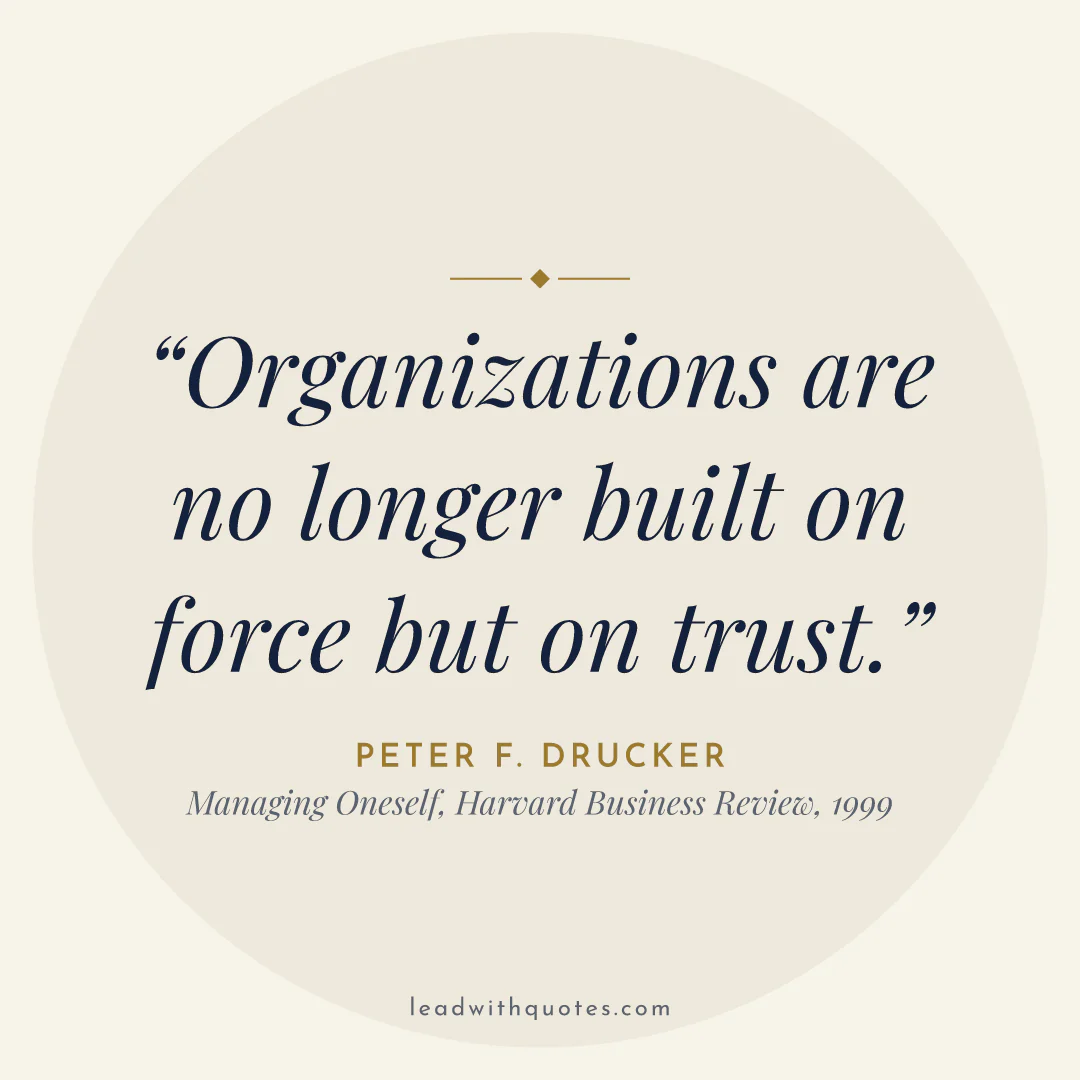
Organizations are no longer built on force but on trust. The existence of trust between people does not necessarily mean that they like one another. It means that they understand one another.
Peter F. Drucker, "Managing Oneself," Harvard Business Review, March–April 1999
The passage sits in the essay's closing section on "responsibility for relationships," where Drucker argues that each person must tell colleagues how they work and what they need. The second and third sentences are the useful part for a manager: trust is not friendship, it is predictability. A colleague you dislike but understand is easier to work with than a friendly one whose next move you cannot guess. Keep "necessarily" in when you quote it; some copies drop it and the sentence becomes a different claim.
The neuroscientist Paul J. Zak gave that argument numbers. In "The Neuroscience of Trust" (HBR, January–February 2017), a February 2016 survey of 1,095 U.S. working adults found that people at high-trust companies, compared with low-trust ones, reported 74% less stress, 106% more energy at work, 50% higher productivity, 13% fewer sick days, 76% more engagement, 29% more satisfaction with their lives and 40% less burnout. The figures are self-reported, so treat them as a direction rather than a forecast for your team, but they are the best-known data point on the question.
When trust goes down in any relationship, on a team, in a company, or in a supply chain, speed will also go down. Everything will take longer to do and cost will go up.
Stephen M. R. Covey, interview with DC Velocity, on the argument of The Speed of Trust (2006)
Covey calls the extra time and cost a "trust tax" and the reverse a "trust dividend" (DC Velocity interview). Use this line when you need to explain trust to someone who only listens to numbers: every approval layer, every "cc my manager" and every double-check is a tax the team pays because trust is missing. Note that "Trust is the one thing that changes everything," often quoted as Covey's, is not a sentence in the book. It is the book's subtitle.
Should a leader give trust first, or wait until it is earned?
The strongest quotes on this question all say the same thing: give it first, because withholding trust produces the behavior you were afraid of. The clearest statement comes from an unlikely document, a memo about nuclear weapons.
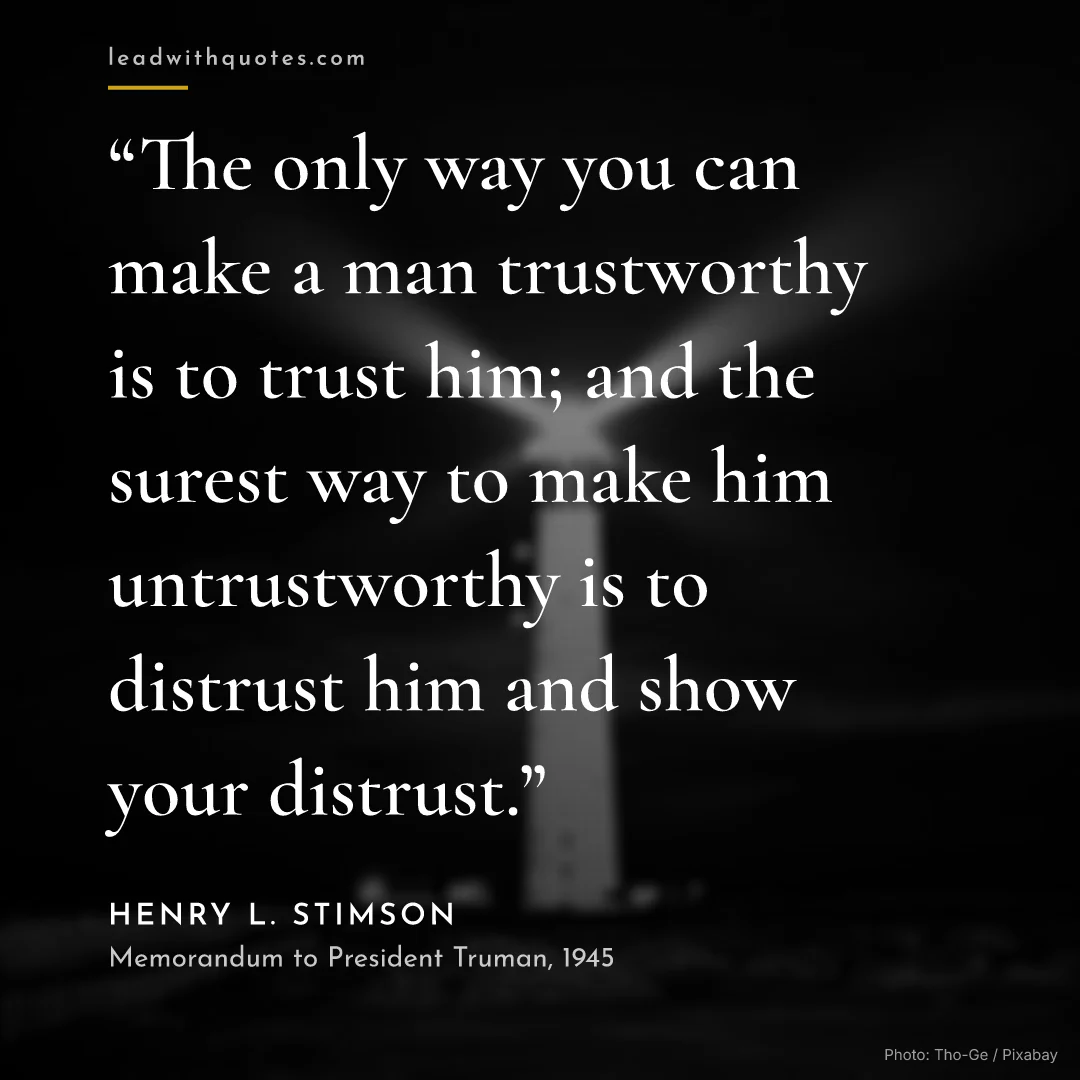
The chief lesson I have learned in a long life is that the only way you can make a man trustworthy is to trust him; and the surest way to make him untrustworthy is to distrust him and show your distrust.
Henry L. Stimson, memorandum to President Truman, "Proposed Action for Control of Atomic Bombs," 11 September 1945
Stimson was Secretary of War and close to retirement when he wrote this, arguing that the United States should approach the Soviet Union directly about controlling the atomic bomb rather than hold it as a diplomatic threat. The memo is printed in Foreign Relations of the United States, 1945, Vol. II (Office of the Historian). Popular copies change "the surest way to make him" into "the surest way you can make him"; the version above is the printed text. It works at work for the same reason it was written: suspicion that shows is read as an accusation, and people tend to live down to it.
Trust men, and they will be true to you; treat them greatly, and they will show themselves great, though they make an exception in your favor to all their rules of trade.
Ralph Waldo Emerson, "Prudence," Essays: First Series (1841)
Emerson's essay is about practical good sense, and this sentence comes right after his remark that frankness "makes their business a friendship" (Wikisource). Most quote sites stop after "great"; if you do, add an ellipsis. The ending matters, though: Emerson is saying that people who drive hard bargains with everyone else will make an exception for someone who trusted them. That is a business observation, not a sentimental one.
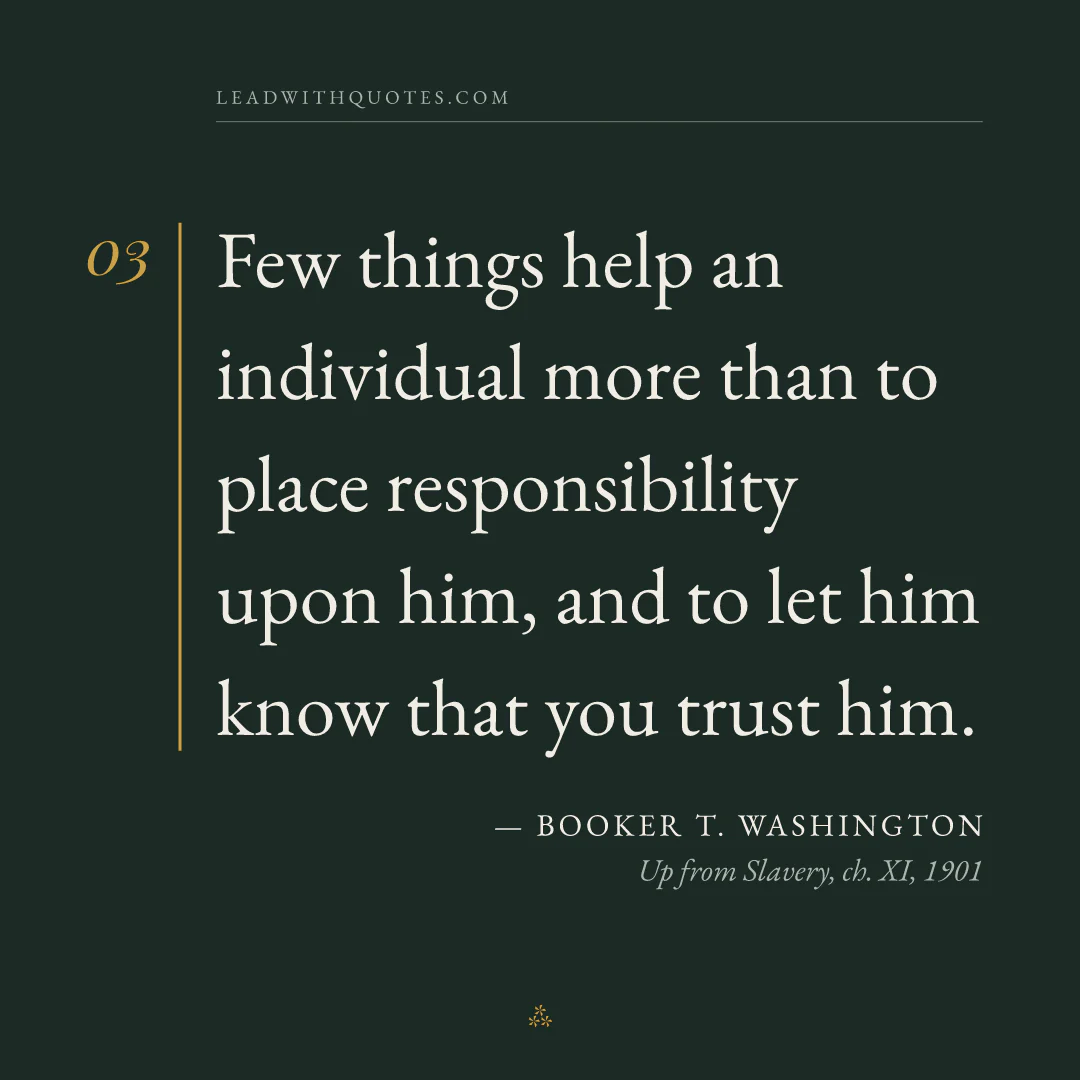
Few things help an individual more than to place responsibility upon him, and to let him know that you trust him.
Booker T. Washington, Up from Slavery (1901), Chapter XI
Washington wrote this about running Tuskegee Institute, where he wanted students to "speak with directness and frankness about anything that concerns the life of the school"; the next paragraph turns to "labour troubles between employers and employees" (Wikisource, from the 1901 edition). The popular version adds a "can" ("few things can help"), which is not in the book. The practical point is the pairing: responsibility and telling the person you trust them. Handing someone a project without saying so leaves them guessing whether they are being trusted or tested.
Trust is the highest form of human motivation.
Stephen R. Covey, The 7 Habits of Highly Effective People (1989), Habit 3
The elder Covey wrote this in his section on delegation, where he contrasts "gofer delegation" (do this, then report back) with stewardship delegation, in which you agree on results and let the person choose the method. He adds that trust takes time and does not replace training people until their skills match it. So the honest answer to "give or earn?" is both: give trust in the size the person can carry now, and enlarge it as they deliver.
Where does "trust, but verify" come from?
It is a Russian proverb, not a Reagan invention, and he presented it as one. The scholar Suzanne Massie taught it to him around the time of the 1986 Reykjavik summit (background). The earliest public use we could confirm is a news conference on 11 June 1987. The best-documented one is the treaty signing:
We have listened to the wisdom in an old Russian maxim. And I'm sure you're familiar with it, Mr. General Secretary, though my pronunciation may give you difficulty. The maxim is: Dovorey no provorey -- trust, but verify.
Ronald Reagan, remarks on signing the INF Treaty, 8 December 1987
The spelling "Dovorey no provorey" is the White House transcript's; the standard transliteration is doveryai, no proveryai (Reagan Library transcript). At work the phrase is often used as a polite way of saying "I don't trust you," which is the opposite of how it worked in 1987: there, verification was what made trust possible between two rivals. If you quote it to a team, say what you will verify (outcomes, numbers, deadlines) and what you will not (how people spend their afternoon). Verification of results builds trust; surveillance of effort, in Stimson's terms, shows your distrust.
What are the "5 C's of trust"?
There is no single, original "5 C's of trust." Several consultants use the label for different lists, and none of them traces back to a research source. The table sets the most-cited versions next to the two models that do have a clear origin, so you can see what they share.
| Model | The parts | Where it comes from |
|---|---|---|
| "Five Cs of trust" | Care, communication, character, consistency, competence | Ali Grovue and Mike Watson, Chief Executive, April 2022 |
| "Four Cs of trust" | Competence, character, consistency, connection | Consultant John Spence, blog |
| 4 Cores of Credibility | Integrity, intent (character); capabilities, results (competence) | Stephen M. R. Covey, The Speed of Trust (2006) |
| Factors of trustworthiness | Ability, benevolence, integrity | Mayer, Davis and Schoorman, Academy of Management Review (1995) |
Strip away the alliteration and every list asks the same two questions: is this person good at the job (competence, ability, capabilities, results), and are they on my side and honest about it (character, care, benevolence, integrity, intent)? Consistency and communication are how people find out the answers over time. If someone asks you for "the 5 C's," it is fair to give one list and say where it comes from.
How do you rebuild trust in a work team?
Start by naming which part broke, then make one small, checkable promise and keep it in public. Quotes can help at the start of that conversation, but only if they are honest about the damage. This old answer about government is the bluntest statement of how much is at stake:
Part with the food. From of old, death has been the lot of all men; but if the people have no faith in their rulers, there is no standing for the state.
Confucius, Analects 12.7, translated by James Legge (1861)
His student Zigong had asked what government needs: enough food, enough weapons, and the confidence of the people. Asked which to give up first, Confucius drops the weapons; asked again, he drops the food, and keeps trust (Legge's text). The original is four characters, 民無信不立: without trust, nothing stands. For a team leader the lesson is about priorities: when trust is damaged, repairing it comes before the next deliverable, because the deliverables depend on it.
A rebuild that people can see usually has four steps:
- Name the break in one sentence. Use the three factors above: "I made a call about the reorganization without telling you (integrity)," not "trust has been low lately."
- Say what you will do differently, and when it can be checked. "From now on, changes to your projects come to you before they go to anyone else. You will see that on the next one, due in March."
- Invite verification. This is where "trust, but verify" belongs: you are asking the team to check you, not the other way round.
- Extend trust back. Stimson's rule applies to the person repairing trust too. Hand over a real decision soon; it shows you are not waiting for the team to prove itself first.
You may be deceived if you trust too much, but you will live in torment if you do not trust enough.
Frank Crane, as quoted in Business Education World, Vol. 15 (1935), p. 172
Crane was an American minister and syndicated newspaper essayist; the line is credited to him in a 1935 magazine (Wikiquote citation), and we have not found it in his own essays, so treat it as reliably attributed rather than primary. It suits a manager who was let down once and is now tempted to check everything: the cost of over-trusting is a bad week, the cost of under-trusting is every week after.
Short trust quotes for a slide, a card or a team channel
For a slide or a sign-off line you want something under twenty words. These are the short forms that stay faithful to the sources above; quote the full version when you have room.
Love all, trust a few, / Do wrong to none.
William Shakespeare, All's Well That Ends Well, Act 1, Scene 1
The Countess of Rossillion says this as part of her blessing to her son Bertram, who is leaving home for the king's court, and the next words are "Be able for thine enemy rather in power than use" (Folger Shakespeare Library). It is advice to someone starting out in a political place, which makes it a fair line for a new manager: be warm to everyone, rely on a few, and be fair to all of them.
| Use it for | Short line | Credit to print |
|---|---|---|
| A slide on delegation | "Trust is the highest form of human motivation." | Stephen R. Covey, The 7 Habits (1989) |
| An all-hands on culture | "Organizations are no longer built on force but on trust." | Peter F. Drucker, HBR (1999) |
| A new manager's first week | "Love all, trust a few, do wrong to none." | Shakespeare, All's Well That Ends Well |
| Handing over a big project | "Let him know that you trust him." | Booker T. Washington, Up from Slavery (1901) |
| An audit or review kickoff | "Trust, but verify." | Russian proverb, quoted by Ronald Reagan (1987) |
| A team that went through a rough patch | "If the people have no faith in their rulers, there is no standing for the state." | Confucius, Analects 12.7 (Legge) |
| A thank-you to a manager who trusted you | "Treat them greatly, and they will show themselves great." | Ralph Waldo Emerson, "Prudence" (1841) |
If the trust line you want is from Simon Sinek, his lines on teams and trust have their own page with book and talk sources: Simon Sinek quotes on teamwork and trust. For lines about teams in general, see our teamwork quotes for work.
Popular trust quotes with the wrong name or no source
Trust quotes are among the most copied on the web, and several of the most shared ones fail a source check. Here is what we found for the ones you are most likely to see.
| The line as shared | Usual credit | What the record shows |
|---|---|---|
| "The best way to find out if you can trust somebody is to trust them." | Ernest Hemingway | A smoothed-out version. The letter to Dorothy Connable in Selected Letters 1917–1961 (1981) is reported as "The way to make people trust-worthy is to trust them," and he goes on to say the man in question is not someone that system works with (Wikiquote discussion). We could not check the page in print. |
| "Trust is like the air we breathe: when it's present, nobody really notices; when it's absent, everybody notices." | Warren Buffett | No letter or interview by Buffett found. The earliest source is Stephen M. R. Covey saying "as Warren Buffett put it" in talks and podcasts. Credit it "attributed to Buffett by Stephen M. R. Covey." |
| "Trust takes years to build, seconds to break, and forever to repair." | Various | No known author. Print it as anonymous. |
| "Trust is like a mirror, you can fix it if it's broken, but you can still see the crack…" | Lady Gaga | No interview, show or date attached anywhere we looked. The full version is also profane, which rules it out for most workplaces anyway. |
| "Trust is the glue of life." | Stephen R. Covey | Not found in his books. The citable version is from First Things First (1994), p. 243: "Trust is the glue that holds everything together." |
| "Trust is the one thing that changes everything." | Stephen M. R. Covey | The subtitle of The Speed of Trust (2006), not a sentence in it. |
| "He who does not trust enough will not be trusted." | Lao Tzu | Real, but one translator's wording: Gia-Fu Feng and Jane English (1972), Tao Te Ching ch. 17 and 23. Other translations read quite differently, so name the translation. |
| "Trust, but verify." | Ronald Reagan | A Russian proverb that Reagan quoted and credited as one. |
| "Few things can help an individual more than to place responsibility on him…" | Booker T. Washington | Right author, altered text: the 1901 book has "Few things help an individual more than to place responsibility upon him." |
| "…the surest way you can make him untrustworthy…" | Henry L. Stimson | Right author, altered text: the 1945 memo has "the surest way to make him untrustworthy." |
We keep a longer list of leadership lines like these, each linked to its evidence, in leadership quotes leaders never said.
How these quotes were checked
Each of the 12 quotes above was checked against the original text or a faithful reprint: the Reagan Library transcript, the State Department's printed edition of the Stimson memo, Wikisource scans of Emerson and Washington, Legge's 1861 translation of the Analects, the Folger edition of Shakespeare, and the published articles by Drucker, Zak and Mayer and colleagues. A few were checked through reliable reprints and citations rather than the printed page, and we say so here: the Frank Crane line (a 1935 magazine citation, noted in its caption), the Lencioni and both Covey book passages (excerpts and the authors' own interviews), and the Mayer definition (consistent page citations in later research; the paper itself is a scan we could not read). Lines that failed the check went into the table above rather than into the list.