Quotes About Excellence: 17 Sourced Lines, From Aristotle to Lombardi
17 quotes about excellence checked at the source, from Aristotle and Daniel to Lombardi and Gardner, plus who really wrote "excellence is a habit".

The most quoted line about excellence first appeared in a pocket-sized pamphlet: Little Blue Book No. 39, The Story of Aristotle's Philosophy, printed by Haldeman-Julius in Girard, Kansas, in 1923. On page 41 its author, Will Durant, summed up Aristotle in his own words: "we are what we repeatedly do. Excellence, then, is not an act but a habit." Aristotle never wrote that sentence, though he wrote the idea behind it. This page collects 17 quotes about excellence, each checked against its source, and follows the idea from Plato's Greek through the King James Bible, Voltaire's French and Vince Lombardi's locker room to the management books of the 1960s and 1980s. For each line you get who said it, where, and when it fits at work. There is also a table of which line suits which moment, a short guide to using one without sounding like a poster, and seven popular excellence quotes with the wrong name on them. For more lines to use at work, see our leadership quotes for work hub.
A note on the word itself. The Greek aretē is usually translated "virtue", but it meant being good at what a thing or a person is for: the aretē of a knife is cutting, of a runner is speed. Most modern translators use "excellence" for it in exactly the passages quoted below, which is why so many excellence quotes lead back to Athens.
"Excellence is not an act, but a habit": Durant's sentence, 1923
Here is the passage as it stands in the 1923 pamphlet, with Durant's two quotations from Aristotle inside it:
Excellence is an art won by training and habituation: we do not act rightly because we have virtue or excellence, but we rather have these because we have acted rightly; 'these virtues are formed in man by his doing the actions'; we are what we repeatedly do. Excellence, then, is not an act but a habit.
Will Durant, The Story of Aristotle's Philosophy, Little Blue Book No. 39 (1923), p. 41, Internet Archive scan
Durant reused the passage word for word three years later in The Story of Philosophy (1926), the best-seller that made it famous; it sits in the Aristotle chapter, part VII, "Ethics and the Nature of Happiness" (1926 scan). Wikiquote's misattribution note traces the line to that 1926 book; the 1923 pamphlet shows Durant had written it even earlier. His footnotes point the inner quotations to the Nicomachean Ethics, Book II chapter 4 and Book I chapter 7.
How did it become "Aristotle"? Look at the punctuation. The short sentences sit between two passages in quotation marks that really are Aristotle, so anyone copying the paragraph quickly could take the whole thing for his. By the time it reached posters, the quotation marks had moved outward and Durant had dropped out. The fair way to use it: "As Will Durant summed up Aristotle, 'We are what we repeatedly do.'" That's accurate, and it credits a writer who did the work of compressing a long argument into two short sentences.
What Aristotle actually wrote about habit and excellence
The real source is the opening of Book II of the Nicomachean Ethics, lectures written down in the 4th century BC. Aristotle starts with a pun: the Greek for character, ēthos, differs by one letter from ethos, habit. In W. D. Ross's translation, "moral virtue comes about as a result of habit, whence also its name (ethike) is one that is formed by a slight variation from the word ethos (habit)." Then he gives the line closest to Durant's:
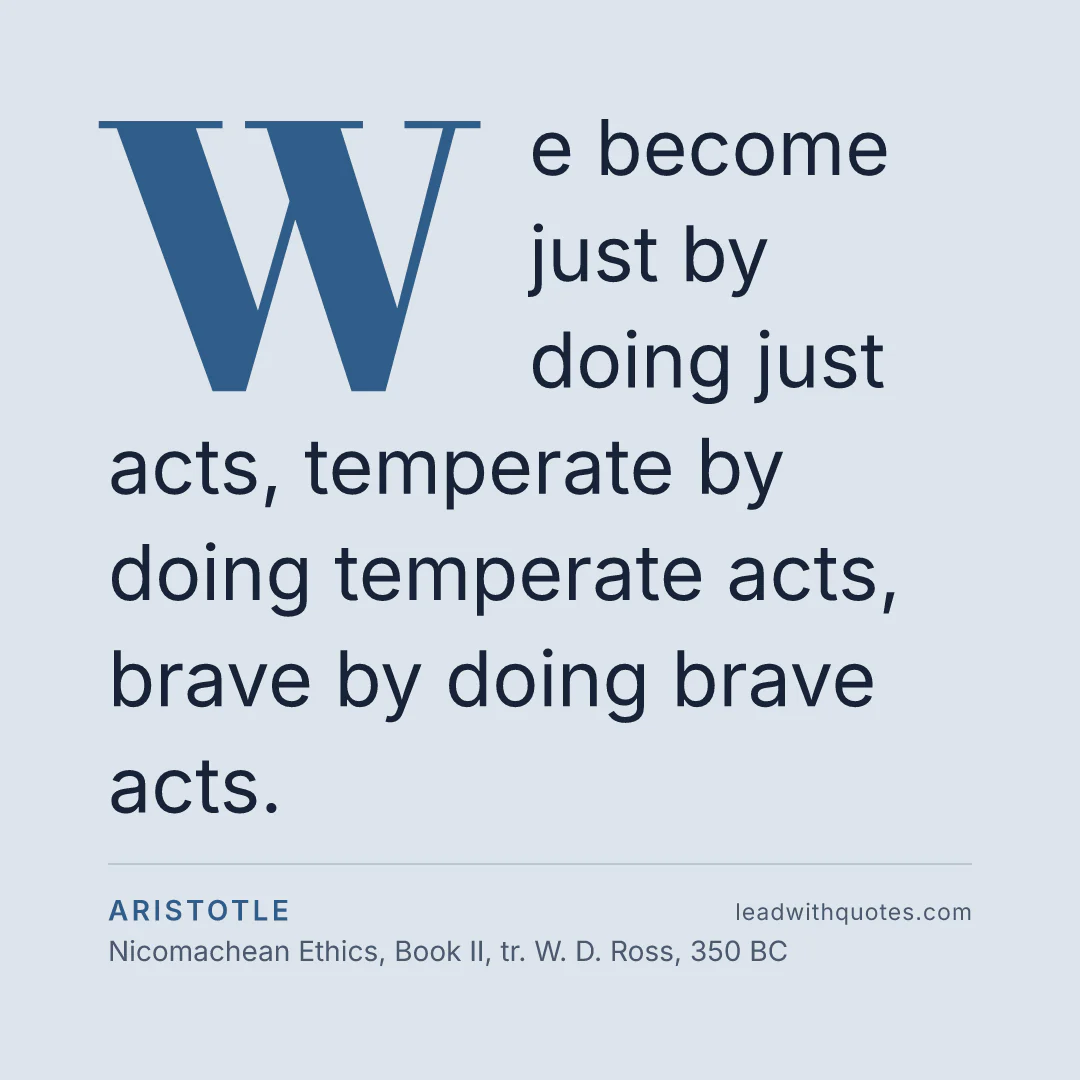
For the things we have to learn before we can do them, we learn by doing them, e.g. men become builders by building and lyreplayers by playing the lyre; so too we become just by doing just acts, temperate by doing temperate acts, brave by doing brave acts.
Aristotle, Nicomachean Ethics Book II, ch. 1, tr. W. D. Ross, MIT Internet Classics Archive
This is the line to use when someone asks how excellence is built. Aristotle's examples are trades, not saints: you become a builder by building. In a team setting it supports a plain point, that standards are learned in the doing, so new people need real work early, with feedback, rather than a long wait until they are "ready".
A few lines earlier he explains why practice works at all. People are not born with these qualities, and they are not against our nature either:
Neither by nature, then, nor contrary to nature do the virtues arise in us; rather we are adapted by nature to receive them, and are made perfect by habit.
Aristotle, Nicomachean Ethics Book II, ch. 1, tr. W. D. Ross, MIT Internet Classics Archive
The Greek ends τελειουμένοις δὲ διὰ τοῦ ἔθους, literally "being completed through habit" (Perseus Greek text, Bekker 1103a). "Made perfect" is Ross's choice; "completed" or "brought to maturity" is closer. That matters if you are tempted to use the line to demand perfection. Aristotle's point is growth into a capacity we already have room for. It works well in a development conversation: nobody arrives finished, and nobody is excused from the practice either.
The chapter closes with the sentence that best explains why leaders care about early habits:
It makes no small difference, then, whether we form habits of one kind or of another from our very youth; it makes a very great difference, or rather all the difference.
Aristotle, Nicomachean Ethics Book II, ch. 1, tr. W. D. Ross, MIT Internet Classics Archive
Read "youth" as "the first months in a job" and it describes onboarding. The habits a new hire picks up in week one, how carefully a handover is written, whether a deadline slips without a word, tend to stay. That is a fair line for a manager's onboarding notes or a training kickoff.
The second passage Durant borrowed comes from Book I, where Aristotle says a good life has to be judged over its whole length:
For one swallow does not make a summer, nor does one day; and so too one day, or a short time, does not make a man blessed and happy.
Aristotle, Nicomachean Ethics Book I, ch. 7, tr. W. D. Ross, MIT Internet Classics Archive
Durant's 1923 version quotes the same idea from an older translation, with "spring" in place of "summer". At work it is a quiet warning against judging people, or projects, on one good or bad week. It suits a performance review that looks at a full year, or a note to a team after a lucky win.
Here is how the popular wording lines up with the text it came from:
| Popular wording | What Aristotle's text says | Where |
|---|---|---|
| "We are what we repeatedly do." | "We become just by doing just acts" (and builders by building) | NE II.1 |
| "Excellence is not an act but a habit." | Virtues are "made perfect by habit"; character (ēthos) is named after habit (ethos) | NE II.1 |
| "Excellence is an art won by training." | We learn by doing, "as also happens in the case of the arts" | NE II.1 |
| (Durant's frame: it takes a lifetime) | "One swallow does not make a summer" | NE I.7 |
If you are collecting Aristotle for leadership more broadly, his anger test is on our emotional intelligence quotes page.
Before Aristotle: Plato and the excellence of an eye
Aristotle's teacher had already tied excellence to function. At the end of Book I of the Republic, Socrates walks the sophist Thrasymachus through a series of small questions about tools and organs:
And that to which an end is appointed has also an excellence? Need I ask again whether the eye has an end? It has. And has not the eye an excellence? Yes.
Plato, Republic Book I (353b), tr. Benjamin Jowett, Project Gutenberg
The argument continues: an eye that has lost its "proper excellence" cannot see. The useful idea for a workplace is that excellence is defined by purpose. Before telling a team to "be excellent", say what the role is for. An excellent support agent and an excellent auditor look nothing alike, because their ends differ. This is a good passage for a job-description workshop or a team charter, quoted with the question-and-answer back-and-forth intact so the logic is visible.
"An excellent spirit": excellence in the Bible
The King James Bible uses "excellent" in its older sense of surpassing, standing out. The best-known verse on the subject is about a public official in a foreign court:
Then this Daniel was preferred above the presidents and princes, because an excellent spirit was in him; and the king thought to set him over the whole realm.
Daniel 6:3, King James Version (1611), Project Gutenberg
The next verse is the reason it gets quoted in workplace devotionals: his rivals looked for something to accuse him of, "but they could find none occasion nor fault; forasmuch as he was faithful, neither was there any error or fault found in him" (Daniel 6:4). Excellence here is reliability under scrutiny, not brilliance. It suits a promotion announcement or a note to someone whose work has held up under an audit.

Proverbs makes the career argument outright:
Seest thou a man diligent in his business? he shall stand before kings; he shall not stand before mean men.
Proverbs 22:29, King James Version, Project Gutenberg
"Mean" here means low-ranking, not unkind. The verse promises that skilled, careful work gets noticed by people who matter. It's a fitting line for a craft award or an apprenticeship graduation; check whether your workplace is comfortable with scripture first.
Paul's list of what to think about is the verse most often printed on "excellence" posters, though the KJV word is "virtue":
Finally, brethren, whatsoever things are true, whatsoever things are honest, whatsoever things are just, whatsoever things are pure, whatsoever things are lovely, whatsoever things are of good report; if there be any virtue, and if there be any praise, think on these things.
Philippians 4:8, King James Version, Project Gutenberg
The Greek word behind "virtue" is aretē, the same word Aristotle used, and several modern translations render it "excellence". That link is worth a sentence if you use the verse at a faith-based organization: it is the one place where the Bible and the Ethics share a keyword.
The last verse comes just before the famous chapter on love in 1 Corinthians:
But covet earnestly the best gifts: and yet shew I unto you a more excellent way.
1 Corinthians 12:31, King James Version, Project Gutenberg
Paul has just listed gifts like prophecy and healing, and the "more excellent way" he goes on to describe is charity. For a leader that's a corrective: skill matters, but the way you treat people around the skill matters more. It reads well at the end of a talk on standards, as the turn from results to character.
Excellence or perfection? Voltaire's warning and Lombardi's chase
Anyone who sets high standards runs into the question of where excellence ends and perfectionism starts. Voltaire answered it in 1772, in the first lines of a verse tale called "La Bégueule" (roughly "The Prude"):
In his writings a wise Italian says that the best is the enemy of the good; not that we cannot grow in prudence, in goodness of heart, in talents, in knowledge: let us seek the best in those matters; everywhere else let us avoid the chimera.
Voltaire, "La Bégueule" (1772), our translation, French text on Wikisource
The French reads: "Dans ses écrits un sage Italien / Dit que le mieux est l'ennemi du bien ; / Non qu'on ne puisse augmenter en prudence, / En bonté d'âme, en talents, en science ; / Cherchons le mieux sur ces chapitres-là ; / Partout ailleurs évitons la chimère." The full stanza is more useful than the slogan. Voltaire does not say "stop improving". He says chase the best in your character and skills, and stop chasing it in everything else. In a project review that is a precise rule: polish the craft, ship the slide deck.
Vince Lombardi gave the other side of the argument. On his first day with the Green Bay Packers in 1959 he is reported to have told the players:
Gentlemen, we are going to relentlessly chase perfection, knowing full well we will not catch it, because nothing is perfect. But we are going to relentlessly chase it, because in the process we will catch excellence.
Vince Lombardi, first team meeting as Packers coach (1959), as reported in Chuck Carlson, Game of My Life (2004), p. 149, via Wikiquote
Treat the wording as a recollection: it was printed more than four decades later. The idea fits well with Voltaire rather than against him. Lombardi aims at perfection to get excellence; Voltaire warns against demanding perfection everywhere. A team kickoff can carry both: aim high on the few things that define the work, and accept "good" on the rest.
The Lombardi family's official site prints a speech, "What It Takes to be Number One", that makes the habit point in his own blunt style:
Winning is not a sometime thing; it's an all the time thing. You don't win once in a while; you don't do things right once in a while; you do them right all of the time. Winning is a habit. Unfortunately, so is losing.
Vince Lombardi, "What It Takes to be Number One", as published on the official Vince Lombardi site (no date or venue given)
"Winning is a habit" is Durant's sentence in football terms. It is a good fit for a sales or operations team where consistency is the whole job; skip it for groups that are already burned out, where "all of the time" lands as a threat.
The novelist W. Somerset Maugham put the case for high standards more lightly, in a short story:
Now it is a funny thing about life; if you refuse to accept anything but the best you very often get it.
W. Somerset Maugham, "The Treasure", in The Mixture as Before (1940), via Wikiquote
Most versions online drop the opening "Now". It works best in hiring and vendor decisions, where holding out for the right person or supplier is the real cost of excellence.
Excellence at work: plumbers, philosophers and "excellent companies"
In 1961 John W. Gardner, then president of the Carnegie Corporation and later Lyndon Johnson's Secretary of Health, Education, and Welfare, wrote a book-length answer to a question Americans were arguing about: can a society be equal and excellent at once? His most quoted line is about respect for every kind of skilled work:
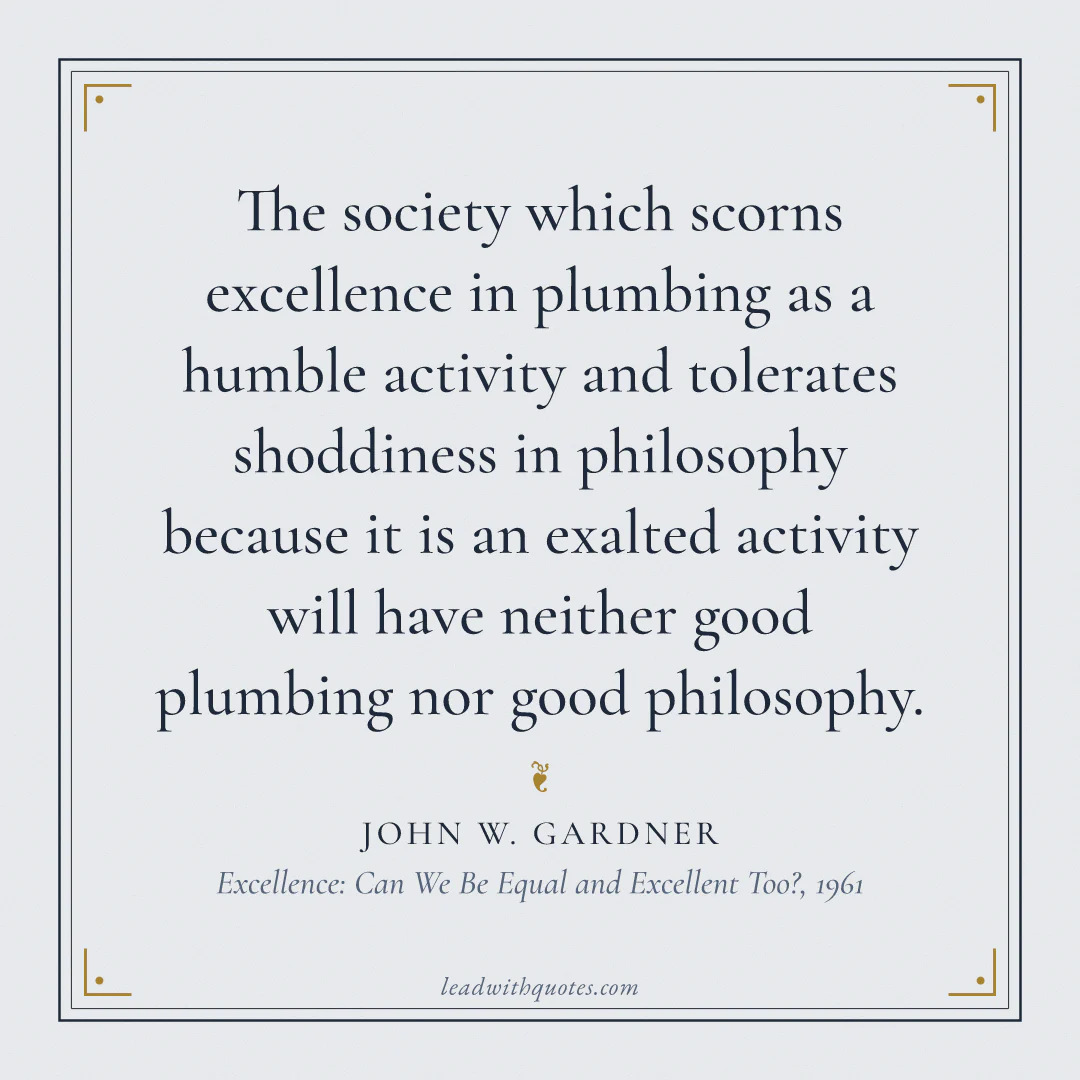
The society which scorns excellence in plumbing as a humble activity and tolerates shoddiness in philosophy because it is an exalted activity will have neither good plumbing nor good philosophy: neither its pipes nor its theories will hold water.
John W. Gardner, Excellence: Can We Be Equal and Excellent Too? (1961), via Wikiquote
This is the strongest excellence quote for a mixed workplace. It says the warehouse and the boardroom are held to the same standard, and it ends with a joke people remember. Use it at an all-hands where frontline and office teams are recognized together, or in a recognition program that wants to honor trades and technical roles. Our work ethic quotes page covers the neighboring idea, the dignity of hard work itself.
Twenty-one years later two McKinsey consultants, Tom Peters and Robert H. Waterman Jr., made "excellence" a management word with In Search of Excellence (1982), a study of companies they judged to be consistently well run. Their conclusion was about values, not tactics:
Every excellent company we studied is clear on what it stands for, and takes the process of value shaping seriously. In fact, we wonder whether it is possible to be an excellent company without clarity on values and without having the right sorts of values.
Tom Peters and Robert H. Waterman Jr., In Search of Excellence (1982), p. 280, via Wikiquote
Several of the book's "excellent" companies stumbled within a few years, which critics have pointed out ever since. The values point has aged better than the list. It fits a strategy offsite or a values workshop, where the question is what the organization is excellent at and for, Plato's question again.
Peters kept writing about excellence for four more decades. One of his later rules is the most useful line on this page for a manager who wants to encourage risk:
Reward excellent failures. Punish mediocre successes.
Tom Peters, The Little Big Things: 163 Ways to Pursue Excellence (2010), p. 53, via Wikiquote
It separates the quality of the effort from the luck of the outcome. Use it in a retrospective after a well-run project that still missed, or when setting rules for an innovation budget. Leave out "punish" if your culture is fragile; "reward excellent failures" carries the point alone.
Which excellence quote fits which moment
| Moment | Line | Why it fits |
|---|---|---|
| Onboarding or training kickoff | Aristotle: "It makes no small difference ... whether we form habits of one kind or of another" | Early habits stick; sets the standard on day one |
| Development conversation | Aristotle: "made perfect by habit" | Growth is expected, and so is practice |
| Team kickoff on quality | Durant: "We are what we repeatedly do" (credited to Durant) | Short, true to Aristotle, honestly attributed |
| All-hands recognition, frontline and office | Gardner: "neither its pipes nor its theories will hold water" | Same standard for every kind of work |
| Retrospective after a well-run miss | Peters: "Reward excellent failures." | Judges the effort, not the luck |
| A perfectionist teammate | Voltaire: "seek the best in those matters; everywhere else let us avoid the chimera" | Permission to stop polishing what doesn't matter |
| Annual review | Aristotle: "one swallow does not make a summer" | Judge the year, not one week |
| Promotion announcement | Daniel 6:3-4: "an excellent spirit was in him" | Excellence as reliability under scrutiny |
How to use an excellence quote without sounding like a poster
"Excellence" is one of the most worn words in office décor, so the quote has to do more work than the word. Three habits help:
- Attach it to one concrete standard. Follow the quote with the specific thing it means for this team this quarter: response times, a review checklist, zero repeat defects. A quote with no standard behind it reads as decoration.
- Credit the right person. "As Will Durant put Aristotle's idea" costs four words and protects you from the colleague who knows the history. If a line has no source, say "attributed to", or pick one that has.
- Use the original's nuance. Aristotle says habits grow; Voltaire says not everything deserves the best; Peters says judge the effort. The nuance is usually kinder than the slogan, and people notice.
Two examples you can adapt:
Kickoff email: "Will Durant, summing up Aristotle, wrote that 'we are what we repeatedly do.' For us this quarter that means one thing: every customer reply gets a second read before it goes out. Not a big gesture, a habit. By March it should feel automatic."
Recognition note: "John Gardner wrote in 1961 that a society which looks down on good plumbing and excuses bad philosophy will end up with neither. Your rebuild of the returns process is the plumbing that let the rest of us look good this year. Thank you." For more ways to thank people, see our employee appreciation quotes; for quotes on setting the standard yourself, lead by example quotes.
Seven excellence quotes with the wrong name
| Quote as shared | Usually credited to | What the record shows |
|---|---|---|
| "We are what we repeatedly do. Excellence, then, is not an act, but a habit." | Aristotle | Will Durant's summary, printed in 1923 (Little Blue Book No. 39, p. 41) and again in 1926. See the first section. |
| "Quality is not an act, it is a habit." | Aristotle | A reworded copy of Durant's line with "quality" swapped in. Nothing like it is in the Ethics. |
| "Quality is never an accident; it is always the result of intelligent effort." | John Ruskin | Quote sites give no book, lecture or letter, and it is not on Wikiquote's Ruskin page. Quote Investigator has found other "Ruskin" business sayings unsupported (one example). Use "attributed to". |
| "Excellence is to do a common thing in an uncommon way." | Booker T. Washington | Quote collections cite no speech, book or date; a near-identical line is also credited to George Washington Carver. Unsourced for both. |
| "If you are going to achieve excellence in big things, you develop the habit in little matters." | Colin Powell | Printed in Oren Harari's The Powell Principles (2003), a book about Powell's leadership, per Wikiquote. Cite the book, not a Powell speech. |
| "The quality of a person's life is in direct proportion to their commitment to excellence." | Vince Lombardi | Not in the speech text on the official Lombardi site, and the wording varies ("man's", "his") from site to site. No dated source found. |
| "Perfect is the enemy of good." | Voltaire | Voltaire wrote "le mieux" (the best, or the better) and credited "a wise Italian"; the Italian proverb is in print by 1603 (Wikiquote). "Perfect" is a later translation. |
Several of these may be fine to use with "attributed to". The trouble starts when they go on a printed program or into a speech with a confident name attached. Our page of leadership quotes leaders never said covers the wider problem.
How we checked these quotes
Every quote on this page was matched against a fetched copy of its source. Durant's 1923 and 1926 texts were searched in the Internet Archive's scans. Aristotle is quoted from Ross's translation in the MIT Internet Classics Archive, with the Greek checked on Perseus. Plato is from Jowett's translation and the Bible verses from the King James text, both on Project Gutenberg. Voltaire's lines come from the French text on Wikisource; the English is our translation. Lombardi's speech is quoted from his official site. Gardner, Peters, Maugham and the reported 1959 Lombardi line are quoted as given on Wikiquote, which cites the books and pages; those editions were not examined in print, and the attributions say so. Our full method is on the how we verify page.