Mentor and Mentee Quotes: 20 Lines With Sources, From the Original Mentor to Today
20 mentor quotes checked at the source, from Homer's original Mentor to Seneca and Rita Pierson, with thank-you note tips and 7 misattributed lines.
A mentor, in the dictionary sense, is an experienced person who guides a less experienced one. The word is a name: Mentor is the old friend in Homer's Odyssey to whom Odysseus left his household, and whose shape the goddess Athena borrows to coach his son Telemachus. This page collects 20 mentor and mentee quotes whose wording and source we checked, starting with what that first Mentor actually said and ending with lines from Seneca, Marcus Aurelius, Isaac Newton, Bill Gates and the teacher Rita Pierson. Each quote comes with where it is from and when it fits: advice to a mentee, a thank-you to a mentor, a mentoring-program kickoff. There's also a table that matches lines to the four stages of a mentoring relationship, a short guide to writing a thank-you note, and seven popular "mentor quotes" with the wrong name or the wrong meaning attached. For more lines to use at work, see our leadership quotes for work hub.
The questions below are the ones people actually ask about mentors and mentor quotes. We answer each with sources, not guesses, and we say where a popular version differs from the original.
Where does the word "mentor" come from?
From a minor character who became famous by being impersonated. In Book II of the Odyssey, Mentor is introduced as "a friend of Ulysses" who "had been left in charge of everything with full authority over the servants" while the king was at Troy (Samuel Butler's 1900 translation, which uses the Latin names). He speaks up for Telemachus in the assembly and gets shouted down. A few lines later Athena (Butler's "Minerva") appears to the young man "in the likeness and with the voice of Mentor", and from then on most of Mentor's guidance in the poem is really the goddess's.
The word as a common noun came much later and through France. In 1699 the archbishop François Fénelon published Les Aventures de Télémaque, a best-selling novel in which Mentor (again Athena in disguise) escorts Telemachus around the Mediterranean and teaches him how to rule. As the summary of the dictionary record puts it, after Télémaque the name was adopted as a term for someone who shares wisdom with a less-experienced colleague, first attested in German in 1725, French in 1749 and English in 1750. So when a card says "mentor", it is quoting a novel about leadership as much as an epic.
What did the original Mentor say to Telemachus?
Two things worth quoting: a challenge and a reassurance. The challenge comes in Book II, when the young man has just announced a voyage he is not sure he can make:
Telemachus, if you are made of the same stuff as your father you will be neither fool nor coward henceforward, for Ulysses never broke his word nor left his work half done.
Athena in the form of Mentor, Homer, Odyssey Book II, tr. Samuel Butler (1900), Project Gutenberg
It is a classic mentor move: name the standard, then tell the person they can meet it. The speech goes on to say the voyage "will not be fruitless" and that she will find him a ship. Use it for someone stepping into a role that used to belong to a respected predecessor, a new team lead taking over from a founder, say. The second half ("never broke his word nor left his work half done") also stands alone as a description of the person they are following.
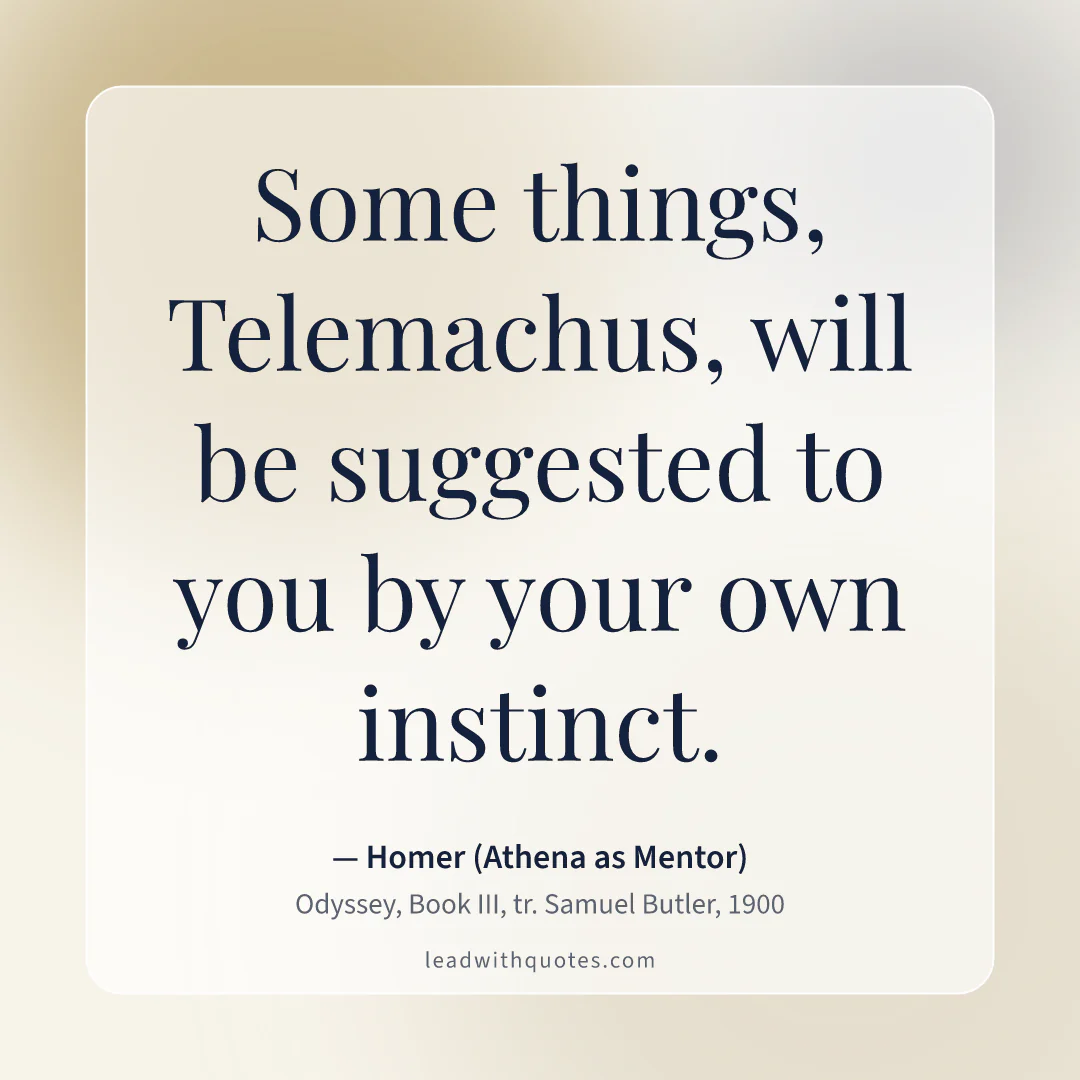
The reassurance comes in Book III. Telemachus has reached Pylos and is too shy to question old King Nestor, "one who is so much older than myself":
Some things, Telemachus, will be suggested to you by your own instinct, and heaven will prompt you further.
Athena in the form of Mentor, Homer, Odyssey Book III, tr. Samuel Butler (1900), Project Gutenberg
This is the oldest mentor-to-mentee line we know of, and it is about trust, not instruction. The mentor doesn't hand over a script for the conversation; she tells him he already has more than he thinks. It fits the night before someone's first big client meeting, first board presentation or first one-on-one as a manager. If "heaven" doesn't suit the setting, quote the first clause and stop.
What did Fénelon's Mentor teach about leading?
A lot, and much of it reads like a modern leadership book. Télémaque was written for the young Duke of Burgundy, the heir Fénelon was tutoring, so Mentor's lessons are a tutor's lessons to a future king. The translations below are ours, from the French text of the 18-book edition on Project Gutenberg; we give the French so you can check them.
It is true that a king is king only to take care of his people, as a shepherd cares for his flock, or a father for his family.
Mentor, in Fénelon, Les Aventures de Télémaque (1699), Book XVIII; French: "le roi n'est roi que pour avoir soin de son peuple, comme un berger de son troupeau, ou comme un père de sa famille"
Telemachus has just complained that a good king is "the least free" man in his kingdom, a slave to everyone's needs. Mentor agrees, then turns it around: isn't it a happiness to have good to do for so many people? It is the servant-leader idea 270 years before Robert Greenleaf named it, and it suits a mentor talking to a new manager who feels buried by other people's problems. That burden is the job, and it can also be the reward.
The best lines come at the very end, when Mentor turns back into Athena and speaks to Telemachus "for the last time":
Your mistakes have been no less useful to you than your misfortunes: for what man can govern wisely if he has never suffered, and never profited from the sufferings his mistakes have brought on him?
Athena (Mentor), Fénelon, Télémaque, Book XVIII; French: "Vos fautes ne vous ont pas été moins utiles que vos malheurs"
Most mentor quotes praise the mentor. This one, the farewell of the original mentor, credits the mentee's own mistakes. It's the right line for the end of a formal mentoring program or a goodbye to someone you've coached through a rough first year: what they learned came from what went wrong as much as from you.
Listen to everyone; believe few people; beware of trusting yourself too much. Be afraid of being wrong, but never be afraid of letting others see that you have been wrong.
Athena (Mentor), Fénelon, Télémaque, Book XVIII; French: "écoutez tout le monde ; croyez peu de gens"
The full French reads: "écoutez tout le monde ; croyez peu de gens ; gardez-vous bien de vous croire trop vous-même : craignez de vous tromper, mais ne craignez jamais de laisser voir aux autres que vous avez été trompé." Four instructions in one sentence, and the last is the most useful to a young leader: admitting a mistake in public is not the danger, making it is. If you want one line from the original mentor to put in a card, this is it. It pairs well with our active listening quotes, which cover the first instruction in more depth.
What does a mentor actually do, according to research?
The study most mentoring programs still lean on is Kathy Kram's "Phases of the Mentor Relationship" (Academy of Management Journal 26, no. 4, December 1983, pp. 608-625; DOI). Kram studied 18 developmental relationships as they unfolded and described four predictable, overlapping phases: initiation, cultivation (when the mentor's help reaches its widest range), separation (when a promotion, a move or simply growth changes the relationship), and redefinition (when it becomes something else, often closer to peers, or ends). The phases are a useful way to choose a quote, because what a mentee needs to hear changes at each stage:
| Phase (Kram 1983) | What the mentee needs | A line that fits |
|---|---|---|
| Initiation | Belief that they can do it | Homer, "Some things, Telemachus, will be suggested to you by your own instinct…" |
| Initiation | A clear standard | Homer, "…never broke his word nor left his work half done" |
| Cultivation | Time with you, not only advice | Seneca, "Cleanthes could not have been the express image of Zeno…" |
| Cultivation | Honest feedback | Gates, "We all need people who will give us feedback." |
| Separation | Permission to have struggled | Fénelon, "Your mistakes have been no less useful to you than your misfortunes…" |
| Separation | Rules to carry on alone | Fénelon, "Listen to everyone; believe few people…" |
| Redefinition | A way to say thank you | Marcus Aurelius on Rusticus; Newton's giants |
| Redefinition | A reason to pass it on | 2 Timothy 2:2, "…faithful men, who shall be able to teach others also" |
Which quotes can a mentor say to a mentee?
The strongest ones are about how mentoring works, not about how wonderful the mentee is. Seneca's sixth letter to his younger friend Lucilius, written in the 60s AD, is the classic statement:
Cleanthes could not have been the express image of Zeno, if he had merely heard his lectures; he shared in his life, saw into his hidden purposes, and watched him to see whether he lived according to his own rules.
Seneca, Moral Letters to Lucilius, Letter 6.6, tr. Richard M. Gummere (1917), Wikisource
Zeno founded Stoicism; Cleanthes succeeded him as head of the school. Seneca's point is that the succession happened because Cleanthes watched Zeno live, including whether Zeno followed his own rules. It's a fine line for a mentor to say at the start, as a promise and a warning: you'll learn more from watching how I work than from what I tell you, so hold me to it. The same letter has the famous sentence about precepts and patterns, which we quote on our lead by example page. Two sections earlier Seneca gives the mentor's own motive:
I am glad to learn in order that I may teach.
Seneca, Moral Letters to Lucilius, Letter 6.4, tr. Richard M. Gummere (1917), Wikisource
He adds that if wisdom were given him on condition that he keep it to himself, he would refuse it. Short enough for a mentoring-program slide, and honest about the fact that mentors get something out of it too.
From our own century, two lines from the same 2013 TED Talks Education series. Bill Gates opened his talk on teacher evaluation like this:
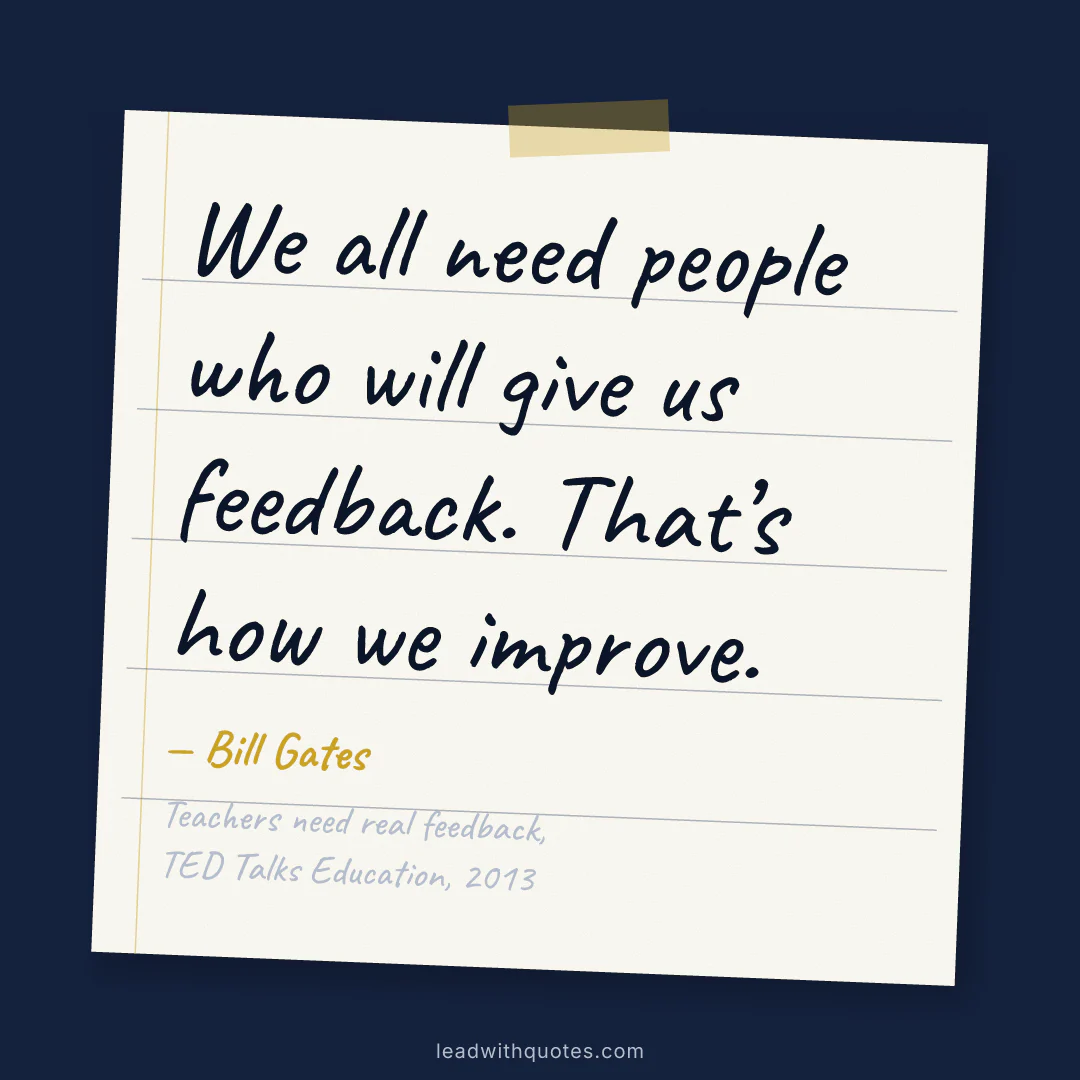
Everyone needs a coach. It doesn't matter whether you're a basketball player, a tennis player, a gymnast or a bridge player. … We all need people who will give us feedback. That's how we improve.
Bill Gates, "Teachers need real feedback", TED Talks Education, May 2013, TED transcript
The cut lines are a joke about his bridge coach, Sharon Osberg. The quote works when a mentor wants to make feedback normal: even Bill Gates has a coach. It's also a good answer to a mentee who reads your feedback as a sign they're failing.
Every child deserves a champion, an adult who will never give up on them, who understands the power of connection, and insists that they become the best that they can possibly be.
Rita Pierson, "Every kid needs a champion", TED Talks Education, May 2013, TED transcript
Pierson taught for 40 years, and this is the closing line of her talk. Note "insists": her champion is not only kind but demanding. That is why it works for mentor teachers and for workplace mentors alike. Earlier in the talk she tells of a colleague who said "They don't pay me to like the kids," and of her own reply:
Kids don't learn from people they don't like.
Rita Pierson, "Every kid needs a champion", TED Talks Education, May 2013, TED transcript
Adults are not so different. If a mentoring pair isn't working, this is the short diagnosis.
Finally, a line that's really for the mentee, about how mentors are found:
We need to stop telling them, 'Get a mentor and you will excel.' Instead, we need to tell them, 'Excel and you will get a mentor.'
Sheryl Sandberg, Lean In (2013), ch. 5, "Are You My Mentor?" (wording as quoted on Goodreads; we have not seen the printed page)
Sandberg was writing about advice given to young women, who she said were too often told that asking a stranger "Will you be my mentor?" was the way in. LeanIn.Org's own mentoring guide restates it as "if I excel, I will get a mentor" and adds that mentors pick people for performance and potential. It's a useful corrective to quote to someone who wants a mentor before they have shown anyone their work.
How do you thank a mentor with a quote?
The finest thank-you to mentors ever written is the first book of Marcus Aurelius's Meditations, a list of what he learned from each person who formed him. Of his Stoic teacher Junius Rusticus he wrote:
To Rusticus I am beholding, that I first entered into the conceit that my life wanted some redress and cure.
Marcus Aurelius, Meditations I.4, Meric Casaubon's translation (1634) as reprinted on Project Gutenberg
In plain English: Rusticus was the first to make me see that my life needed fixing. It's an emperor thanking his teacher for the criticism, not the praise. The entry goes on to thank Rusticus for teaching him to write letters without affectation and to forgive people who had offended him "as soon as any of them would be content to seek unto me again", and for giving him his own copy of Epictetus's moral commentaries. That is the model: thank a mentor for specific things. Near the end of Book I he adds a line any mentee who was a difficult student can borrow:
That having been often displeased with Rusticus, I never did him anything for which afterwards I had occasion to repent.
Marcus Aurelius, Meditations I.17, Casaubon translation, Project Gutenberg
He admits he was often annoyed with his teacher, and is grateful he never acted on it. Honest, and rarer in thank-you cards than it should be.
The other classic is about giants, and it's older than the man who made it famous. In 1159 the English scholar John of Salisbury wrote down what his teacher's teacher used to say:
Bernard of Chartres used to compare us to dwarfs perched on the shoulders of giants. He pointed out that we see more and farther than our predecessors, not because we have keener vision or greater height, but because we are lifted up and borne aloft on their gigantic stature.
John of Salisbury, Metalogicon (1159), in the English translation quoted on Wikipedia
Five centuries later Isaac Newton used the image in a letter to his rival Robert Hooke, dated 5 February 1675 (1676 by our calendar), now in the Historical Society of Pennsylvania:
What Des-Cartes did was a good step. You have added much several ways, & especially in taking the colours of thin plates into philosophical consideration. If I have seen further it is by standing on the shoulders of Giants.
Isaac Newton, letter to Robert Hooke, 5 February 1675/6, as transcribed on Wikipedia (HSP catalog record)
Two cautions before you put it in a card. Newton's letter credits Descartes and Hooke, not a teacher, and some historians read it as a polite move in a quarrel rather than humility. And the image was a commonplace by 1676. Quoting Bernard, via John of Salisbury, is both more accurate and a better fit for a mentor: Bernard was literally a teacher talking to students about their teachers.
A three-part thank-you note to a mentor
- One specific thing they did. Not "for everything", but the meeting they sat in on, the draft they returned covered in notes, the call they made for you. Marcus Aurelius thanks Rusticus for a book he gave him.
- What it changed. A decision you made differently, a habit you still have, a job you got.
- One line, credited properly. Put the quote last, so it sums up rather than replaces what you said.
Two examples you can adapt:
- "When you made me rewrite the Q3 plan three times, I was annoyed; I now do the same to my own team's drafts. Marcus Aurelius thanked his teacher for showing him his work 'wanted some redress and cure.' Thank you for doing that for me."
- "You introduced me to half the people I now work with and never once asked for credit. Bernard of Chartres said we see farther because we're 'lifted up and borne aloft' by those before us. I've been standing on your shoulders for three years."
If your mentor is a manager who is leaving or retiring, our farewell quotes for a boss page has lines for the goodbye itself.
What does the Bible say about mentorship?
The word isn't there, but the relationship is, most clearly in Paul's letters to his younger colleague Timothy and in the prophet Elijah's training of Elisha. All verses below are from the King James Version as printed in the Project Gutenberg KJV.
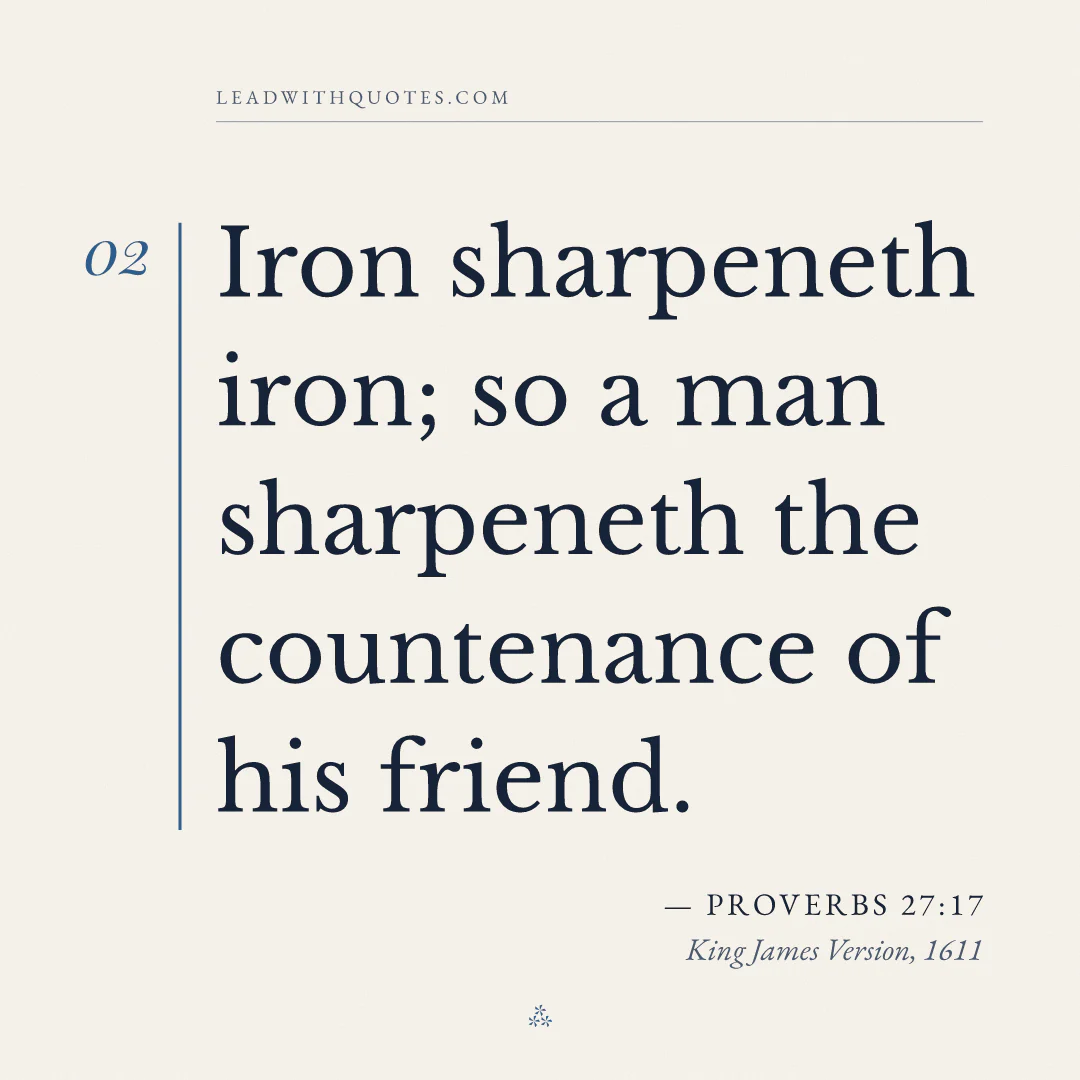
Iron sharpeneth iron; so a man sharpeneth the countenance of his friend.
Proverbs 27:17 (KJV)
The most-used mentoring verse, and a two-way one: both pieces of iron get sharper. It suits peer mentoring and reverse mentoring better than a top-down program.
He that walketh with wise men shall be wise: but a companion of fools shall be destroyed.
Proverbs 13:20 (KJV)
The Bible's version of Seneca's Cleanthes line: you become like the people you spend time with. For a card, the first half is enough.
And the things that thou hast heard of me among many witnesses, the same commit thou to faithful men, who shall be able to teach others also.
2 Timothy 2:2 (KJV)
Paul to Timothy, and the clearest statement of mentoring as a chain: what you received, hand on to people who will hand it on again. It is the right verse for a mentee who has become a mentor.
And Elisha said, I pray thee, let a double portion of thy spirit be upon me.
2 Kings 2:9 (KJV)
Elijah, about to be taken up, asks his apprentice what he wants before they part; Elisha asks for a double portion, the share the law gives a firstborn son (Deuteronomy 21:17). Elijah answers "Thou hast asked a hard thing" (2:10). A good mentee asks for a lot. For the servant-leadership side of the Bible, see our servant leadership Bible verses.
Is "Our chief want in life is somebody who shall make us do what we can" about mentors?
Not in the original. It is a regular on mentor-quote lists, usually credited simply to Emerson, and the wording is right:
Our chief want in life, is, somebody who shall make us do what we can. This is the service of a friend.
Ralph Waldo Emerson, "Considerations by the Way", The Conduct of Life (1860), Project Gutenberg
The second sentence, almost always cut from the lists, says who Emerson means: a friend. The paragraph is about "the covenant of friendship", and he goes on, "With him we are easily great." It's still a fine thing to say to a mentor, and arguably a better compliment: you treated me as a friend, not a project. Just don't present it as Emerson's definition of a mentor.
Which popular mentor quotes have the wrong name on them?
Several of the lines that top mentor-quote lists were never said by the person credited, or were said about something else. Here are the seven we checked:
| Quote as shared | Usually credited to | What we found |
|---|---|---|
| "Tell me and I forget, teach me and I remember, involve me and I learn." | Benjamin Franklin | No evidence Franklin wrote it; the earliest partial match is in the Confucian philosopher Xunzi, 3rd century BC (Quote Investigator). |
| "They may forget what you said, but they will never forget how you made them feel." | Maya Angelou | Earliest known print is 1971, credited to Carl W. Buehner, an LDS church official, in Richard Evans' Quote Book (Quote Investigator). |
| "When the student is ready, the teacher will appear." | Buddha, Lao Tzu | Not in the Tao Te Ching (we searched Legge's 1891 translation, Gutenberg), and we found no early source tying it to the Buddha. Use it as a proverb. |
| "A mentor is someone who allows you to see the hope inside yourself." | Oprah Winfrey | Quote sites repeat it with no interview, date or transcript; we found none. Use "attributed to". |
| "The delicate balance of mentoring someone is not creating them in your own image, but giving them the opportunity to create themselves." | Steven Spielberg | Same pattern: widely shared, no interview or year given anywhere we looked. Use "attributed to". |
| "Our chief want in life is somebody who shall make us do what we can." | Emerson, "on mentors" | Real (1860), but about a friend; see the section above. |
| "If I have seen further it is by standing on the shoulders of giants." | Isaac Newton, "on his teachers" | Real (1676 letter), but the image goes back at least to Bernard of Chartres via John of Salisbury (1159), and Newton was crediting Descartes and Hooke. |
The Oprah and Spielberg lines may well be genuine; the problem is that nobody who shares them says where they come from. For a card that's fine with an "attributed to". For a speech or a printed program, pick a line you can cite. Our page of leadership quotes leaders never said covers the wider problem.
How we checked these quotes
Every quote was matched against a fetched copy of its source: Butler's Odyssey, the French Télémaque, the Casaubon Meditations, Emerson's Conduct of Life, the KJV and Legge's Tao Te Ching on Project Gutenberg; Gummere's Seneca on Wikisource; the TED transcripts for Gates and Pierson. The Fénelon translations are ours, with the French alongside. For John of Salisbury and Newton we relied on the published translation and transcription quoted in Wikipedia's article on the phrase, and we link the Pennsylvania archive's record of the letter. Sandberg's wording is from a quote database and is labelled as such. Misattribution findings come from Quote Investigator's dated citations. The details of Kram's 1983 study are from the journal record and the article's published abstract. Our full method is on the how we verify page.