End of Year Quotes for Work: 23 Sourced Lines for the Last Meeting, the Year-End Note and January
23 end of year quotes for work, from Dickens and Tennyson to Bible verses, sorted by moment and traced to their sources, plus 11 year-end misquotes fixed.

Why does almost every year-end email to a team open with a quote? Partly habit, and partly because the last weeks of December ask a manager to do two things at once: close the books on a year and open the next one. This page collects 23 end of year quotes for work, each traced to the book, poem, letter, essay or verse it comes from, and sorts them by the moment you would actually use one: the last team meeting, the year-end note or card, the review or retrospective, the business year-end, the January kickoff, and the office party. It also has five Bible verses for the end of the year, a table of short lines, a three-part way to write a year-end note, and eleven end of year quotes that carry the wrong name or the wrong words.
Why the end of the year makes everyone reach for a quote
The idea of a year that looks backward and forward at once is older than the office calendar. The Roman poet Ovid opened Book I of his Fasti, the book about January, with a conversation with Janus, the two-faced god the month is named after. Asked why he alone has two faces, Janus answers:
Every door has two fronts, this way and that, whereof one faces the people and the other the house-god; and just as your human porter, seated at the threshold of the house-door, sees who goes out and in, so I, the porter of the heavenly court, behold at once both East and West.
Ovid, Fasti, Book I, tr. James G. Frazer (Loeb Classical Library, 1931)
We read the Frazer translation on Theoi. Note what Janus calls himself: a porter, a doorkeeper, not "the door of the year" as some posters put it. That is still a useful picture for a team lead in December. Your job at the threshold is to see clearly what is leaving and what is coming in, and to let both through in good order.
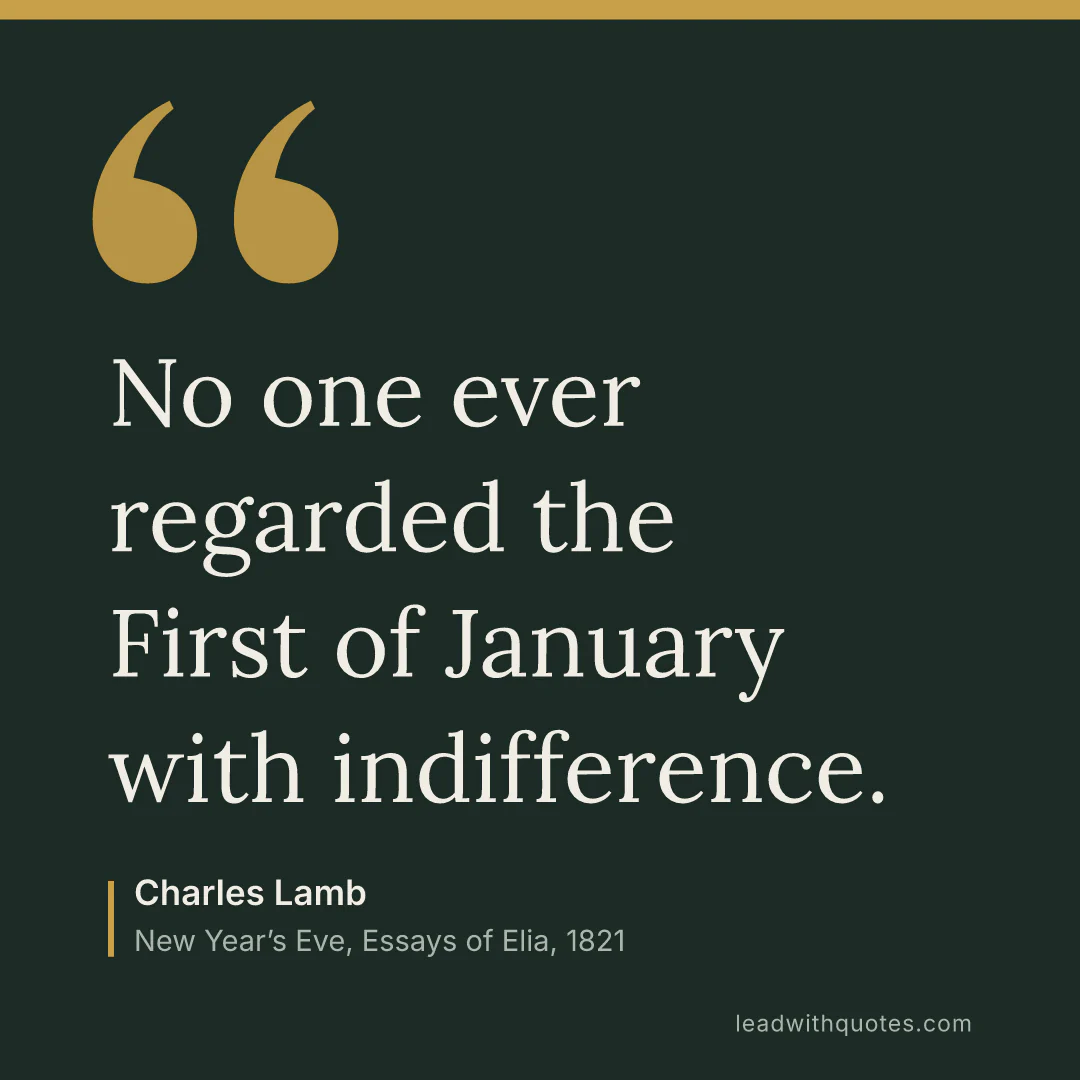
No one ever regarded the First of January with indifference. It is that from which all date their time, and count upon what is left.
Charles Lamb, "New Year's Eve," London Magazine, January 1821; collected in Essays of Elia (1823)
Lamb wrote this essay under his pen name Elia, and the sentence just before it says the birth of a new year is "of an interest too wide to be pretermitted by king or cobbler." His point is that everyone has two birthdays: their own, and the first of January, when people "count upon what is left." The checked wording has a capital F in "First" (Project Gutenberg, Works of Charles and Mary Lamb, vol. 2). The line works well at the top of a planning document, because it names the feeling behind every year-end deadline: the time left is suddenly countable.
For the last team meeting of the year
The last meeting before the break is short and a little sentimental. A line here should mark an ending without turning it into a eulogy. The two most quoted passages come from the same poem, and they are usually printed wrong.
For last year's words belong to last year's language
And next year's words await another voice.T. S. Eliot, "Little Gidding," section II (1942)
These lines come from the scene in "Little Gidding" where the poet, walking at dawn after an air raid, meets a "familiar compound ghost" who tells him to let old arguments go. In a meeting they say something every team needs in December: the way we described our work this year will not fit next year, and someone new may be the one to describe it. They fit a closing slide after a reorganization or a product change.
What we call the beginning is often the end
And to make an end is to make a beginning.T. S. Eliot, "Little Gidding," section V (1942)
Many sites print "For last year's words…" and "And to make an end is to make a beginning" as one three-line quote. They are from different sections of the poem, II and V. If you want both, use two quotes or an ellipsis. The section V lines suit a team that is shutting down a project; the poem continues "The end is where we start from," which you can read aloud if the room is ready for it.
Ring out the old, ring in the new,
Ring, happy bells, across the snow:
The year is going, let him go;
Ring out the false, ring in the true.Alfred Tennyson, In Memoriam A. H. H. (1850), section CIV in the first edition (CVI in later editions)
Tennyson wrote In Memoriam over seventeen years of grief for his friend Arthur Hallam, and this New Year's Eve section is the point where the poem turns from mourning to hope. We checked the stanza in the 1850 Moxon first edition on Project Gutenberg, which numbers it CIV; later editions call it CVI. "Ring out the false, ring in the true" is the line to borrow for a team that spent the year fixing something broken, such as a process, a codebase or a reputation.
For the year-end email or card to your team
A year-end note is a thank-you with a calendar attached. The quote should carry the thanks; your own sentences should carry the specifics. If you need lines that are only about thanks, our employee appreciation quotes are sorted by how you give them, including a year-end speech.
I will honour Christmas in my heart, and try to keep it all the year. I will live in the Past, the Present, and the Future. The Spirits of all Three shall strive within me. I will not shut out the lessons that they teach.
Charles Dickens, A Christmas Carol, Stave IV, "The Last of the Spirits" (1843)
Scrooge says this on his knees at his own neglected grave, which is why the line is so often credited to the happy last chapter: it is in fact the end of Stave IV, a moment before he wakes (Gutenberg text). For a team note, the middle two sentences are enough. They say a year-end message should do three jobs: honor what happened, deal with the present, and make a promise about what comes next.

Gratitude makes sense of our past, brings peace for today, and creates a vision for tomorrow.
Melody Beattie, The Language of Letting Go (Hazelden, 1990)
Beattie's book is a collection of daily meditations for people recovering from codependency, not a management text, and that is part of why the line works in a team note: it is plain about what gratitude does. Quote sites that give a page number cite p. 218. We could only confirm the line through secondary sources, not a copy of the book, so treat the page number as reported. Pair it with one sentence naming what the team actually did this year; the line is too general to carry a note alone.
For a year-end review or team retrospective
The year-end review is where quotes can do real work. They set the tone of the conversation before anyone looks at a number. The three below are less famous than the poster lines, but each one comes with a method attached.
The only way to discover your strengths is through feedback analysis. Whenever you make a key decision or take a key action, write down what you expect will happen. Nine or 12 months later, compare the actual results with your expectations.
Peter F. Drucker, "Managing Oneself," Harvard Business Review (1999)
Drucker called this "feedback analysis" and presented it as a habit anyone can keep, not a company process. HBR's own page is paywalled; we checked the wording against the passage quoted in a PBS NewsHour column that applies the method to a year of predictions. December is the natural "nine or 12 months later" for anything decided in the first quarter. Read it out before a review and ask everyone to bring one prediction they made in January and what actually happened.
Regardless of what we discover, we understand and truly believe that everyone did the best job they could, given what they knew at the time, their skills and abilities, the resources available, and the situation at hand.
Norman L. Kerth, the Retrospective Prime Directive, Project Retrospectives: A Handbook for Team Reviews (2001)
Kerth wrote this for software teams looking back at a finished project, and agile teams still read it aloud at the start of a retrospective. We took the wording from the Retrospective Wiki; some printings of the book read "must understand" and "his or her," so small variants are normal. It is the best line on this page for a year that went badly, because it moves the review from blame to learning. For other lines that frame a meeting, see our quotes for team meetings, which also uses the Prime Directive.
To 'learn from experience' is to make a backward and forward connection between what we do to things and what we enjoy or suffer from things in consequence.
John Dewey, Democracy and Education, chapter 11, "Experience and Thinking" (1916)
This is what Dewey really wrote about learning from experience. The popular line "We do not learn from experience… we learn from reflecting on experience" is not in his books (see the table below). The real sentence is better for a review anyway: "backward and forward" is a year-end in three words, and "enjoy or suffer" admits that some lessons were expensive. Dewey's text is on Project Gutenberg.
For the business year-end: results, targets and next year's plan
Year-end business messages tend to oversell the year just finished and overpromise the next. The two lines below are, in effect, warnings against both, which makes them good openers for a planning offsite.
People tend to overestimate what can be done in one year and to underestimate what can be done in five or ten years.
J. C. R. Licklider, Libraries of the Future (MIT Press, 1965), quoting what he called a "modern maxim"
This is the earliest printing of the "one year / ten years" saying that Quote Investigator found, and even Licklider did not claim it as his own. It is usually credited to Bill Gates today. Use it when a team is discouraged that this year's plan was only half done: the half that got done may matter more than it looks over a five-year horizon.
People often overestimate what will happen in the next two years and underestimate what will happen in ten. I'm guilty of this myself.
Bill Gates, The Road Ahead, second edition, Afterword (1996)
This is Gates's own version, as quoted by Quote Investigator: two years, not one, and a confession at the end. The second sentence is the useful part in a leadership message. A CEO who says "I'm guilty of this myself" about last year's forecast gets a more honest planning conversation than one who explains the miss.
Be at War with your Vices, at Peace with your Neighbours, and let every New-Year find you a better Man.
Benjamin Franklin, Poor Richard Improved, December (1755)
Franklin printed this in the December pages of his almanac for 1755; the text is in the Papers of Benjamin Franklin, vol. 5, on Founders Online. Most versions online modernize it to "each new year." Quote Investigator notes that Franklin often reworked older proverbs, and this may be one of them. It suits a small-business owner's year-end note to staff better than a corporate one: it is about character, not targets.
Motivational end of year quotes for employees and the January kickoff
The motivational line belongs at the turn of the year: in the last message before the break or the first one after it. These three push forward without promising a perfect year. For more on opening a kickoff talk, see quotes to start a presentation.
One of the illusions is that the present hour is not the critical, decisive hour. Write it on your heart that every day is the best day in the year.
Ralph Waldo Emerson, "Works and Days," Society and Solitude (1870)
Emerson's essay is about time, and its argument is that people always think the important day is some other day. We matched the text in the 1870 edition on Project Gutenberg. The second sentence is the famous one, but the first is the one a team needs in late December, when it is tempting to treat the last two weeks as already over.

And now let us believe in a long year that is given to us, new, untouched, full of things that have never been, full of work that has never been done…
Rainer Maria Rilke, letter to Clara Rilke, Capri, 1 January 1907, tr. Jane Bannard Greene and M. D. Herter Norton (1945)
The poster version says "let us welcome the new year." Rilke wrote "believe in a long year," and the full sentence goes on about "tasks, claims, and demands," which makes it a better quote for work than the greeting-card version. He was writing to his wife on New Year's Day; we read the letter in the 1945 Norton translation on the Internet Archive. "Work that has never been done" is a fine line for a team starting a new product or a new role.
I hope that in this year to come, you make mistakes. Because if you are making mistakes, then you are making new things, trying new things, learning, living, pushing yourself, changing yourself, changing your world.
Neil Gaiman, "My New Year Wish," his journal, 31 December 2011
Gaiman posted New Year wishes on his blog for years, and this 2011 one is the most shared. In a workplace it gives permission: from a manager, "I hope you make mistakes this year" is a strong signal that experiments are allowed. Say it only if you mean it, and only if the next mistake will not be held against anyone.
Funny end of year quotes for the office
Year-end humor at work is mostly about resolutions. Both of these are a century or more old and still land at a team lunch.
Good resolutions are useless attempts to interfere with scientific laws. Their origin is pure vanity. Their result is absolutely nil. … They are simply cheques that men draw on a bank where they have no account.
Oscar Wilde, The Picture of Dorian Gray, chapter VIII (1891)
Lord Henry says this to Dorian right after a death that Dorian caused through cruelty. In the novel it is a cynical comfort, not a joke, so credit it to the character if you print it. At the office, the last sentence works on its own for a slide about New Year's resolutions or next year's budget asks. We checked the 1891 text on Project Gutenberg.
Now is the accepted time to make your regular annual good resolutions. Next week you can begin paving hell with them as usual.
Mark Twain, Territorial Enterprise (Virginia City, Nevada), 1 January 1863
Twain was 27 and writing local news for a Nevada paper; this comes from a mock New Year's Day column (transcript). It plays on the proverb that the road to hell is paved with good intentions. It is a safe joke for a team chat on December 31: it teases everyone equally and no one in particular.
Bible verses for the end of the year
For faith-based organizations, chaplaincy teams and many small businesses, a verse is the natural year-end line. All five below are in the King James Version, checked on Bible Gateway.
To every thing there is a season, and a time to every purpose under the heaven.
Ecclesiastes 3:1 (KJV)
The most used verse at any ending. It suits a farewell to a project or a team that is being reorganized, because it frames the change as timing rather than failure.
It is of the LORD's mercies that we are not consumed, because his compassions fail not. They are new every morning: great is thy faithfulness.
Lamentations 3:22-23 (KJV)
Written after the fall of Jerusalem, in a book of laments. "New every morning" is a quiet way to tell a tired team that January really is a fresh start.
Brethren, I count not myself to have apprehended: but this one thing I do, forgetting those things which are behind, and reaching forth unto those things which are before, I press toward the mark…
Philippians 3:13-14 (KJV)
Paul admits he has not arrived and keeps going anyway. It is the best verse here for a year-end goal-setting session.
So teach us to number our days, that we may apply our hearts unto wisdom.
Psalm 90:12 (KJV)
This is Lamb's "count upon what is left," many centuries earlier. Use it for a reflective, unhurried year-end message.
Remember ye not the former things, neither consider the things of old. Behold, I will do a new thing; now it shall spring forth; shall ye not know it?
Isaiah 43:18-19 (KJV)
A verse for a hard year that you would rather not dwell on. It suits a January kickoff after a difficult twelve months.
Short end of year quotes: which line for which moment
| Moment | Short line | Source |
|---|---|---|
| Subject line of a year-end email | "The year is going, let him go." | Tennyson, In Memoriam, 1850 |
| Last slide of the last meeting | "To make an end is to make a beginning." | Eliot, "Little Gidding" V, 1942 |
| Opening a retrospective | "Everyone did the best job they could, given what they knew at the time." | Kerth, 2001 (shortened) |
| Planning offsite | "I'm guilty of this myself." | Gates, The Road Ahead, 1996 |
| Last working day before the break | "Every day is the best day in the year." | Emerson, 1870 |
| Team chat on December 31 | "Simply cheques that men draw on a bank where they have no account." | Wilde, 1891 (Lord Henry, on resolutions) |
| First message in January | "Full of work that has never been done." | Rilke, 1907 letter |
| Faith-based team card | "They are new every morning." | Lamentations 3:23 |
Shortened lines are fine on a slide or in a subject line, but the full quote and source should appear somewhere a reader can find them, such as the body of the email or the speaker notes.
How to write a year-end note to your team
The quote is the easy part. A year-end note that people remember has three parts, in this order:
- One specific thing the team did. Name the launch, the hard quarter, the customer you kept. "Thanks for all your hard work" is the line everyone skims past.
- One line that frames it. Pick the quote for what the year was, not for how you want to sound: Tennyson for a year of fixing things, Kerth for a year that went badly, Rilke for a year of new starts.
- One sentence about January. A date, a first priority, or a promise you can keep, such as "no meetings in the first week back."
Example 1, a hard year: "This year we rebuilt the billing system while customers were still using it, and we lost two people we wish we'd kept. Tennyson's line fits: 'Ring out the false, ring in the true.' The new system is live. In January we start with one week of fixing whatever annoyed you most about it."
Example 2, a good year: "We shipped four releases and kept every customer we started with. Dickens has Scrooge promise to 'live in the Past, the Present, and the Future.' Keep this year's habits, enjoy the break, and come back on the 5th ready for a plan that, as Gates warned, will probably take longer than we think."
Keep it under 150 words, and send it before the last day, not on it, when half the team is already offline.
End of year quotes with the wrong name
Year-end quote lists repeat each other, so a wrong credit spreads every December. These eleven are the ones that turn up most often; more corrections are in our running list of leadership quotes leaders never said.
| Line as shared | Usually credited to | What the record shows |
|---|---|---|
| "We do not learn from experience… we learn from reflecting on experience." | John Dewey | Not in How We Think (1910) or Democracy and Education (1916); a 2014 study by Robert Lagueux calls it spurious. His real line is quoted above. |
| "By three methods we may learn wisdom: First, by reflection, which is noblest…" | Confucius | Not in the Analects. The earliest known printing is James Wood's Dictionary of Quotations (1893). The closest real line is "Learning without thought is labour lost; thought without learning is perilous" (Analects II.15, Legge). |
| "Most people overestimate what they can do in one year and underestimate what they can do in ten years." | Bill Gates | An anonymous maxim, first printed by J. C. R. Licklider in 1965. Gates's 1996 wording is "two years" and "ten." |
| "And now let us welcome the new year, full of things that have never been." | Rainer Maria Rilke | Right author, altered words: the 1907 letter says "believe in a long year." |
| "And suddenly you know: It's time to start something new and trust the magic of beginnings." | Meister Eckhart | No Eckhart text contains it; Wikiquote lists it as disputed. It is a modern line, and the "magic of beginnings" image recalls Hermann Hesse's poem "Stufen" (1941). |
| "For last year's words belong to last year's language… And to make an end is to make a beginning." | T. S. Eliot | Right author, but two sections of "Little Gidding" (II and V) joined as one passage. |
| "Let each new year find you a better man." | Benjamin Franklin | Modernized. The 1755 almanac reads "let every New-Year find you a better Man." |
| "The year's end is neither an end nor a beginning but a going on…" | Hal Borland | No book, column or date located, only quote sites. Borland did write year-end nature editorials, so the credit is plausible but unproven. |
| "An optimist stays up until midnight to see the new year in. A pessimist stays up to make sure the old year leaves." | Bill Vaughan | Plausible: Vaughan wrote one-liners for the Kansas City Star. But no dated column has been located, so the credit is unproven. |
| "We will open the book. Its pages are blank… The book is called Opportunity and its first chapter is New Year's Day." | Edith Lovejoy Pierce | No original publication found; it appears only on blogs and quote sites. |
| "Feeling gratitude and not expressing it is like wrapping a present and not giving it." | William Arthur Ward | No book or year found; listed as "attributed" by the WIST quotation archive. |
The four unproven credits (Borland, Vaughan, Pierce, Ward) may well be right; we just could not find where they first appeared. If you use one, write "attributed to" before the name.
How we checked these quotes
Every quote on this page was matched against a fetched copy of its source: Project Gutenberg texts for Lamb, Tennyson (1850 first edition), Dickens, Wilde (1891), Emerson and Dewey; Theoi for Frazer's Ovid; the Internet Archive for the 1945 Rilke letters; Gaiman's own journal; the twainquotes.com transcript of the Territorial Enterprise; the Retrospective Wiki for Kerth; Founders Online and Quote Investigator for Franklin; Quote Investigator for Licklider and Gates; and Bible Gateway for the KJV verses. Eliot's poem is still in copyright, so we quote only short passages and checked their section placement against two independent online transcriptions. Two citations rest on reliable secondary sources and say so: Drucker (PBS NewsHour quoting "Managing Oneself") and Beattie (quotation sites citing the 1990 book). Lines we could not trace are in the table above, not in the quote list.