Quotes to Start a Presentation: 13 Sourced Openers, Matched to the Talk You're Giving
13 quotes to start a presentation, Cicero to Seinfeld, each traced to its source and matched to a talk type, plus 11 popular openers with the wrong name.

More than two thousand years ago, Cicero wrote that the opening of a speech has three jobs: make the audience well disposed toward you, make them attentive, and make them ready to learn. A quote to start a presentation is worth using only if it does at least one of those jobs. This page gives you 13 quotes to start a presentation, each traced to the letter, book, play or stage show it comes from, sorted by the kind of talk you are giving: a short update, a training session, a proposal, a strategy deck, a data review, a nervous first talk. After the quotes comes a 30-second method for saying one out loud, a way to reuse your opener as your close, and eleven popular opening lines that fail a source check.
Cicero's test: the three jobs of an opening line
Cicero wrote On Invention as a young man, a handbook on how to build a speech, and its opening chapters are still the shortest explanation of what the first minute of a talk is for.
An exordium is an address bringing the mind of the hearer into a suitable state to receive the rest of the speech; and that will be effected if it has rendered him well disposed towards the speaker, attentive, and willing to receive information.
Cicero, On Invention, Book I, ch. 15 (§20), translated by C. D. Yonge (1853)
The "exordium" is the opening, and Yonge's translation is on Wikisource. Turn the three parts into a test before you pick a quote. Goodwill: does the line make the room like you a little, usually through humor or honesty? Attention: does it surprise, or name a problem people care about? Readiness: does it set up what you are about to explain? Every quote below is tagged with the job it does best in the table further down. A quote that does none of the three is decoration, and the audience can tell.
Openers for a short update or a status report
When you have five minutes on a crowded agenda, an opener that admits brevity is a promise. Both of these are about keeping it short, and both have a twist that makes them better than the usual "I'll be brief."
I have made this one longer only because I did not have the leisure to make it shorter.
Blaise Pascal, Provincial Letters, Letter XVI (dated 4 December 1656, collected 1657); French: "Je n'ai fait celle-ci plus longue que parce que je n'ai pas eu le loisir de la faire plus courte"
Pascal tacked this apology onto the end of a long polemical letter defending the Jansenists against the Jesuits. The English above is Quote Investigator's rendering; versions such as "I would have written a shorter letter, but I did not have the time" are looser translations (Quote Investigator, which also finds the same idea in Locke, Franklin and Thoreau, and says it is wrongly credited to Mark Twain). As an opener it signals that you did take the time: "Pascal once apologized for a long letter because he hadn't had time to write a short one. I took the time. This update is four slides."
Therefore, since brevity is the soul of wit, / And tediousness the limbs and outward flourishes, / I will be brief.
William Shakespeare, Hamlet, Act 2, Scene 2 (Polonius)
The joke inside this line is that Polonius is the most long-winded character in the play: he says he will be brief and then talks on until the Queen cuts him off with "More matter, with less art" (Folger Shakespeare Library). Use that. Quote the line, mention who says it, and promise to do better than Polonius. Quoting it straight, as if Shakespeare were endorsing brevity, misses the point and anyone who knows the play will notice.
For a training session or a technical walkthrough
Training talks fail when the presenter assumes understanding instead of checking it. These two lines name that problem before it happens, which makes the audience more willing to ask questions.
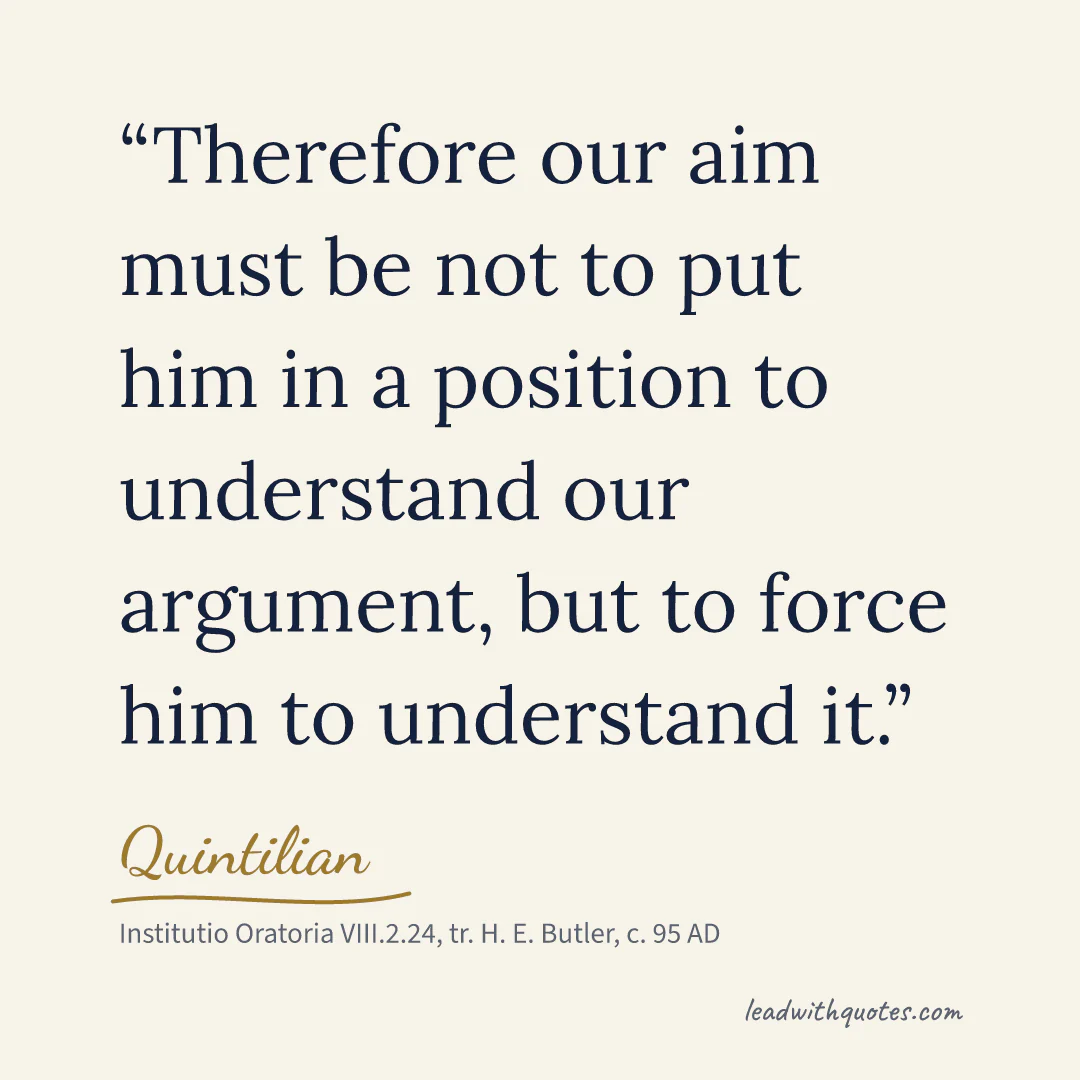
Therefore our aim must be not to put him in a position to understand our argument, but to force him to understand it.
Quintilian, Institutio Oratoria, VIII.2.24, translated by H. E. Butler (Loeb, 1920–22); Latin: "Quare non ut intellegere possit sed ne omnino possit non intellegere curandum"
Quintilian, Rome's best-known teacher of rhetoric, was writing about how to speak to a judge who might be distracted. Clarity has to be built so strong that the listener cannot miss it (LacusCurtius, Butler's translation). The popular "speak not so that you can be understood, but so that you cannot be misunderstood" is a paraphrase of this Latin, so credit it as such if you use the short form. It opens a technical session well because it puts the burden on the speaker, not on the audience.
The great enemy of communication, we find, is the illusion of it.
William H. Whyte, "Is Anybody Listening?", Fortune, September 1950
Whyte, later the author of The Organization Man, wrote this in a Fortune series on why corporate communication programs were not working. The line now circulates as George Bernard Shaw's "The single biggest problem in communication is the illusion that it has taken place." Quote Investigator traces that Shaw credit only as far back as a 1994 business book (Quote Investigator). Credit Whyte, and you have a better opener for any session that rolls out a new process: "In 1950 a Fortune writer said the great enemy of communication is the illusion of it. Today I want to make sure we're not just under the illusion."
For a proposal, or a problem you need the room to solve
If you want something from the audience, a budget, a decision, help, the opener should frame the problem so the ask feels like the obvious answer.
It is a familiar and significant saying that a problem well put is half-solved.
John Dewey, Logic: The Theory of Inquiry (1938), Chapter VI, "The Pattern of Inquiry"
Note Dewey's own framing: he calls it a familiar saying, so he is endorsing the idea rather than claiming it (Wikiquote, with the book citation). The version credited to Charles Kettering, "A problem well stated is a problem half solved," has no source we could find. Dewey's chapter is about inquiry starting from a clearly stated problem, which is exactly what the first slide of a proposal should do. After the quote, state the problem in one sentence and stop.
Last year 1 million quarter-inch drills were sold … not because people wanted quarter-inch drills but because they wanted quarter-inch holes.
Leo McGivena, as quoted by Theodore Levitt, The Marketing Mode (1969), Chapter 1
This is the real 1969 wording; the cut is only Levitt's "Leo McGivena once said." Levitt, a Harvard Business School professor, was quoting the advertising man. The snappier "People don't want to buy a quarter-inch drill. They want a quarter-inch hole!" comes from a 2005 Harvard Business Review article by Clayton Christensen and co-authors, who credited it to Levitt (Quote Investigator). Either way it opens a sales pitch or a product proposal by moving attention from your feature to the customer's result. If you use the short form, say "as Ted Levitt used to tell his students."
For a strategy, roadmap or change presentation
Strategy talks ask people to imagine a different future. These three lines cover the three moods such a talk can have: confident, honest about change, and wary of repeating a mistake.
Look, the best way to predict the future is to invent it.
Alan Kay, "Predicting the Future," Stanford Engineering, Autumn 1989
Kay, a computer scientist at Xerox PARC, said it in a 1971 meeting when Xerox planners kept pressing the lab for forecasts. In his 1989 talk he told the story himself and added: "This is the century in which you can be proactive about the future; you don't have to be reactive" (Quote Investigator, which also notes the physicist Dennis Gabor's 1963 "futures can be invented"). The story behind it is the opener: someone asked for a forecast, and the answer was a plan. Use it to start a roadmap.

Heracleitus says, you know, that all things move and nothing remains still, and he likens the universe to the current of a river, saying that you cannot step twice into the same stream.
Plato, Cratylus 402a, translated by H. N. Fowler (Loeb, 1921)
This is Socrates in Plato's dialogue, reporting what Heraclitus said; Heraclitus's own book is lost apart from fragments quoted by later writers, and "everything flows" is later shorthand (Perseus, Fowler's translation). For a change presentation it is gentler than the usual "change is the only constant." It says the organization itself is already different from last year's, so the question is not whether to change but how to steer.
Those who cannot remember the past are condemned to repeat it.
George Santayana, The Life of Reason, Vol. I, Reason in Common Sense (1905), Chapter XII
Santayana's sentence comes at the end of an argument that progress depends on "retentiveness," on keeping what experience taught (Quote Investigator). Note the real words: "cannot remember" and "condemned," not "those who do not learn from history are doomed." It is the right opener for a lessons-learned review or a post-mortem, where you want the room to look back before arguing about what's next. Our page of quotes for team meetings has more lines for retrospectives.
For a data or metrics review
A numbers presentation can open with a warning about numbers. It tells the audience you know the limits of your dashboard, which makes them trust the rest of it more.
However, not everything that can be counted counts, and not everything that counts can be counted.
William Bruce Cameron, Informal Sociology (1963), p. 13
Cameron, a sociologist, wrote it in a short book about his own field's habits, just after a joke about wanting to "run them through IBM machines and draw charts as the economists do." The line is now usually credited to Albert Einstein, but Quote Investigator found that credit first in 1986, three decades after Einstein died (Quote Investigator). Use it to open a quarterly review, then show the one metric that matters most and the one thing your numbers don't capture.
Funny quotes to start a presentation, and settle your own nerves
A laugh in the first minute is the fastest way to win Cicero's first job, goodwill. Both of these work because they admit what everyone in the room already knows: speaking in public is scary, and "impromptu" talks are rehearsed.
Speaking in front of a crowd is considered the #1 fear of the average person. I found that amazing! #2 was death. This means, to the average person, if you have to be at a funeral, you would rather be in the casket than doing the eulogy.
Jerry Seinfeld, I'm Telling You for the Last Time (1998)
Seinfeld used the bit for years, and it exists in more than one wording; this one is from his 1998 stand-up special as cited on Wikiquote. An earlier TV version runs "better off in the casket," so don't mix the two. It is the best-known opener for a student presentation or a first talk at work because it turns your nerves into the joke. Keep it to one sentence of setup and get to your topic: the laugh is the point, not the survey it mocks.
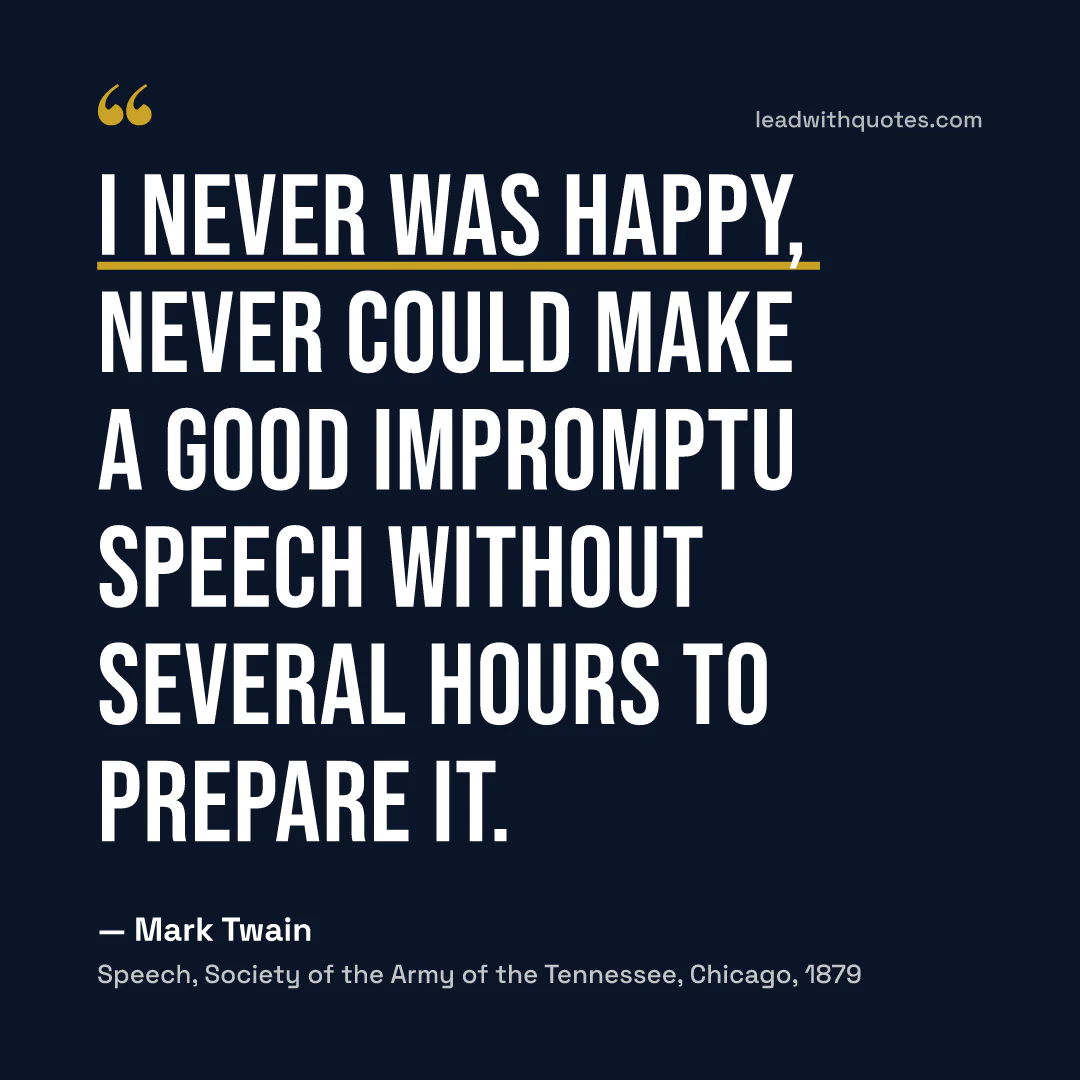
I never was happy, never could make a good impromptu speech without several hours to prepare it.
Mark Twain, speech to the Society of the Army of the Tennessee, Chicago, November 1879
Twain said this at a banquet for Union veterans, and it was printed in the society's report of the proceedings that year (Quote Investigator). The famous "It usually takes me more than three weeks to prepare a good impromptu speech" has no early source and first appears in a 2000 quotation book, so use this real one instead. It works best when you really are speaking off the cuff, or when you want to admit, with a smile, that your "quick thoughts" were rehearsed.
Which opener for which talk
| Talk | Quote | Cicero's job it does | Length to say |
|---|---|---|---|
| Short update, status report | Pascal, "longer only because…" | Goodwill | ~6 seconds |
| Any talk where you promise brevity | Shakespeare/Polonius, "brevity is the soul of wit" | Goodwill (with the joke) | ~5 seconds |
| Training, technical walkthrough | Quintilian, "force him to understand" | Readiness | ~6 seconds |
| New process, internal comms | Whyte, "the illusion of it" | Attention | ~4 seconds |
| Proposal, problem to solve | Dewey, "a problem well put" | Readiness | ~4 seconds |
| Sales pitch, product proposal | Levitt/McGivena, quarter-inch holes | Attention | ~7 seconds |
| Roadmap, vision | Alan Kay, "invent it" | Attention | ~4 seconds |
| Reorganization, change | Plato on Heraclitus, the river | Readiness | ~8 seconds |
| Post-mortem, lessons learned | Santayana, "condemned to repeat it" | Attention | ~4 seconds |
| Quarterly numbers, metrics review | Cameron, "not everything that counts" | Readiness | ~6 seconds |
| Student presentation, first talk | Seinfeld, the casket and the eulogy | Goodwill | ~12 seconds |
| Off-the-cuff remarks | Twain 1879, "several hours to prepare" | Goodwill | ~6 seconds |
| A talk about how to present | Cicero, the three jobs of an opening | Readiness | ~12 seconds |
The time is a rough reading speed for the quote alone. If the quote plus your bridge sentence runs past 30 seconds, pick a shorter line.
How to say a quote out loud in the first 30 seconds
A quote read off a slide in a flat voice is the weakest possible opening. A quote said, credited and then tied to the room in under half a minute is one of the strongest. Five steps, in this order:
- Stand still and wait two seconds. Let the room go quiet before the first word. The quote is your first sentence, not something you say while the clicker warms up.
- Say who, then the line. "In 1657, Blaise Pascal apologized at the end of a letter…" works better than reading the line and adding "— Pascal" as an afterthought. Named people and dates make listeners lean in; a dangling dash makes them check their phones.
- Say it from memory, short enough to remember. If you can't say the line without reading it, it is too long for an opener. Cut to the clause that matters and keep the wording exact.
- Bridge in one sentence. "That is the problem with our quarterly report: it's long because we didn't take the time to make it short." The bridge is what turns a quote into an opening. Without it, the audience waits for the point.
- Put the source on the slide, not in your mouth. A small credit line under the quote (author, work, year) answers the "did they really say that?" question nobody asks out loud. If a quote has no source you can name, don't use it.
A worked example for a project update, using Dewey: "In 1938 the philosopher John Dewey repeated an old saying: 'a problem well put is half-solved.' For six weeks we've been solving the wrong half. Here is the problem, put properly, in one slide." Twenty-two seconds, and the audience knows what the talk is about.
A worked example for a student presentation, using Seinfeld: "Jerry Seinfeld had a joke that at a funeral most people would rather be in the casket than doing the eulogy. I'm glad today is only a book report." The laugh buys you goodwill, and it admits the nerves everyone in the room shares.
Closing a presentation with the same quote
People who search for quotes to end a presentation are usually looking for a second, different line. A stronger move is to bring back your opener, with one change: at the start it set up a question, at the end it carries your answer. "Dewey said a problem well put is half-solved. We put the problem; this plan is the other half." "Kay said the best way to predict the future is to invent it. Here is what we're inventing in Q3." A callback signals that the talk was planned from first slide to last, and the audience remembers one line instead of two. If you do want a separate closing line, the same rule applies as for openers: say who said it and where, and tie it to the one thing you want people to do next.
Eleven opening favorites that fail a source check
These lines show up at the top of most "presentation quotes" lists. Some are real ideas with the wrong name on them; some have no author at all. If you open with one, someone in the room may know, and your first impression becomes a correction. Our larger list of leadership quotes leaders never said covers more.
| Popular line | Usually credited to | What the record shows |
|---|---|---|
| "The single biggest problem in communication is the illusion that it has taken place." | George Bernard Shaw | A reworded William H. Whyte, Fortune 1950; the Shaw credit first appears in 1994 (QI) |
| "Not everything that counts can be counted…" | Albert Einstein | William Bruce Cameron, 1963; Einstein credit from 1986 (QI) |
| "It usually takes me more than three weeks to prepare a good impromptu speech." | Mark Twain | No early source; Twain's real 1879 and 1899 remarks are worded differently (QI) |
| "There are only two types of speakers in the world: the nervous and the liars." | Mark Twain | Earliest instance a 1998 Usenet post; author unknown (QI) |
| "If you don't know where you are going, you'll end up someplace else." | Yogi Berra | Close wording in Robert F. Mager's 1962 book on teaching objectives; Berra credit from 1969 (QI) |
| "Simplicity is the ultimate sophistication." | Leonardo da Vinci | Not in his notebooks; Gaddis 1955 has the phrase, Luce 1931 a close version (QI) |
| "Tell me and I forget, teach me and I may remember, involve me and I learn." | Benjamin Franklin | Franklin credit from 1986; the idea goes back to the Chinese thinker Xunzi (QI) |
| "If I had asked people what they wanted, they would have said faster horses." | Henry Ford | No evidence; first tied to Ford in 1999, five decades after his death (QI) |
| "We are what we repeatedly do. Excellence, then, is not an act, but a habit." | Aristotle | Will Durant's summary of Aristotle, The Story of Philosophy (1926) |
| "Be sincere; be brief; be seated." | Franklin D. Roosevelt | Credited to FDR by his son in 1940, but already in print in 1935 with other names (QI) |
| "The human brain starts working the moment you are born and never stops until you stand up to speak in public." | George Jessel | A 1937 verse has the idea; in 1949 it was credited to the magazine Dublin Opinion as well as to Jessel (Barry Popik) |
You can still use a good line with an uncertain author. Say "as the old line goes" instead of a name, and it will land just as well.
How these quotes were checked
Every quote above was checked against a fetched page: the translated text itself (Wikisource for Cicero, LacusCurtius for Quintilian, Perseus for Plato, the Folger edition for Hamlet) or a research page that cites the original publication (Quote Investigator for Pascal, Whyte, Levitt, Kay, Cameron, Santayana and Twain; Wikiquote's book citations for Dewey and Seinfeld). Three details are weaker, so we say so here: the Seinfeld wording rests on Wikiquote's citation of the 1998 special, not a transcript we read; Pascal's English is Quote Investigator's translation, not a published one; and we did not confirm Dewey's page number, so only the chapter is given. Translations are credited because the wording of a translated line belongs partly to its translator. For more lines that suit talks to a team, see teamwork quotes for work; for school talks, our leadership quotes for students are sorted by speech type.