Quotes for Team Meetings: 16 Sourced Lines by Meeting Type, and How to Use One in 30 Seconds
16 quotes for team meetings, sorted by kickoff, all-hands, decision, retro, huddle reflection and hard-week meetings, each traced to its source.
In The Surprising Science of Meetings (Oxford University Press, 2019), organizational psychologist Steven Rogelberg cites an estimate that employees in the United States sit through 55 million meetings a day. Most begin the same way: someone shares a screen while the late joiners trickle in. A good quote can turn that dead first minute into a cue. It tells the room what kind of meeting this is going to be.
This page gives 16 quotes for team meetings, sorted by the meeting you are actually running: the Monday kickoff, the all-hands, the decision meeting, the retrospective, the week after a loss, the short reflection that opens a staff meeting or huddle, and the one where everyone needs a laugh first. Each line was checked against its original speech, letter, book or paper, and the source is next to it. Some famous lines didn't survive the check, and they are listed near the end so you can see why. For quotes sorted by other moments of the working week, from appreciation notes to work anniversaries, see our leadership quotes for work hub.
The 30-second rule: how to open a meeting with a quote
A quote at the start of a meeting earns its place only if it changes what people do in the next hour. Read aloud, most of the lines below take under ten seconds. Use the other twenty for this:
- Name the source in one breath. "Eisenhower, talking to emergency planners in 1957" lands better than "a famous general once said". It also shows you checked, and in a room of skeptics that matters.
- Say the line once, slowly. Don't paraphrase it first and then read it. If it needs explaining before you say it, pick a shorter one.
- Tie it to one item on today's agenda. "That's why we're spending the first ten minutes on what changed since the plan, not on the plan." One sentence, then move on.
- Don't ask the room what it means. Discussion prompts turn a 30-second opener into a 10-minute detour. If someone wants to pick it up, they can do that at the end.
Two things to avoid. Don't use the same quote two weeks in a row; a weekly team learns your rotation fast and starts to tune it out. And don't open a meeting about bad news with a cheerful line. People hear it as you not taking the problem seriously. Start with the facts, and save the quote for the moment you turn to what happens next.
Monday kickoffs and weekly planning
The weekly planning meeting has one job: agree on what matters this week, knowing the week will not go to plan. These two lines say exactly that, and both are older than any project-management method.
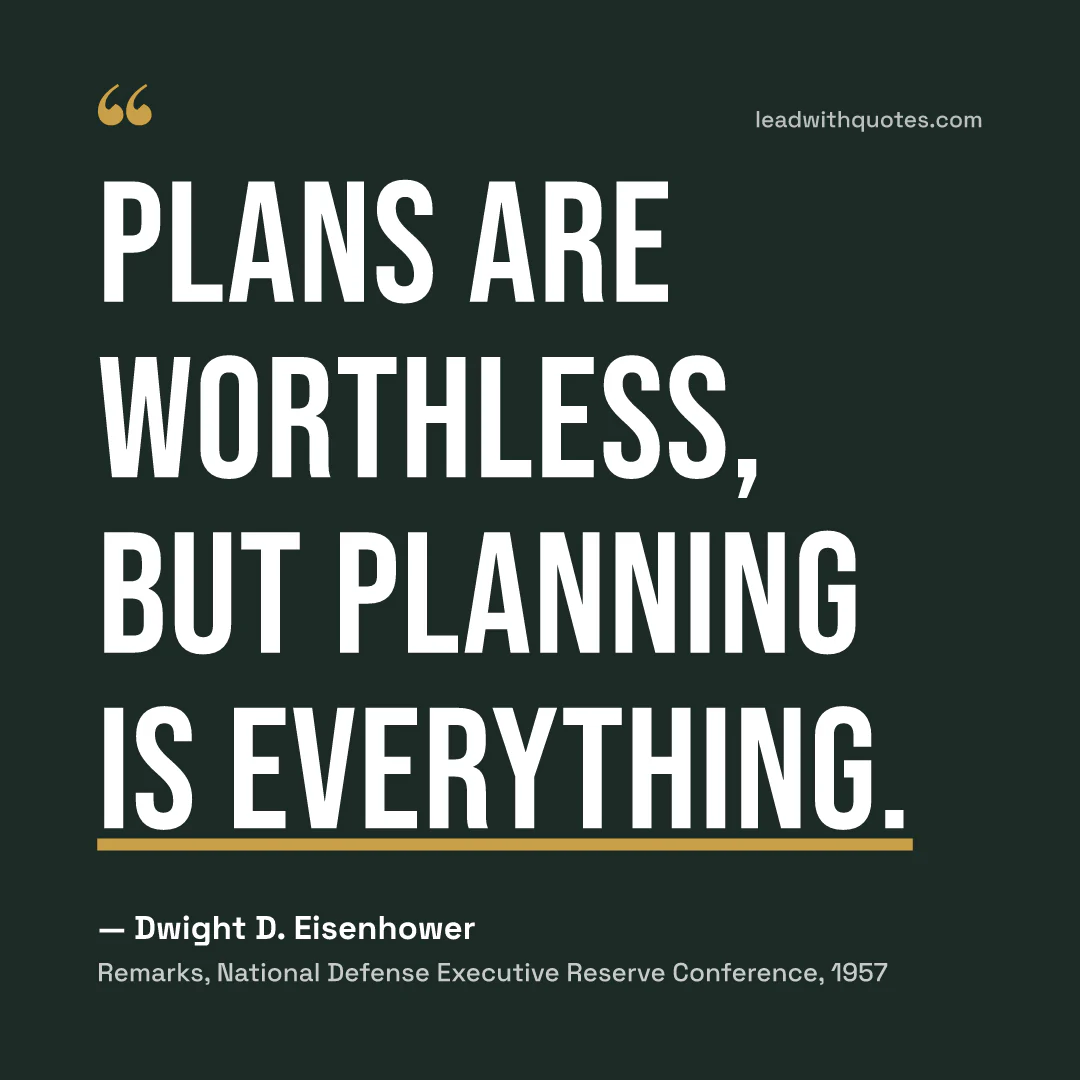
I tell this story to illustrate the truth of the statement I heard long ago in the Army: Plans are worthless, but planning is everything.
Dwight D. Eisenhower, remarks at the National Defense Executive Reserve Conference, Washington, November 14, 1957
Eisenhower was speaking to business people and officials who would run civilian agencies in a national emergency. He had just told the story of staff officers at Leavenworth who planned wars on local maps, then found themselves fighting in Alsace-Lorraine. He presented the line as an old Army saying, not his own invention, and his next sentence explains it: an emergency is by definition unexpected, so "it is not going to happen the way you are planning." That is why the line suits a Monday meeting so well. The plan you write will break by Wednesday; the thinking you did to write it is what lets the team adjust. The full transcript is on the American Presidency Project.
When a man does not know what harbour he is making for, no wind is the right wind.
Seneca, Moral Letters to Lucilius, Letter 71, translated by Richard M. Gummere (Loeb Classical Library, 1917–25)
Seneca wrote this to his friend Lucilius in the early 60s AD, arguing that people go wrong because they have no settled aim for their whole life. The version on posters ("If one does not know to which port one is sailing, no wind is favorable") is a later paraphrase; Gummere's public-domain wording is above, and the Latin is ignoranti quem portum petat nullus suus ventus est. Use it when the team is busy but can't say what this week is for. Say the line, then ask for the one outcome that would make Friday feel like a win. The letter is on Wikisource.
All-hands and town halls
An all-hands is where people listen for what is changing and whether they still fit. A quote there should point at how the team works, not at a slogan on the wall.
Who is on a team matters less than how the team members interact, structure their work, and view their contributions.
Julia Rozovsky, Google People Analytics, "The five keys to a successful Google team", re:Work, 2015
This sentence summed up Project Aristotle, Google's study of more than 180 of its own teams. The researchers expected the right mix of star individuals to explain which teams did well. Instead they found five dynamics, led by psychological safety, then dependability, structure and clarity, meaning, and impact. (The original re:Work post has since moved; HR Dive's report quotes it.) It is a strong opener when you are announcing a reorg or new hires, because it tells people that how they work together still counts more than the names on the chart.
The dogmas of the quiet past are inadequate to the stormy present. The occasion is piled high with difficulty, and we must rise with the occasion. As our case is new, so we must think anew and act anew.
Abraham Lincoln, Annual Message to Congress, December 1, 1862
Lincoln wrote this in the middle of the Civil War, a month before the Emancipation Proclamation took effect, to push Congress toward policies it had refused to consider. The text on the American Presidency Project is quoted here; the Collected Works edition, which follows his manuscript, adds a comma after "past". At an all-hands it suits one moment only: when you are changing a process people liked. Use the line and then name the specific old rule you are dropping. Lincoln's next sentence, "We must disenthrall ourselves, and then we shall save our country", is too grand for most offices; stop before it.
When a decision has to come out of the room
Decision meetings fail in two ways: nobody will commit until everyone agrees, or the meeting should never have been called. Here is one line for each failure, and one for the manager who has to run them anyway.
Third, use the phrase 'disagree and commit.' This phrase will save a lot of time. If you have conviction on a particular direction even though there's no consensus, it's helpful to say, 'Look, I know we disagree on this but will you gamble with me on it? Disagree and commit?'
Jeff Bezos, 2016 Letter to Amazon Shareholders (published April 2017)
Bezos listed this as the third of his tips for making fast decisions. The part people forget comes next in the letter: "This isn't one way. If you're the boss, you should do this too." He describes approving an Amazon Studios series he doubted because the team believed in it. So read it as a rule for the person in charge too, not only for the people asked to go along. It works best said just before the call is made, so that dissent is on the record and the team still leaves with one direction.
Meetings are by definition a concession to deficient organization. For one either meets or one works. One cannot do both at the same time.
Peter F. Drucker, The Effective Executive, 1967
Drucker put meetings on his list of time-wasters that come from poor organization: if people need to meet all the time to coordinate, their jobs were never clearly defined. It is a harsh line to open a meeting with, which is exactly why it works for one kind of meeting: the review of your standing meetings. Read it, then go through the calendar and ask of each one what decision it exists to make. More of Drucker's lines, with page references, are on our Peter Drucker quotes page.
Thus I will assert again that a meeting is nothing less than the medium through which managerial work is performed.
Andrew S. Grove, High Output Management, 1983
Grove, Intel's president when he wrote the book, is Drucker's counterweight. A manager's work, he argued, is passing on information and making or shaping decisions, and both happen face to face. So meetings are the job, not a break from it. Use it with new managers who feel guilty about a full calendar, and pair it with Drucker when you want both sides of the argument. Our page of quotes for managers has more from Grove.
Retrospectives and post-mortems
A retrospective only works if people tell the truth about what went wrong. These two lines come from people who spent years on exactly that problem: a software consultant who ran project reviews, and a Harvard Business School researcher who studied why some teams admit errors and others hide them.
Regardless of what we discover, we understand and truly believe that everyone did the best job they could, given what they knew at the time, their skills and abilities, the resources available, and the situation at hand.
Norman L. Kerth, the Retrospective Prime Directive, Project Retrospectives: A Handbook for Team Reviews, 2001
Kerth wrote this as the opening statement for retrospectives, and many agile teams still read it aloud before they start. Martin Fowler describes the practice and the debate around it. The point is not that nobody made mistakes. It is that the meeting looks for causes in the situation and the system before it looks for someone to blame. Read it word for word; shortening it to "everyone did their best" loses the conditions that make it believable.
Team psychological safety is "a shared belief held by members of a team that the team is safe for interpersonal risk taking." — Amy C. Edmondson, "Psychological Safety and Learning Behavior in Work Teams", Administrative Science Quarterly 44, no. 2 (June 1999)
Edmondson studied 51 work teams in a manufacturing company and found that this shared belief predicted whether teams asked for help, admitted errors and sought feedback, and that this learning behavior in turn predicted performance. It is a definition, not a slogan, which is why it works in a post-mortem with engineers or analysts. Read it, then ask the question it implies: "What's one thing you noticed during this project that you didn't say at the time?" Our page on Simon Sinek's quotes on teamwork and trust covers the same ground from the leader's side.
After a loss, a layoff or a brutal week
When the team has taken a hit, inspiration sounds hollow. What helps is a reminder that nobody carries it alone, said plainly and without a pep talk attached. For crisis briefings rather than team meetings, see our leadership quotes for uncertain times.
For the strength of the Pack is the Wolf, and the strength of the Wolf is the Pack.
Rudyard Kipling, "The Law of the Jungle", The Second Jungle Book, 1895
The line closes the first stanza of the wolves' law in Kipling's Mowgli stories; the verse follows the story "How Fear Came" (Project Gutenberg). It is popular with sports coaches because it runs both ways: the group depends on each person, and each person on the group. After a bad week, that is the honest message. Nobody is being asked to carry it alone, and nobody can step back from it either. Leave out the stanza's earlier line about the wolf that breaks the law: it "must die" is not a tone for a Monday.
Two are better than one; because they have a good reward for their labour. For if they fall, the one will lift up his fellow: but woe to him that is alone when he falleth; for he hath not another to help him up.
Ecclesiastes 4:9–10 (King James Version)
The Preacher of Ecclesiastes is not a cheerful writer. The passage comes right after a description of a man who works endlessly with "no end of all his labour" and no one to share it with. That is why it lands after a setback: it doesn't deny the fall, it says what happens next. It suits faith-based organizations, or a quiet moment after a layoff when people are wondering who will still be around. In a secular workplace, say where it comes from and keep it to verse 9 and 10.
Alone we can do so little. Together we can do so much.
Helen Keller, spoken in her vaudeville act with Anne Sullivan, early 1920s (quoted in Joseph P. Lash, Helen and Teacher, 1980)
This one appears on every teamwork poster, usually with no source, which makes people suspect it is fake. It isn't, as far as the record goes. Quote Investigator traced it to Lash's biography, which reproduces the short speech Keller gave on stage in the early 1920s; the speech text itself has not been found. Coming from a woman who learned language through words spelled into her hand by her teacher, it says more than it does on a poster. Tell the room that, in one sentence, before you read it.
Short reflections to open a staff meeting or huddle
Many hospital units, care homes and nonprofits open a staff meeting or a morning huddle with a "reflection": someone reads a short passage, everyone is quiet for a moment, and then the agenda starts. It is less a quote than a pause. So the line has to be calm and about the work itself, not a slogan. These three come from people who wrote about care and attention for a living, and each is short enough to read in one breath.
One of the essential qualities of the clinician is interest in humanity, for the secret of the care of the patient is in caring for the patient.
Francis Weld Peabody, "The Care of the Patient", Journal of the American Medical Association 88 (1927), pp. 877–882
Peabody, a professor of medicine at Harvard, gave this as a talk to Harvard medical students; it was printed in JAMA in March 1927, months before he died that October. The essay warned that young doctors trained in laboratory science were treating diseases and forgetting the person in the bed. This sentence is its last line, which is why it is quoted so often in medical schools. The text is reprinted in Peabody's collection Doctor and Patient (1930), now on Project Gutenberg. In a clinical huddle, read the full sentence: the first half is what gives the wordplay at the end its weight. Outside healthcare, swap nothing; say who said it, and let the team hear their own customers in it.
It may seem a strange principle to enunciate as the very first requirement in a Hospital that it should do the sick no harm.
Florence Nightingale, Preface to Notes on Hospitals, third edition, 1863
Nightingale's next sentence explains why she had to say something so obvious: death rates in hospitals, "especially in those of large crowded cities", were much higher than the same diseases produced among patients treated at home. Her book was about ventilation, crowding and ward design, the systems around the nurse, not the nurse's goodwill. That makes it a strong reflection for a safety huddle or an incident review: the point is that good people inside a bad system still do harm, so the meeting looks at the system. The 1863 edition is scanned on the Internet Archive. The line is often shortened to "first, do no harm", which is a separate medical maxim with its own history; quote her wording, not that one.
Attention is the rarest and purest form of generosity.
Simone Weil, letter to Joë Bousquet, April 13, 1942 (French original: "L'attention est la forme la plus rare et la plus pure de la générosité")
Weil wrote this to the poet Joë Bousquet, paralysed by a spinal wound from the First World War, to thank him for reading pages she had sent him. She meant it literally: giving someone your full attention costs more than giving them advice. The letter was published in their Correspondance (Lausanne: L'Âge d'Homme, 1982), p. 18, as cited on Wikiquote; we have not seen the printed page ourselves. It fits any team that serves people face to face, and it is the right reflection before a meeting where people tend to check their phones. For more on that theme, see our active listening quotes.
How to run the reflection in about a minute:
- Rotate the reader. A different person each week picks and reads the line. The manager reading every time turns it into a sermon.
- Read, then pause for ten seconds. No discussion. The silence is the point; it marks the line between the corridor and the meeting.
- One sentence of connection, optional. The reader may add why they chose it ("We had three falls on the ward this week"), then hands over to the agenda.
What a nurse lead might say:"This week's reflection is from Florence Nightingale, 1863: 'It may seem a strange principle to enunciate as the very first requirement in a Hospital that it should do the sick no harm.' [pause] I picked it because the first item today is the new handover checklist."
Lines that make a room laugh first
A meeting that starts with a laugh usually runs better, and the best jokes about meetings are old ones. One rule: only the person who called the meeting should open with a joke about meetings. From anyone else it sounds like a complaint.
If you had to identify, in one word, the reason why the human race has not achieved, and never will achieve, its full potential, that word would be 'meetings.'
Dave Barry, "25 Things I Have Learned in 50 Years", syndicated column, 1997 (collected in Dave Barry Turns 50, 1998)
Barry wrote it as one item on a comic list of life lessons for his 50th birthday. The list later went around by email as "16 Things", usually without his name. It is the right size for a kickoff: one sentence, a pause, and then "So let's keep this one to 25 minutes", which you then have to actually do. More lines like this, with their real sources, are on our funny boss quotes page.
Which line for which meeting
| Meeting | Line | Source | Best when |
|---|---|---|---|
| Monday kickoff | "Plans are worthless, but planning is everything." | Eisenhower, 1957 | Last week's plan broke |
| Weekly planning | "…no wind is the right wind." | Seneca, Letter 71 | The team is busy but unfocused |
| All-hands | "Who is on a team matters less than how the team members interact…" | Rozovsky, Google, 2015 | Reorg or new hires |
| All-hands | "…we must think anew and act anew." | Lincoln, 1862 | Retiring a process people liked |
| Decision meeting | "Disagree and commit" | Bezos, 2017 letter | No consensus, deadline today |
| Meeting audit | "For one either meets or one works." | Drucker, 1967 | Cutting standing meetings |
| New-manager 1:1 | "…the medium through which managerial work is performed." | Grove, 1983 | A full calendar feels like failure |
| Retrospective | The Prime Directive | Kerth, 2001 | Every retro, read in full |
| Post-mortem | "…safe for interpersonal risk taking." | Edmondson, 1999 | Analytical teams, blame in the air |
| After a loss | "…the strength of the Wolf is the Pack." | Kipling, 1895 | Sports-minded teams |
| After a layoff | "Two are better than one…" | Ecclesiastes 4:9 | Faith-based or quiet settings |
| Clinical huddle | "…the secret of the care of the patient is in caring for the patient." | Peabody, 1927 | Read the full sentence |
| Safety huddle | "…that it should do the sick no harm." | Nightingale, 1863 | Incident or checklist review |
| Staff meeting reflection | "Attention is the rarest and purest form of generosity." | Simone Weil, 1942 | Phones out, minds elsewhere |
| Cross-team kickoff | "Alone we can do so little…" | Helen Keller, 1920s | Told with her story |
| Any meeting you called | "…that word would be 'meetings.'" | Dave Barry, 1997 | You will keep it short |
No quote fits? Write a one-line opener instead
Some weeks nothing on this page matches the meeting, and a forced quote is worse than none. A plain opening line does the same job if it has three parts: what happened since the last meeting, what this meeting has to decide, and how long it will take. Three examples you can adapt:
- "Since last Monday we shipped the pricing page and lost two days to the outage. Today we decide whether the launch date holds. Twenty minutes."
- "This is the last retro for the migration project. One question only: what would we do differently next time? We'll stop at the hour."
- "Hard week. I'll give you the facts on the reorg first, then we'll take every question you have. No other agenda today."
If you do use a quote, it replaces the first part, never the second. The decision is the reason people came.
Popular meeting quotes to retire, or credit correctly
These turn up in almost every list of quotes for team meetings. Each has a problem with its attribution, and in a room that includes one person who has checked, that problem becomes the story. Our page of leadership quotes leaders never said covers more of them.
- "Coming together is a beginning, keeping together is progress, working together is success." Credited to Henry Ford everywhere. Barry Popik found Calvin Coolidge quoting it as Edward Everett Hale's in 1927; the first Ford credit is from 1949, with no evidence Ford said it (Popik). If you use it, credit Hale, as Coolidge did.
- "If you want to go fast, go alone; if you want to go far, go together." Usually called an African proverb. NPR asked scholars of African languages and could not find it in any of them; their conclusion was "We just don't know" (NPR Goats and Soda, July 30, 2016). Call it a proverb of unknown origin.
- "Never doubt that a small group of thoughtful, committed citizens can change the world." The earliest known printing is Donald Keys's Earth at Omega (1982), four years after Margaret Mead died, with no source given; the institute that manages her legacy could not say where or when she said it (Quote Investigator). Say "attributed to Margaret Mead".
- "Teamwork is the ability to work together toward a common vision." Credited to Andrew Carnegie, who died in 1919. The earliest printing found is an unsigned one from 1975. Treat it as anonymous.
- "Meetings are indispensable when you don't want to do anything." Credited to John Kenneth Galbraith, but cut down: Wikiquote gives a longer passage, beginning "Meetings are a great trap", from his Ambassador's Journal (1969), with no page number. Until it is checked against the book, we left it off the list above.
One last check before you read it out
Read the line aloud once, alone, before the meeting. If you trip over it, the room will notice; pick a shorter one. Check that the source you are about to name matches the one on this page, not the one on a poster. And keep the quote at the very start or the very end. In the middle of an agenda it sounds like a speech, and nobody called the meeting to hear one.