Team Leader Quotes: 12 Sourced Lines for New Leads, Thank-You Notes and Farewells
12 team leader quotes for a new team lead, a thank-you note or a farewell card, each checked against its book or article, plus 6 lines with the wrong name.

A team leader is the person one rung above everyone else on the team, and often the person who was doing the same job as them last year. That closeness is what makes the role hard, and it is also why the team leader matters so much. Gallup's 2015 State of the American Manager report found that managers account for at least 70% of the variance in employee engagement scores across business units. For most people, "the company" means the person who runs their stand-up.
So this page collects team leader quotes for the three moments people actually search for them: when someone has just become a team lead, when the team wants to thank one, and when one is leaving. There are 12 lines. Each one was checked word for word against the book, article or newspaper it comes from, and several famous "team" quotes that failed that check are listed near the end, with the person who really said them.
For someone who just became a team lead
New team leads get two kinds of quotes: motivational posters, and lines from people who studied or did the job. These are the second kind. They are good for a congratulations card, a first one-to-one, or a note to yourself on day one.
Even for the most gifted individuals, the process of becoming a leader is an arduous, albeit rewarding, journey of continuous learning and self-development. The initial test along the path is so fundamental that we often overlook it: becoming a boss for the first time.
Linda A. Hill, "Becoming the Boss," Harvard Business Review, January 2007
Hill, a Harvard Business School professor, followed star performers through their first year as managers for her book Becoming a Manager (1992). The HBR article distills that research, and its main finding is reassuring: almost every new boss finds the switch harder than expected, because the skills that got them promoted are not the skills the new job needs. In a 2011 Working Knowledge interview she put the failure case plainly: many managers "never really made the psychological transformation from being an individual contributor to being a manager." Send the long quote to someone a week into the role, when the surprise has set in.
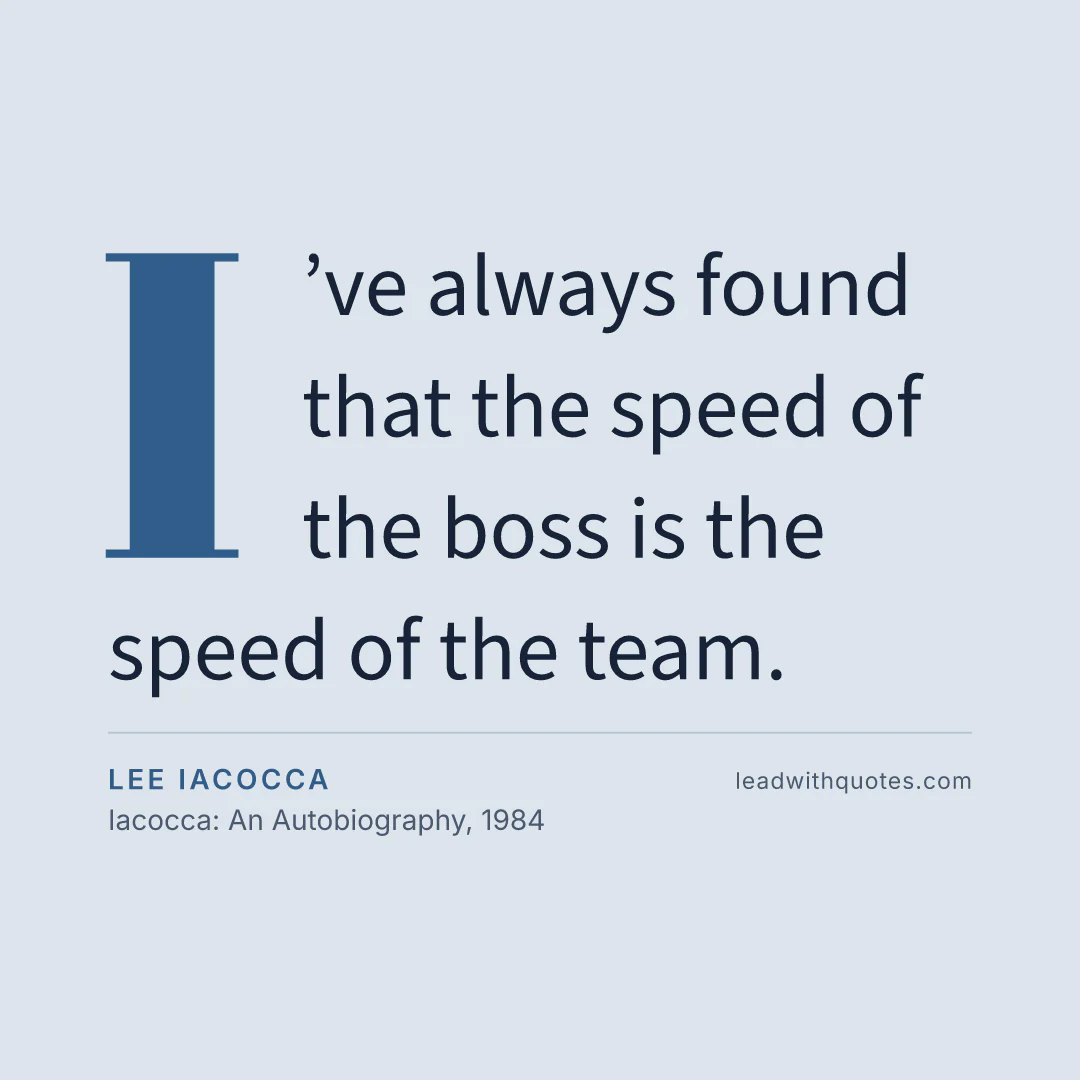
I've always found that the speed of the boss is the speed of the team.
Lee Iacocca, Iacocca: An Autobiography (with William Novak), 1984
Iacocca wrote this while describing what he expected from the managers who worked for him at Ford and Chrysler. The line is usually quoted in a trimmed form, "The speed of the boss is the speed of the team"; the full sentence above is how it reads in the 1984 book. For a new team lead it works as a warning more than a boast: the team will match your pace on replies, decisions and follow-up, whether you mean it to or not.
No man will make a great business who wants to do it all himself, or to get all the credit of doing it. That spirit is fatal, and the sure proof of a small mind.
Andrew Carnegie, interview in the St. Louis Globe-Democrat, October 15, 1899
You will usually see this as "No man will make a great leader who wants to do it all himself." That is a later rewording. Quote Investigator traced the original to an 1899 newspaper interview in which Carnegie was crediting the young partners who ran his steel business, and found that "business" had become "leader" by 1975. The original is still the better line for a new team lead, because the trap it names is the classic one for people promoted from the team: doing the work yourself because it is faster than explaining it.
Short lines a team lead can put on the team board
These are for the team lead's own use: the top of a sprint board, the team channel's description, the first slide of a kickoff. All four are short enough to read in passing, and all come from people who led teams for a living.
Not finance. Not strategy. Not technology. It is teamwork that remains the ultimate competitive advantage, both because it is so powerful and so rare.
Patrick Lencioni, The Five Dysfunctions of a Team, 2002, Introduction
These are the first lines of Lencioni's best-known book, a business fable about a new CEO and a leadership team that cannot trust each other. The book's argument is that teams fail for five connected reasons, starting with absence of trust. If you put this line on a board, be ready to be asked what the team is doing about it. That is the point.
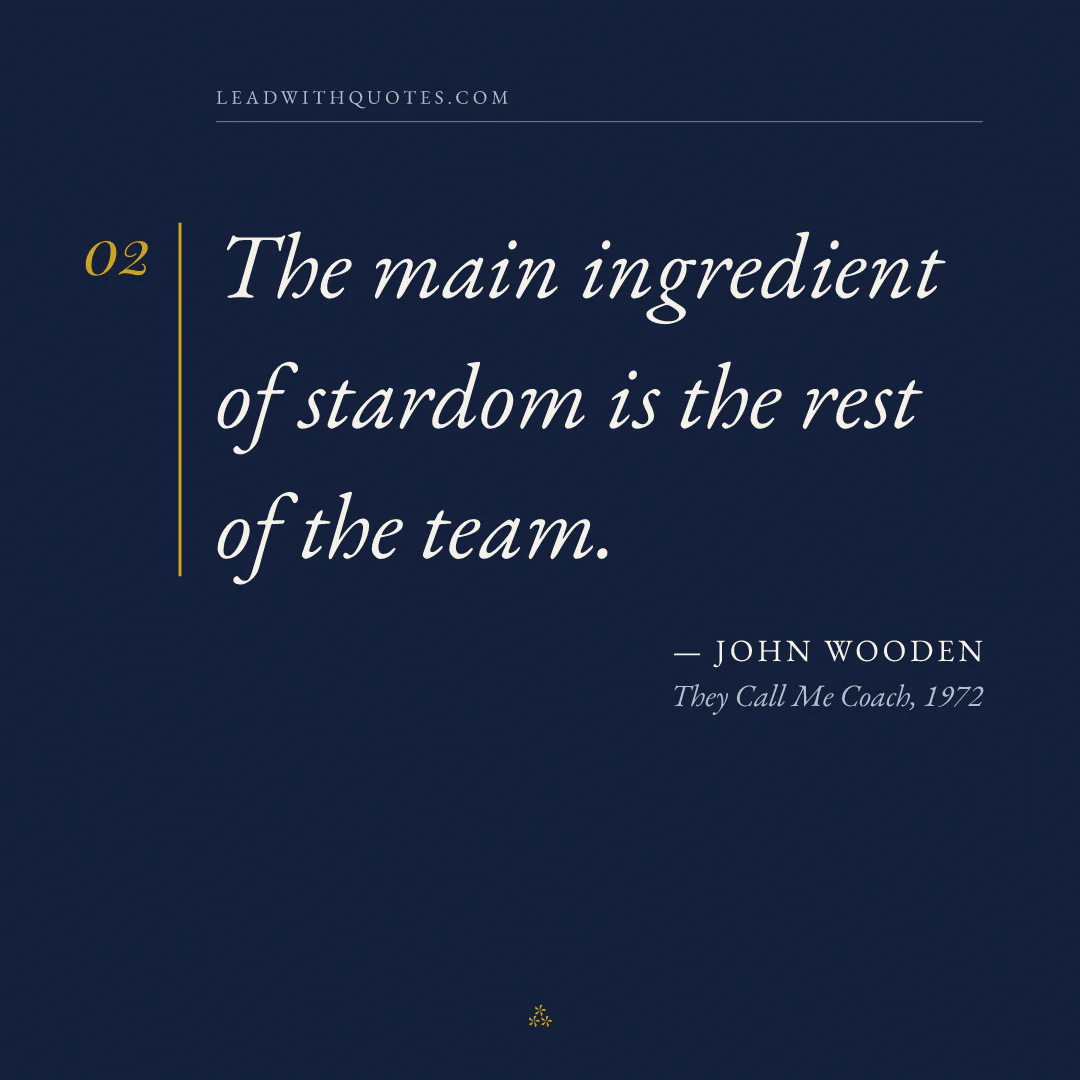
The main ingredient of stardom is the rest of the team.
John Wooden, They Call Me Coach (with Jack Tobin), 1972
Wooden won ten NCAA championships at UCLA in twelve seasons, and he repeated this line in his 1997 book Wooden (p. 66) under the heading "The Main Ingredient of Stardom." He meant it literally: the player who scores is the one who got the pass. It is the most useful line on this page for a team that has one standout performer and several quieter people who make that performance possible.
Champions behave like champions before they're champions; they have a winning standard of performance before they are winners.
Bill Walsh, The Score Takes Care of Itself (with Steve Jamison and Craig Walsh), 2009
Walsh took over a 2–14 San Francisco 49ers team in 1979 and won the Super Bowl three seasons later. He credited what he called his "Standard of Performance": a written code for how everyone in the building behaved, from the receptionist to the quarterback, long before the results came. For a team lead, the practical reading is that you set standards for the work you can control (how a handover is written, how fast a customer gets a reply), not for the outcome you can't.
Two is better than one if two can act as one.
Mike Krzyzewski, Leading with the Heart (with Donald T. Phillips), 2000
Coach K follows his "fist" analogy with this sentence: five fingers are weak alone and strong closed together. It is the shortest line here and the easiest to remember, which makes it a good team-channel description or the last line of a kickoff message.
Thanking your team leader
A thank-you to a team lead is different from a Boss's Day card to a senior manager. You probably work side by side, so a grand quote can feel stiff. The lines below are specific about what a good team lead does, which is what makes a thank-you land. For cards to a senior manager, see our boss appreciation quotes for Boss's Day instead.
A man may do an immense deal of good, if he does not care who gets the credit for it.
Father Strickland, an English Jesuit, as recorded in Sir Mountstuart E. Grant Duff's diary, September 21, 1863 (published in Notes from a Diary, 1897)
This is the real source of the line usually credited to Harry Truman ("It is amazing what you can accomplish if you do not care who gets the credit"). Quote Investigator found it in a Victorian politician's diary, where he attributes it to a Jesuit priest he met, and found no evidence that Truman said it. It is the best line on this page for thanking a team lead who quietly passed your work up the chain with your name on it.
Radical Candor is what happens when you put 'Care Personally' and 'Challenge Directly' together.
Kim Scott, Radical Candor, 2017
Scott developed the idea as a manager at Google and Apple. Her point is that the boss who only cares is too soft to help you improve, and the boss who only challenges is a jerk; good feedback takes both at once. Use this line to thank a team lead who told you something hard that turned out to be right. Name the moment: "the review in March where you told me the deck was too long" is what makes the note mean something.
It tells us that people leave managers, not companies.
Marcus Buckingham and Curt Coffman, First, Break All the Rules, 1999
Buckingham and Coffman drew this from Gallup interviews with more than 80,000 managers: whether people stay depends mostly on their immediate manager, not on pay or perks. Turned around, it makes a quiet compliment for a team lead: the reason you are still here is them. Keep it for a personal note, not a group card, since it implies something about the rest of the company.
When a team leader moves on
Farewell notes to a team lead tend to say "you'll be missed" and stop there. A line about the team itself is a better send-off, because what the team will miss is how the team lead made it work. Both of these come from athletes who said the team mattered more than they did.
Talent wins games, but teamwork and intelligence win championships.
Michael Jordan, I Can't Accept Not Trying (with Mark Vancil), 1994
Jordan's short 1994 book collects his thoughts on goals, fundamentals and teamwork, written after his first three titles with the Bulls. Coming from the most individually talented player of his era, the line carries weight. In a farewell card it says: you didn't just have the skills, you built the team that used them.
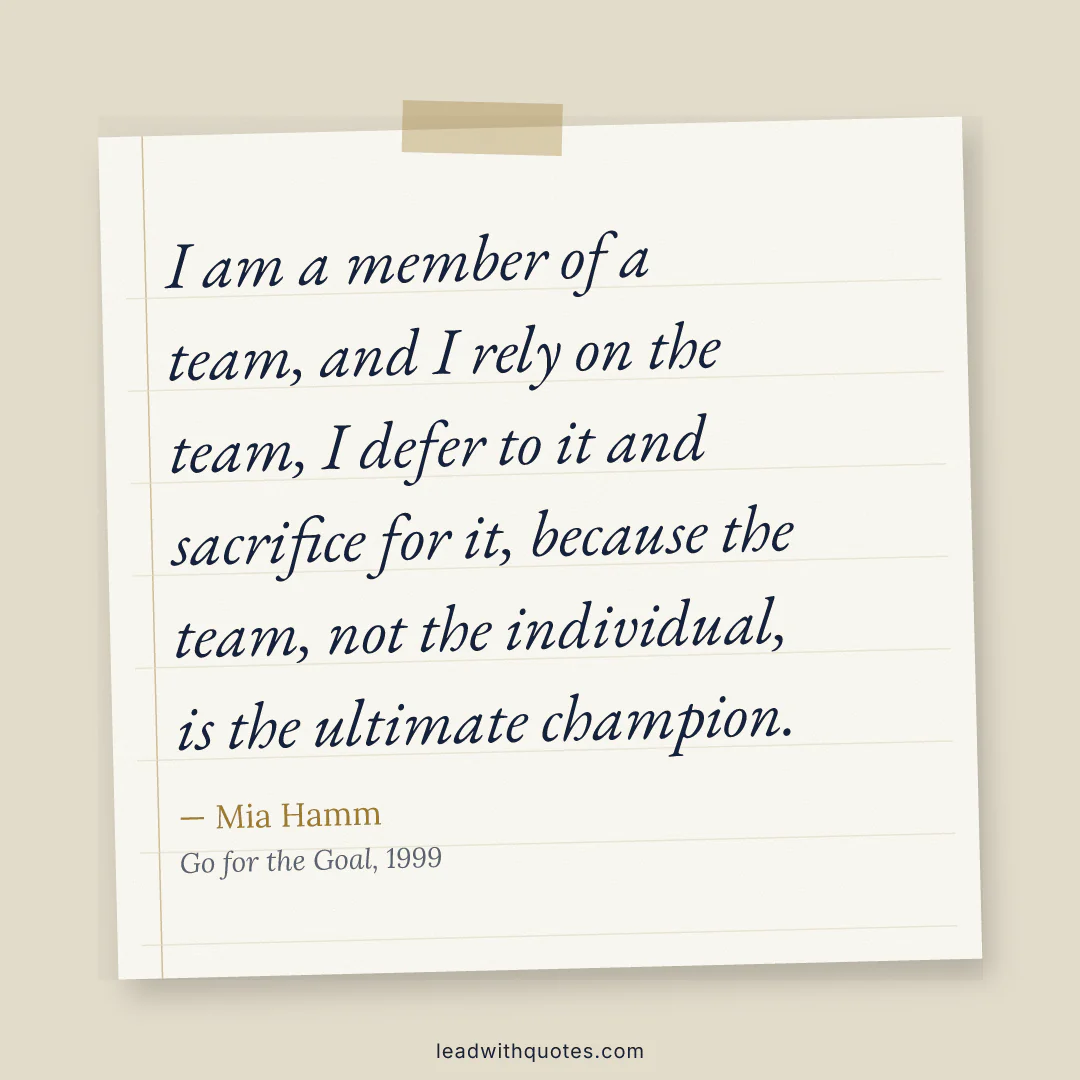
I am a member of a team, and I rely on the team, I defer to it and sacrifice for it, because the team, not the individual, is the ultimate champion.
Mia Hamm, Go for the Goal (with Aaron Heifetz), 1999
Hamm wrote this at the opening of her book, the same year the US women's team won the World Cup, when she was the most famous soccer player in the country. It suits a team lead who is leaving for a bigger job, as a reminder of what they did well here, and it fits a card that the whole team signs.
How to write the note itself: three sentences
A quote alone reads like a greeting card. Use the quote to set up the message, then add the part only you can write. Three sentences are enough:
- One moment. Name something specific the team lead did: a deadline they protected you from, a review that helped, the week they covered for someone who was ill.
- What it changed. Say what happened because of it. "I shipped my first feature without being scared of the release" beats "you're so supportive."
- The line, with its owner. Pick the one quote above that matches the moment, and keep the name on it.
Two examples written for this page, so you can see the shape (not quotes from anyone):
- Thank-you on Slack: "Thanks for letting me present the migration plan last week when it was mostly your work. Father Strickland had it right in 1863: a lot of good gets done by people who don't care who gets the credit."
- Farewell card: "You turned six people who sat near each other into a team. 'Two is better than one if two can act as one.' (Coach K). We'll keep the fist closed."
For a team lead's birthday, skip the leadership quotes entirely; a work-themed quote on a birthday card reads like a performance review. A short personal message is enough. If you are the team lead and want a line for the next team meeting instead, our quotes for team meetings are sorted by type of meeting.
Six famous team lines with the wrong name on them
These appear on almost every team-quote list. Each one is fine to use, but the name usually attached to it is wrong. If you put one on a card, use the attribution in the right-hand column.
| The line | Usually credited to | What the record shows |
|---|---|---|
| "A boss says 'Go'; a leader says 'Let's go!'" | E. M. Kelly, The Rotarian, 1928 | Anonymous. In print by November 1930 in Cost and Management, as part of a "boss vs. leader" list. The Kelly credit first appears in William Safire's Leadership (1990); no 1928 Rotarian source has been found. |
| "It is amazing what you can accomplish if you do not care who gets the credit." | Harry S. Truman | Father Strickland, 1863, in Grant Duff's diary (QI). No evidence for Truman. |
| "Coming together is a beginning; keeping together is progress; working together is success." | Henry Ford | Credited to Edward Everett Hale by Calvin Coolidge in 1927. Ford's name is attached from 1949 (Barry Popik). |
| "None of us is as smart as all of us." | Ken Blanchard | A suggestion-box slogan in print in 1940. Blanchard popularized it in High Five! (2001), p. 103 (Popik). |
| "The strength of the team is each individual member. The strength of each member is the team." | Phil Jackson | Not found in Jackson's own books. In Sacred Hoops (1995) he quotes Kipling instead: "For the strength of the Pack is the Wolf, and the strength of the Wolf is the Pack." |
| "Teamwork is the ability to work together toward a common vision…" | Andrew Carnegie | No evidence. The earliest prints found are unattributed and date from about 1992, decades after Carnegie died in 1919. |
We keep a longer, fully sourced list of these in leadership quotes leaders never said. For quotes about trust inside a team, see Simon Sinek's quotes on teamwork.
A note on how these were checked
Book quotes were matched against scanned editions in the Internet Archive's full-text search (the 1984 Iacocca, 1972 and 1997 Wooden, 1994 Jordan, 1999 Hamm, 2000 Krzyzewski, 2002 Lencioni, 2009 Walsh, 2017 Scott and 1999 Buckingham and Coffman texts). Article and interview lines were checked on the publisher's own page. Where a well-known version differs from the original, as with Iacocca and Carnegie, we print the original and say so. If you spot a line on this page you think is wrong, tell us and we will check it again.