Desk essay
14 Quotes About Leadership and Service from Speeches and Memoirs
Historical speeches and private memoirs reveal the heavy demands of authority. These 14 perspectives expose the quiet reality of guiding others.
By Morgan Ellis
Morgan Ellis

People often think of service-based leadership as a modern corporate rebranding exercise. They picture soft-spoken managers handing out employee satisfaction surveys and scheduling trust falls.
The truth is far less comfortable. True authority grounded in service demands a relentless willingness to shoulder the heaviest burdens first, long before anyone else notices the weight. I learned more about mutual reliance watching my uncle navigating a flooded basement in Evanston, Illinois, 2013, than I ever absorbed from a management seminar. The water was rising fast. He did not issue commands from the dry stairs. He waded into the freezing muck and handed us buckets. Exploring how the historical shift toward service-based theory emerged reveals similar patterns of gritty, unglamorous action across generations of thinkers.
If we could gather the sharpest minds from the past century to debate the mechanics of authority, the resulting conversation would bypass organizational charts entirely. We would hear the raw realities of stewardship. Here is how that conversation might unfold.
On Shared Burdens
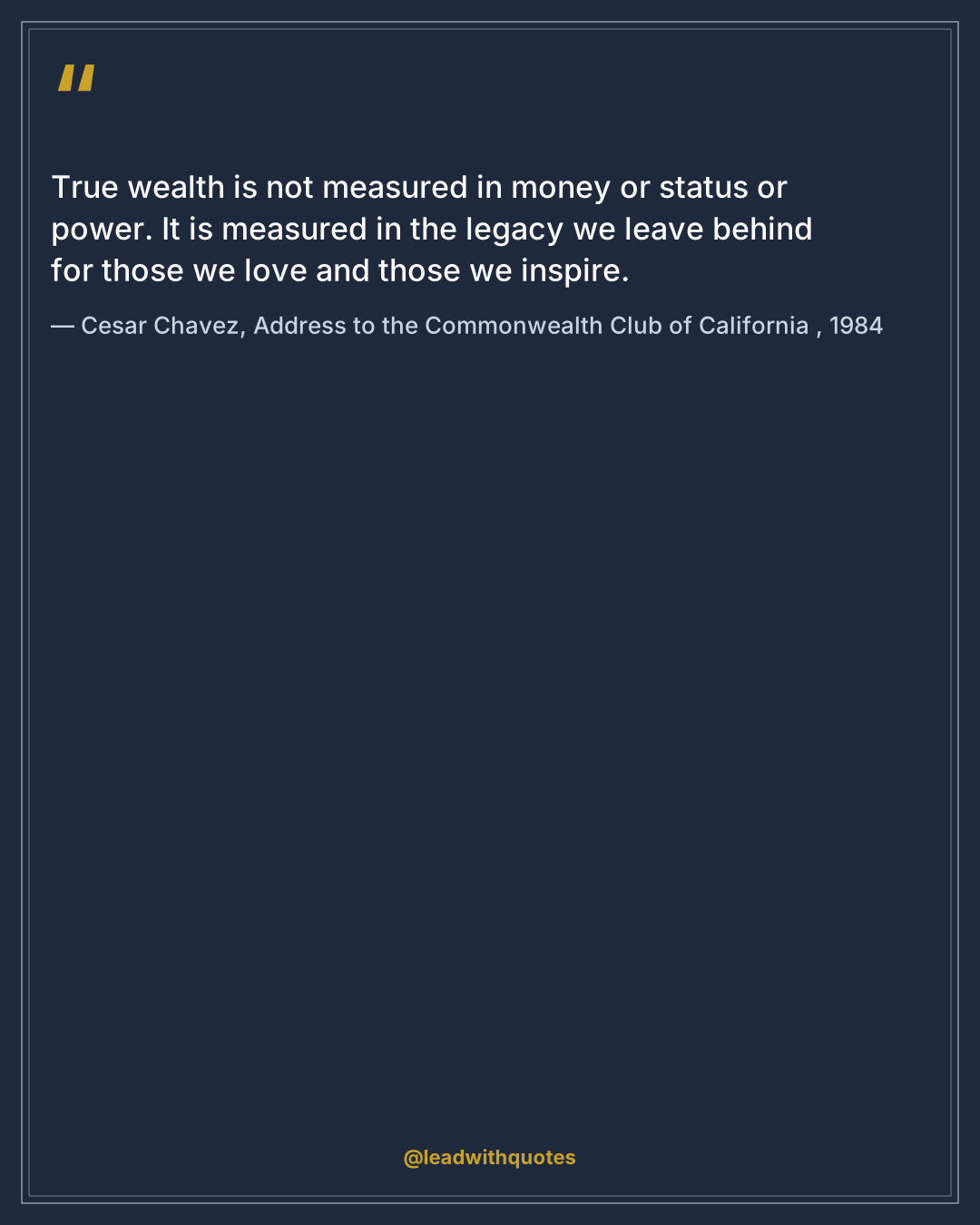
Labor organizer Cesar Chavez understood that influence rarely accumulates in boardrooms. He viewed authority as a physical transfer of energy between people sharing a struggle.
"True wealth is not measured in money or status or power. It is measured in the legacy we leave behind for those we love and those we inspire." — Cesar Chavez, Address to the Commonwealth Club of California, 1984
Leaving a legacy requires spending your own capital on someone else's future. When we examine how early pioneers viewed visionary strategy, we see this exact refusal to hoard power.
Booker T. Washington took a highly pragmatic approach to social elevation. He recognized that isolation is the enemy of progress.
"If you want to lift yourself up, lift up someone else." — Booker T. Washington, Up from Slavery, 1901
The physics of social mobility dictate that you cannot pull a heavy weight upward without bracing yourself against solid ground. Washington knew the ground was the community itself.
On Civic Duty and Giving
Calvin Coolidge rarely wasted words on abstract philosophy. His perspective on public service remained stubbornly transactional, but in a moral sense.
"No person was ever honored for what he received. Honor has been the reward for what he gave." — Calvin Coolidge, Veto of Salary Increase, 1924
History forgets the collectors and remembers the distributors. Taking is a private event, while giving alters the public landscape.
Winston Churchill faced the grim arithmetic of wartime survival. He knew that demanding sacrifice required an unshakeable commitment to carrying the resulting blame.
"The price of greatness is responsibility." — Winston Churchill, Harvard University Address, 1943
Greatness is a bill that comes due every single morning. We see the inverse of this accountability when we look at how modern corporations navigate miscommunication today, where responsibility is often deferred.
On the Mechanics of Empathy
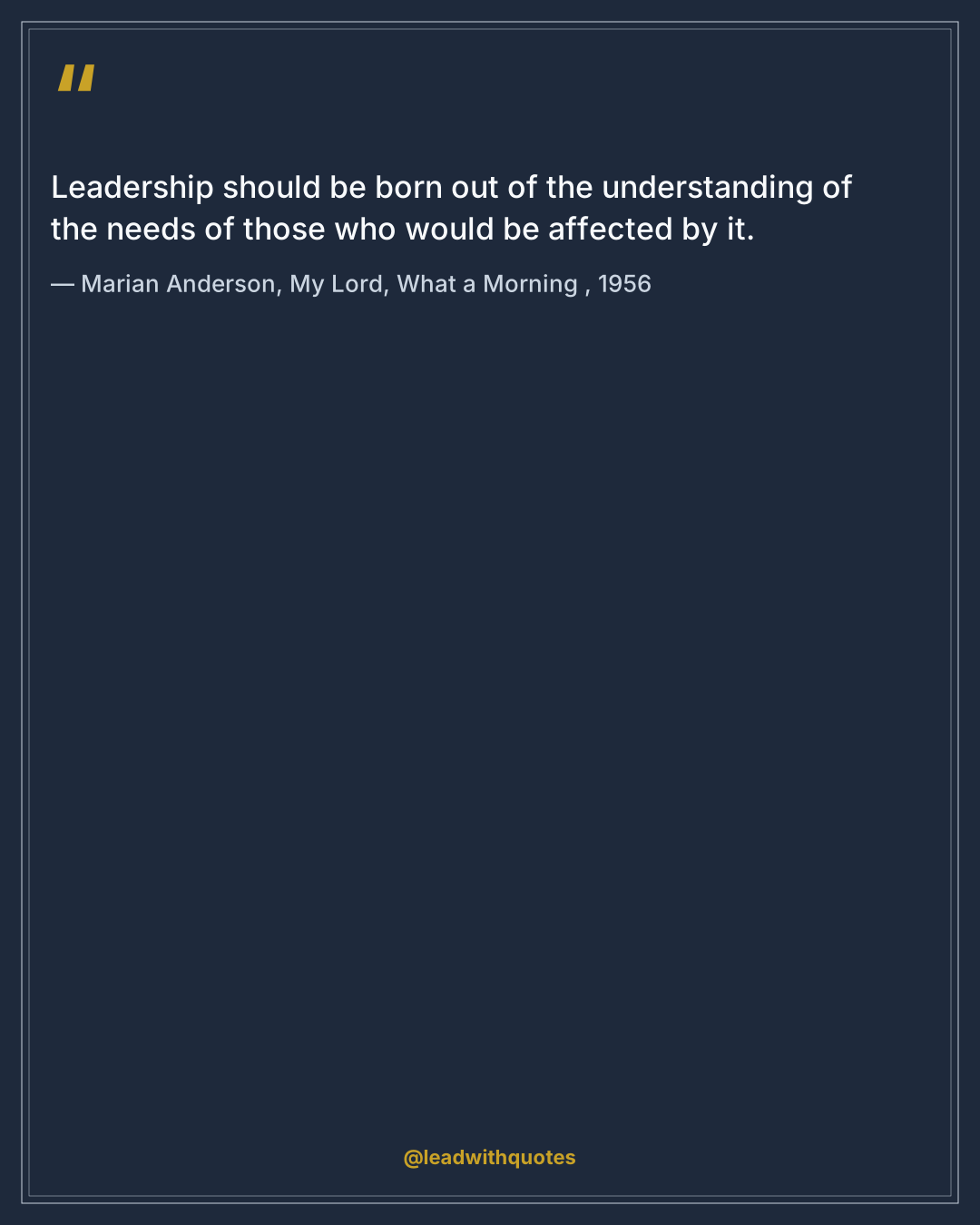
Marian Anderson broke profound racial barriers on the global stage. Her understanding of influence stemmed directly from observing systemic deprivation.
"Leadership should be born out of the understanding of the needs of those who would be affected by it." — Marian Anderson, My Lord, What a Morning, 1956
You cannot guide a group whose pain you refuse to acknowledge. Reading about how female leaders historically framed agency underscores the necessity of this grounded empathy.
Eleanor Roosevelt operated within intense political friction. She despised the hypocrisy of commanders who exempted themselves from the rules.
"It is not fair to ask of others what you are not willing to do yourself." — Eleanor Roosevelt, If You Ask Me, 1946
Double standards destroy organizational trust faster than market forces ever could. She demanded a brutal symmetry between a manager's expectations and their own daily habits.
On Discovering Purpose
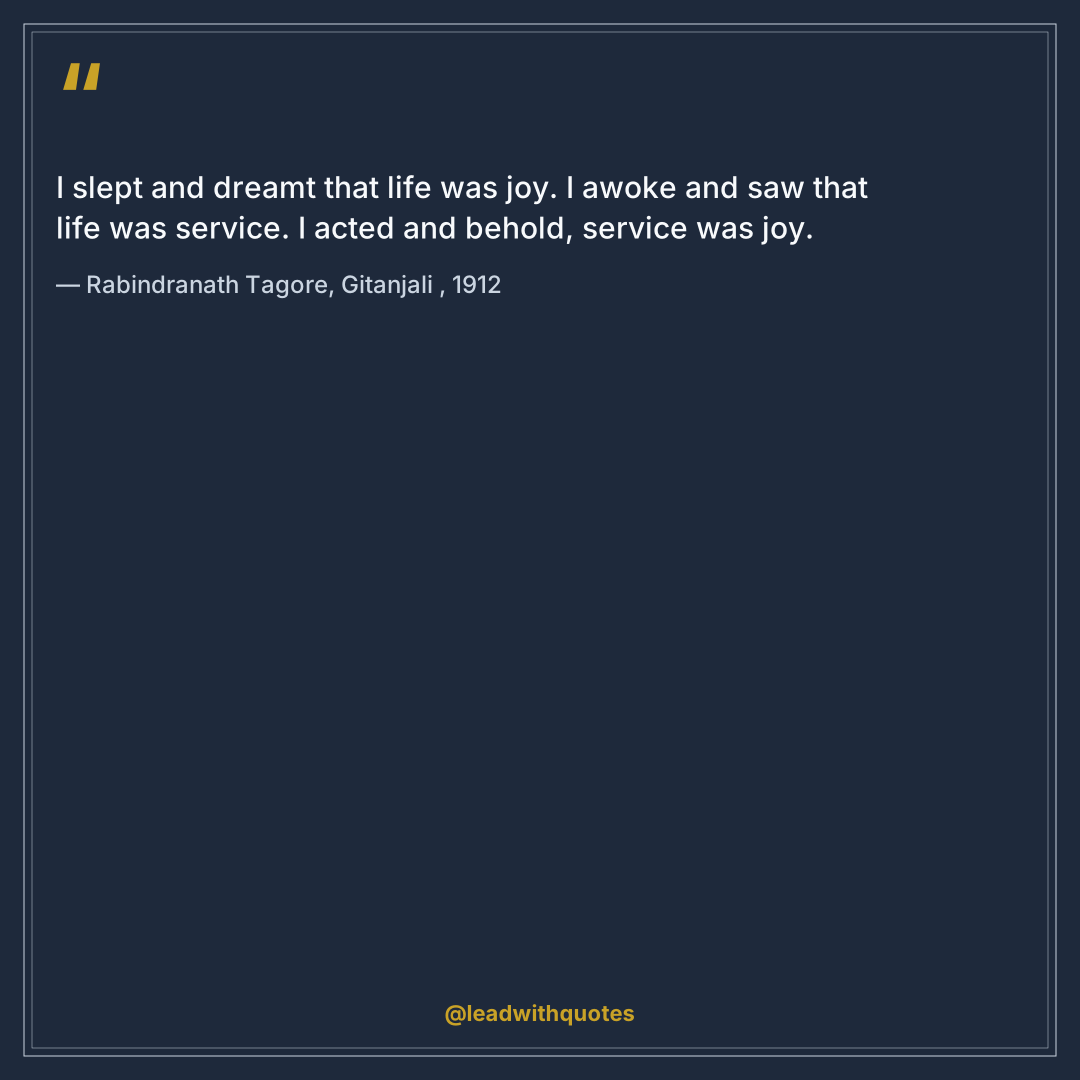
Rabindranath Tagore approached human obligation with poetic precision. He saw duty not as a tax on happiness, but as its primary source.
"I slept and dreamt that life was joy. I awoke and saw that life was service. I acted and behold, service was joy." — Rabindranath Tagore, Gitanjali, 1912
The realization hits differently when you finally step off the sidelines. Grasping the foundational ethics of servant leadership requires experiencing the physical exhaustion of helping someone else succeed.
Mahatma Gandhi weaponized self-denial to dismantle an empire. His formula for personal clarity required complete immersion in a collective cause.
"The best way to find yourself is to lose yourself in the service of others." — Mahatma Gandhi, Young India, 1925
Identity crystalizes under the pressure of external obligations. The ego shrinks so the mission can expand.
On the Scale of Impact
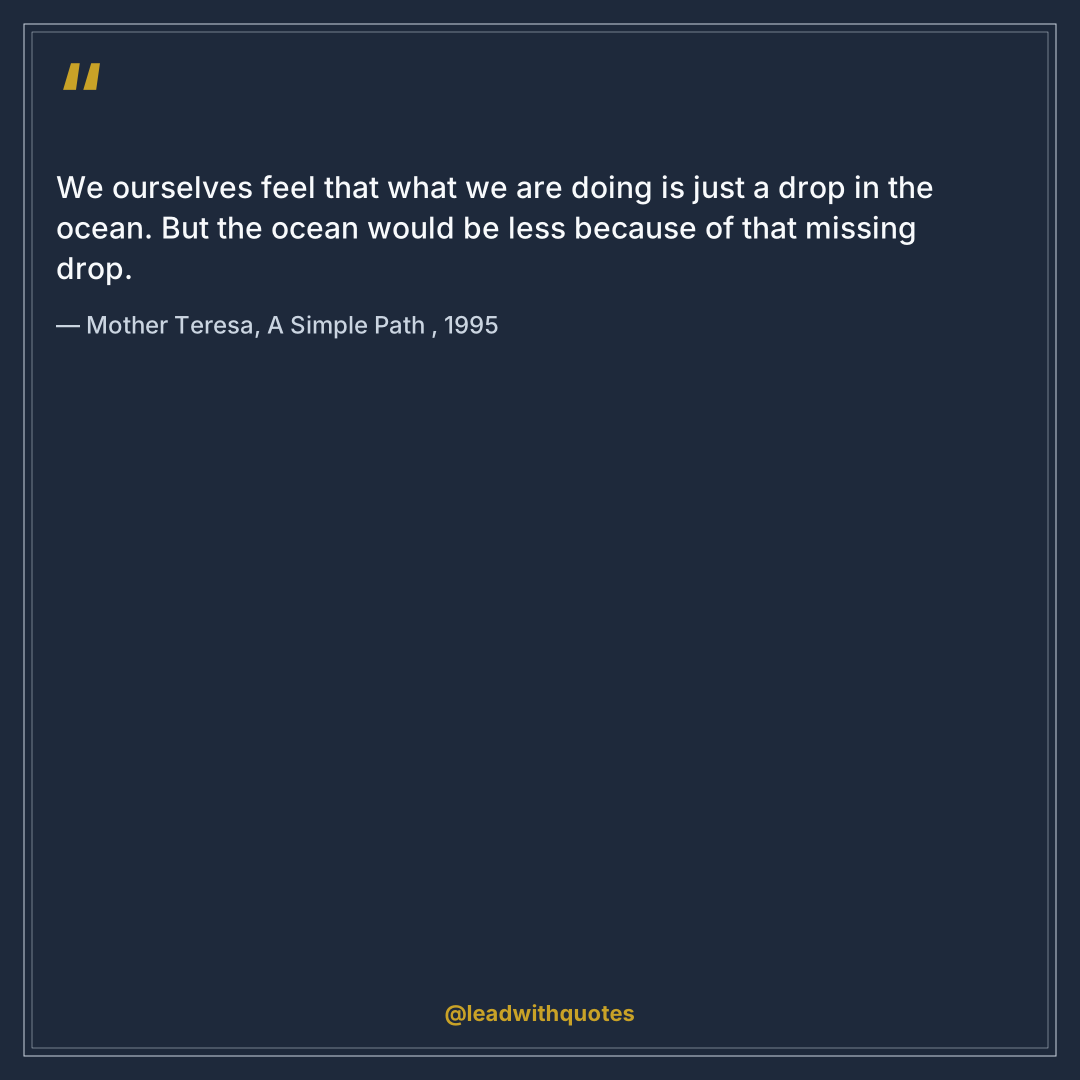
Mother Teresa operated in environments defined by overwhelming scarcity. She rejected the paralyzing idea that small interventions are meaningless.
"We ourselves feel that what we are doing is just a drop in the ocean. But the ocean would be less because of that missing drop." — Mother Teresa, A Simple Path, 1995
Scale is a distraction when immediate suffering sits right in front of you. You measure the work by the depth of the intervention, not the breadth of the audience.
Albert Schweitzer abandoned a comfortable European career for medical fieldwork in Africa. He possessed zero tolerance for performative altruism.
"I don't know what your destiny will be, but one thing I know: the only ones among you who will be really happy are those who have sought and found how to serve." — Albert Schweitzer, The Spiritual Life, 1947
Happiness decoupled from utility eventually rots. Schweitzer framed service as a biological necessity for a functioning human mind.
On Drawing Out Greatness
John Buchan wrote biographies of historical giants while serving as Governor General of Canada. He noticed that the best commanders acted as mirrors, not generators.
"The task of leadership is not to put greatness into humanity, but to elicit it, for the greatness is already there." — John Buchan, Montrose, 1928
You do not inject talent into your team. Studying broad historical approaches to guidance proves that effective managers simply remove the obstacles blocking native ability.
Lao Tzu observed the natural rhythms of authority centuries ago. He advocated for a stealthy, nearly invisible form of guidance.
"The sage stays behind, thus he is ahead. He is detached, thus at one with all." — Inspired by Lao Tzu
The strongest influence operates below the surface of conscious awareness. The group moves forward because they believe the momentum is entirely their own.
On Accessibility and Character
Martin Luther King Jr. democratized the concept of greatness. He stripped away the elitist prerequisites for making a historical impact.
"Everybody can be great...because anybody can serve. You don't have to have a college degree to serve." — Martin Luther King Jr., The Drum Major Instinct Sermon, 1968
Academic credentials cannot generate moral courage. The capacity to aid a neighbor requires only a functioning conscience and two hands.
Frances Hesselbein turned the Girl Scouts of the USA into a modern organizational powerhouse. She viewed strategy as secondary to personal integrity.
"Leadership is a matter of how to be, not how to do." — Frances Hesselbein, Hesselbein on Leadership, 2002
Character precedes execution in every high-stakes scenario. You can teach a manager how to read a balance sheet, but you cannot train them to care about the people generating the numbers.
As you step into the friction of a new week, notice who quietly picks up the slack when the system falters. The real authorities in your building are rarely the ones demanding the microphone. They are the ones holding the ladder steady so someone else can climb.
The Short Version
- Authority demands a physical transfer of energy from the leader to the team.
- Demanding sacrifice from others requires carrying the resulting blame yourself.
- Effective managers act as mirrors to elicit existing talent rather than forcing it.
- Personal integrity and empathy precede any functional business strategy.
- The scale of an intervention matters less than the depth of the commitment.