Work Anniversary Quotes for Employees: 13 Sourced Lines for 1, 5, 10 and 20 Years
13 work anniversary quotes for employees, sorted by milestone (1, 5, 10, 20+ years), each traced to its source, plus lines for yourself and a note method.

The typical American employee has been in their current job for 4.1 years, according to the Bureau of Labor Statistics' January 2026 survey. So when someone reaches five, ten or twenty years with your organization, they have stayed longer than most of the workforce. This page collects 13 work anniversary quotes for employees, sorted by milestone (first year, five, ten, twenty and beyond), plus lines for marking your own anniversary and a few funny ones. Each is traced to the book, speech or letter it comes from. It also shows how a manager can build a short anniversary note around a quote, and lists five popular "anniversary" quotes that carry the wrong name.
What each milestone means, in tenure numbers
Before you pick a line, it helps to know how unusual the milestone is. The figures below come from the BLS Employee Tenure Summary (released 24 September 2026, data for January 2026). The tone suggestions are ours.
| Milestone | What the BLS data says | Tone that fits | Lines on this page |
|---|---|---|---|
| 1 year | Median tenure for workers aged 25–34 is 3.0 years, so a first year is a real start, not a formality | Encouraging, forward-looking | Clear, Roosevelt |
| 5 years | Above the overall median of 4.1 years | Recognition of skill built | Gladwell (with Ericsson's caveat) |
| 10 years | About 31% of men and 29% of women aged 25 and over have 10+ years with their employer | Warm, personal | Jobs, Gibran |
| 20+ years | Median tenure for ages 55–64 is 9.6 years; 52.6% of workers aged 60–64 have passed 10 years | Respect for craft and loyalty | King, Voltaire, Aesop |
One practical consequence: a five-year anniversary is no longer "just a number" in most companies. It means the person has outlasted the median employee, and the note should say so.
First-year work anniversary quotes
A first anniversary is about what has started, not what has been achieved. The best lines for it talk about small things that add up.
Habits are the compound interest of self-improvement.
James Clear, Atomic Habits (2018)
Clear's point, explained on his own site, is that a 1% change looks like nothing in a week and like everything after a year, the same way money grows through compound interest. That makes it a good fit for someone who spent their first year learning systems, building relationships and fixing small things nobody else had time for. Pair it with one concrete example of a habit they brought to the team.
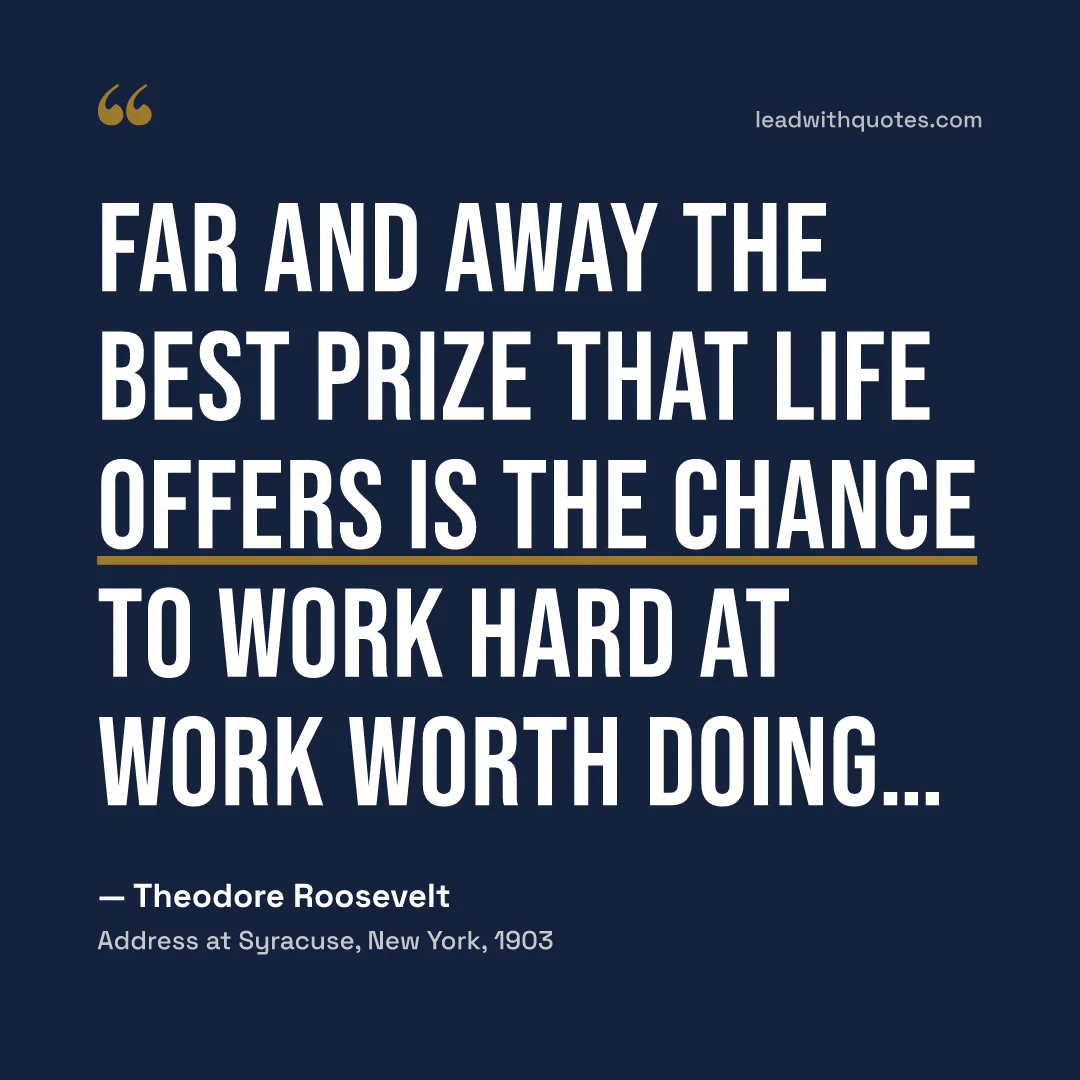
Far and away the best prize that life offers is the chance to work hard at work worth doing…
Theodore Roosevelt, address to the New York State Agricultural Association, Syracuse, Labor Day, 7 September 1903
The famous half-sentence is genuine, but Roosevelt kept going: "…and this is a prize open to every man, for there can be no better worth doing than that done to keep in health and comfort and with reasonable advantages those immediately dependent upon the husband, the father, or the son" (full text, American Presidency Project). Quote it with the ellipsis, as above, rather than a full stop. It suits a first anniversary because it praises the work itself, not the title, and new employees rarely have a title worth praising yet.
Five years: the 10,000-hour mark
Five years of full-time work comes to roughly 10,000 working hours (40 hours a week for 50 weeks is 2,000 hours a year). That happens to be the most famous number in popular writing about expertise.
Ten thousand hours is the magic number of greatness.
Malcolm Gladwell, Outliers (2008), chapter 2, "The 10,000-Hour Rule"
It makes a neat fifth-anniversary line, but use it with a wink, because the researcher behind it disagreed. In Peak (2016), Anders Ericsson and Robert Pool wrote that the rule "is wrong in several ways": "there is nothing special or magical about ten thousand hours," the figure for the best violinists was "only an average," and Gladwell did not separate "deliberate practice" from ordinary time on the job (excerpt in Salon). An honest note can use both: "By the usual math you've just crossed 10,000 hours here. Gladwell would call that the magic number; Ericsson would say what counts is how you spent them, and you spent them well."
Ten years: work that fills a life
At ten years, work has become part of who someone is. The lines that fit here are about loving the work, which is not the same as loving the company.
Your work is going to fill a large part of your life, and the only way to be truly satisfied is to do what you believe is great work. And the only way to do great work is to love what you do.
Steve Jobs, Stanford commencement address, 12 June 2005
Jobs said this to graduates who had not started their careers yet (Stanford transcript), which is why it reads differently at a ten-year mark: the "large part of your life" has now happened. Use the full two sentences. The short version, "The only way to do great work is to love what you do," drops the first sentence, which is the part that fits an anniversary.
Work is love made visible.
Kahlil Gibran, The Prophet (1923), "On Work"
Five words, and they work in a card that the whole team signs. Gibran's next sentence is sharper: if you cannot work with love "but only with distaste, it is better that you should leave your work and sit at the gate of the temple and take alms of those who work with joy" (Project Gutenberg text). Read in context, the line is a compliment to anyone who has stayed ten years by choice.
Twenty years and more: quotes about craft and staying power
Long-service awards tend to get the most generic messages, when they deserve the most specific ones. These three lines honor doing one job well for a long time.
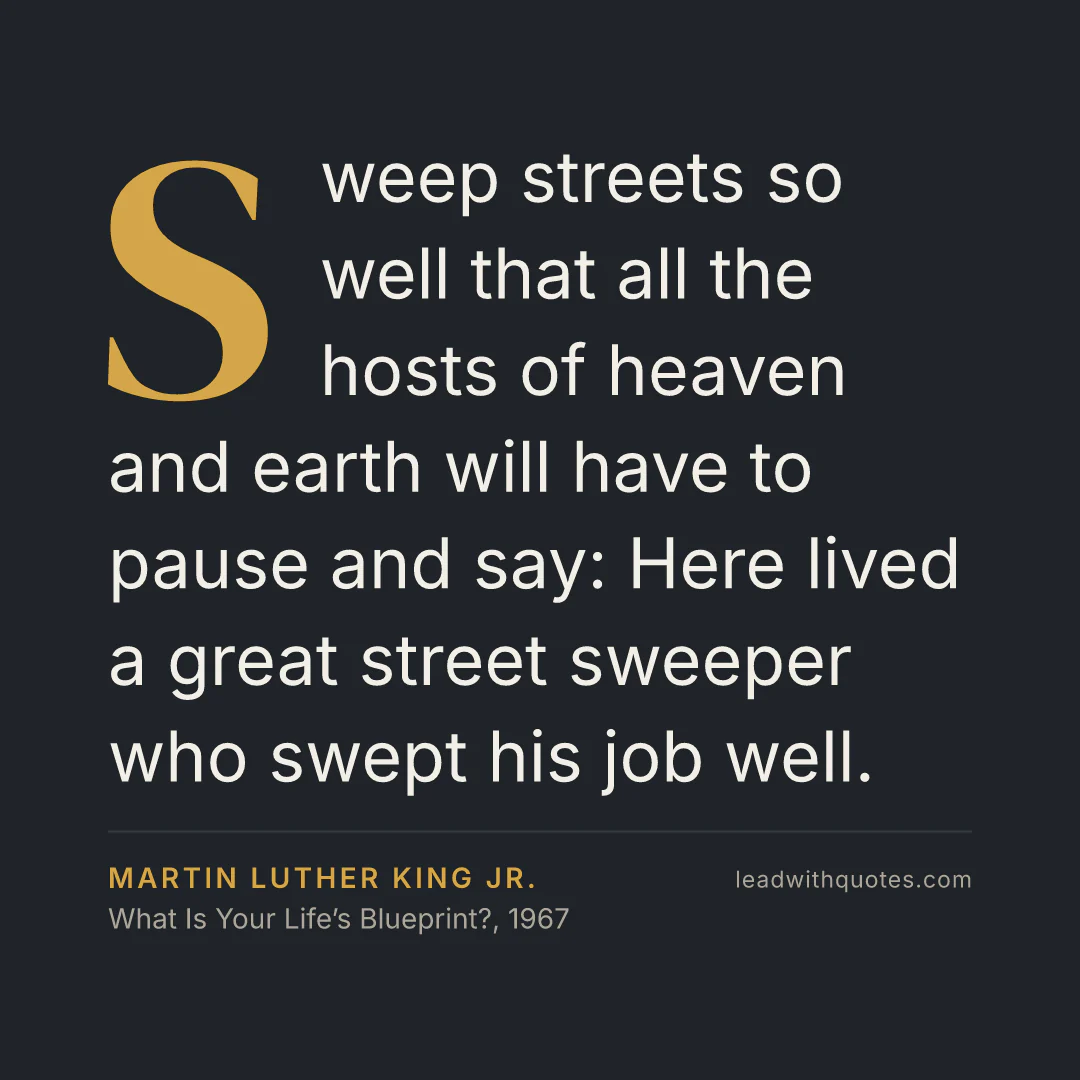
If it falls your lot to be a street sweeper, sweep streets like Michelangelo painted pictures, sweep streets like Beethoven composed music, sweep streets like Leontyne Price sings before the Metropolitan Opera. Sweep streets like Shakespeare wrote poetry. Sweep streets so well that all the hosts of heaven and earth will have to pause and say: Here lived a great street sweeper who swept his job well.
Martin Luther King Jr., "What Is Your Life's Blueprint?", Barratt Junior High School, Philadelphia, 26 October 1967
King gave this talk to students six months before his death (transcript, Seattle Times). He had used the image for years: an earlier version appears in "Facing the Challenge of a New Age," Montgomery, 3 December 1956, where the list reads "like Michelangelo painted pictures, like Shakespeare wrote poetry, like Beethoven composed music" (King Papers Project, Stanford). For a twenty-year card, the last sentence alone carries the meaning: "Here lived a great … who swept his job well." Do not swap in the person's job title. The line works because street sweeping is ordinary work.
All that is very well," answered Candide, "but let us cultivate our garden.
Voltaire, Candide (1759), chapter 30, Modern Library translation (1918)
These are the last words of the novel. In French they read "il faut cultiver notre jardin" (Wikisource), which other translations render as "we must cultivate our garden." After a whole book of grand theories and disasters, Candide settles on tending the patch of ground in front of him. That makes it the right line for someone who has spent decades quietly maintaining the systems, client relationships or know-how everyone else relies on.
Slow but steady wins the race.
moral of "The Hare and the Tortoise," Three Hundred Æsop's Fables, tr. George Fyler Townsend (Routledge, 1867 edition)
Townsend's Victorian translation (Project Gutenberg) gives the moral in this exact form. The fable itself has the better phrase for a long-service note: the tortoise "never for a moment stopped, but went on with a slow but steady pace straight to the end of the course." Keep it for someone with a sense of humor about their own pace. Said to the wrong person, it sounds like you are calling them slow.
Work anniversary quotes for yourself
On your own work anniversary, say what the years taught you, not only how many there were. A LinkedIn post or a short note to your team reads better with one reflective line and one sentence about what you plan to do next. These three suit that.
It is perfectly true, as the philosophers say, that life must be understood backwards. But they forget the other proposition, that it must be lived forwards.
Søren Kierkegaard, journal entry, 1843 (JJ:167), standard English translation
The Danish original reads "at Livet maa forstaaes baglænds … at det maa leves forlænds" (Søren Kierkegaards Skrifter vol. 18, p. 306). The tidy version on posters, "Life can only be understood backwards; but it must be lived forwards," is a paraphrase. Howard and Edna Hong translate it as "Philosophy is perfectly right in saying that life must be understood backwards. But then one forgets the other clause—that it must be lived forwards." Either full translation fits an anniversary post that looks back over the years and ends with what comes next.
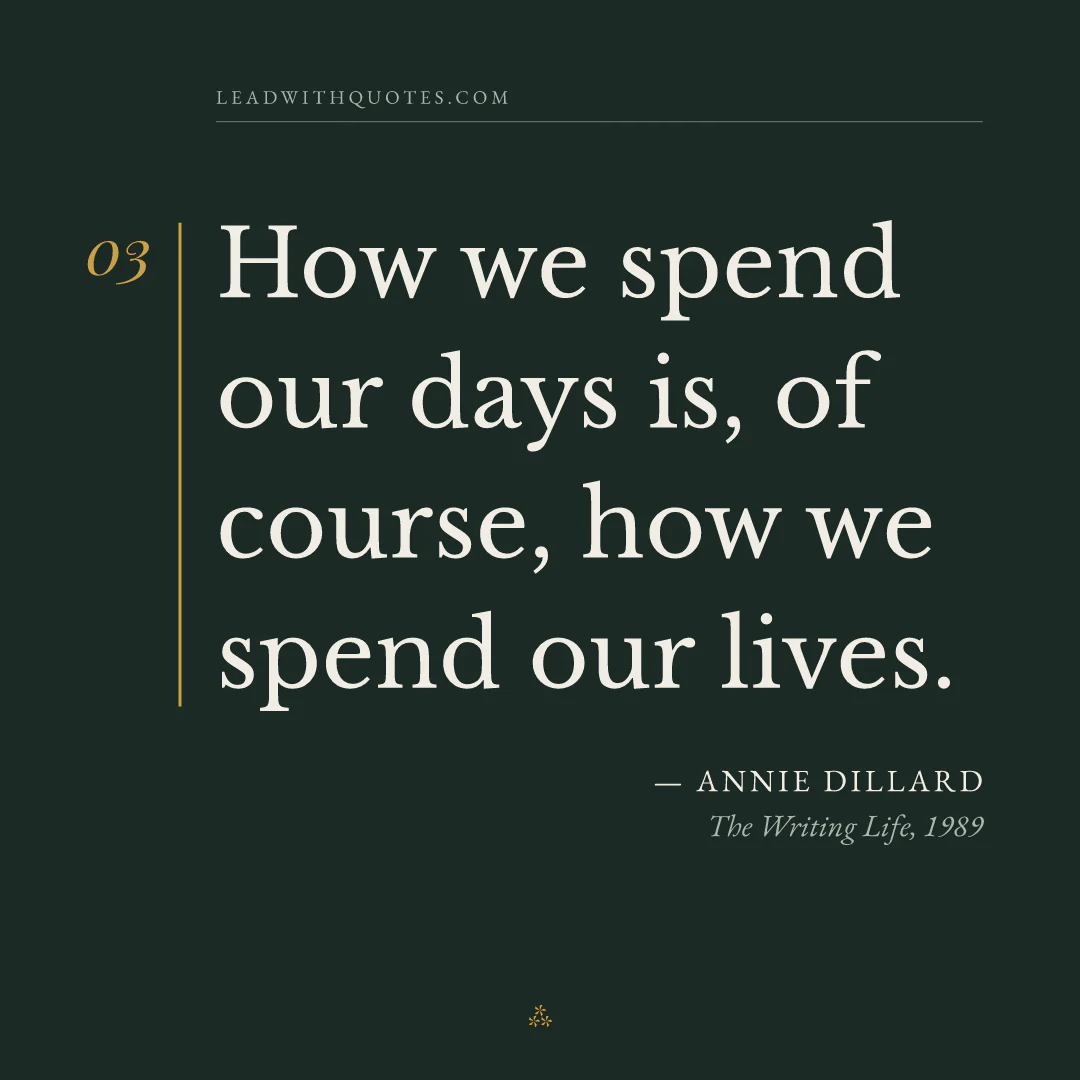
How we spend our days is, of course, how we spend our lives. What we do with this hour, and that one, is what we are doing.
Annie Dillard, The Writing Life (1989)
Usually only the first sentence gets shared (longer excerpt, The Marginalian). The second sentence is what makes it useful at work. Dillard is arguing for routine and schedules, not for grand gestures. It suits a post that thanks a team for the ordinary days rather than the launch party.
It is about a search, too, for daily meaning as well as daily bread, for recognition as well as cash, for astonishment rather than torpor; in short, for a sort of life rather than a Monday through Friday sort of dying.
Studs Terkel, Working (1974), introduction
Terkel built Working from interviews with people about their jobs, and this sentence closes the passage that opens the book with "This book, being about work, is, by its very nature, about violence — to the spirit as well as to the body." Our check rests on quoted excerpts (The Marginalian), not a page scan, and some sites print "It's about." Use it if your anniversary post is honest that the years were not all easy, and that staying was worth it anyway.
Funny work anniversary quotes
Humor works best for a coworker you know well, and it works better about work in general than about the person's job. Both of these come from writers who were joking about themselves.
Any one can do any amount of work, provided it isn't the work he is supposed to be doing at that moment.
Robert Benchley, "How to Get Things Done," Chicago Tribune, 2 February 1930
Benchley called it "the psychological principle" behind his own procrastination, and he reprinted the essay in Chips Off the Old Benchley (1949). Quote Investigator traced the original: it ends "at that moment," not "at the moment." Good for a card for the colleague who reorganizes the shared drive whenever a deadline looms.
One of the symptoms of approaching nervous breakdown is the belief that one's work is terribly important, and that to take a holiday would bring all kinds of disaster.
Bertrand Russell, The Conquest of Happiness (1930), chapter 5, "Fatigue"
Often quoted with an extra "an" before "approaching," and usually cut off after "important" (chapter text, Russell Society Japan). The full sentence is the funnier one and makes an obvious point for an anniversary: the person has earned time off, so tell them to take it. For more lines in this register, see our funny boss quotes with sources.
How to build the anniversary note around a quote
What should you say instead of "Happy work anniversary"? Something only you could write. A quote can open the note, but it should not be the whole note. A manager's anniversary message reads well in three parts:
- The number, made concrete. Not "5 years" but what five years has meant: the systems migrated, the hires trained, the clients kept.
- One specific moment. A project, a hard week, a decision. If you cannot name one, ask a teammate before writing.
- The quote, chosen for that moment, followed by one sentence about the year ahead.
Two fill-in examples:
- Ten years: "Ten years, [name]. Gibran wrote that 'work is love made visible,' and nobody who watched you rebuild [project] in [year] would argue. Thank you for choosing to stay. I'm glad we get the next chapter too."
- First year: "One year in, and [habit or fix] has already changed how the team works. James Clear calls habits 'the compound interest of self-improvement'; we're seeing the interest. Happy first anniversary."
Need a short line? Five from this page fit a chat message or a slide:
| Short line | Who said it | Best for |
|---|---|---|
| "Work is love made visible." | Kahlil Gibran, 1923 | Team card, any milestone |
| "Habits are the compound interest of self-improvement." | James Clear, 2018 | First year |
| "Let us cultivate our garden." | Voltaire, 1759 | Long service |
| "Slow but steady wins the race." | Aesop (Townsend tr.) | Long service, with humor |
| "…a sort of life rather than a Monday through Friday sort of dying." | Studs Terkel, 1974 | Your own anniversary |
If the anniversary turns into a retirement or a goodbye, our farewell quotes for a boss cover that, and for recognition outside a milestone see employee appreciation quotes.
Five anniversary favorites with the wrong name on them
These show up on almost every list of work anniversary quotes. The words are fine to use; the credit is not.
| Quote as shared | Usual credit | What the evidence shows |
|---|---|---|
| "Choose a job you love, and you will never have to work a day in your life." | Confucius | Earliest known version: Arthur Szathmary, Princeton Alumni Weekly, 1982, crediting an unnamed "old-timer"; first tied to Confucius in 1985 (Quote Investigator). |
| "We are what we repeatedly do. Excellence, then, is not an act, but a habit." | Aristotle | Will Durant's summary of Aristotle in The Story of Philosophy (1926), p. 87 (Wikiquote). Credit Durant. |
| "Nothing in the world can take the place of persistence…" | Calvin Coolidge | Unsigned in a 1914 trade journal; first credited to Coolidge in 1929 (Quote Investigator). |
| "Opportunity is missed by most people because it is dressed in overalls and looks like work." | Thomas Edison | An anonymous 1921 newspaper filler; Edison's name was attached in 1962, after his death (Quote Investigator). |
| "The secret of getting ahead is getting started." | Mark Twain | Grew out of a 1923 bank ad; Twain's name first appears in 1997 (Quote Investigator). |
If you use one of these, write "as the saying goes" instead of a name. More corrections of this kind are collected on our page of leadership quotes leaders never said.
How these quotes were checked
Each of the 13 quotes was checked on 20 October 2026 against the fullest text available: the Roosevelt and Jobs transcripts, the King estate transcript and the King Papers, Project Gutenberg texts of Gibran, Aesop and Candide, the French text on Wikisource, the Russell chapter, and Quote Investigator's newspaper research for Benchley. Four rest on secondary pages rather than a scan we could read, and the notes beside them say so: Gladwell and Clear (published excerpts), Dillard and Terkel (quoted passages). Tenure figures are from the BLS release linked at the top. Lines that could not be traced to the person usually named are in the table above, not in the list.