Quotes About Bad Leadership: 12 Sourced Lines on Toxic, Weak and Corrupt Leaders
12 quotes about bad leadership, traced to their sources and sorted by type: corrupt, rigid, toxic and weak leaders, micromanagers, plus 6 misattributions.

The most quoted sentence about bad leadership is usually quoted wrong. Lord Acton did not write "power corrupts." In a letter to the historian Mandell Creighton in April 1887 he wrote that power tends to corrupt, and the hedge matters: Acton was describing a pull that every leader feels, not a fate. This page collects 12 quotes about bad leadership, each traced to the letter, book, speech or scripture it comes from. They are grouped by the seven kinds of bad leadership that the Harvard scholar Barbara Kellerman described in 2004: incompetent, rigid, intemperate, callous, corrupt, insular and evil. There are also sections on micromanagement and on weak leaders, a table of popular lines that carry the wrong name, and advice on using these quotes at work without it reading as a dig at your own boss.
Seven kinds of bad leader, and the line that fits each
In Bad Leadership: What It Is, How It Happens, Why It Matters (Harvard Business School Press, 2004), Kellerman argued that leadership studies had spent decades on good leaders and almost none on bad ones. She split bad leadership into two families. The first three types are ineffective: they fail to produce the change they promise. The other four are unethical: they may get results, but they do harm along the way. Her definitions also include "at least some followers," because in her view a bad leader always has help. The summaries below are ours, based on the book and on the Globe and Mail's 2004 review.
| Type | What it means (paraphrased) | How it shows up at work | Quote on this page |
|---|---|---|---|
| Incompetent | Lacks the will or the skill to get things done | Confident plans that never land | Darwin |
| Rigid | Competent, but won't adapt to new ideas or new facts | "We tried that in 2019" | Galbraith |
| Intemperate | Lacks self-control, and nobody stops it | Shouting, public blame, late-night messages sent in anger | Jefferson |
| Callous | Uncaring and unkind toward the people being led | Fear as the main management tool | Machiavelli |
| Corrupt | Lies, cheats or steals; puts self-interest first | Rules for the team, exceptions for the boss | Acton, Proverbs |
| Insular | Ignores the welfare of people outside the group | Wins for the department at the customer's expense | Tacitus |
| Evil | Uses pain and atrocity as instruments of power | Rare at work, but the mechanism (ordinary people following orders) is not | Arendt |
The table is useful when you need a quote for a talk or a training session: start from the behavior you want to name, then pick the line, rather than reaching for whichever quote about "bad leaders" comes up first.
Corrupt leaders: what power does to the people who hold it
Corruption is the type most people mean when they search for quotes about bad leadership. The two lines below were written more than two thousand years apart and say the same thing from opposite ends: one from inside power, one from the people underneath it.
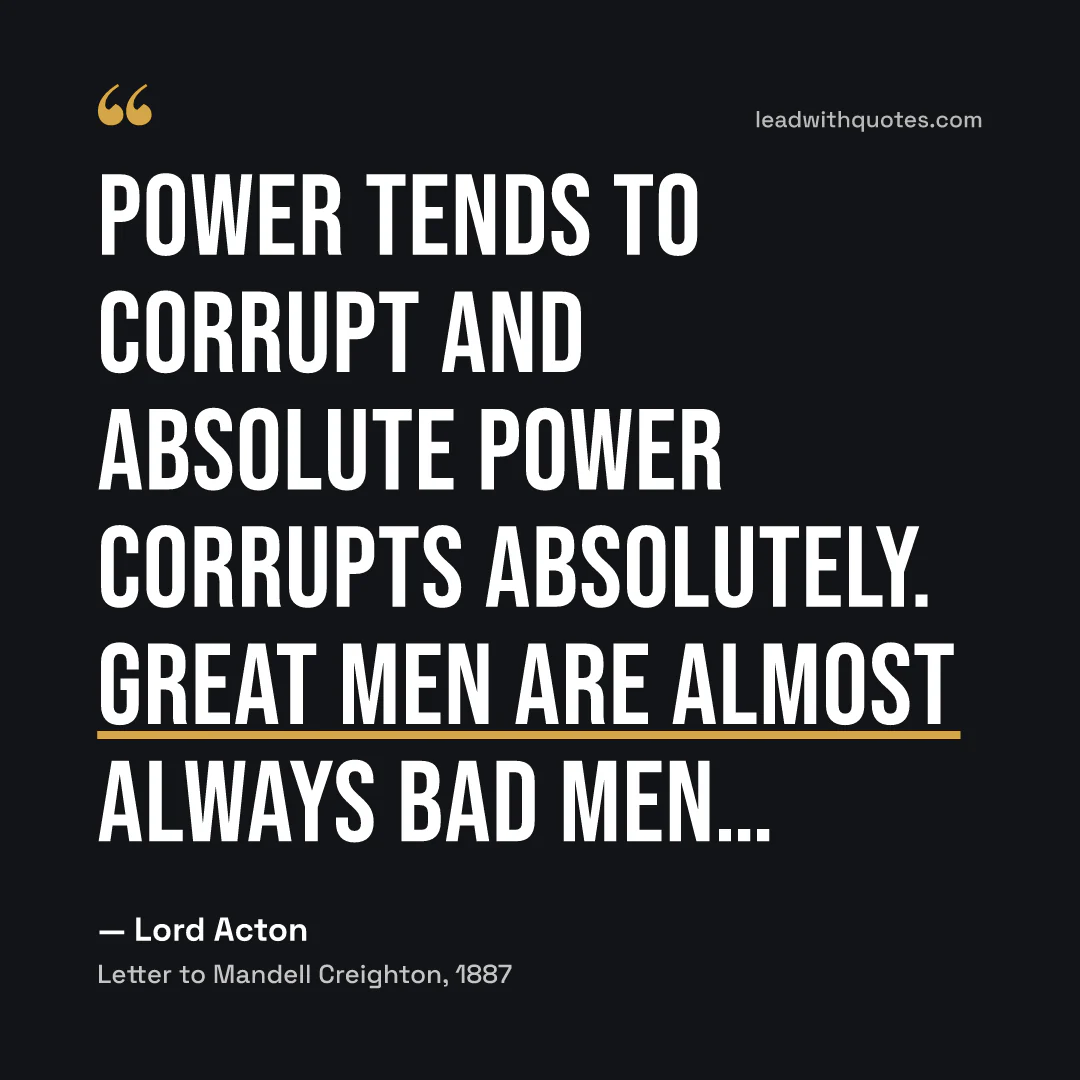
Power tends to corrupt and absolute power corrupts absolutely. Great men are almost always bad men, even when they exercise influence and not authority: still more when you superadd the tendency or the certainty of corruption by authority.
Lord Acton, letter to Mandell Creighton, 5 April 1887
Acton was arguing with Creighton about how historians should judge popes and kings, and he refused to give powerful men the benefit of the doubt (Hanover College text of the letter; the full exchange is on Econlib). Two details are usually lost. The word "tends" turns a cynical slogan into a warning a decent leader can take personally. And the second sentence says influence corrupts too, not only formal authority, which makes it a sharper line for a senior individual contributor or a founder than for a dictator. The letter was printed in Acton's Historical Essays and Studies (1907); some editions add a comma after "corrupt."
When the righteous are in authority, the people rejoice: but when the wicked beareth rule, the people mourn.
Proverbs 29:2 (King James Version)
The proverb measures a leader by the mood of the people under them, which is the same yardstick modern engagement surveys use (Bible Gateway, KJV). It works well in a church leadership setting or a values talk, and it is honest about who pays for bad leadership: not the leader, but "the people." For more on the private side of the same problem, see our page of integrity quotes for leaders.
Incompetent and rigid: the leader who can't, and the leader who won't
Kellerman's first two types are often confused. The incompetent leader doesn't know enough and doesn't know it. The rigid leader knows plenty but has stopped learning. Each has a good line, and neither line was written about management at all.
…ignorance more frequently begets confidence than does knowledge: it is those who know little, and not those who know much, who so positively assert that this or that problem will never be solved by science.
Charles Darwin, The Descent of Man (1871), Introduction
Darwin was answering critics who said the origin of humans could never be known (Darwin Online, first edition, vol. 1, p. 3). The middle clause is the part people quote, and it describes the incompetent leader exactly: certainty grows faster than skill. It is more than a century older than the psychology studies that later made the same point, which makes it a good opener for a session on decision-making.
Faced with the choice between changing one's mind and proving that there is no need to do so, almost everyone gets busy on the proof.
John Kenneth Galbraith, A Contemporary Guide to Economics, Peace, and Laughter (1971), ch. 3
Galbraith first used a shorter version in a New York Times book review in May 1965, ending "almost everyone opts for the latter"; the wording above is the 1971 book version (Quote Investigator traces both). It names the rigid leader's habit without naming the leader. Note the "almost everyone": Galbraith is including the reader, which is why the line lands in a room instead of offending it.
Intemperate and callous: temper, fear and contempt
These two types do the most damage to people's days. One can't control anger; the other doesn't care what the team feels. A founding father and a Florentine diplomat supply the lines.
When angry, count ten, before you speak; if very angry, an hundred.
Thomas Jefferson, letter to Thomas Jefferson Smith, 21 February 1825
It is the last of ten rules ("A Decalogue of Canons for observation in practical life") that the 81-year-old Jefferson sent to a boy named after him (Monticello's Jefferson Quotes & Family Letters). Many reprints change "an hundred" to "a hundred." For a manager it is less a quote than a practical rule, and it works as one on a team charter: no decisions and no messages sent while angry.
…it is much safer to be feared than loved, when, of the two, either must be dispensed with.
Niccolò Machiavelli, The Prince (1532), chapter XVII, trans. W. K. Marriott (1908)
This is the callous leader's favorite line, and it is usually quoted without its conditions (Wikisource, Marriott translation). Machiavelli says it is best to be both loved and feared, and fear is only the fallback "when, of the two, either must be dispensed with." He then adds a warning that rarely makes the poster: a prince "ought to inspire fear in such a way that, if he does not win love, he avoids hatred." A boss who rules by fear and is hated has failed even by Machiavelli's standard, which makes the full passage a useful corrective rather than an endorsement.
Insular and evil: when the harm lands on someone else
Kellerman's last two types look furthest from office life. They are worth including because both describe a mechanism that shows up at small scale: a group that stops counting outsiders as people, and ordinary staff who carry out what they are told.
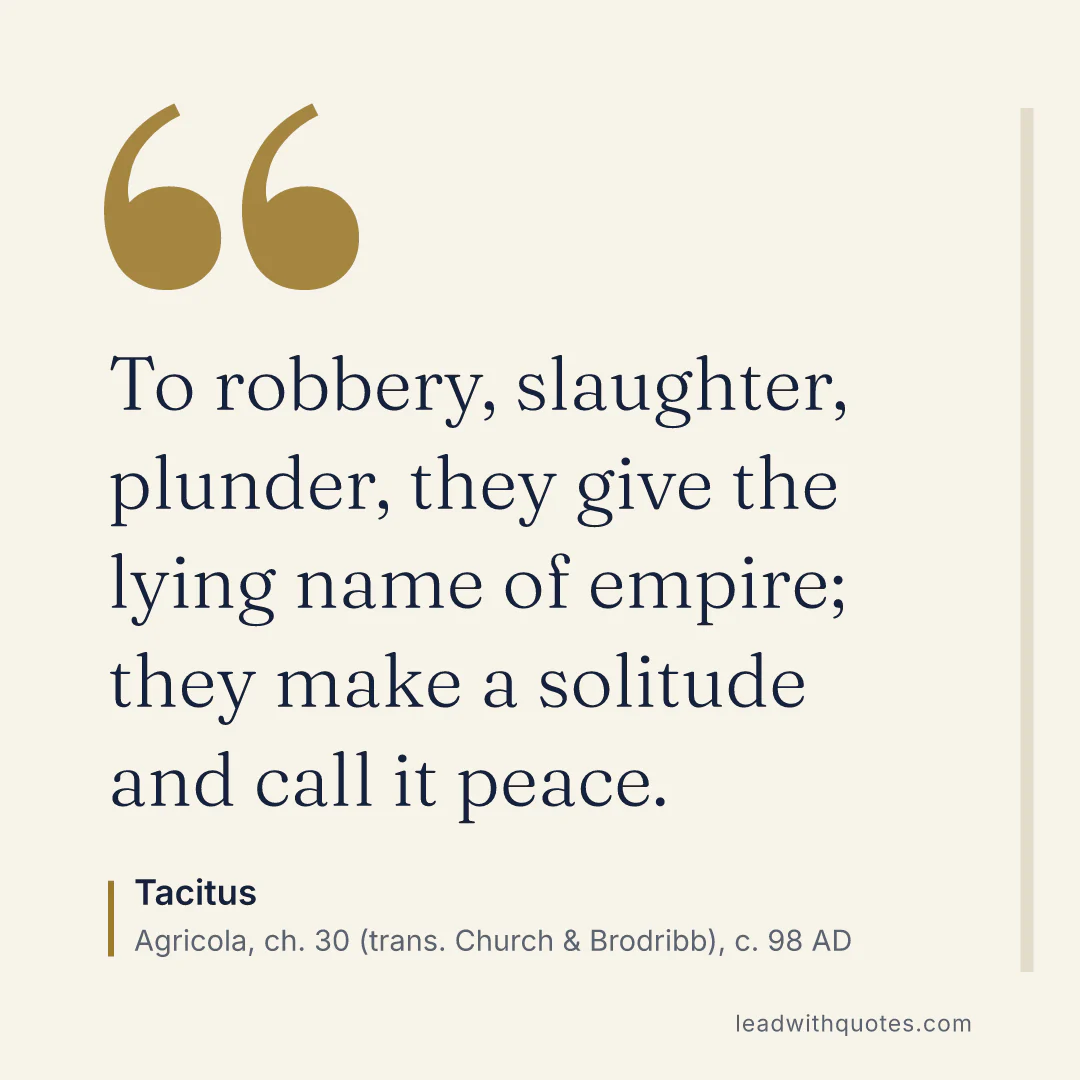
To robbery, slaughter, plunder, they give the lying name of empire; they make a solitude and call it peace.
Tacitus, Agricola, chapter 30 (c. AD 98), trans. Church and Brodribb
Tacitus puts these words in the mouth of Calgacus, a Caledonian chieftain about to fight the Roman army led by Tacitus's own father-in-law (Perseus Digital Library). That a Roman historian wrote the best line against Rome is the point: insular leaders rename the damage they do to outsiders, and someone inside has to notice. Other translations give "desert" or "wasteland" for solitudinem; Church and Brodribb's "solitude" is the standard public-domain version.
The trouble with Eichmann was precisely that so many were like him, and that the many were neither perverted nor sadistic, that they were, and still are, terribly and terrifyingly normal.
Hannah Arendt, Eichmann in Jerusalem (1963), Epilogue
Arendt covered the 1961 trial of Adolf Eichmann for The New Yorker, and her conclusion, that great evil needs mostly ordinary functionaries, is why she belongs on a page about leadership (the sentence is on p. 276 of the Penguin Classics edition, per the publisher's reader's guide). Use it with care: it belongs in an ethics course, a history class or an essay on compliance, not in a team meeting about a difficult manager.
Micromanagement quotes: the boss who can't let go
Micromanagement is not one of Kellerman's seven types, but it is the form of bad leadership most employees meet first. The two best lines against it come from people who ran very large organizations.
Those men and women, to whom we delegate authority and responsibility, if they are good people, are going to want to do their jobs in their own way. Mistakes will be made. But if a person is essentially right, the mistakes he or she makes are not as serious in the long run as the mistakes management will make if it undertakes to tell those in authority exactly how they must do their jobs.
William L. McKnight, 3M, management principles (1948)
McKnight ran 3M for decades, and this statement is still cited as the root of the company's culture of letting engineers experiment (text as reproduced in Wikipedia's McKnight article; we could not load 3M's own history pages to check it, and the "men and women… he or she" phrasing is likely 3M's modernized version of the 1948 text). The next sentence in the statement is just as good for a slide: "Management that is destructively critical when mistakes are made kills initiative." His other famous line, about fences and sheep, has no source; see the table below.
I believe that you surround yourself with the best people you can find, delegate authority, and don't interfere as long as the overall policy that you've decided upon is being carried out.
Ronald Reagan, interview with Fortune, 1986
Reagan said this in an Oval Office interview for a September 1986 Fortune cover story on his management style (UPI report, 27 August 1986). The poster version drops "overall," which changes the meaning: Reagan was setting the policy and leaving the details alone, not stepping away. Months later the Iran-Contra affair became the standard case study of what happens when hands-off goes too far, so the quote is honest only if you use both halves of that story.
Weak leaders and the people who stand aside
One of the most searched questions on this topic is what to say about weak leaders. The oldest answer puts part of the blame on everyone who refused to lead instead.
But the chief penalty is to be governed by someone worse if a man will not himself hold office and rule.
Plato, Republic, 347c, trans. Paul Shorey (1930)
Socrates is explaining why good people agree to rule even though they don't want to: not for money or honor, but to avoid being ruled by someone worse (Perseus, Shorey translation). The popular version, "One of the penalties for refusing to participate in politics is that you end up being governed by your inferiors," is a modern paraphrase; Barry Popik traces that exact wording to a 1960 speech, not to Plato. Use Shorey's line, or say "paraphrasing Plato."
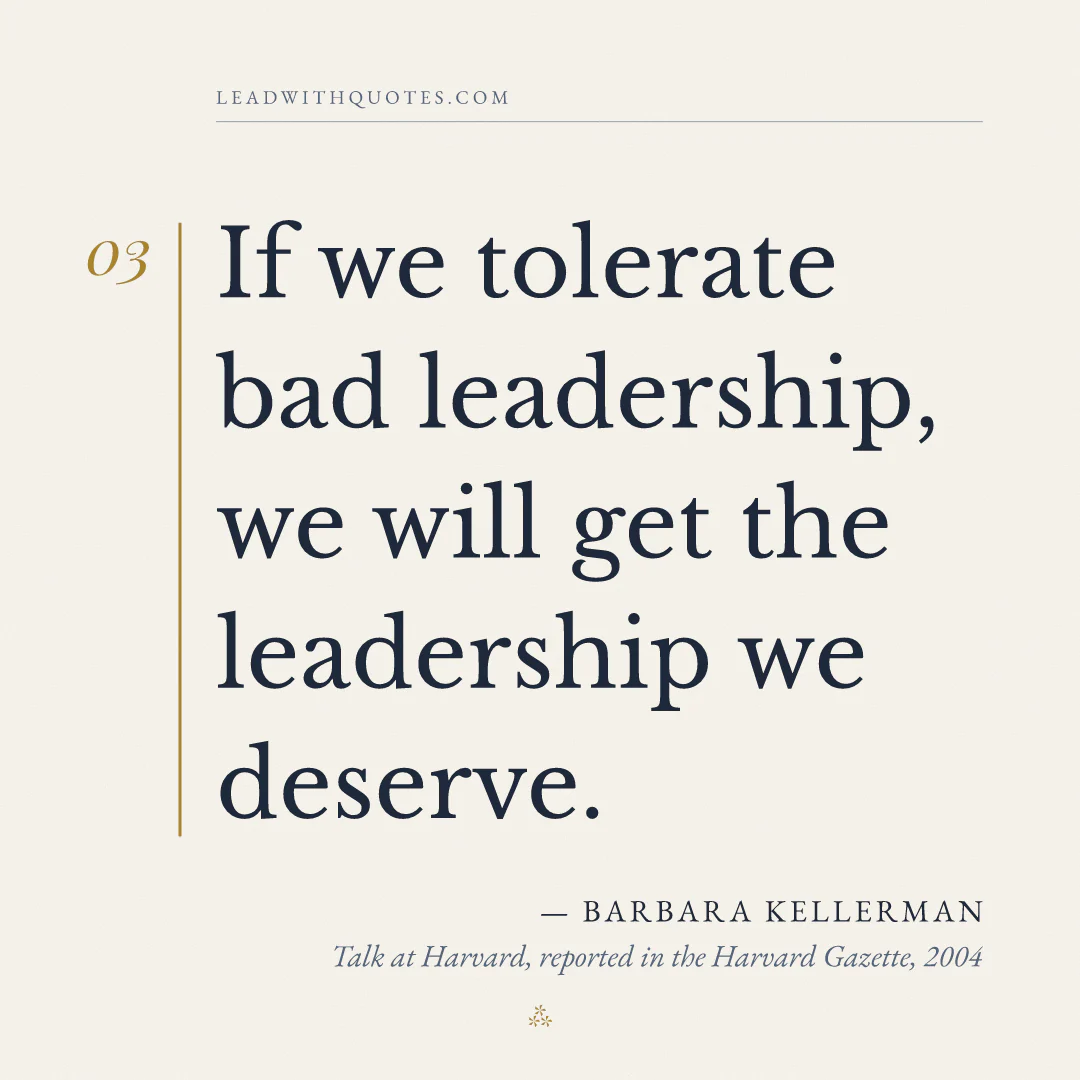
Be emboldened to act. Consider it your right, your duty to take a stand. If we tolerate bad leadership, we will get the leadership we deserve.
Barbara Kellerman, talk at Harvard, October 2004
Kellerman said this at a Harvard talk on the book, reported in the Harvard Gazette on 28 October 2004. In the same talk she put the whole argument in two sentences: "Followers are every bit as important to leadership as are leaders. You can't have bad leadership without having bad leaders and bad followers." It is the right note to end a training session on, because it gives the audience something to do. For the follower's side of the job, our page of accountability quotes picks up the thread.
What a toxic boss actually costs
Quotes about toxic bosses are popular because almost everyone has had one. Two documented findings explain why the subject matters beyond hurt feelings. In 2015 Gallup reported that "managers account for at least 70% of variance in employee engagement scores" (Harter and Adkins, Gallup, summarizing its State of the American Manager report). And the phrase "people leave managers, not companies" is not an internet proverb: it comes from Marcus Buckingham and Curt Coffman's First, Break All the Rules (1999), p. 33, where it follows Gallup survey research on what keeps employees in a job. Quote either one with the source attached and it reads as evidence, not a complaint.
If your goal is the positive version, how a good manager behaves day to day, see our quotes for managers with sources.
What makes leadership poor? A four-step ranking from the Tao Te Ching
People searching for "poor leadership quotes" usually want one thing: a line that names the failure without naming the boss. The oldest ranking of rulers we could find that does this is chapter 17 of the Tao Te Ching, here in James Legge's 1891 translation:
In the highest antiquity, (the people) did not know that there were (their rulers). In the next age they loved them and praised them. In the next they feared them; in the next they despised them. Thus it was that when faith (in the Tao) was deficient (in the rulers) a want of faith in them ensued (in the people).
Tao Te Ching, chapter 17, trans. James Legge (1891; Project Gutenberg #216)
The passage works as a checklist. Leadership at its best is barely noticed, then admired, then feared, and at the bottom despised. The last sentence is the practical part: distrust in the leader follows from the leader's own lack of faith, not from the team's mood. Brackets are Legge's own insertions, and other translators phrase the ranking differently, so quote the translator when you use it. It pairs with Machiavelli's "feared than loved" line above, which describes the third rung as if it were a safe place to stop.
Bad-leadership lines with the wrong name on them
Pages about bad leadership are full of lines credited to famous generals and presidents. These are the most common ones we checked, and what the record shows. Our longer list of leadership quotes leaders never said covers more.
| Popular line | Usually credited to | What the record shows |
|---|---|---|
| "Power corrupts, and absolute power corrupts absolutely." | Lord Acton | Acton wrote "Power tends to corrupt" (1887). Pitt the Elder said something similar in the House of Lords in 1770: "Unlimited power is apt to corrupt the minds of those who possess it" (phrases.org.uk). |
| "An army of sheep led by a lion is better than an army of lions led by a sheep." | Alexander the Great | Plutarch gives a version with stags to the Athenian general Chabrias; the sheep version appears as a "proverb" in 1523; the Alexander credit is modern (Quote Investigator). |
| "There are no bad regiments, only bad colonels." | Napoleon | No Napoleon source found; not on Wikiquote's Napoleon page. A documented relative is Field Marshal William Slim's line about "good and bad officers" in Defeat into Victory (1956). Call it an old military maxim. |
| "The best executive is the one who has sense enough to pick good men… and self-restraint enough to keep from meddling with them while they do it." | Theodore Roosevelt | No primary source; not on Wikiquote's or the TR Library's pages. Say "attributed to," or use Reagan's documented line above instead. |
| "If you put fences around people, you get sheep." | William L. McKnight, 1948 | Widely credited to McKnight but not part of his 1948 statement, and no primary source has been found. Use the 1948 text above. |
| "A fish rots from the head." | Greek or Chinese sages | A proverb of unknown origin. The earliest English print (1768) calls it Turkish; a version appears in Rumi (phrases.org.uk). |
Using these quotes without making it about your boss
A quote about bad leadership always points at somebody. Used carelessly, it points at the person who signs your performance review. A few rules keep it useful:
- Aim at a behavior, not a person. Use the type table above. "Let's not become the rigid team Galbraith described" invites a discussion; posting the same line the day after a tense meeting invites a reply from HR.
- Use the full version. Acton's "tends," Machiavelli's caveat about hatred and Reagan's "overall" each make the quote fairer, and a fair quote is harder to dismiss.
- Pair every warning with a practice. Jefferson's count-to-ten rule, McKnight's tolerance for mistakes and Kellerman's call to followers all suggest something to do on Monday. A slide with only a complaint on it ends the conversation.
- Turn it inward first. The lines that land best in a leadership workshop are the ones a manager reads about themselves. Galbraith's "almost everyone" and Acton's point about influence both work that way.
- In writing, cite the source. In an essay or a LinkedIn post, a dated source ("Acton, letter to Creighton, 1887") separates you from the thousands of posts recycling the same unsourced lines.
How these quotes were checked
Each quote was checked against a page we loaded: a scan or transcription of the original (Darwin Online, Perseus, Wikisource, Project Gutenberg, Bible Gateway), a primary-document collection (Hanover College, Monticello), the publisher, or a contemporary news report (UPI 1986, Harvard Gazette 2004). Where only a secondary source was available, as with McKnight's 1948 statement, the note under the quote says so. Translations are named because they change the wording: Tacitus, Plato and the Tao Te Ching read differently in every edition. If you find an earlier or better source for any line here, we will update the page.