Integrity Quotes for Work and Leadership: 12 Lines Traced to Their Sources
12 integrity quotes for work and leadership, from Drucker to Brené Brown, each traced to its book or speech, plus 7 common attribution errors to avoid.

Is integrity just a longer word for honesty? No, and the difference is the reason most integrity quotes miss the point. Honesty is about what you say; integrity is about whether what you say, decide and do line up, especially when it costs you something. This page collects 12 integrity quotes for work and leadership, each traced to the book, letter, lecture or speech it comes from, and sorts them by the four words people mix up: integrity, honesty, character and ethics. It also answers what Warren Buffett really said about integrity, which short lines suit which moment at work, and which famous integrity quotes carry the wrong name.
Integrity, honesty, character, ethics: which word do you actually mean?
Pick the word before you pick the quote. A line about honesty read out at a talk on integrity sounds slightly off, because the audience hears that you are asking for something smaller. This table is our working distinction, built from the sources quoted below rather than from a dictionary.
| Word | What it asks of a leader | Quick test | Line on this page that fits |
|---|---|---|---|
| Honesty | Say what is true | Would the statement survive a fact check? | Twain, Spencer Johnson |
| Integrity | Act on what you believe is right, even at a cost, and say so | Did you do it when it was expensive? | Carter, Brown, Buffett |
| Character | The habits that show when nobody checks | What do you do unobserved? | Watts, Heraclitus |
| Ethics | Shared rules about right and wrong in a role or profession | Is it allowed, and is it right? | Acton, Drucker |
The overlap is real: you cannot have integrity without honesty. But the reverse fails, and that gap is where the best quotes live.
The definition worth quoting: Stephen Carter's three steps
The most useful definition of integrity in print comes from a Yale law professor, and it works at work because each step can be checked.
Integrity, as I will use the term, requires three steps: (1) discerning what is right and what is wrong; (2) acting on what you have discerned, even at personal cost; and (3) saying openly that you are acting on your understanding of right from wrong.
Stephen L. Carter, Integrity (1996), chapter 1, "The Rules About the Rules"
Carter first set out the same sentence, without the numbers, in "The Insufficiency of Honesty," The Atlantic Monthly, February 1996, which the book reprints as a chapter (book scan, Internet Archive). The third step is the one managers forget. A leader who quietly does the right thing but never explains it leaves the team guessing about the rule, and the next person in the same spot may decide differently. Saying "I'm turning down this deal, and here's why" turns a private choice into a standard.
one cannot have integrity without being honest ... but one can certainly be honest and yet have little integrity.
Stephen L. Carter, "The Insufficiency of Honesty," The Atlantic Monthly (February 1996)
The omitted words are a short aside ("the matter gets complicated"). The version shared online, "but one can be honest and yet lack integrity," is a paraphrase; it does not appear in the scanned text. Carter's example is the person who blurts out a hurtful truth to win an argument: honest, but not acting on any considered sense of right. Use this line when someone defends a bad call with "at least I was honest about it."
Honesty is the outward half
If integrity is the whole, honesty is the part other people can see. Two writers put the split in one sentence each.
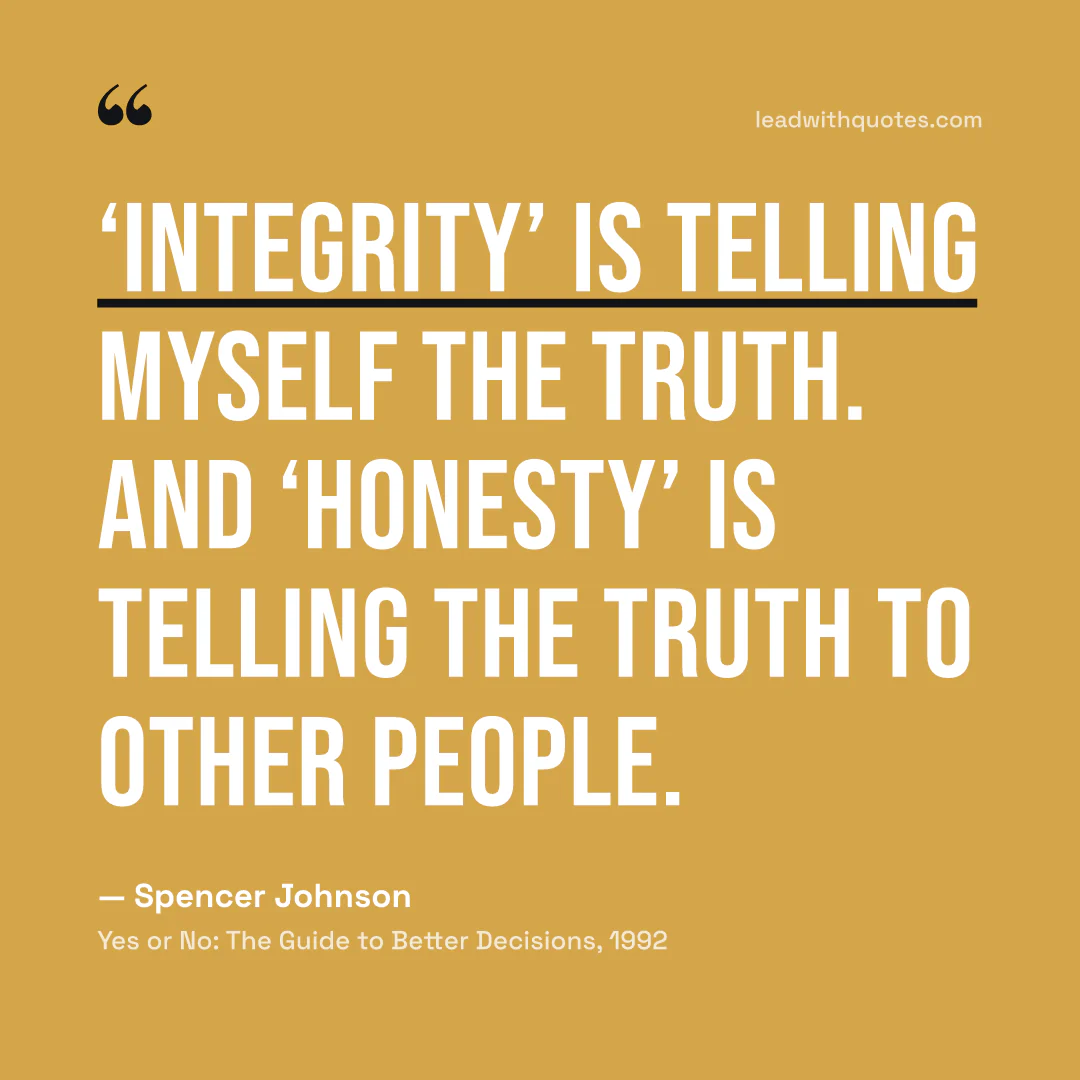
'Integrity' is telling myself the truth. And 'honesty' is telling the truth to other people.
Spencer Johnson, "Yes" or "No": The Guide to Better Decisions (1992)
The line is spoken by a character in Johnson's business fable, which is why the two key words sit inside their own quotation marks in the book (Internet Archive). It is often credited to Johnson's earlier One Minute for Myself (1985), but a full-text search of that book turns up no match; the 1992 book is the earliest source on record. The practical reading for a manager: a team cannot be more honest with you than you are with yourself about a failing project. Integrity starts with the status report you write in your own head.
If you tell the truth you don't have to remember anything.
Mark Twain, notebook entry, early 1894, printed in Mark Twain's Notebook, ed. Albert Bigelow Paine (1935), p. 240
Twain wrote it privately; it reached print a quarter century after his death, and the only evidence that he coined it is Paine's edition (twainquotes.com, Barbara Schmidt). It is the most practical argument for honesty ever made: lying is a memory task, and memory fails under pressure. It suits a team meeting about consistent customer messaging better than a speech on values.
Integrity in leadership: why the top sets the standard
Every serious writer on management makes the same point: integrity at the top is not a private virtue but a signal everyone below reads and copies.
The final proof of the sincerity and seriousness of a management is uncompromising emphasis on integrity of character.
Peter F. Drucker, Management: Tasks, Responsibilities, Practices (1974)
Drucker first wrote this in The Practice of Management (1954), in the chapter "The Spirit of an Organization," as "The final proof of its sincerity and seriousness is uncompromising emphasis on integrity of character"; the familiar "of a management" wording is his 1974 revision. His point in both books is about appointments: a company shows what it values by whom it promotes, and promoting a high performer known to cut corners tells everyone that results excuse anything. If you quote it, cite the book you are quoting.
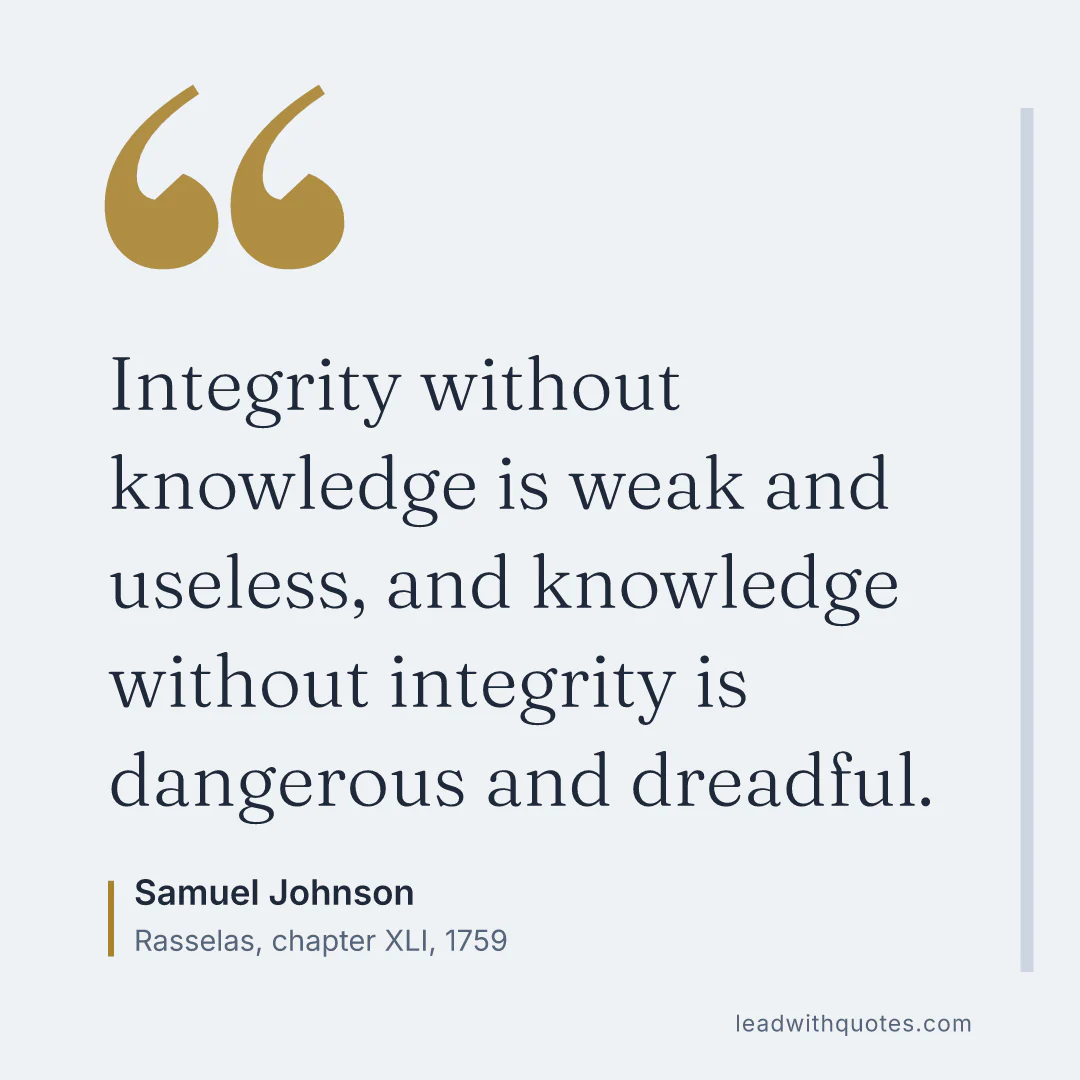
Integrity without knowledge is weak and useless, and knowledge without integrity is dangerous and dreadful.
Samuel Johnson, The History of Rasselas, Prince of Abyssinia (1759), chapter XLI
Quote sites give it to Johnson in his own voice, but in the novel it is spoken by the astronomer to the philosopher Imlac, in the chapter where the astronomer confesses the cause of his unease (Standard Ebooks text). The sentence is a good corrective for leadership training that treats integrity as enough: a well-meaning manager who does not understand the work makes weak decisions, and a brilliant one without scruples makes dangerous ones. You need both, and this is the line that says so.
Power tends to corrupt and absolute power corrupts absolutely. Great men are almost always bad men, even when they exercise influence and not authority.
Lord Acton, letter to Bishop Mandell Creighton, 5 April 1887
Acton was arguing with Creighton about how a historian should judge popes and kings, insisting that high office should earn more scrutiny, not less (full letter, Mises Institute edition). Note "tends to": he did not say power always corrupts, and the original has no comma before "and." The second sentence is the one leaders should read: it covers influence too, which means a senior engineer or a star salesperson, not only the boss. It is the case for checks such as a second signature or a real audit, which are not insults to an honest leader but protection for one.
What did Warren Buffett say about integrity?
He said he hires for three qualities and that integrity is the one that cannot be missing, but he never claimed to have coined the line. The best-documented early version comes from a 1993 talk at Columbia Business School, reported in the Omaha World-Herald on 2 January 1994:
Somebody once said that in looking for people to hire, you look for three qualities: integrity, intelligence and energy. And if they don't have the first, the other two will kill you.
Warren Buffett, Columbia Business School talk (1993), as reported in the Omaha World-Herald, 2 January 1994
Quote Investigator traced the history and found that Buffett always presented it as borrowed; in his 1998 University of Florida lecture he credited Pete Kiewit, the Omaha contractor (Quote Investigator, 2023). He has also used it with the order reversed ("if they don't have the last, the first two will kill you"), so check which version you are quoting. The logic is what makes it useful in a hiring discussion: intelligence and energy multiply whatever values a person brings. In someone dishonest, they make the damage bigger and faster.
If you have integrity, nothing else matters. And if you don't have integrity, nothing else matters.
Alan K. Simpson, as quoted in the Dallas Morning News, 6 October 2000
The former Wyoming senator made this line famous, but he did not invent it: an unattributed "it has been said" version ran in the Milwaukee Journal Sentinel in 1997, and the credit to Winston Churchill has no support (Barry Popik's newspaper citations). It is a strong closing line for a talk because the repetition does the work; say it slowly and don't explain it.
Character and the "when nobody's looking" test
The most-shared integrity quote of all, "Integrity is doing the right thing, even when no one is watching," has no known author. It is usually credited to C. S. Lewis, and the C. S. Lewis Foundation lists it among lines he never wrote (C. S. Lewis Foundation). The closest documented version is about character, and it comes from a congressman:
And I was taught that character does count, and that character is simply doing what's right when nobody's looking.
J. C. Watts Jr., Republican response to the State of the Union address, 4 February 1997
Watts, then a congressman from Oklahoma, had used a similar line at the 1996 Republican convention; the 1997 wording is in the official transcript (American Presidency Project). If you want the "nobody's looking" idea with a real name attached, this is the version to use, and it is worth saying "character" rather than swapping in "integrity."
The character of man is his guardian spirit.
Heraclitus, fragment B119 (Diels–Kranz), c. 500 BC, translated by Daniel W. Graham, Stanford Encyclopedia of Philosophy (2023)
The Greek is three words, ēthos anthrōpōi daimōn, and "character is destiny" is the loose popular rendering (Stanford Encyclopedia of Philosophy). Graham's translation keeps the meaning that matters for leaders: your fate at work is not decided by luck or a powerful patron but by your settled habits. It suits a slide on culture better than a speech, because it needs a sentence of explanation.
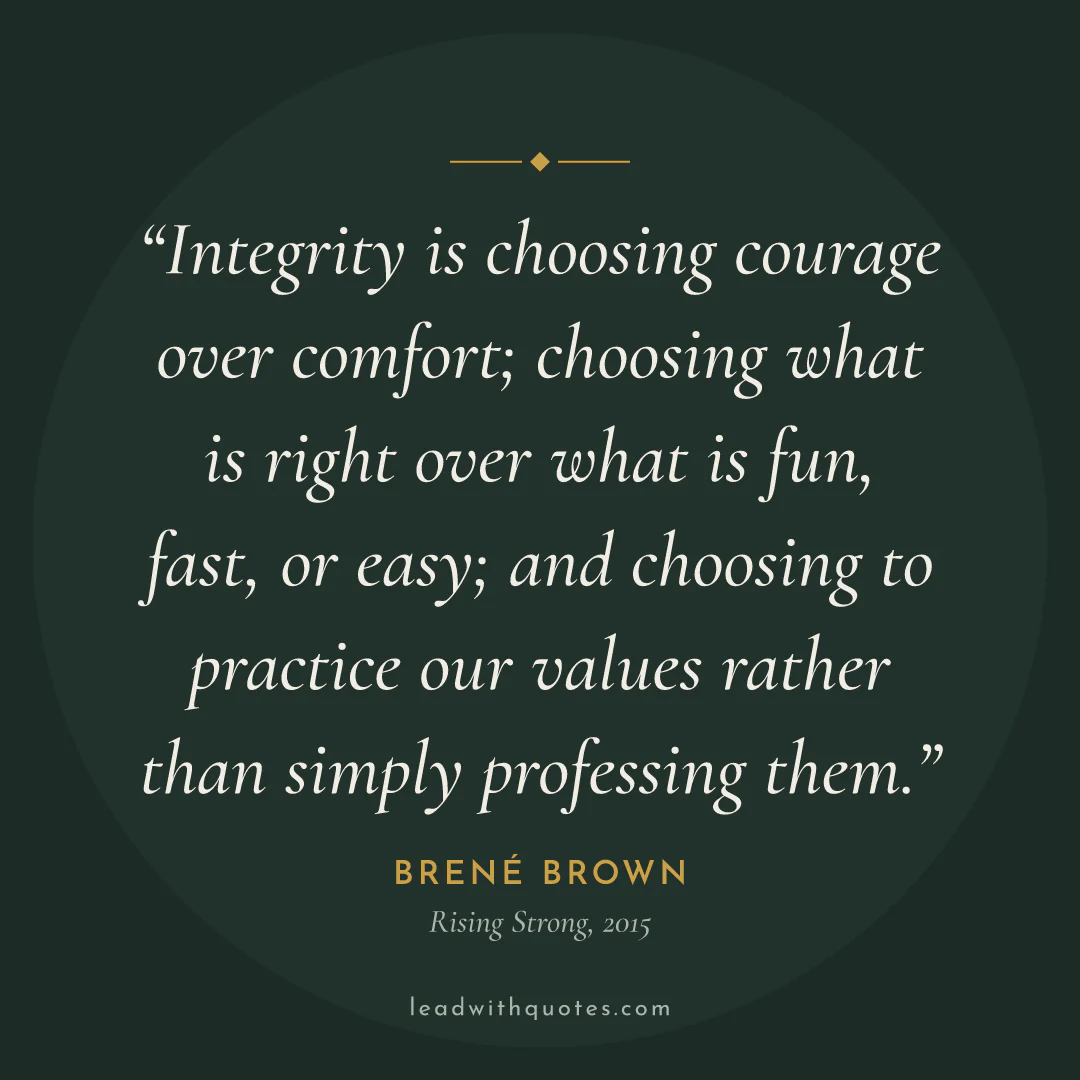
Integrity is choosing courage over comfort; choosing what is right over what is fun, fast, or easy; and choosing to practice our values rather than simply professing them.
Brené Brown, Rising Strong (2015)
Brown introduces it as her own definition (book scan, Internet Archive). It is often credited to her later Dare to Lead (2018), and a spoken variant with "your values" circulates from an interview; the book version above is the one to quote. Its middle clause, "fun, fast, or easy," is the most honest description of workplace temptation we know: most integrity failures at work are not dramatic frauds but shortcuts taken because the deadline was tomorrow.
Short integrity quotes for work: which line for which moment
Short lines work when the moment is small: a slide, a Slack post, a card for a values award. Match the line to the job it has to do.
| Moment at work | Short line | Why it fits |
|---|---|---|
| Code of conduct training, opening slide | "If you tell the truth you don't have to remember anything." (Twain) | Practical, not preachy; gets a smile |
| Hiring panel or interview guide | "…if they don't have the first, the other two will kill you." (Buffett, quoting someone else) | Turns a value into a hiring rule |
| Values award or recognition card | "…character is simply doing what's right when nobody's looking." (Watts) | Honors something nobody saw |
| Closing line of a talk | "If you have integrity, nothing else matters…" (Simpson) | Repetition lands without explanation |
| Post-mortem after a shortcut went wrong | "…choosing what is right over what is fun, fast, or easy…" (Brown) | Names the real temptation, without blaming anyone |
| Promotion or leadership program | "…uncompromising emphasis on integrity of character." (Drucker) | Ties integrity to who gets promoted |
Keep the ellipsis when you shorten a line. A trimmed quote without one changes the source's sentence, and on a slide about integrity that is a poor look.
How to use an integrity quote without sounding preachy
An integrity quote read out by a manager can land as a lecture, especially if the team suspects a problem prompted it. Four habits keep it useful:
- Attach it to a real decision. If your team once refunded a client for an error the client never noticed, tell that story and then say: "That's what Carter means by acting on what you've discerned, even at personal cost." A quote with an example teaches; a quote alone moralizes.
- Use it on yourself first. Brown's "fun, fast, or easy" works best as a confession: "Here's a shortcut I took last quarter."
- Do step three out loud. Carter's third step is saying openly why you acted. When you make a values-based call, explain it in the same meeting.
- Get the name right. Quoting "C. S. Lewis" on integrity in an ethics talk undercuts the talk. The table below lists the usual traps.
Two fill-in templates (replace the brackets with your own facts). For an all-hands after a hard call: "We walked away from [the decision] because it would have meant [the shortcut]. Warren Buffett likes to repeat a line about hiring for integrity, intelligence and energy: without the first, the other two will kill you. That applies to companies too." For a values award: "Nobody asked [name] to [the unseen action]. J. C. Watts called character 'doing what's right when nobody's looking.' This award is for exactly that."
If the topic is the trust that integrity builds, our trust in the workplace quotes pick up where this page ends, and the accountability quotes cover what happens after a mistake. For integrity shown through behavior rather than words, see the lead by example quotes.
Integrity quotes with the wrong name
These lines are everywhere in integrity lists. Each is either credited to the wrong person or has no documented source.
| Popular line and credit | What we found |
|---|---|
| "Integrity is doing the right thing, even when no one is watching." (C. S. Lewis) | Not in Lewis's writings. No known author; the closest documented line is J. C. Watts on character (1996–97). |
| "The supreme quality for leadership is unquestionably integrity…" (Dwight D. Eisenhower) | No speech or writing by Eisenhower found. Earliest known printing: J. A. Cheley, Stories for Talks with Boys and Girls (1958), as "for a leader." |
| "Real integrity is doing the right thing, knowing that nobody's going to know…" (Oprah Winfrey) | No source in O magazine, oprah.com or her books; credited to her in print from the early 2000s. Treat as attributed. |
| "Ethics is knowing the difference between what you have a right to do and what is right to do." (Potter Stewart) | No source in Stewart's opinions or speeches found. Printed without a name in 1995; the ethicist Michael Josephson used it in 2002. The Stewart credit appears from about 2004. |
| "If you have integrity, nothing else matters…" (Winston Churchill) | No support. Popularized by Alan Simpson (2000), after an unattributed 1997 newspaper use. |
| "Integrity, intelligence, energy…" (Warren Buffett, as his own) | Buffett presents it as borrowed, crediting Pete Kiewit in 1998; the original author is unknown. |
| "Integrity without knowledge is weak and useless…" (Samuel Johnson, speaking) | Johnson wrote it, but in Rasselas it is the astronomer's line, not the narrator's. |
For more corrections of this kind across leadership quotes, see our page on leadership quotes leaders never said.
How we checked these
Each of the 12 quotes was checked on 19 October 2026 against the original text where we could reach it: book scans on the Internet Archive (Carter, Spencer Johnson, Brown, Drucker), the full text of Rasselas and of Acton's letter, and the official Watts transcript. Three rest on careful secondary research rather than a primary page we could read: Buffett (Quote Investigator and the 1994 newspaper report), Simpson (newspaper citations collected by Barry Popik) and Twain (Paine's 1935 edition, via Popik and twainquotes.com). We say so beside each one. Lines we could not trace to anyone are in the table above, not in the list.