Desk essay
16 Valuable Woman Quotes That Will Redefine Your Standards
The historical record often reduces female intellect to polite encouragement, but primary sources reveal a tradition of sharp, unsentimental pragmatism.
By Morgan Ellis
Morgan Ellis

Popular culture often insists that the archives of female thought are dominated by soft, nurturing encouragement designed primarily to uplift others. Look closer at the actual letters, essays, and speeches from the eighteenth and nineteenth centuries, and a fiercely unsentimental pragmatism emerges. I learned this distinction from my aunt in a cramped kitchen in Portland, Maine, 2011, when she casually dismissed a self-help book's platitudes about empowerment in favor of reading raw historical biographies. The women who genuinely altered the trajectory of history did not trade in vague affirmations. They documented their exact worth, demanded precise compensation, and articulated their boundaries with a clarity that still cuts through the noise of contemporary professional life.
Why Do We Sanitize the Ambition of Historical Women?
Archivists and early biographers frequently smoothed the rough edges of female intellect to align with the domestic ideals of their respective eras. By selectively quoting polite correspondence while burying assertive economic and political demands, the historical record artificially softened the brilliant, tactical minds that actually drove social reform and literary innovation.
"I do not wish them to have power over men; but over themselves." — Mary Wollstonecraft, A Vindication of the Rights of Woman, 1792
Writing during the turbulent aftermath of the French Revolution, Wollstonecraft rejected the prevailing notion that female influence should rely on manipulation or submissive charm. Her groundbreaking treatise argued that genuine autonomy requires rigorous intellectual education rather than superficial finishing schools. This foundational text continues to inform historical perspectives from female directors who prioritize structural competence over likability.
"If particular care and attention is not paid to the ladies, we are determined to foment a rebellion, and will not hold ourselves bound by any laws in which we have no voice or representation." — Abigail Adams, Letters to John Adams, 1776
Penned mere months before the Declaration of Independence was signed, this private correspondence reveals a sophisticated grasp of political leverage. Adams did not merely suggest inclusion; she explicitly threatened civil disobedience if the new republic ignored half its population. The Continental Congress failed to heed her warning.
"I am no bird; and no net ensnares me: I am a free human being with an independent will." — Charlotte Brontë, Jane Eyre, 1847
Through the voice of her famously plain but fiercely intelligent protagonist, Brontë dismantled the Victorian expectation that women should passively accept mistreatment in exchange for financial security. The novel shocked contemporary critics precisely because its heroine possessed the audacity to claim her own moral and psychological sovereignty.
"I would rather be a beggar and single, than a queen and married." — Elizabeth I, Diplomatic Correspondence, 1566
Navigating a treacherous court that constantly pressured her to secure the succession through matrimony, the Tudor monarch understood that sharing her throne meant diluting her absolute authority. She deliberately cultivated an image of the Virgin Queen to transform her unmarried status from a perceived vulnerability into an impenetrable political shield. This strategic independence mirrors how contemporary founders establish their authority in male-dominated industries.
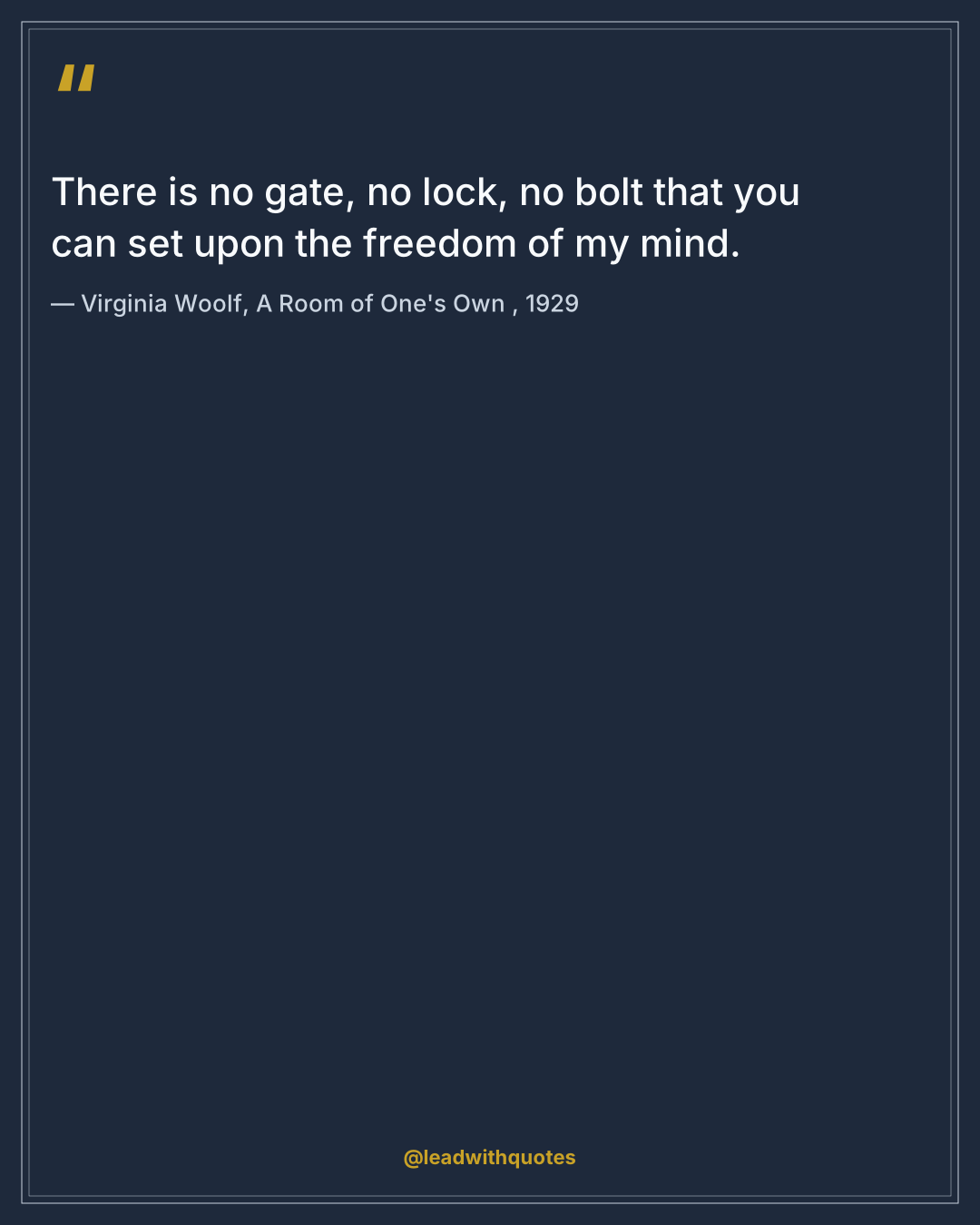
"There is no gate, no lock, no bolt that you can set upon the freedom of my mind." — Virginia Woolf, A Room of One's Own, 1929
Delivered originally as a series of lectures at Cambridge University's two women's colleges, Woolf's essay inextricably linked creative freedom to physical space and financial independence. She diagnosed the historical absence of female genius not as a lack of biological capacity, but as a direct result of institutional poverty and domestic interruption.
Adjacent: brief principles for navigating high-stakes negotiations
How Does Real Value Differ From Performative Grace?
True worth requires an internal anchor of self-respect that operates entirely independent of external applause or societal permission. While performative grace focuses on making others comfortable at the expense of one's own boundaries, authentic value demands the courage to state difficult truths, negotiate fair compensation, and stand firmly in one's earned expertise.
"I have always observed that to succeed in the world one should seem a fool, but be wise." — Montesquieu, Pensées, 1720
Though attributed to a male Enlightenment thinker, this strategic masking was famously adopted and documented by influential salonnières like Madame de Tencin and Madame du Deffand. They weaponized aristocratic society's low expectations, orchestrating major political appointments and literary careers from their drawing rooms while feigning harmless social grace. It was a dangerous game.
"I attribute my success to this: I never gave or took any excuse." — Florence Nightingale, Personal Letters, 1861
Far from the gentle "Lady with the Lamp" mythologized by Victorian media, Nightingale was a ruthless statistician and hospital administrator who bullied military bureaucracy into accepting sanitary reforms. Her uncompromising standards saved thousands of lives during the Crimean War, demonstrating a fierce administrative competence that revolutionized modern nursing.
"You have to act as if it were possible to radically transform the world. And you have to do it all the time." — Angela Davis, Southern Illinois University Lecture, 2014
Moving from historical archives to modern civil rights, this philosophy demands an exhausting but necessary suspension of cynicism in the face of systemic resistance. The sustained energy required for decades of abolitionist work cannot rely on immediate victories; it requires a deep, structural commitment to the possibility of structural change.
"The way to right wrongs is to turn the light of truth upon them." — Ida B. Wells, The Light of Truth, 1892
When her printing press was destroyed by a mob in Memphis, Wells refused to let the threat of violence silence her pioneering investigative journalism regarding lynchings. She meticulously compiled public records and newspaper accounts to prove that racial violence was an organized tool of economic suppression rather than spontaneous mob justice. Her methodology set a standard for what female executives say about managing crisis with undeniable data.
"I am not afraid of storms, for I am learning how to sail my ship." — Louisa May Alcott, Little Women, 1868

Alcott wrote this line for her semi-autobiographical character Jo March, capturing the essence of experiential learning and the willingness to face professional turbulence. The author herself practically sustained her entire family through relentless commercial writing, viewing her literary output not merely as art, but as an essential economic engine.
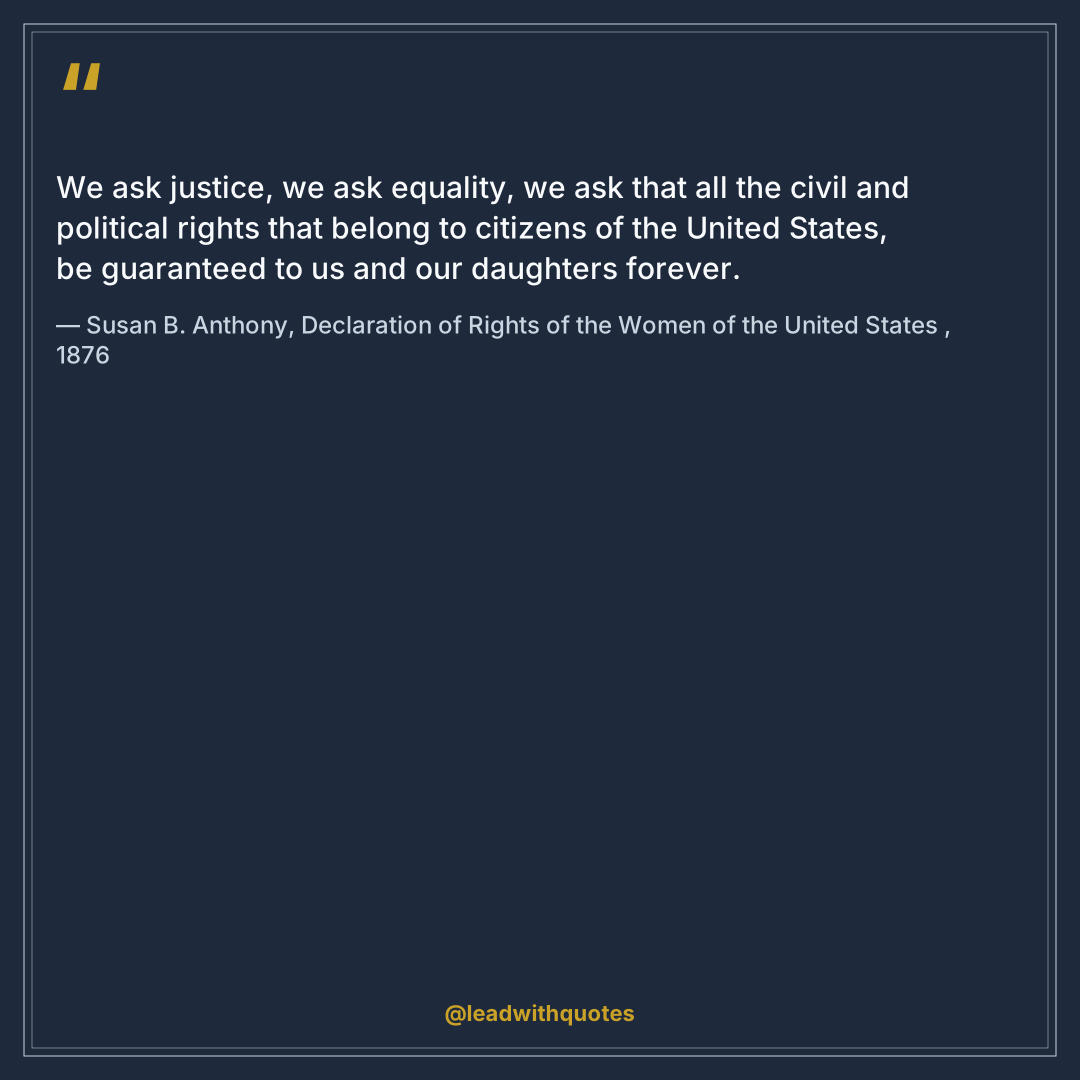
"We ask justice, we ask equality, we ask that all the civil and political rights that belong to citizens of the United States, be guaranteed to us and our daughters forever." — Susan B. Anthony, Declaration of Rights of the Women of the United States, 1876
Delivered uninvited during the Centennial Exhibition in Philadelphia, this audacious document hijacked a celebration of American independence to highlight the hypocrisy of disenfranchisement. Anthony understood that waiting for polite permission to speak guarantees permanent silence.
Adjacent: enduring maxims from political and social movements
When Did Women First Document Their Own Economic Worth?
Long before modern corporate systems adopted the language of equal pay, nineteenth-century journalists and activists explicitly tied their personal dignity to financial independence and property rights. These early writers recognized that philosophical equality meant very little without the legal capacity to own land, control inherited wealth, and retain the wages earned through their own physical labor.
"Energy rightly applied and directed will accomplish anything." — Nellie Bly, Ten Days in a Mad-House, 1887
Bly fundamentally altered the landscape of investigative journalism by feigning insanity to expose the horrific conditions within the Women's Lunatic Asylum on Blackwell's Island. Her immersive reporting forced a grand jury investigation and a massive increase in funding for the Department of Public Charities and Correction, proving that female reporters could handle assignments far beyond the society pages.
"Men their rights and nothing more; women their rights and nothing less." — Susan B. Anthony, The Revolution Publication Motto, 1868
Printed boldly on the masthead of the newspaper she co-founded with Elizabeth Cady Stanton, this concise editorial stance refused to accept incremental concessions regarding suffrage. The publication deliberately tackled controversial subjects like unionization and divorce reform, refusing to separate the right to vote from broader economic and bodily autonomy.
"It is not the mountains ahead to climb that wear you out; it's the pebble in your shoe." — Inspired by Harriet Tubman
While the exact phrasing belongs to later mid-century motivational speakers, the sentiment perfectly encapsulates the grueling, logistical reality of leading the Underground Railroad. Survival depended less on grand heroics and entirely on the meticulous management of small, deadly details—forged papers, timed train schedules, and silent river crossings.
"I detest the idea of women being considered as merely dependent on the affections of men." — Jane Austen, Letters to Fanny Knight, 1814
Writing privately to her niece, the novelist whose entire bibliography centers on the economic necessity of marriage expressed deep frustration with the very system she chronicled. Austen's fiction masterfully cloaked devastating critiques of female financial vulnerability inside the acceptable framework of drawing-room comedy.
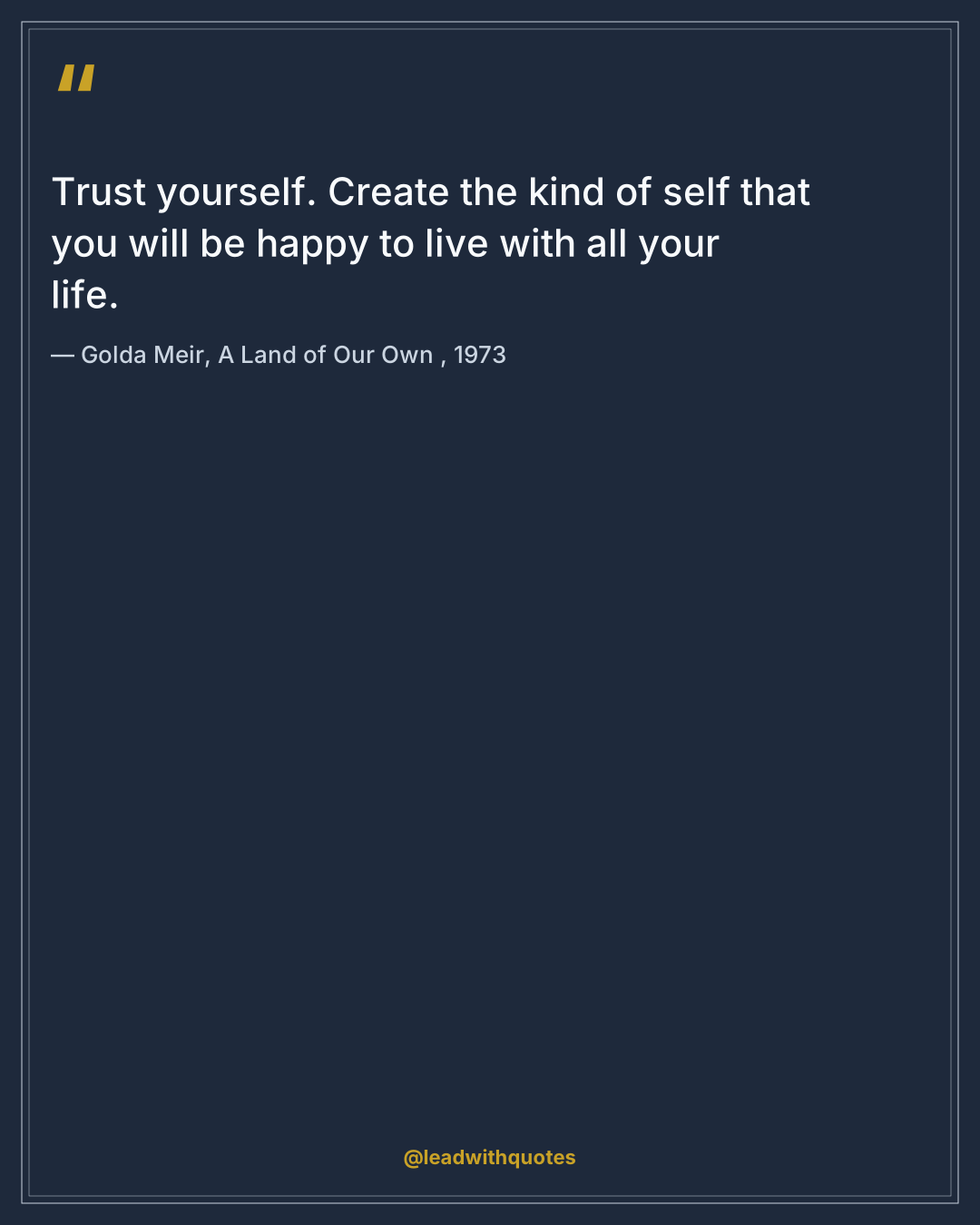
"Trust yourself. Create the kind of self that you will be happy to live with all your life." — Golda Meir, A Land of Our Own, 1973
The fourth Prime Minister of Israel operated in an environment entirely devoid of female peers, requiring a profound level of internal conviction to navigate brutal geopolitical conflicts. Meir recognized that leadership requires making decisions that will alienate allies, meaning a leader's primary loyalty must be to their own rigorously examined conscience.
We often inherit a curated, diminished version of history that strips away the sharpest insights of those who came before us. By returning to the original words and raw documentation of these figures, we recover a legacy not of passive endurance, but of calculated, brilliant agency.
Quick Reference
- Wollstonecraft defined autonomy as intellectual rigor over oneself rather than influence over others.
- Virginia Woolf identified financial independence as the absolute prerequisite for creative and professional freedom.
- Ida B. Wells utilized meticulous public data to dismantle systemic violence and force accountability.
- Nellie Bly transformed investigative journalism through extreme personal risk and applied energy.
- Susan B. Anthony rejected incrementalism, demanding full economic and political citizenship without compromise.