Desk essay
Black Women on Authority: 20 Leadership Quotes from Speeches and Literature
The historical archives reveal how Black female leaders defined power not through dominance, but through community building and relentless self-trust.
By Morgan Ellis
Morgan Ellis

The Solitary Executive Illusion
Corporate literature often paints leadership as a solitary ascent to a corner office, a ruthless climb where the loudest voice inevitably wins the room. Trade paperbacks line airport bookstores promising secret formulas for executive dominance, suggesting that true authority requires isolating oneself from the very communities a leader is supposed to serve. We are taught to revere the lone genius. We idolize the individual.
Real influence rarely resembles that sterile boardroom caricature. I realized this while watching my aunt in a cramped classroom in Oakland, 1984, as she quietly orchestrated a neighborhood reading program without a title, a budget, or a megaphone. The historical record demonstrates that Black women have repeatedly forged authority out of sheer necessity, building vast coalitions and demanding structural accountability when formal institutions explicitly refused to grant them a seat at the table. Their approach to power focuses on collective elevation rather than individual hoarding, shaping the boundaries of modern authority for entire generations of organizers and educators.
"If they don't give you a seat at the table, bring a folding chair." — Shirley Chisholm, Unbought and Unbossed, 1970
Chisholm wrote these words as she recounted her path to becoming the first Black woman elected to the United States Congress, summarizing a political strategy that bypassed traditional gatekeepers entirely.
"I am not free while any woman is unfree, even when her shackles are very different from my own." — Audre Lorde, The Uses of Anger: Women Responding to Racism, 1981
Delivered during a keynote presentation at the National Women's Studies Association Conference in Connecticut, Lorde challenged white feminists to recognize the intersectional nature of systemic oppression.
"If you have some power, then your job is to empower somebody else." — Toni Morrison, Interview with O Magazine, 2003
The Nobel laureate famously viewed literary success not as a pedestal to stand upon, but as a crowbar to pry open publishing doors for younger writers of color.
"You may not control all the events that happen to you, but you can decide not to be reduced by them." — Maya Angelou, Letter to My Daughter, 2008
Angelou framed resilience as an active, daily choice rather than an innate personality trait, an idea that deeply influenced how public figures handle sudden visibility.
"Nobody's free until everybody's free." — Fannie Lou Hamer, Speech at the National Women's Political Caucus, 1971
Hamer delivered this searing indictment of conditional liberty to a crowd in Washington D.C., cementing her legacy as a foundational architect of voting rights.
The Reality of Coalition Building
Authority operates effectively only when it remains tethered to a community's actual needs. Historical examples show that sustained movements require organizers who prioritize the health of the collective over the ego of the individual at the microphone. Grassroots mobilization demands patience. It requires listening. By studying the broader canon of female leadership, we see a recurring theme of shared responsibility.
When resources are scarce, leadership becomes a matter of pooling what little exists and distributing it where it can create the most leverage. You cannot legislate trust from a distance. The women who organized the Montgomery Bus Boycott understood this intimately, spending months mapping out carpools and walking routes long before the national press arrived to document the struggle.
"The way to right wrongs is to turn the light of truth upon them." — Ida B. Wells, The Light of Truth, 1892
Wells risked her life to publish anti-lynching journalism in Memphis, wielding meticulous data collection as her primary weapon against domestic terrorism.
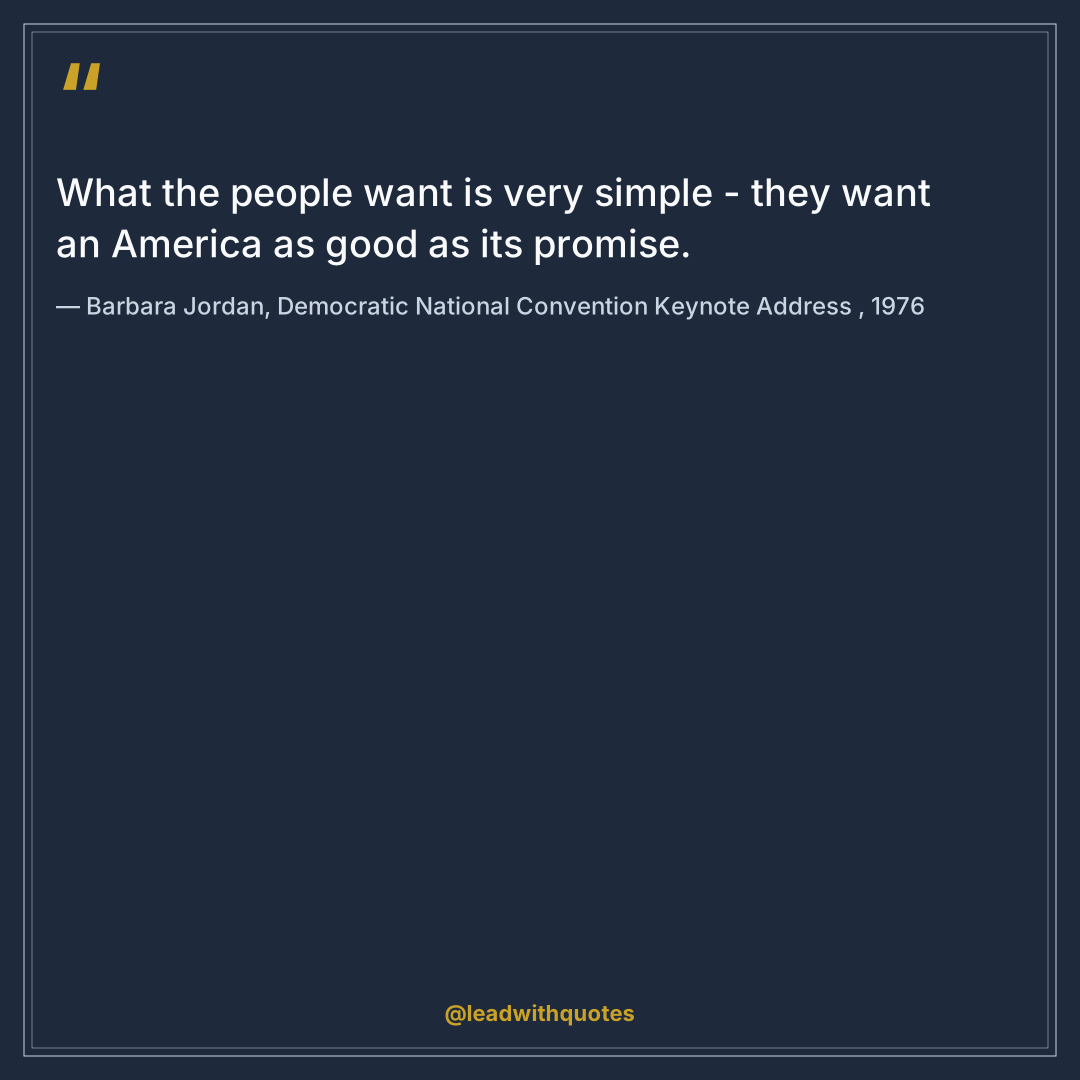
"What the people want is very simple - they want an America as good as its promise." — Barbara Jordan, Democratic National Convention Keynote Address, 1976
Speaking to a fractured nation recovering from the Watergate scandal, Jordan anchored her vision of leadership in the strict enforcement of constitutional ideals.
"I was the conductor of the Underground Railroad for eight years, and I can say what most conductors can't say — I never ran my train off the track and I never lost a passenger." — Harriet Tubman, Suffrage Convention Speech, 1896
Tubman used this precise metric of flawless execution to advocate for women's voting rights late in her life, silencing critics who questioned female competence.
"Strong people don't need strong leaders." — Ella Baker, Speech in Atlanta, 1968
Baker frequently clashed with the male-dominated hierarchy of the civil rights movement, advocating instead for decentralized, student-led organizing models that empowered local communities.
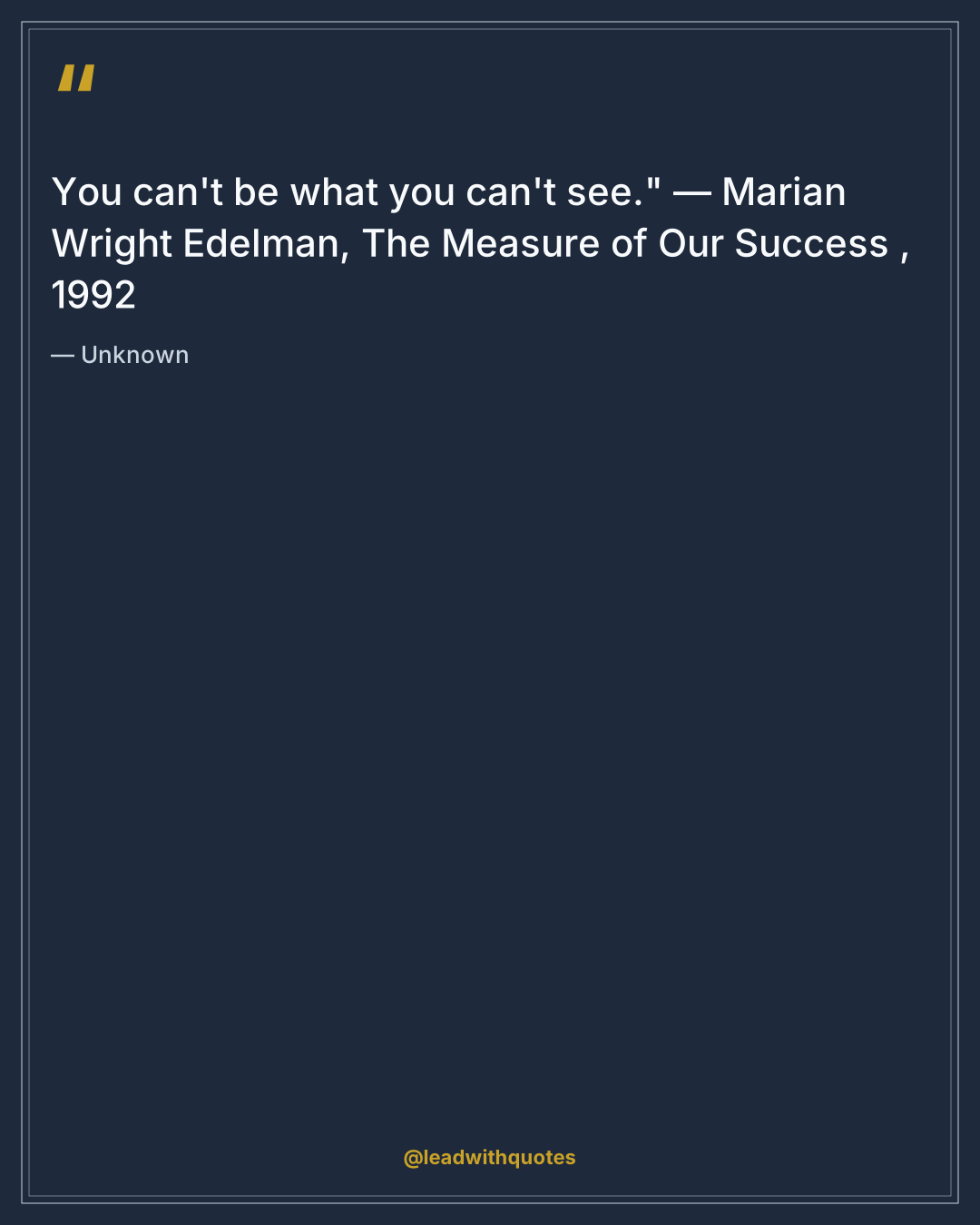
"You can't be what you can't see." — Marian Wright Edelman, The Measure of Our Success, 1992
The founder of the Children's Defense Fund captured the devastating psychological impact of representational absence in media and government.
Demanding Accountability in Public Spaces
Visibility brings intense scrutiny, forcing trailblazers to constantly justify their presence in rooms historically designed to exclude them. This pressure often necessitates a firm adherence to internal standards, setting boundaries that protect energy when external validation is withheld. They built their own platforms. They published their own papers.
Silence is rarely protective in hostile environments. Those who spoke up faced severe economic and physical retaliation, yet they calculated that the long-term cost of compliance far outweighed the immediate danger of speaking out. This calculation remains central to perspectives from female executives navigating modern corporate landscapes today.
"I have learned over the years that when one's mind is made up, this diminishes fear; knowing what must be done does away with fear." — Rosa Parks, Quiet Strength, 1994
Parks rejected the sanitized narrative of her being merely a tired seamstress, clarifying that her defiance on the bus was a calculated, politically conscious decision.
"Invest in the human soul. Who knows, it might be a diamond in the rough." — Mary McLeod Bethune, My Last Will and Testament, 1955
Bethune wrote this final message to her students, summarizing a lifelong educational philosophy that built a university from a literal garbage dump in Florida.
"I believe unconditionally in the ability of people to respond when they are told the truth." — Septima Poinsette Clark, Ready from Within, 1986
Known as the "Mother of the Movement," Clark developed the citizenship schools that taught literacy as a direct prerequisite for voter registration across the Deep South.
"Women, if the soul of the nation is to be saved, I believe that you must become its soul." — Coretta Scott King, Speech at Solidarity Day, 1968
Delivered just months after her husband's assassination, King stood at the Lincoln Memorial and called upon women to lead the ongoing fight against poverty and militarism.
"I am no longer accepting the things I cannot change. I am changing the things I cannot accept." — Inspired by Angela Davis, Activist Rallies, 1970s
This phrasing, while often loosely attributed on protest signs, perfectly encapsulates the radical shift from passive endurance to active dismantling of the prison-industrial complex.
Self-Definition as a Radical Act
Allowing opponents to dictate the terms of your identity surrenders the battle before it even begins. Defining oneself requires rejecting inherited narratives about what is possible, a theme thoroughly explored in reflections on inherent personal worth. The work starts inward. The results project outward.
Leaders who maintain their integrity under pressure do so by anchoring themselves to a specific, unshakeable truth about their own value. They refuse to shrink to accommodate the fragility of their critics, understanding that playing small serves absolutely no one in the long run.
"To build community requires vigilant awareness of the work we must continually do to undermine all the socialization that leads us to behave in ways that perpetuate domination." — Bell Hooks, Teaching Community: A Pedagogy of Hope, 2003
The acclaimed cultural critic warned that unchecked hierarchical thinking inevitably poisons progressive movements from the inside out.
"The most common way people give up their power is by thinking they don't have any." — Alice Walker, Interview, 1982
Walker highlighted the psychological conditioning that convinces marginalized groups to voluntarily surrender their agency to the state.
"I had to make my own living and my own opportunity. But I made it!" — Madam C.J. Walker, National Negro Business League Convention, 1912
Speaking to a room full of skeptical male entrepreneurs, America's first female self-made millionaire defended her aggressive business expansion strategies.
"We are each other's harvest; we are each other's business; we are each other's magnitude and bond." — Gwendolyn Brooks, Paul Robeson, 1970
The Pulitzer Prize-winning poet framed human interconnectedness not as a poetic ideal, but as an absolute survival requirement for the Black community.
"Effective leadership is not about making speeches or being liked; leadership is defined by results not attributes." — Inspired by Stacey Abrams, Lead from the Outside, 2018
This sentiment strips the glamour away from political office, refocusing the conversation entirely on the unglamorous mechanics of voter registration and policy implementation.
Key Takeaways
- Reject the myth of solitary power; true authority requires deep coalition building and decentralized organizing.
- Treat self-definition as a necessary leadership tool to prevent external forces from dictating your limitations.
- Use whatever platform you secure to immediately open access for the next generation of leaders.
- Acknowledge that systemic change demands continuous, unglamorous work long before the public takes notice.
The historical record left by these organizers, writers, and educators offers a blueprint for navigating hostile environments with your integrity intact. Write down the quote that challenges your current approach to management on a sticky note and place it directly on your desk for tomorrow morning.