Quotes About Serving Others: 13 Sourced Lines, and Who First Said "Service Is the Rent We Pay"
13 quotes about serving others, each checked at its source, from Einstein to Mandela, plus who said 'service is the rent we pay' and 11 misattributions.

In November 1917 the American Journal of Nursing reported a meeting at which the president, Emma Vernon, welcomed visiting nurses with a line she said was painted over the doorway of a hospital in India: "Service is the rent we pay for a room on earth." Nobody signed it. Over the next century the same sentence was credited to a Lions Club chaplain, a British ambassador, Muhammad Ali, Marian Wright Edelman and Shirley Chisholm. This page follows that saying from the doorway to the present, then collects 13 quotes about serving others whose wording and source we checked, from Dickens and Einstein to Mandela and Robert F. Kennedy. Each comes with where it was said, what the speaker meant, and when it fits a card, a speech or a team meeting. There's also a short-quote table, a guide to using one at work, and the eleven popular lines with the wrong name on them. For the leadership side of the idea, see our servant leadership quotes hub.
Most lists for this search mix three kinds of lines: real quotes, real quotes with the wording drifted, and proverbs with a famous name added later. The difference matters if you put a line on a plaque, a slide or a volunteer certificate. Where the popular version differs from what was said or written, we say so next to the quote.
Who said "service is the rent we pay"?
No single person. The saying was already anonymous when it first reached print, and every famous name attached to it came later. The dated citations below were found by the word researcher Barry Popik in newspaper and book databases (his full list); we read each entry on his page.
| Year | Wording | Where it appeared | Credited to |
|---|---|---|---|
| 1917 | "Service is the rent we pay for a room on earth." | American Journal of Nursing, Nov. 1917, p. 167 | Inscription over a hospital doorway in India, no author |
| 1920 | "…the rent we pay for the space we occupy in this world." | Racine (Wis.) Journal-News, 29 Jan. | "Some one has said" |
| 1928 | "…the rent one pays for his room on earth." | Ottawa Citizen, 17 Oct. | Rev. C. G. Hepburn, in a talk to the Lions Club |
| 1947 | "…the rent we pay for our room on earth." | The Rotarian, Feb. 1947, p. 72 | Lord Halifax, wartime British ambassador to the U.S. |
| 1976 | "Service to others is the rent I pay for my room here on earth." | Gadsden (Ala.) Times, 10 Jan. | Muhammad Ali |
| 2011-2012 | "…the rent we pay to live on this earth" / "The service we render others is the rent…" | Two inspirational books | Stephen Covey; Wilfred Grenfell (no early source for either) |
| 2014 | "…service is the rent each of us pays for living" | Commencement address, Lewis & Clark College | Marian Wright Edelman, in her own speech |
The oldest printed version, then, is the one from the hospital doorway:
Service is the rent we pay for a room on earth.
Inscription over a hospital doorway in India, as reported in the American Journal of Nursing, November 1917, p. 167 (via Barry Popik)
The image works because it turns service into an obligation everyone owes, not a favor a few people do. A tenant doesn't get thanked for paying rent. That is why nurses' associations, Rotary and Lions clubs passed the line around: it describes service as the normal cost of being alive, which is how those groups wanted members to see it. If you use this version, credit it as "anonymous, 1917" or "a hospital inscription quoted in 1917". That is both accurate and the more interesting story.
Service to others is the rent I pay for my room here on earth.
Muhammad Ali, quoted in the Gadsden (Ala.) Times, 10 January 1976, p. 3 (via Barry Popik)
Ali is the most-quoted name for this line, and he did say a version of it. The paper gave it as his reason for donating $150,000 to an old-age center in New York. Note the wording: "I pay", first person, about himself. The posters that read "Service to others is the rent you pay" turn his explanation into an instruction. The "you" form appears online decades later. Quote him as "I".
I was taught that the world had a lot of problems, but that I could struggle and change them; that intellectual and material gifts brought the privilege and responsibility of sharing with others less fortunate; and that service is the rent each of us pays for living—the very purpose of life and not something you do in your spare time or after you have reached your personal goals.
Marian Wright Edelman, commencement address, Lewis & Clark College, 10 May 2014 (transcript, p. 3)
Edelman, the founder of the Children's Defense Fund, used the saying for decades. In this speech she presents it as one of the lessons she grew up with as a Black girl under segregation, when, as she puts it earlier, service "was as essential a part of my upbringing as eating and sleeping and going to school." Her addition is the second half: service is "not something you do in your spare time." That makes it the strongest version for a graduation, a volunteer award or a new-hire talk about a company's community work. In the speech she says these lessons come from a letter and later book she wrote for her sons, The Measure of Our Success (1992). The short form quote sites give, "Service is the rent we pay for being," is credited to that book; we could not check it against the page, so we quote the 2014 speech instead.

Shirley Chisholm's name is attached to "Service is the rent we pay for the privilege of living on this earth" on dozens of sites, always without a speech, date or book, and she does not appear in Popik's chronology. We found no source, so the line is in the wrong-name table below.
A life measured by other lives
The second large family of serving quotes is about judgment: what makes a life count. Three of the best-known lines come from a letter, a birthday speech and a gravestone.
Only a life lived for others is the life worth while.
Albert Einstein, reply to Albert Bassuk, quoted in the New York Times, 20 June 1932, p. 17 (via Barry Popik)
The context is ordinary. Albert Bassuk, a student at St. John's College in Brooklyn who edited Youth, the magazine of the Young Israel of Williamsburg, wrote to several well-known people, among them John Dewey, Aldous Huxley and Justice Louis Brandeis, asking what qualifications were needed for success. Einstein answered in one sentence, and the Times put it in the headline. So it's a reply about success: his definition of a successful life was one spent on other people. The common modern form, "a life lived for others is a life worthwhile," is a later smoothing. "The life worth while," in two words, is what the paper printed.
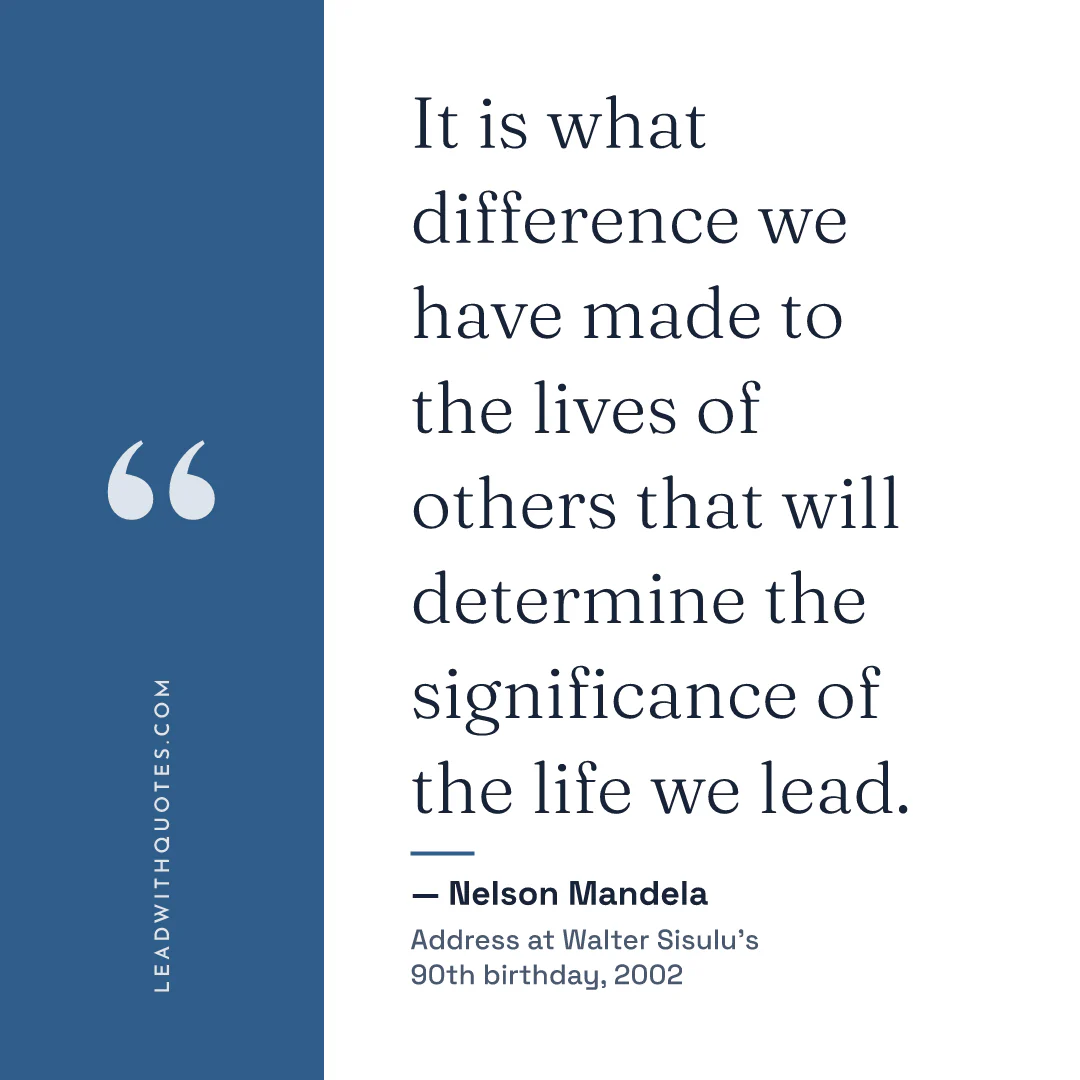
Often in addressing younger people I make the point that what counts in life is not the mere fact that we have lived. It is what difference we have made to the lives of others that will determine the significance of the life we lead.
Nelson Mandela, address at the 90th birthday celebration of Walter Sisulu, 18 May 2002 (South African History Online)
Mandela said this about his oldest political friend, the man who had brought him into the ANC in the 1940s and shared Robben Island with him. The setting gives the line its weight: it's a tribute, offered to someone whose life had been almost entirely spent on others. That makes it one of the best lines on this page for a retirement, a long-service award or a memorial. Most posters drop the first sentence; the second stands on its own, but "often in addressing younger people" shows it was a point he made again and again.
A life is not important except in the impact it has on other lives.
Jackie Robinson (1919-1972), inscription on his gravestone, Cypress Hills Cemetery, Brooklyn (Find a Grave)
Robinson broke Major League Baseball's color line in 1947 and spent much of his later life on civil rights causes. The sentence is cut into his headstone, which is the only source we could confirm. Some quote sites place it in his 1972 autobiography I Never Had It Made, but we couldn't see that text, so we cite the stone. Credit it as "inscribed on his gravestone" and you're on firm ground.
What serving does for the person who serves
A quieter set of quotes makes a claim that sounds like self-interest but isn't quite: serving others changes the server. All three below were said or written well before modern research on volunteering.
I don't know what your destiny will be. Some of you will perhaps occupy remarkable positions. Perhaps some of you will become famous by your pens, or as artists. But I know one thing: the only ones among you who will be really happy are those who have sought and found how to serve.
Albert Schweitzer, address at Silcoates School, Wakefield, England, 3 December 1935, printed in The Silcoatian, December 1935 (transcription from the school's copy)
Schweitzer, by then running his hospital at Lambaréné in Gabon, spoke to the boys in French and was translated by an interpreter, so the English is the interpreter's. He was talking to teenagers about to choose careers, and his point is that position and fame are not where happiness comes from. Two details: the original is "those who have sought and found", not the common "will have sought and found", and the speech was at a school, years before his Nobel Peace Prize (awarded for 1952). It's the strongest line here for a graduation or a youth volunteer program.
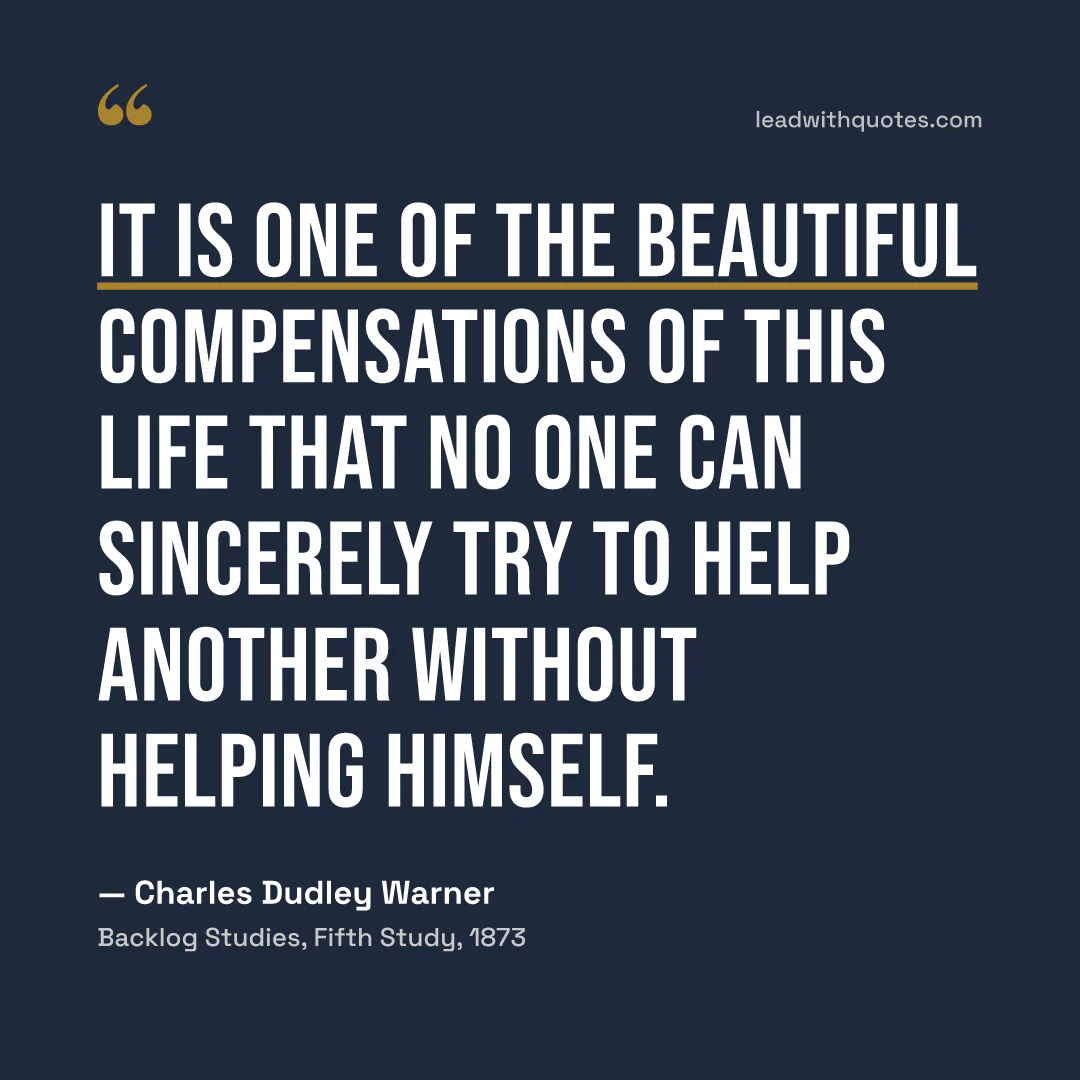
It is one of the beautiful compensations of this life that no one can sincerely try to help another without helping himself.
Charles Dudley Warner, Backlog Studies (1873), Fifth Study, section III (Project Gutenberg)
This is one of the most misattributed serving quotes on the web, almost always signed "Ralph Waldo Emerson". It was written by Warner, a Hartford editor and Mark Twain's co-author on The Gilded Age, in a book of fireside essays first serialized in Scribner's Monthly. The Gutenberg text has "beautiful compensations" and "no one"; the common version has "most beautiful" and "no man", which may come from a later edition. The word "sincerely" is the one to keep: help given for show doesn't earn the reward Warner means.
No one is useless in this world… who lightens the burden of it for any one else.
Charles Dickens, Our Mutual Friend (1864-65), Book the Third, ch. 9 (Project Gutenberg)
Dickens didn't say this in his own voice. It's dialogue: Bella Wilfer tells John Rokesmith, the Boffins' secretary, that she feels "useless enough in this world," and he answers with this line (the ellipsis marks "retorted the Secretary"). That context makes it a line of encouragement to someone who feels they contribute nothing, not a general motto. It suits a note to a colleague who has quietly covered for others, or a thank-you to a volunteer who does unglamorous work. The popular "who lightens the burdens of another" is a rewording.
The question King asked, and the ripple Kennedy described
Two speeches from the civil rights era turned serving others into a question for the listener and an argument about scale.
Every man must decide whether he will walk in the light of creative altruism or the darkness of destructive selfishness. … Life's most persistent and urgent question is, 'What are you doing for others?'
Martin Luther King Jr., "Three Dimensions of a Complete Life," Strength to Love (Harper & Row, 1963), p. 72 (via Quote Investigator)
Many sites date this to a 1957 speech in Montgomery. Quote Investigator traces it to the printed sermon in Strength to Love, and the 1957 text usually named, "Conquering Self-Centeredness," doesn't contain it. The sermon's "three dimensions" are length (care for yourself), breadth (care for others) and height (relation to God); this question belongs to breadth. As a quote it works best as a question you actually put to a group, at the start of a service day or a planning meeting, rather than as decoration. King's other famous serving line, "Everybody can be great, because everybody can serve," is often printed with "anybody" in place of the second "everybody"; we cover it on our page about the servant leadership examples from his 1968 sermon.
Each time a man stands up for an ideal, or acts to improve the lot of others, or strikes out against injustice, he sends forth a tiny ripple of hope, and crossing each other from a million different centers of energy and daring, those ripples build a current which can sweep down the mightiest walls of oppression and resistance.
Robert F. Kennedy, Day of Affirmation Address, University of Cape Town, 6 June 1966 (Wikisource text)
Kennedy gave this speech in apartheid South Africa, at the invitation of an anti-apartheid student union, to a hall of university students. "Acts to improve the lot of others" sits in the same list as standing up for an ideal and fighting injustice. For him, small acts of service count as political acts because they add up. That's why it's quoted so often at the end of community projects: no single act needs to be large. The full sentence is long; "he sends forth a tiny ripple of hope" is a fair excerpt if you keep "acts to improve the lot of others" in view.
Giving yourself, not just your things
The last group answers a question that comes up often in searches: what's the quote about giving to others? Two writers, eighty years apart, both insisted that real giving costs something personal.
You give but little when you give of your possessions. It is when you give of yourself that you truly give.
Kahlil Gibran, The Prophet (Knopf, 1923), "On Giving" (Project Gutenberg)
The popular wording is exact, which is rare. In The Prophet the line answers a rich man who asks the prophet Almustafa to "speak to us of giving", and the chapter goes on to criticize people who give "for recognition". That's useful context for a volunteer thank-you: the line honors time and effort over money. Avoid it in a fundraising appeal, where it can sound like you're asking for less.
Give and you shall receive, much more than you would have ever thought possible. Give, give again and again, don't lose courage, keep it up and go on giving! No one has ever become poor from giving!
Anne Frank, "Give!" (1944), in Tales from the Secret Annex, older English translation (via Barry Popik)
Anne Frank wrote the short essay "Give!" in hiding in 1944; sources disagree on whether it was dated 26 March or 26 April, so we give the year. In it she imagines a world where generosity would make beggar children disappear "in a few generations." The famous last sentence was her mother's: the 1959 collection The Works of Anne Frank notes that Edith Frank used to say "No one ever becomes poor from giving," and Anne repeats it. Posters usually print "by giving"; the translation has "from". In front of an audience, mentioning that she wrote it while hiding gives the line its weight.
For scripture on serving others (Galatians 5:13, Mark 10:45, Philippians 2:3-4 and others), see our servant leadership Bible verses, where each passage is given in the King James wording with its context.
Short quotes about serving others
For a card, a slide or a caption, these excerpts keep the meaning of the full quotes above. Each is the exact wording, cut at a natural break.
| Short line | Who, where | Good for |
|---|---|---|
| "Service is the rent each of us pays for living." | Marian Wright Edelman, 2014 | Volunteer award, graduation |
| "Service is the rent we pay for a room on earth." | Hospital inscription, 1917 | Nurses, care workers, plaques |
| "Only a life lived for others is the life worth while." | Albert Einstein, 1932 | Mentoring program, youth group |
| "What are you doing for others?" | Martin Luther King Jr., 1963 | Opening question for a service day |
| "It is when you give of yourself that you truly give." | Kahlil Gibran, 1923 | Thank-you card for volunteers |
| "No one has ever become poor from giving!" | Anne Frank, 1944 | Giving drive, holiday collection |
| "A life is not important except in the impact it has on other lives." | Jackie Robinson, gravestone | Memorial, tribute, retirement |
| "…he sends forth a tiny ripple of hope." | Robert F. Kennedy, 1966 | Wrap-up of a small community project |
Using a serving quote at work without sounding like a poster
These lines turn up most at work in four places: a company volunteer day, a service or long-tenure award, a thank-you to someone who helped a colleague, and a team kickoff where a manager wants to set the tone. (For thanking a whole team for its results, our employee appreciation quotes fit better.) Three habits keep a serving quote from feeling pasted on:
- Say what the person actually did, first. "You spent four Saturdays rebuilding the community garden" earns the quote that follows. A quote with no act attached reads like a poster.
- Match the line to the kind of service. Duty lines (the rent saying, Edelman) suit organizations and awards. Reward lines (Schweitzer, Warner) suit encouraging someone to start. Measure-of-a-life lines (Mandela, Robinson, Einstein) suit retirements and tributes. Dickens suits one person who feels unnoticed.
- Use the real wording and a one-clause credit. "…as Marian Wright Edelman told graduates in 2014" takes four seconds and protects you from the person in the room who knows Emerson never wrote the Warner line.
Two examples of how that sounds:
- Service award, read aloud: "For twelve years Dana has run our blood drive, signed up the donors and stayed until the last bag was labeled. Marian Wright Edelman told a graduating class that service is 'not something you do in your spare time.' Dana has never treated it that way, and this award is our thanks."
- Note to a colleague: "Thank you for taking the night calls while I was out. In Our Mutual Friend Dickens has a character say that no one is useless 'who lightens the burden of it for any one else.' You lightened mine for two weeks."
If your audience is a leadership group rather than volunteers, the leader's version of the idea is Robert Greenleaf's "servant first" test, which we quote in full on our page of Greenleaf's own lines.
Eleven serving quotes with the wrong name on them
These lines are everywhere, usually with a famous name. Here's what the record shows. Several are also tracked on our running list of quotes leaders never said.
| Popular line | Usually credited to | What the record shows |
|---|---|---|
| "The best way to find yourself is to lose yourself in the service of others." | Mahatma Gandhi | No Gandhi source. "Lose yourself in the service of others" appears anonymously in the San Francisco Call, 1908; the Gandhi credit starts online around 2000 (Popik). |
| "We make a living by what we get, but we make a life by what we give." | Winston Churchill | Anonymous; earliest found in the Altoona (Pa.) Mirror, 1944. The Churchill Centre says it isn't in his words (Popik). |
| "Not all of us can do great things. But we can do small things with great love." | Mother Teresa | Listed by the Mother Teresa Center as a paraphrase, "not her authentic words" (MTC). |
| "It is one of the most beautiful compensations of this life…" | Ralph Waldo Emerson | Charles Dudley Warner, Backlog Studies, 1873 (quoted above). |
| "The purpose of life is not to be happy. It is to be useful, to be honorable, to be compassionate…" | Ralph Waldo Emerson | Leo Rosten: "to matter" in 1962, the useful/honorable/compassionate version in The Rotarian, 1965 (QI). |
| "Do all the good you can, by all the means you can…" | John Wesley | Not found in Wesley; first printed in 1852, credited to a "Dr. Murray" (QI). |
| "Service is the rent we pay for the privilege of living on this earth." | Shirley Chisholm | No speech, date or book found. The saying is anonymous from 1917 (table above). |
| "The service we render others is the rent we pay for our room on earth." | Wilfred Grenfell | The earliest Grenfell credit in Popik's list is Zig Ziglar's 2012 quote book; the saying is decades older. |
| "Our prime purpose in this life is to help others. And if you can't help them, at least don't hurt them." | Dalai Lama | No primary source found; a 1984 book is said to have a longer, different wording, which we could not check. Use "attributed". |
| "How wonderful it is that nobody need wait a single moment before starting to improve the world." | Anne Frank | The idea is in "Give!" (1944), but the English translations we found read differently, e.g. "How lovely to think that no one need wait a moment; we can start now, start slowly changing the world!" (Popik). |
| "Everybody can be great, because anybody can serve." | Martin Luther King Jr. | Real quote, wrong word: the 1968 sermon has "because everybody can serve" (King Institute). |
The pattern is the same as with leadership quotes generally: an anonymous saying gets a famous name because the name makes it easier to share. Where a real person said something close, as with Edelman, Ali and Anne Frank, quoting their actual words is both more accurate and more moving than the polished version.
How we checked these quotes
Every quote on this page was matched word for word against a fetched copy of its source: the Lewis & Clark transcript for Edelman; Project Gutenberg texts for Warner, Dickens and Gibran; South African History Online for Mandela; the Wikisource text of Kennedy's address; the gravestone record for Robinson; and a transcription of the school magazine for Schweitzer. Where we could not reach the original, we relied on researchers who cite dated newspaper and book pages (Barry Popik for the rent saying, Einstein and Anne Frank; Quote Investigator for King) and say so next to the quote. Wording we couldn't confirm, such as Edelman's 1992 book line and the Robinson autobiography, is named as unchecked rather than quoted. Our full method is on the how we verify page; the history of the servant-leader idea itself is on how the language of service took over leadership.