Desk essay
Humble Servant Quotes For Community Builders
A close look at historical texts reveals how quiet devotion shapes authority far better than force ever could.
By Morgan Ellis
Morgan Ellis

The Architecture of Duty
Watching my stepfather clear the brush around a rented seaside cabin outside Bodega Bay, California, in 1978 taught me more about responsibility than any management seminar. He didn't own the property. He just saw a dry-rot fire hazard near the propane tank and grabbed a pair of rusted shears from the porch. The quiet act of tending to a shared space without expecting a plaque or a paycheck embodies the core of this philosophy. Authority requires maintenance. When people step in to fix what is broken, they generate a specific kind of trust that titles alone cannot command. Real power roots itself in the dirt.
How do we measure the impact of someone who refuses the spotlight? This question forces us to examine the foundations of servant leadership across different eras.
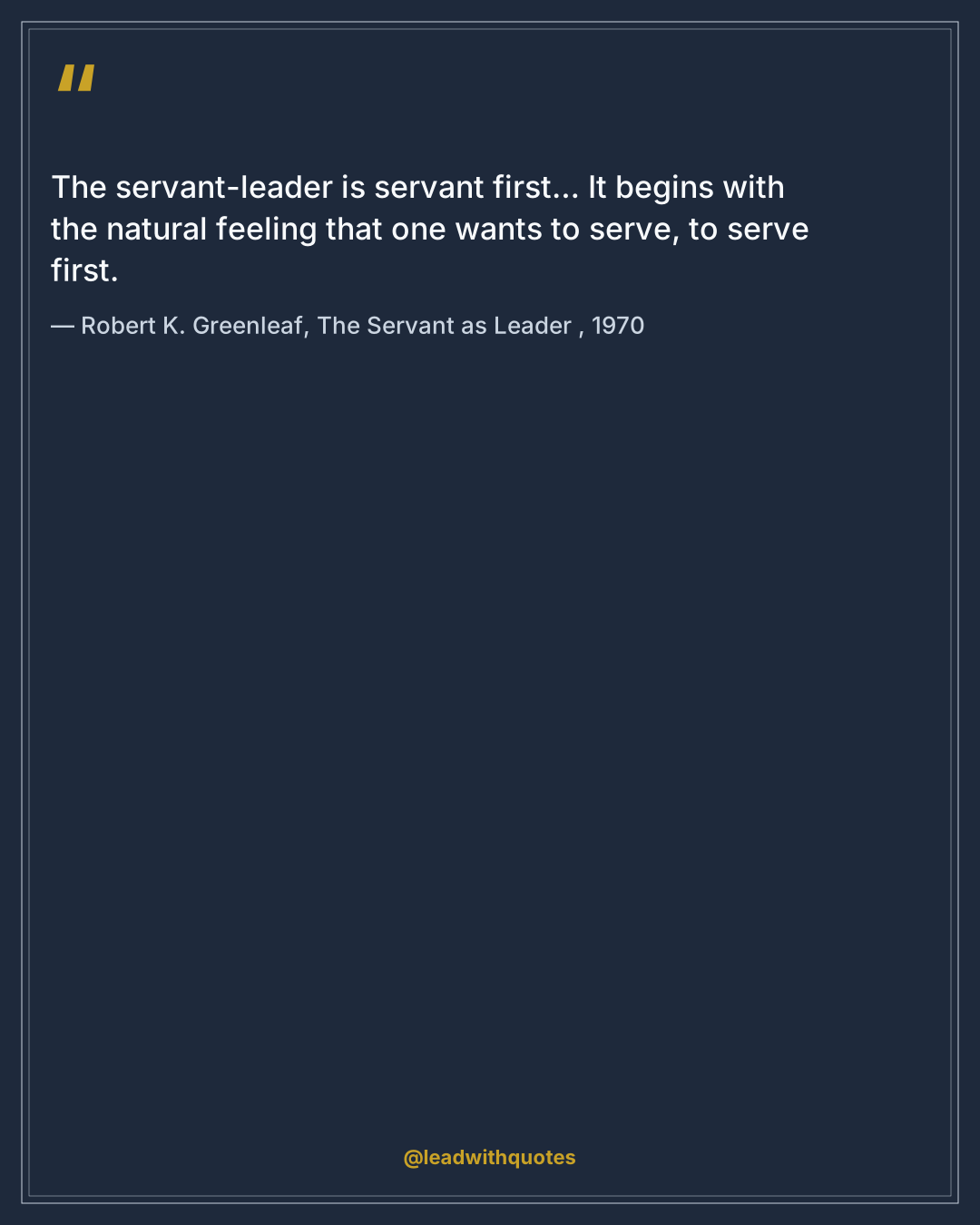
"The servant-leader is servant first… It begins with the natural feeling that one wants to serve, to serve first." — Robert K. Greenleaf, The Servant as Leader, 1970
Greenleaf coined this specific organizational phrase while working at AT&T, fundamentally shifting corporate management theory away from rigid top-down control. He drafted the essay to address the widespread campus unrest of the late 1960s. The concept quickly migrated from university sociology departments into mainstream executive boardrooms.
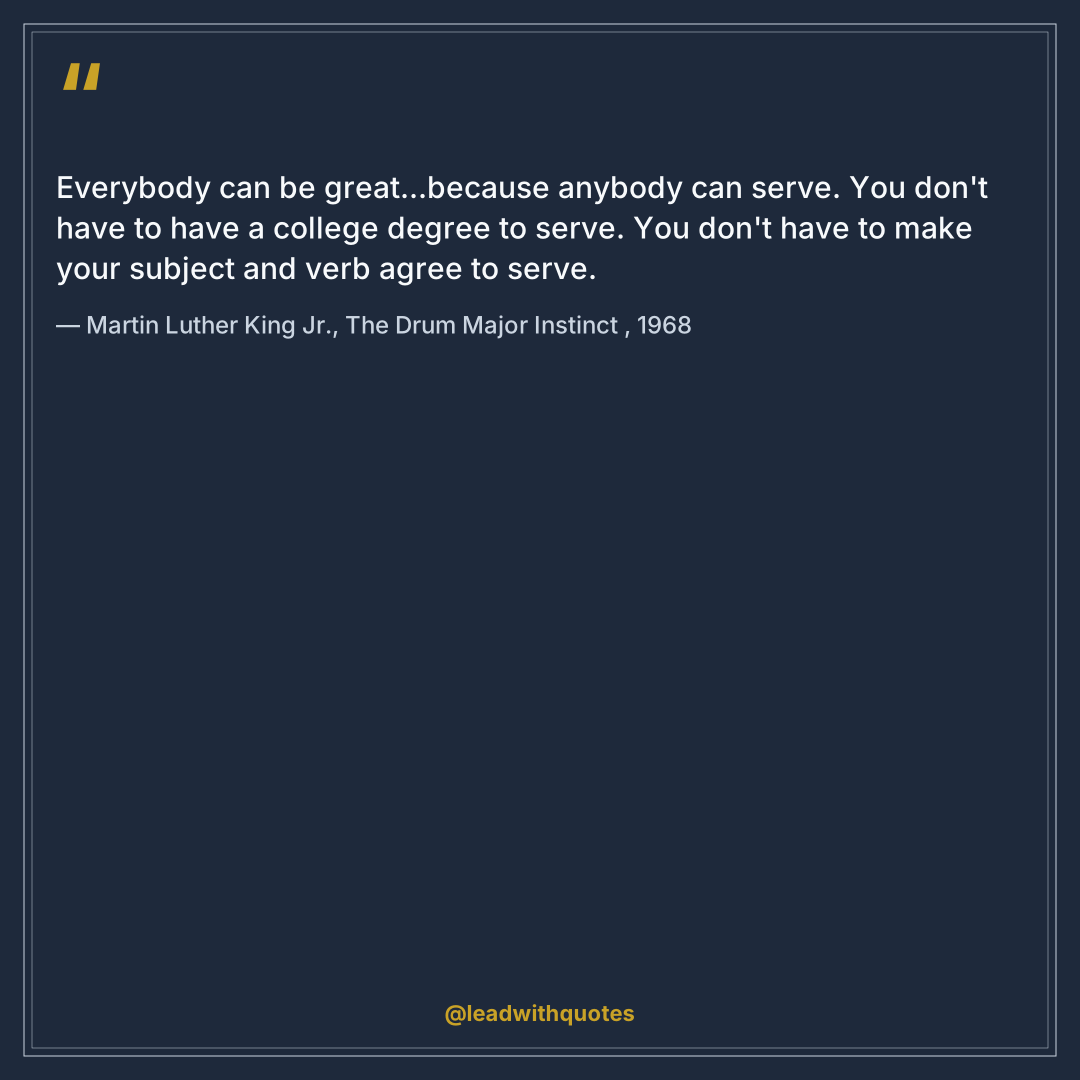
"Everybody can be great...because anybody can serve. You don't have to have a college degree to serve. You don't have to make your subject and verb agree to serve." — Martin Luther King Jr., The Drum Major Instinct, 1968
Delivered exactly two months before his assassination, this sermon at Ebenezer Baptist Church reframed greatness as a matter of moral utility rather than social status. He warned his congregation against the ego-driven desire to outshine neighbors. The speech remains a cornerstone text for civil rights organizers.
"The best way to find yourself is to lose yourself in the service of others." — Mahatma Gandhi, Young India, 1925
Gandhi wrote extensively in this weekly English-language journal, using its pages to articulate how personal ego dissolution leads directly to collective political liberation. He hand-cranked the printing press himself during periods of strict colonial censorship. The publication served as the intellectual engine of the non-cooperation movement.
Shifting the Paradigm of Power
This framework deeply connects with the theological roots of serving others, demanding a radical inversion of traditional corporate hierarchy.
"A leader is best when people barely know he exists, when his work is done, his aim fulfilled, they will say: we did it ourselves." — Lao Tzu, Tao Te Ching, 4th Century BCE
This ancient text lays the groundwork for invisible facilitation, arguing that overt control disrupts the natural order of human cooperation. The verses advocate for yielding as a strategic mechanism rather than a sign of weakness. Scholars continue to debate the exact compilation dates of these bamboo slips.
"I slept and dreamt that life was joy. I awoke and saw that life was service. I acted and behold, service was joy." — Rabindranath Tagore, Gitanjali period writings, 1912
The Bengali polymath often structured his poetry around the realization that civic duty and personal fulfillment intertwine completely. He translated his own Bengali verses into English, catching the attention of the Nobel committee the following year. His educational experiments at Santiniketan physically manifested these literary ideals.
"Do all the good you can, by all the means you can, in all the ways you can, in all the places you can, at all the times you can, to all the people you can, as long as ever you can." — Inspired by John Wesley
Though universally attributed to the eighteenth-century founder of Methodism on coffee mugs and posters, historians trace this exact phrasing to early twentieth-century summaries of his broader theological directives. The rhythmic cadence perfectly captures his actual sermons on active charity. It distills complex theological obligations into a simple operational checklist.
Quiet Sacrifices in Daily Work
Looking closely at how authority is currently defined shifts our focus from public stages to private, unglamorous actions.
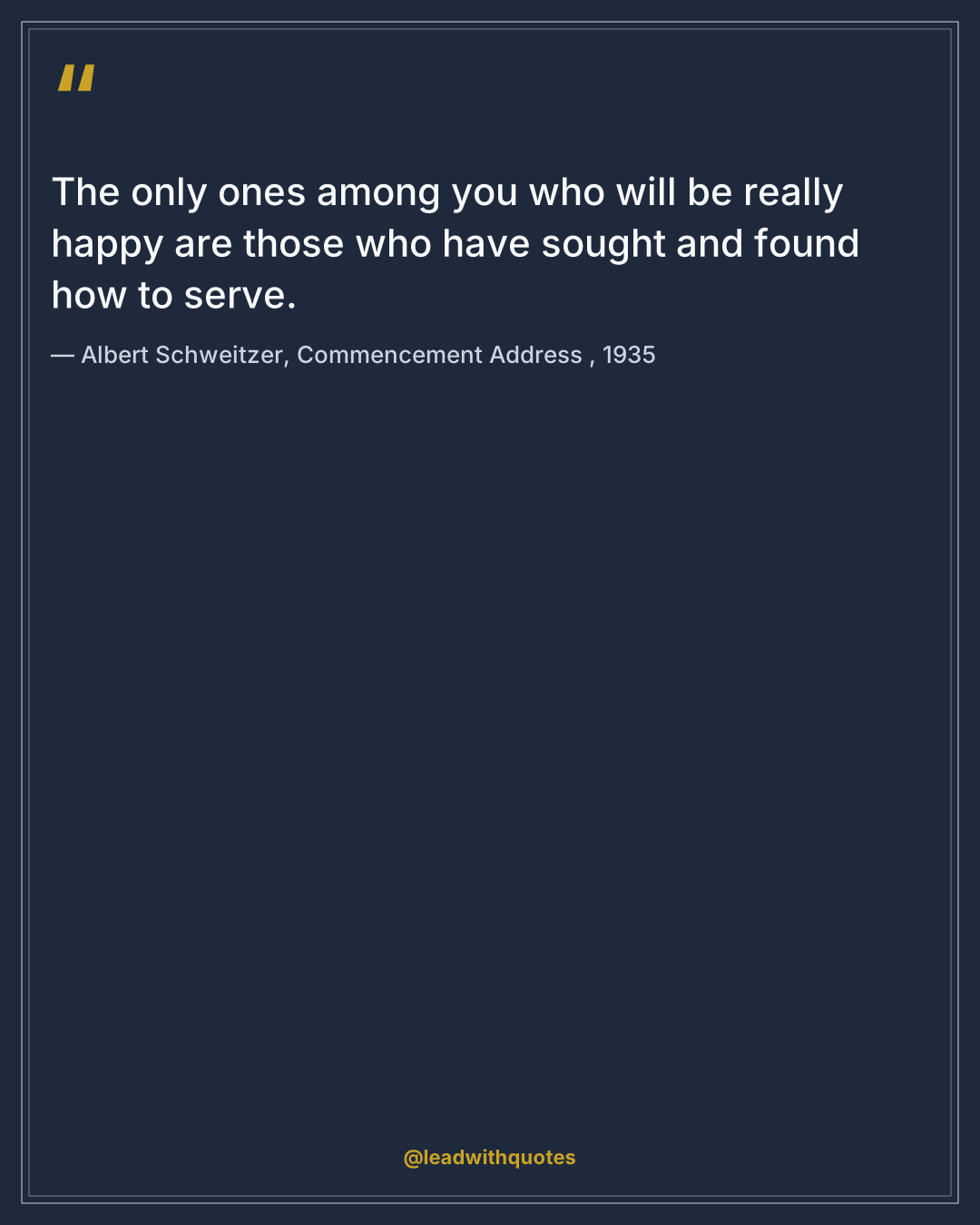
"The only ones among you who will be really happy are those who have sought and found how to serve." — Albert Schweitzer, Commencement Address, 1935
The medical missionary addressed students with this stark warning against pursuing wealth over community utility during the height of the Great Depression. He abandoned a lucrative academic career in Europe to build a hospital in Lambaréné. His philosophy of reverence for life dictated every administrative decision he made in the clinic.
"Those who are happiest are those who do the most for others." — Booker T. Washington, Up from Slavery, 1901
Washington anchored his autobiography on the premise that practical, community-oriented labor secures both personal dignity and societal advancement. He built the Tuskegee Institute brick by literal brick alongside his first generation of students. The publication funded the expansion of the campus agricultural programs.
"I was the conductor of the Underground Railroad for eight years, and I can say what most conductors can't say — I never ran my train off the track and I never lost a passenger." — Harriet Tubman, Suffrage Convention Speech, 1896
Tubman leveraged her flawless operational record to advocate for women's voting rights late in her life. She measured her success entirely by the survival of the people she escorted through the Maryland swamps. The federal government denied her a proper military pension for decades despite her tactical espionage work.
The Internal Mechanics of Restraint
Exploring these historical texts reveals condensed wisdom for today's executives facing complex team dynamics.
"We make a living by what we get, but we make a life by what we give." — Winston Churchill, Post-War Reflections, 1950
Despite his aristocratic background and wartime dominance, Churchill recognized that legacy rests entirely on public contribution rather than inherited estates. He dictated many of these postwar aphorisms while laying bricks at his Chartwell home. The physical labor grounded his sweeping political theories.
"Good leaders must first become good servants." — Robert K. Greenleaf, The Institution as Servant, 1972
Following his initial essay, Greenleaf expanded his thesis to argue that entire corporations must function as servants to their local communities. He challenged trustees to evaluate their hospitals and universities based on the health of the surrounding neighborhoods. This secondary text birthed the modern corporate social responsibility movement.
The Emotional Rigor of Care
Reviewing these perspectives from influential female pioneers reveals the rigorous emotional control required to serve effectively over decades.
"I attribute my success to this: I never gave or took any excuse." — Florence Nightingale, Personal Letters, 1861
Nightingale's relentless push for sanitary hospital conditions stemmed from a fierce devotion to her patients rather than a desire for personal glory. She weaponized statistical graphics to force the British military to improve barracks ventilation. Her administrative hostility saved thousands of infantrymen from preventable typhus.
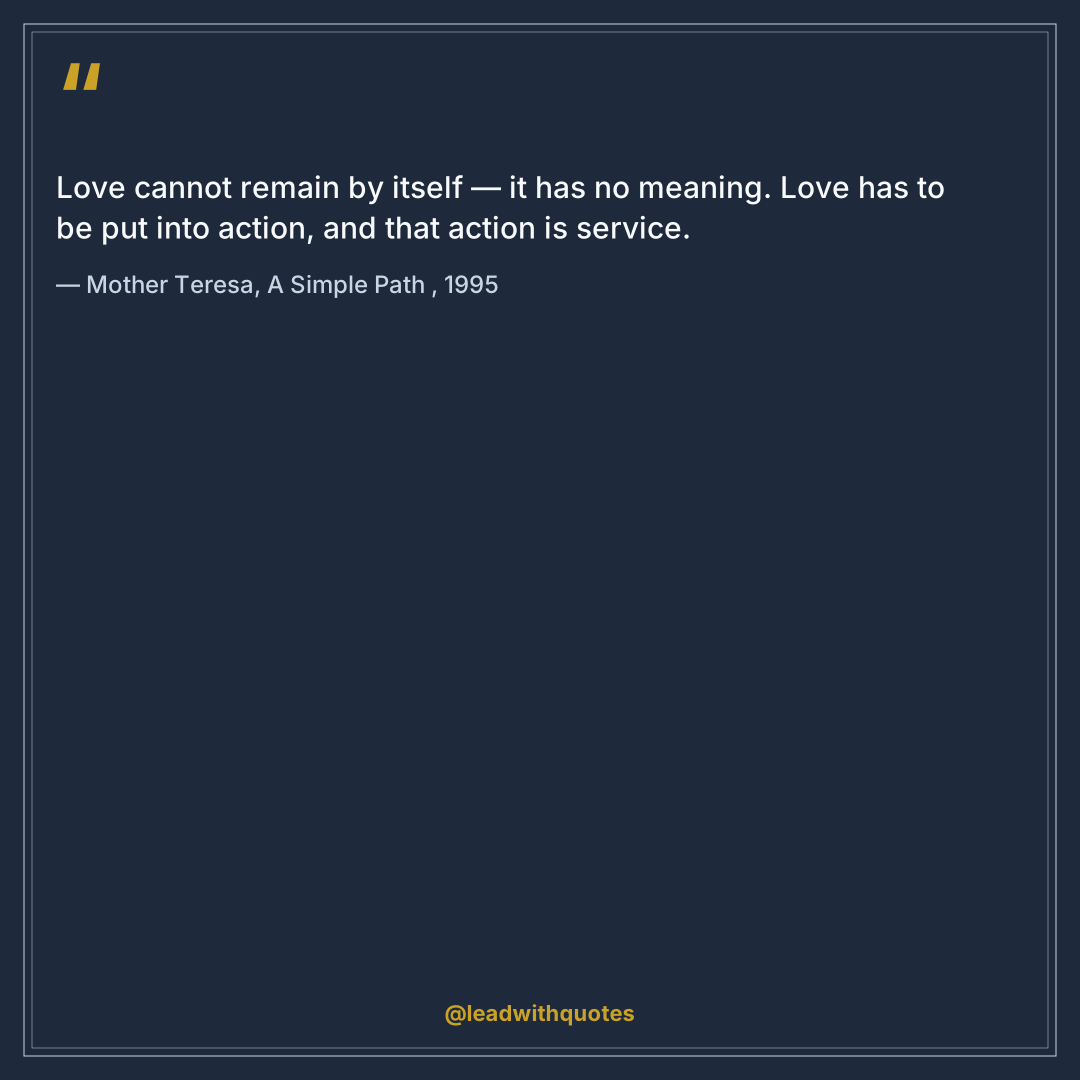
"Love cannot remain by itself — it has no meaning. Love has to be put into action, and that action is service." — Mother Teresa, A Simple Path, 1995
Compiled from her conversations, this book details her conviction that abstract affection remains useless until materialized through physical labor. She founded her order on the explicit mandate to touch the untouchable residents of Calcutta. The daily routine of her clinics prioritized immediate wound care over theoretical theology.
"Service is the rent we pay for being. It is the very purpose of life, and not something you do in your spare time." — Marian Wright Edelman, The Measure of Our Success, 1992
The founder of the Children's Defense Fund framed civic duty as a fundamental debt of existence rather than an optional philanthropic hobby. She wrote the book originally as a series of letters to her own sons departing for college. The text eventually became a manual for child advocacy lawyers across the federal court system.
Second Looks at Familiar Claims
Popular reading: Servant leaders lack the executive presence to command large organizations.
On closer look: Historical data from the mid-twentieth century proves otherwise. Robert Greenleaf developed the entire framework while managing massive personnel logistics for AT&T during its monopoly era. The philosophy requires immense structural discipline to prioritize employee development over executive comfort. Weakness cannot sustain the friction of genuine service.
Popular reading: Humility means accepting poor performance to spare people's feelings.
On closer look: Florence Nightingale's administrative records demonstrate the exact opposite. She fired incompetent doctors and berated supply clerks who failed to deliver clean bandages to the Crimean front. Her brand of service demanded absolute operational perfection because lives depended on the outcome.
Popular reading: Service-driven work inevitably leads to total psychological burnout.
On closer look: Activists who pace themselves build longer institutional legacies. Marian Wright Edelman structured the Children's Defense Fund with clear legislative targets to prevent her staff from drowning in generalized despair. Sustainable service relies on targeted, measurable actions rather than unending emotional bleeding.
Tomorrow morning presents another ordinary chance to pick up the rusted shears on the porch. The machinery of our shared communities breaks down daily, waiting for someone willing to turn the wrench.